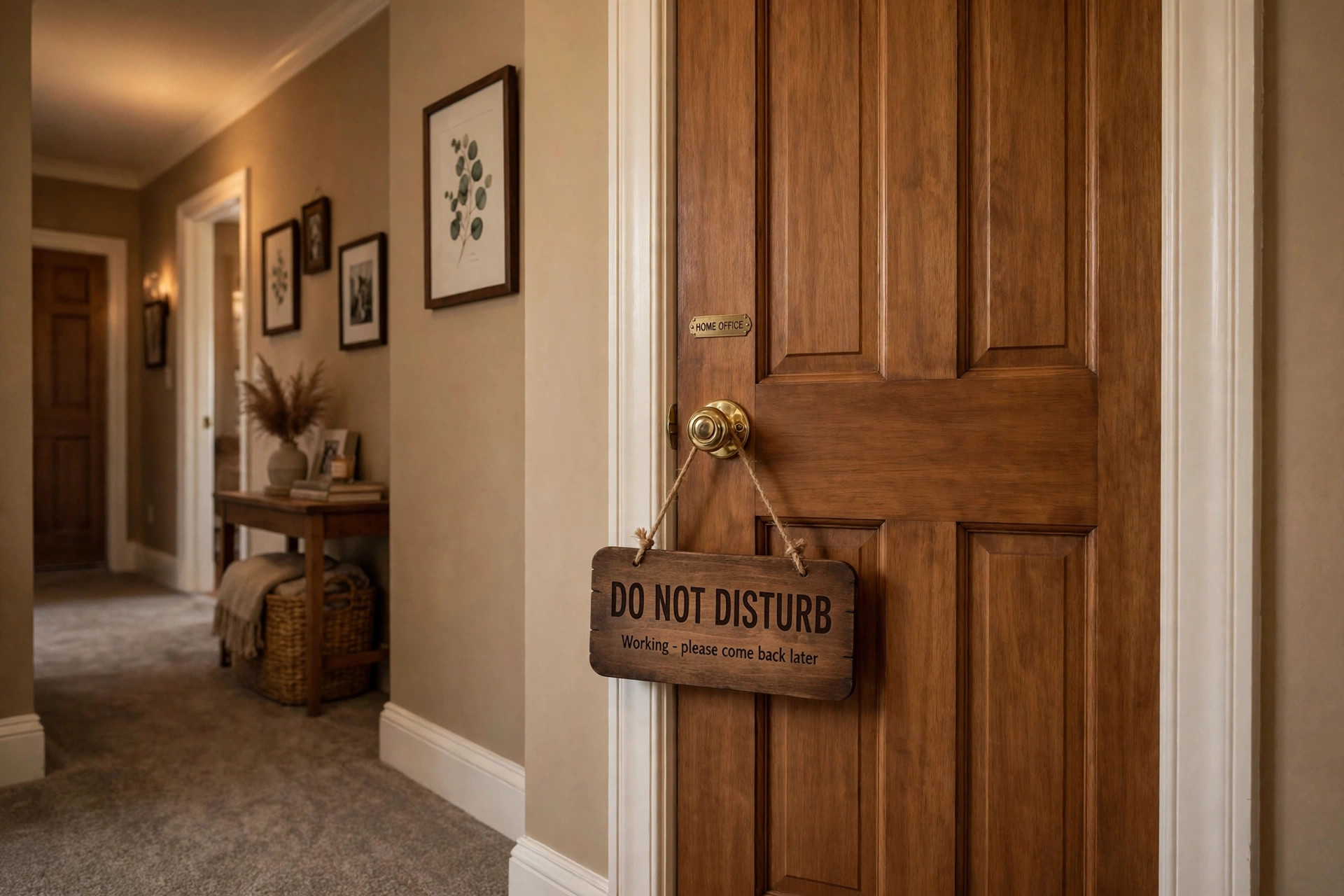

A home office door sign do not disturb working notice is a small tool with a large effect. Many people who work from home face the same problem. A family member knocks. A child walks in during a call. A delivery rings the bell at the worst time. A simple sign on the door can fix much of this. This guide explains how to choose a sign, how to hang it, what it costs, and how to make the whole family follow it.
Why a Door Sign Matters in a Home Office
A closed door sends a message, but it is not always clear. Some people knock anyway. Others open the door to ask a small question. A sign removes the doubt. It says, in plain words, that you are at work and should not be disturbed.
The sign works best when everyone in the house agrees on what it means. Talk with your family before you hang it. Tell them the sign means you are in a meeting or doing deep work. Tell them it does not mean you are angry or unavailable for an emergency. A clear rule turns the sign from a decoration into a working tool.
A sign also helps you. When you hang it, you tell yourself that work has begun. It marks the start of your work time the way a commute once did. This small ritual can raise your focus and your output.
What to Look For When You Choose a Sign: Home Office Door Sign Do Not Disturb Working
Not all signs are equal. The right one depends on your door, your style, and how often you need quiet. Here are the main points to weigh.
The Message
The words on the sign must be clear at a glance. Short phrases work best. “Do Not Disturb” is the classic choice. Some signs add a second line such as “In a Meeting” or “Working.” A sign with a polite tone fits a home better than a harsh one. Look for words that set a firm boundary without sounding rude. Guides at The Spruce often note that clear labeling is one of the cheapest ways to organize a shared home.
The Material
Signs come in wood, plastic, metal, acrylic, and printed card. Wood looks warm and fits a classic office. Acrylic and metal look modern and last longer. Printed card is cheap but bends and fades. If your door gets direct sun, choose a material that resists fading.
The Hanging Style
Most signs hang from the doorknob with a hook or a cord. This style is easy to move. You hang it when you work and take it down when you are free. Some signs stick to the door with adhesive or attach with a magnetic mount. These stay in place all day and often have two sides that flip. A two-sided sign, such as “Working” on one side and “Free” on the other, is a smart choice for many homes.
The Size and Readability
The letters must be large enough to read from the hallway. A sign smaller than a postcard is hard to see. Aim for letters at least one inch tall. High contrast helps too. Dark letters on a light board read best in a dim hallway.
Types of Home Office Door Signs
Knob-Hanging Signs
These are the most common type. They loop over the doorknob and hang flat against the door. They cost little and move in seconds. Retailers such as IKEA and Wayfair carry simple versions that suit a home office shelf of decor.
Two-Sided Flipping Signs
These mount on the door and flip between messages. One side may say “Do Not Disturb — Working.” The other may say “Come In” or “On a Break.” They cost more than knob hangers, but they last longer and look tidy.
Light-Up Signs
A small LED sign that glows when you are busy sends a strong signal. Some plug into a USB port. Others run on batteries. They work well in homes where a printed sign gets ignored. Light-up signs pair nicely with a home office desk lamp with usb charging station since both can share a power strip.
Sliding and Dial Signs
These have a small window or dial that shows your status. You slide it to “In a Meeting” or “Available.” They look like the privacy signs on hotel rooms. They are neat, quiet, and easy for children to understand.
Custom and Engraved Signs
Some families order signs with the worker’s name or a company logo. These cost more but look professional. They also work well on video calls when the door shows in the background. Office furniture makers such as Herman Miller and Steelcase design workspaces where small details like this add polish.
Cost and Price
Most home office door signs are cheap. A simple printed or plastic knob hanger costs between three and ten dollars. Wood signs with engraved words run from ten to twenty-five dollars. Two-sided flipping signs usually cost between twelve and thirty dollars.
Light-up LED signs are the priciest common option. They range from fifteen to forty dollars depending on size and features. Custom engraved signs cost from twenty to fifty dollars.
For most home offices, a sign in the ten-to-twenty-dollar range is plenty. It will last for years and look fine on camera. Price trackers and review sites such as Wirecutter and PCMag often test home office gear in this class and find that simple items beat fancy ones.
Care and Upkeep
A door sign needs almost no care, but a little upkeep keeps it looking good.
Dust the sign once a month with a dry cloth. Fingerprints show fast on acrylic and glass, so wipe those with a damp cloth when they appear. Check the cord or hook twice a year. Cords fray where they meet the metal hook. Replace a worn cord before it snaps.
For light-up signs, check the batteries or the USB cable every few months. Keep a spare set of batteries in your desk drawer. If the sign has adhesive backing, press it back into place if an edge starts to lift.
Store a spare sign if you can. A backup costs little and saves a trip to the store when the first one breaks.
Safety and Good Manners
A sign sets a boundary, but manners make it work. A few simple rules keep the peace.
First, define what counts as an emergency. Tell your family that fire, injury, or a true urgent need overrides the sign. Children follow rules better when they know the exception.
Second, use the sign only during real work hours. If the sign hangs all day, people stop noticing it. Take it down at lunch and at the end of the day. A sign that appears and disappears keeps its meaning.
Third, respect the sign yourself. Do not leave the office every ten minutes while the sign hangs. Your family will mirror what you do.
Fourth, think about visitors and deliveries. A sign on the front door can tell delivery workers to leave packages quietly. This protects your meetings from doorbell noise.
If you pair the sign with other quiet-work tools, the whole office improves. A home office monitor riser with drawer storage keeps your desk tidy for video calls. A small rolling desk for laptop in living room gives you a backup spot when the main office is noisy. Ergonomic makers like UPLIFT Desk build desks that make long focus hours easier on the body.
Making the Sign a Daily Habit
A sign only works if it becomes part of your routine. The habit takes a few days to build, and then it feels natural.
Start each workday the same way. Walk to your office, open the door, and hang the sign. This two-second act tells your brain that work has begun. In the evening, take the sign down when you finish. This marks the end of the workday. People who work from home often say the workday bleeds into the night. The sign gives the day a clear start and a clear end.
Set fixed hours when you can. If you work from nine to five, the sign hangs from nine to five. Fixed hours teach your family when to expect quiet and when to expect you. They also teach clients and co-workers. When your online status matches your door sign, your whole work life feels more steady.
Talk about the sign with your children in simple words. Tell them the sign means you are doing important work and will be free soon. Give them a clock or a timer so they can see when the sign will come down. Children wait better when they can watch the time pass. A small sticker chart can reward a week of quiet knocks.
Keep a backup plan for loud days. Some days the house is noisy no matter what the sign says. On those days, noise-canceling headphones or a quiet corner desk can help. The sign handles the knocks. Headphones handle the noise. Together they give you real focus.
Check the sign once a month. Look at the hook, the cord, and the print. A worn sign sends a weak message. A fresh sign shows that you take your work hours seriously. Replace it when it starts to fade or fray.
Frequently Asked Questions
Do door signs really stop interruptions?
They reduce them a lot, but they are not magic. Studies of home offices find that a clear visual signal cuts casual knocks by more than half. The sign works best when you pair it with a family talk about rules and hours.
What should the sign say?
Keep it short and polite. “Do Not Disturb — Working” covers most cases. A second side that says “Available” or “Come In” helps when you are free. Avoid jokes that blur the message. Clarity beats wit here.
Where should I hang the sign?
Hang it at eye level on the outside of the office door. A doorknob hanger sits at the natural height. If you mount a sign on the door face, center it near the top so it shows above a child’s reach but below the lintel.
Can I use a sign in a shared room?
Yes. If your office is a corner of the living room or bedroom, hang the sign on the room door or on a folding screen near your desk. The rule still works as long as everyone agrees on what the sign means.
Are light-up signs worth the extra cost?
They are worth it if your family ignores printed signs. The glow is hard to miss. They are also handy in a dark hallway. For a quiet household, a simple printed sign is enough.
How do I make children follow the sign?
Keep the rule simple and reward it. Tell children the sign means “quiet work time.” Give them a small task or a quiet activity while the sign hangs. Praise them when they wait. Most children learn the rule in a week. Parenting and home guides at shops like Amazon and Etsy sell child-friendly sign versions with pictures.
A Final Word
A home office door sign do not disturb working notice is one of the cheapest upgrades you can make to a home office. It costs a few dollars, takes a minute to hang, and pays off every workday in fewer knocks and deeper focus. Choose clear words, a readable size, and a style that fits your door. Agree on the rules with your family. Then hang the sign and get to work.
References
Amazon. (n.d.). Online shopping. https://www.amazon.com Etsy. (n.d.). Handmade and craft marketplace. https://www.etsy.com Herman Miller. (n.d.). Office furniture and ergonomic seating. https://www.hermanmiller.com IKEA. (n.d.). Home furnishings. https://www.ikea.com PCMag. (n.d.). Technology product reviews. https://www.pcmag.com Steelcase. (n.d.). Office furniture and workplace research. https://www.steelcase.com The Spruce. (n.d.). Home and garden advice. https://www.thespruce.com UPLIFT Desk. (n.d.). Standing desks and ergonomic office furniture. https://www.uplift-desk.com Wayfair. (n.d.). Furniture and home goods. https://www.wayfair.com Wirecutter. (n.d.). Product reviews from The New York Times. https://www.nytimes.com/wirecutter
Was this guide helpful?

About Jennifer Lee
The My Garden US editorial team writes practical, in-depth home and garden guides for American homeowners — tested advice, no fluff.
You May Also Like

An Ergonomic Lumbar Support Pillow for Office Chair Comfort That Lasts All Day
May 25, 2026 0 views
A Small Adjustable Desk for Kids Homework Station: A Plain Guide for Parents
August 8, 2026 0 views
Narrow Ladder-Style Bookshelves for the Home Office
February 26, 2026 0 views