---
Table of Contents
Table of Contents
- Warm Shelter for Neighborhood Strays: Why Strays Need Shelter
- The Tote-and-Cooler Design
- Straw, Not Blankets: The Golden Rule
- Placement: Location Matters as Much as Design
- Food and Water in Cold Weather
- Maintenance Through the Season
- Going Further: TNR and Community Cats
- What About Dogs?
- The Bottom Line
- References
When the temperature drops, the stray and feral cats in your neighborhood face a hard season. They are tough animals, but cold, wind, and wet ground wear them down. Building a warm shelter for neighborhood strays is one of the kindest, cheapest projects you can do. One afternoon, about twenty dollars in supplies, and a cat that was sleeping under a porch now has a dry, insulated home. If you want to warm shelter for neighborhood strays, start with the basics below.
This guide covers the proven tote-and-cooler design, the critical straw-not-blankets rule, where to place the shelter, and how to maintain it through the cold months.
Warm Shelter for Neighborhood Strays: Why Strays Need Shelter
When it comes to warm shelter for neighborhood strays, getting the details right makes all the difference.
Many homeowners find that warm shelter for neighborhood strays is easier than they expected once they know the basics.
Feral and stray cats grow thick winter coats, and they are better at handling cold than most people think. But there is a limit. Wind strips away body heat. Wet fur loses its insulation. And a cat that cannot find a dry place to sleep burns enormous energy just staying warm, energy it cannot spare if food is scarce.
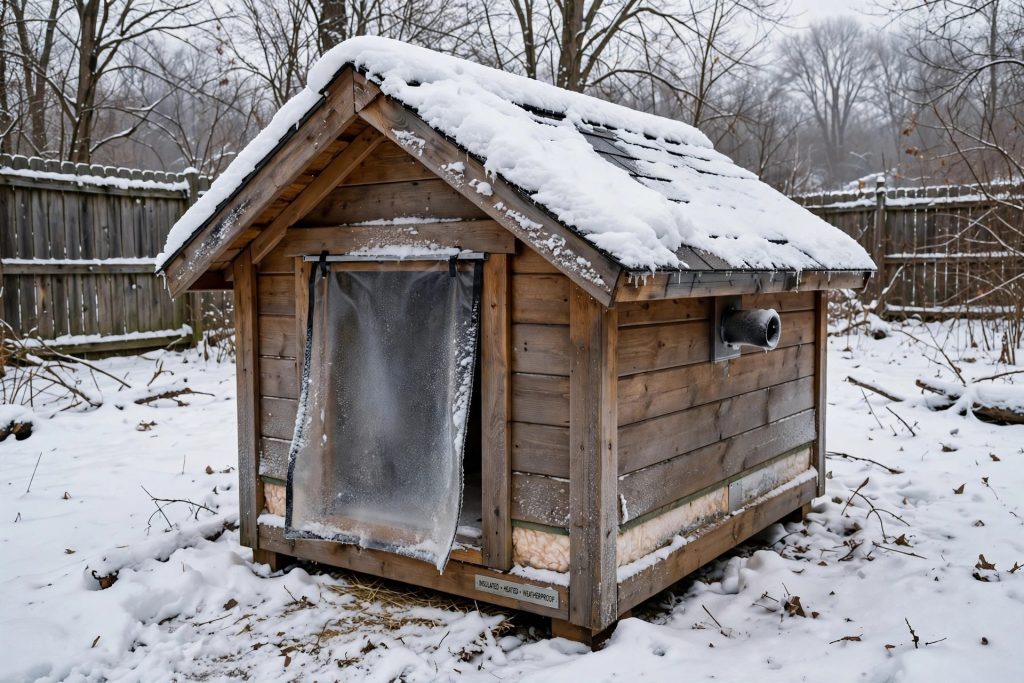
A good shelter does not need to be warm like a house. It needs to be dry, windproof, and small enough that the cat's own body heat warms the air inside. That is it. A well-built shelter can keep the interior dramatically warmer than the outside air, which is often the difference between a cat that thrives through winter and one that does not.
Shelters also anchor a colony in one spot, which matters if you are doing trap-neuter-return work or just keeping an eye on the neighborhood cats. A cat with a reliable shelter is a cat you can monitor, feed, and eventually vet.
The Tote-and-Cooler Design
Many homeowners find that warm shelter for neighborhood strays is easier than they expected once they know the basics.
The key to warm shelter for neighborhood strays is choosing the right approach for your space and budget.
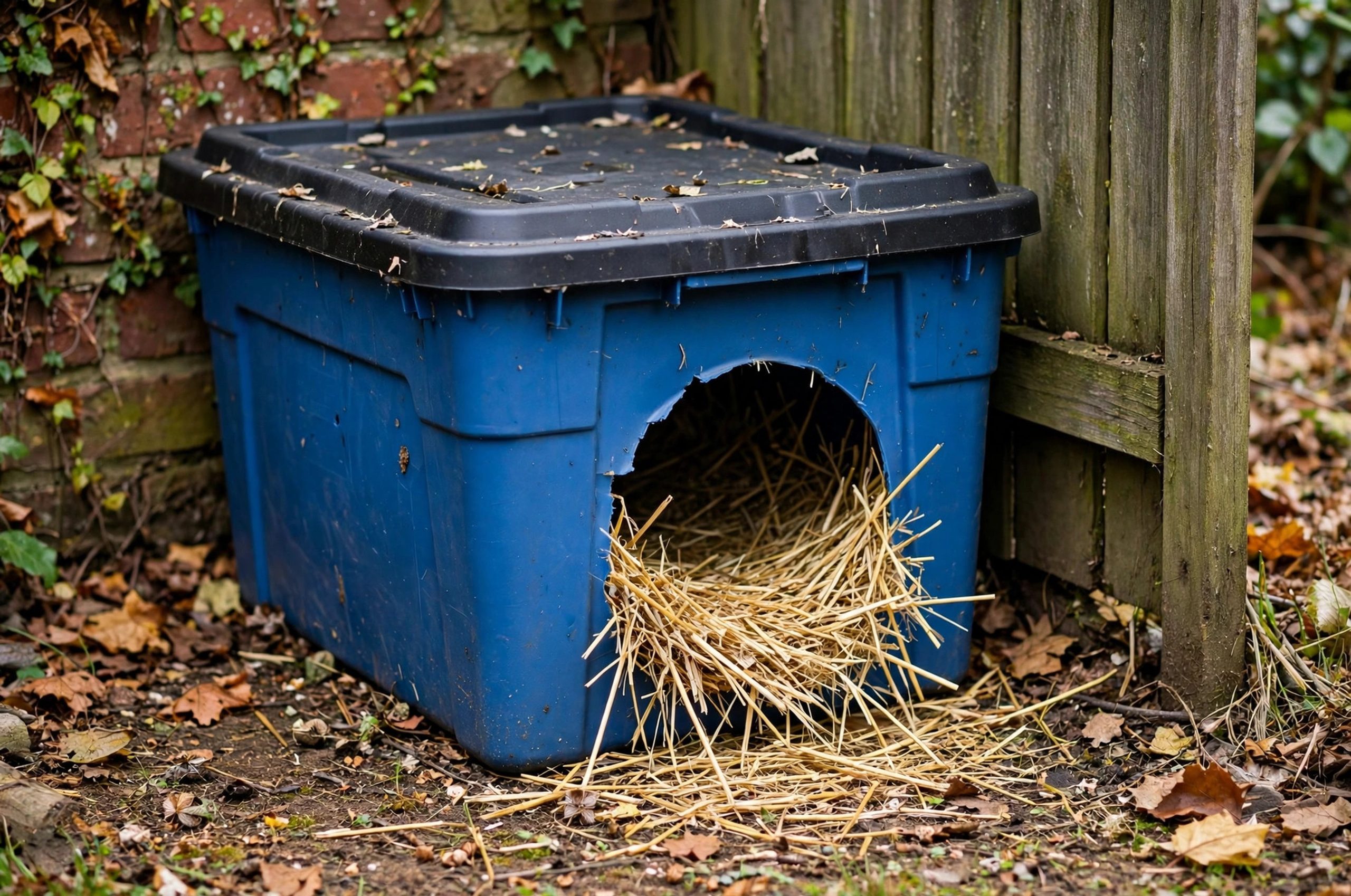
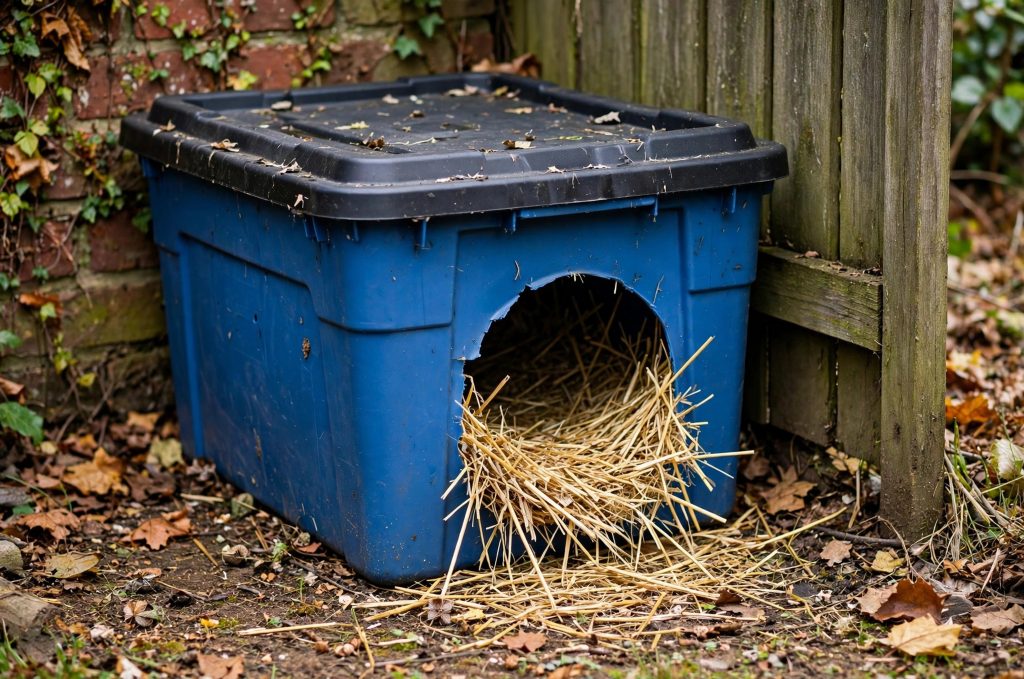
The most proven DIY shelter uses two nested containers: a plastic storage tote on the outside and a foam cooler on the inside, with straw filling the gap as insulation. Rescue groups across the country teach this design because it is cheap, effective, and lasts for years.
You will need:
- One 18-gallon (or larger) plastic storage tote with a lid
- One foam cooler that fits inside the tote
- Straw, not hay (a small bale is plenty for several shelters)
- A box cutter or utility knife
- Duct tape
- Two bricks or a pallet for elevation
Build steps:
1. Cut a doorway in the tote, about 6 inches across, positioned a few inches above the bottom. This height keeps rain and snow from blowing straight in. 2. Cut a matching doorway in the foam cooler and set it inside the tote, lining up the doors. 3. Pack straw firmly into the gap between the cooler and the tote, on all sides. This is your insulation layer. 4. Put a thick layer of loose straw inside the cooler as bedding. 5. Put the cooler lid on, then the tote lid. Tape the tote lid edges if you want extra wind protection. 6. Tape over any sharp cut edges so cats do not scratch themselves going in and out.
The Houston Humane Society publishes this exact double-bin method with clear steps, noting that the trapped air and straw between the bins retains the cat's body heat (Houston Humane winter shelter guide).
Some builders cut two doorways, one on each end, so a cat has an escape route if a predator enters. This is smart in areas with raccoons or opossums. In very windy spots, one door with a flap of heavy plastic over it may hold heat better. Know your neighborhood and choose accordingly.
Straw, Not Blankets: The Golden Rule
The key to warm shelter for neighborhood strays is choosing the right approach for your space and budget.
With a little planning, warm shelter for neighborhood strays can fit even a busy schedule.
This is the most important thing in this whole guide. Use straw. Never use blankets, towels, or clothing as bedding in an outdoor shelter.
It feels wrong. A blanket seems cozier. But fabric absorbs moisture from the air, from wet paws, and from the cat's breath. Once damp, a blanket pulls heat away from the cat instead of holding it in. A wet blanket in a winter shelter is worse than no bedding at all.
Straw is different. It is hollow, so it traps warm air. It sheds moisture instead of soaking it up. A cat can burrow into loose straw and stay dry even in damp weather. And do not confuse straw with hay: hay is feed, it holds moisture and molds. Straw is bedding, golden and dry. Alley Cat Advocates, which publishes detailed winter shelter plans, is explicit on this point: straw only, never blankets, towels, or newspaper (Alley Cat Advocates winter shelter guide).
A video walkthrough of the tote-and-cooler build explains the difference well: straw is the dry leftover stalk from harvested crops, while hay is green, heavier, and prone to mold (winter cat shelter build video).
Replace the straw if it gets damp, flattened, or soiled. A quick check every few weeks through winter is enough.
Placement: Location Matters as Much as Design
With a little planning, warm shelter for neighborhood strays can fit even a busy schedule.
Before you start, it helps to understand how warm shelter for neighborhood strays works in real homes.
A perfect shelter in a bad spot goes unused. Cats choose shelter the way they choose everything: safety first.
Quiet and hidden. Tuck the shelter where foot traffic is low: behind a garage, under a deck, along a fence line, at the edge of woods. Strays avoid busy, exposed spots.
Out of the wind. Face the doorway away from the prevailing wind. Even better, face it toward a wall or fence so wind cannot blow straight in. A wind block matters more than most people realize. Cold wind is what defeats a cat's coat.
Off the ground. Elevate the shelter a few inches on bricks, a pallet, or boards. Ground contact wicks cold and moisture upward. Elevation keeps the floor dry and a bit warmer.
Near food and water, but not too near. Place the shelter close to where you feed, so cats connect the area with safety. But keep food and water a few feet away from the doorway, not inside the shelter. Food inside attracts other animals and can make the cat feel trapped while eating.
Stable. Weigh the lid down with a brick or paver so wind cannot lift it. In very windy areas, strap the whole shelter to a fence post or stake it down.
A rescue guide to feral shelter placement adds that the entrance should stay clear of snow and debris, and that a small awning of plastic sheeting over the door adds meaningful protection (Halfway Home feral shelter guide).
Food and Water in Cold Weather
Before you start, it helps to understand how warm shelter for neighborhood strays works in real homes.
A good plan for warm shelter for neighborhood strays saves time, money, and frustration.
Shelter is half the battle. The other half is calories and water. Cold burns energy fast, and a cat that is not eating enough cannot stay warm no matter how good the shelter is.
Feed more in winter. Outdoor cats need extra calories when temperatures drop. Wet food gives more energy per bite, but it freezes fast. Dry food stays edible in the cold and can be left out. Many caretakers offer both: wet food at feeding time, dry food available around the clock.
Water is critical. Cats cannot hydrate from snow. Eating snow actually lowers their core temperature. Use a heated water bowl rated for outdoor use, and place it outside the shelter, never inside. Check it daily. A guide to feral winter care recommends heated bowls as the most reliable option, with deep rubber bowls as a backup that freeze slower than shallow ones (feral cat winter care guide).
A heated water dish made for outdoor use solves the freezing problem for both stray cats and any barn cats you care for.
Feed on a schedule. Regular feeding times train the colony to show up when you do. That lets you monitor who is eating, who looks thin, and who might need vet care.
Maintenance Through the Season
A good plan for warm shelter for neighborhood strays saves time, money, and frustration.
For most people, warm shelter for neighborhood strays comes down to a few smart choices.
A shelter is not a set-it-and-forget-it project. A few minutes of upkeep keeps it working all winter.
- Check the straw monthly. Fluff it up or replace it if it is packed flat or damp.
- Clear the doorway of snow, ice, and fallen leaves.
- Confirm the lid is still secure after windstorms.
- Look for damage. Chewed foam, cracked plastic, or a shifted shelter needs fixing.
- Watch for uninvited guests. Opossums and skunks sometimes move in. If that happens, you may need to adjust the doorway size or placement.
In spring, clean the shelter out fully. Replace all the straw, wash the tote, and store the shelter dry for next season. A well-kept shelter lasts for years.
Going Further: TNR and Community Cats
For most people, warm shelter for neighborhood strays comes down to a few smart choices.
A shelter often leads to a bigger question: should I be doing more for these cats? If strays are breeding in your neighborhood, the kindest long-term help is trap-neuter-return. TNR stops the endless cycle of kittens born outdoors, and fixed cats are healthier, calmer, and easier to care for.
Many humane societies run community cat programs that lend traps, cover spay and neuter costs, and even supply winter shelter materials like straw and insulated coolers. The Nebraska Humane Society's community cat program supports caretakers with exactly these resources (Nebraska Humane Society community cat program).
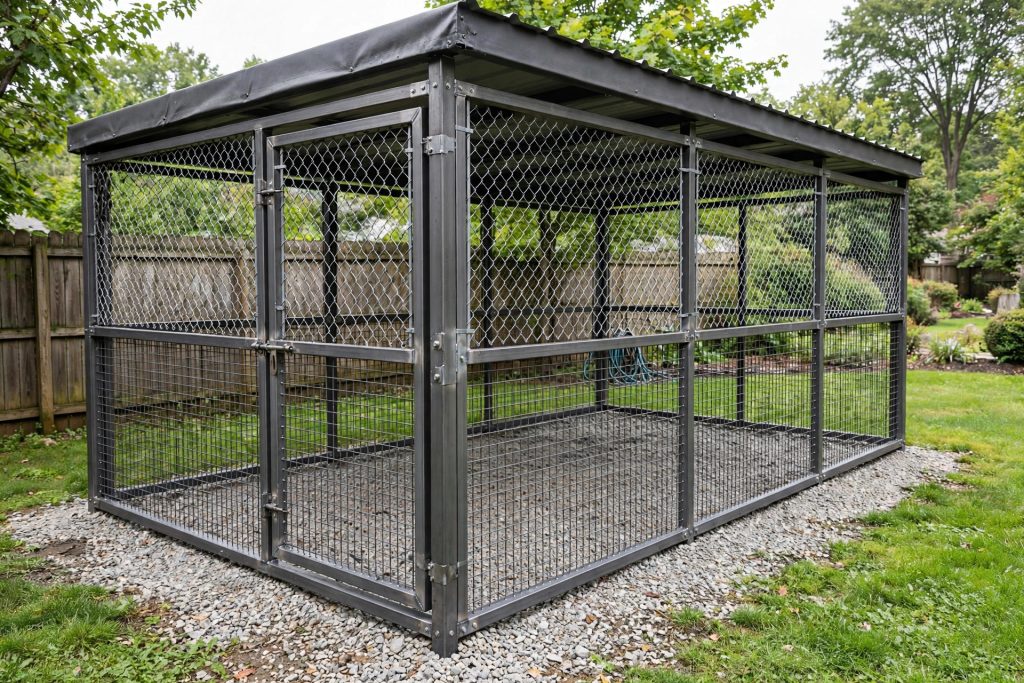
You do not have to become a full-time rescuer. Feeding on a schedule, providing shelter, and getting the cats fixed is a complete and enormously valuable contribution. An outdoor cat enclosure is the next step if you ever decide to bring a friendly stray indoors permanently, giving them safe outdoor time while they adjust to house life.
What About Dogs?
If you are new to warm shelter for neighborhood strays, start with the simplest option and build from there.
Stray dogs need shelter too, but the approach is different. A loose stray dog should be reported to animal control, since roaming dogs face traffic danger and legal issues that cats do not. If you are caring for a dog outdoors temporarily, a waterproof outdoor dog bed inside a covered area works, but the real goal should be getting the dog to a shelter or rescue quickly.
The Bottom Line
When it comes to warm shelter for neighborhood strays, getting the details right makes all the difference.
Building a warm shelter for neighborhood strays takes an afternoon and a few dollars. The tote-and-cooler design, packed with straw and placed out of the wind, gives outdoor cats a dry place to ride out the cold. Add unfrozen water and extra food, check the straw through the season, and you will have done something genuinely good for the animals outside your door. A little care goes a long way when you warm shelter for neighborhood strays.
References
Many homeowners find that warm shelter for neighborhood strays is easier than they expected once they know the basics.
Alley Cat Advocates. (n.d.). Building winter shelters for community cats. https://alleycatadvocates.org/creating-winter-shelters/?sfnsn=mo
Catington Post. (n.d.). How to build an inexpensive winter shelter for stray and feral cats. https://catingtonpost.com/build-inexpensive-winter-shelter-stray-feral-cats/
Halfway Home Pet Rescue. (n.d.). DIY feral and stray cat winter shelter. https://halfwayhomepetrescue.org/normas-notes/diy-feral-and-stray-cat-winter-shelter/
Houston Humane Society. (n.d.). How to make an insulated winter shelter for stray and feral cats. https://www.houstonhumane.org/news/latest-news/how-to-make-an-insulated-winter-shelter-for-stray-and-feral-cats
LK & Friends. (n.d.). Feral winter care. https://sites.google.com/view/lkandfriends/feral-winter-care
Nebraska Humane Society. (n.d.). Community cat program. https://nehumanesociety.org/services/community-cat-program/
PetsCare. (n.d.). DIY cat shelter cooler: Save feral cats this winter. https://www.petscare.com/news/post/diy-cat-shelter-cooler-winter
YouTube. (n.d.). A $10 storage tote + a foam cooler = a winter cat SHELTER. https://www.youtube.com/shorts/EQq6GkoCj-o
Was this guide helpful?

About My Garden US
The My Garden US editorial team writes practical, in-depth home and garden guides for American homeowners — tested advice, no fluff.
You May Also Like

Ferret Cage Multi Level for Active Ferrets: A Complete Buying Guide
July 10, 2026 4 views
Dog Cooling Vest for Summer Walks Heat: Keep Your Dog Safe on Hot Days
May 5, 2026 3 views
Dog Car Barrier for SUV Cargo Area Safety
July 26, 2026 4 views