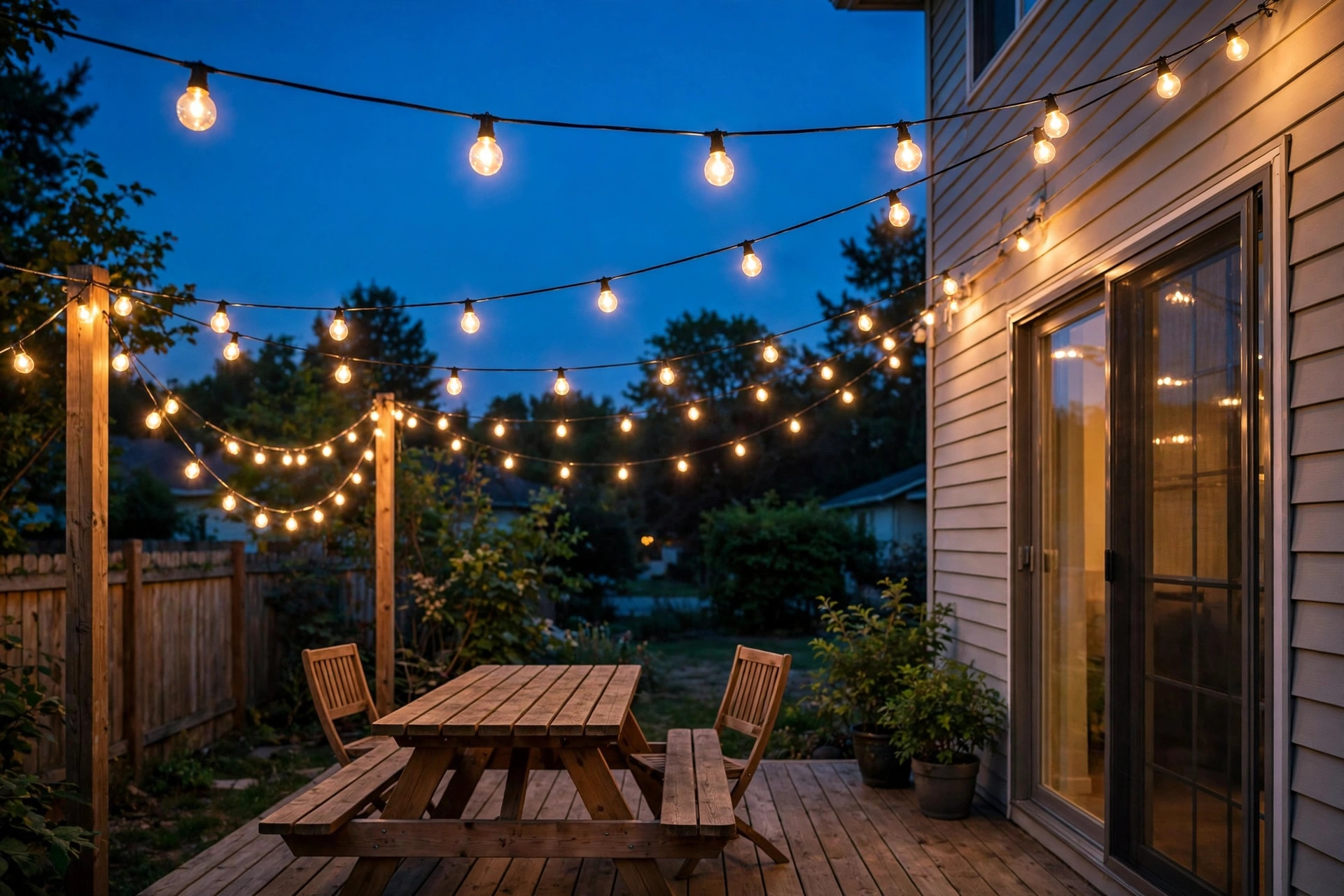

On warm summer evenings, the patio becomes the best room of the house. Good light makes the difference between a dark yard and a space where family and friends want to stay. This patio string lights american homes guide explains how to choose, hang, and care for string lights on a typical American patio.
Why Patio String Lights Matter
A patio that is well lit gets used more. People eat dinner outside. They talk long after sunset. Children play in the yard while parents watch from the table. Light makes all of this possible.
String lights are simple. They cost less than built-in fixtures. They go up in an afternoon. They also give a soft, warm glow that harsh floodlights cannot match. A floodlight makes a yard feel like a parking lot. String lights make it feel like home.
Light also adds safety. Steps and edges show up better under a string of lights. Guests do not trip over unseen objects. Pets move around the yard with less risk. Good light marks the edges of the patio so no one walks into the dark by mistake.
Finally, string lights raise the value of time spent at home. A patio with warm light feels welcoming. It becomes a place for birthdays, cookouts, and quiet nights. Few upgrades give so much for so little money.
How to Choose the Right String Lights: Patio String Lights American Homes Guide
Shopping for patio lights can feel confusing. Boxes show many words: lumens, kelvin, IP rating, strand length. Each term matters. The sections below explain them in plain words.
Light Color
Look for “warm white” on the box. Warm white is around 2700 kelvin. It gives a soft yellow glow like an old porch bulb. Cool white looks blue and harsh. Most American homes look best in warm white for outdoor living spaces.
Some strings offer many colors. They can be fun for holidays. For daily use, plain warm white works best. It flatters faces, food, and furniture.
Bulb Type
Most modern strings use LED bulbs. LED lights last far longer than old glass bulbs. They stay cool to the touch. They use very little power. Old-style incandescent strings still exist, but they burn out fast and run hot.
Energy-saving lamps earn a special label when they meet strict tests. That label is a good sign of quality. LED technology has come far in the past ten years. Today’s outdoor LEDs look warm and natural, not cold and blue.
Strand Length and Wire
Measure the patio before buying. Most strings come in 25, 50, or 100 feet. It is better to buy one long strand than to join many short ones. Every connection is a weak point.
Look at the wire itself. Thick rubber wire handles weather and weight. Thin wire sags and breaks. Commercial-grade strings cost more but last many seasons. For a first purchase, a medium-grade strand from a trusted seller is fine.
Weather Rating
Outdoor strings must survive rain. Look for an IP rating on the package. IP44 or higher is good for patios. The first digit guards against dust. The second guards against water.
Make sure the string is rated for outdoor use, not indoor use only. Indoor strings in the rain can short out. The box will say “outdoor” or “indoor/outdoor” clearly.
Types and Options
String lights come in several styles. Each has its place on an American patio. The list below covers the main types.
Bistro Lights
Bistro lights are the classic choice. They have large round bulbs, about the size of a golf ball. They hang in gentle curves from poles or hooks. They give the most light of all string types. A 50-foot bistro strand can light a full dining area.
Fairy Lights
Fairy lights use tiny bulbs on thin wire. They give a delicate, starry look. They do not light up a table for reading. They work best wrapped around a tree trunk, a rail, or a pergola post. They add sparkle rather than true light.
Edison-Style Lights
These copy the look of old Edison bulbs. The glass is clear. The filament inside shows as a warm line. They suit rustic and farmhouse patios. They give a medium amount of light and a charming vintage feel.
Solar String Lights
Solar strings charge by day and glow at night. They need no outlet and no cord. They suit patios far from the house. Their light is softer and their run time is shorter than plug-in types. On cloudy weeks they may fade early in the night. A solar path lights article can help if you want to learn more about solar yard lighting in general.
Smart String Lights
Smart strings connect to a phone app or a home hub. You can dim them, change color, or set a timer from the couch. They cost more. They need a stable Wi-Fi signal on the patio. For tech-minded households, they are worth a look.
For a deeper look at choices and prices, see this guide to patio string lights.
Planning the Layout
A little planning saves trouble. Walk the patio at night with a flashlight. Note where people sit, where they walk, and where the dark corners are. These notes guide where the lights should go.
Common Patterns
The zigzag is the most popular pattern. Hang the strand back and forth across the patio like the letter Z. It covers a wide area with one string. It looks full and festive.
The perimeter pattern runs the lights along the fence or rail. It frames the space. It works well on small patios where the zigzag would feel crowded.
The center-swirl starts at one point and winds outward. It suits round patios and umbrella tables. It takes more care to hang but looks very fine.
Support Points
String lights need something to hang from. Many patios have a house wall on one side and open yard on the other. Poles solve this. Wooden or metal poles set in planters work well. They are heavy enough to stand firm.
Attach points must hold the weight. A 50-foot string is heavier than it looks, especially when wet. Use sturdy hooks screwed into wood or masonry. Do not trust gutter clips or light plastic hooks in wind.
Leave some slack in the line. Lights should sag a little between supports. A tight line pulls on the hooks. A gentle curve looks better and lasts longer. Lighting design guides often show this catenary curve, the natural dip of a hanging wire.
Cost and Price
Prices vary wide. A basic 50-foot LED string costs about fifteen to thirty dollars at a home improvement store. Commercial-grade strands run forty to eighty dollars. Poles and mounting gear add twenty to sixty dollars.
Most households can light a medium patio for under one hundred dollars. That includes one or two strands and simple supports. A large patio with poles, smart controls, and premium bulbs may reach two or three hundred dollars.
Electricity costs are tiny. LED strings draw very little power. A 50-foot LED strand may use less power than one old light bulb. Running it each evening costs only a few dollars a year. That is one reason LED strings beat old incandescent types so clearly.
Watch for sales. Spring brings deals as stores stock patio goods. End-of-summer sales cut prices further. Buying off-season can save a third or more. Check outdoor lighting sections of large retailers for seasonal discounts.
Hanging the Lights
Hang lights on a dry day. Work with a helper. One person holds the ladder. The other handles the strand.
Start at the outlet. Plug the strand in before you hang it. This lets you see dark bulbs right away. Replace any dead bulbs before the whole line is up.
Work from one end to the other. Secure the first end firmly. Walk the strand to each support point. Let it sag naturally. Do not pull it tight. When you reach the end, step back and look. The line should dip in smooth, even curves.
Keep cords safe. Run extension cords where no one walks. Use an outdoor-rated cord with a ground plug. Cover connections with a cord connection box if rain is likely. Never run cords through standing water.
If you want more wall-mounted options to pair with your strings, read about outdoor wall lanterns. They suit house walls and entry doors well.
Care and Upkeep
String lights need little care, but a little care goes far. Each spring, take them down or inspect them in place. Look for cracked bulbs and frayed wire. Replace bad bulbs at once. One dead bulb can dim a whole section on older strings.
Clean the bulbs once a year. Dust and grime cut light output. Wipe each bulb with a damp cloth. Do this with the power off and the strand cool.
In cold states, many people take strings down for winter. Ice can crack bulbs and snap wire. Store the strand loosely coiled in a dry box. Do not wrap it tight around your arm. Tight coils kink the wire.
Check timers and smart plugs now and then. A timer that drifts will turn lights on at noon. Reset it when the seasons change and sunset moves earlier or later.
Safety
Electricity and water do not mix. Every outdoor string must be plugged into a GFCI outlet. A GFCI outlet cuts power fast if it senses a fault. Most outdoor outlets on American homes built since the 1970s are GFCI. If your outlet has no test and reset buttons, call an electrician.
Keep lights away from heat sources. Do not drape strings over a grill or a fire pit. Heat melts wire insulation. Give grills at least three feet of clear space.
Check weight limits on structures. A pergola holds a string easily. A thin trellis may not. In wind, a heavy wet strand pulls hard. When storms are forecast, take down light strands if you can.
Use only outdoor-rated products outside. The box must say outdoor or indoor/outdoor. Indoor strings have no weather sealing. Rain can reach the wiring and cause a shock. Outdoor lighting tips from the federal government stress this point.
Do not overload one outlet. Most LED strings draw little power, so several strands on one outlet are fine. Read the box for the maximum number of strands that can connect end to end. Stay well under that limit.
For broader backyard decor ideas, look at how lighting works with furniture and plants. Light alone cannot carry a patio. Chairs, tables, and greenery complete the scene.
Frequently Asked Questions
How long do patio string lights last?
LED strings last a long time. Many makers promise 15,000 to 25,000 hours of bulb life. At five hours a night, that is eight to thirteen years of bulbs. The wire and sockets may wear sooner in harsh sun. Plan on five to eight good years from a quality strand with basic care.
Can I leave string lights up all year?
You can, in mild climates. In states with snow and ice, take them down for winter. Ice loads snap wires. Freeze-thaw cycles crack bulb seals. If you leave them up, use commercial-grade strands with heavy wire.
How many strands do I need for my patio?
Measure first. A 12-by-16-foot patio needs about 50 feet of lights in a zigzag pattern. Add more for a perimeter run. Buy ten percent more length than your math says. It is easier to have slack than to stretch a short string.
Do string lights attract bugs?
Warm white LEDs attract fewer bugs than old bulbs. Bugs love blue and ultraviolet light. Warm 2700-kelvin strings draw the least. To cut bugs further, hang lights a little away from the dining table and use a fan. Moving air keeps most flying insects off.
Can I connect different brands together?
It is best not to. Plugs and sockets differ by brand. Voltage and wire gauge may not match. Mixing brands can void the warranty. Stick to one brand and one product line for all strands on a patio.
Are solar string lights bright enough for dining?
Usually not. Solar strings give soft accent light. They suit paths, trees, and rails. For a dinner table, plug-in LED strings work far better. They give steady, bright light all evening. Use solar where no outlet is near and accent light is enough.
A Final Word
Patio string lights are one of the simplest upgrades an American home can make. They cost little. They install fast. They turn a dark yard into a living room under the stars. Choose warm white LEDs, hang them with a gentle sag, and keep them dry and safe. Then enjoy the glow.
Many patio lighting ideas start with a single strand. Yours can too. Start small, see the change, and add more as you learn what your patio needs.
References
ENERGY STAR. (n.d.). Energy efficient products. https://www.energystar.gov Lamps Plus. (n.d.). Lighting and home decor. https://www.lampsplus.com Lowe’s. (n.d.). Home improvement products. https://www.lowes.com Lumens. (n.d.). Lighting and ceiling fans. https://www.lumens.com Philips. (n.d.). Lighting products. https://www.philips.com The Home Depot. (n.d.). Home improvement products. https://www.homedepot.com The Spruce. (n.d.). Home and garden advice. https://www.thespruce.com U.S. Department of Energy. (n.d.). Energy efficiency and renewable energy. https://www.energy.gov
Was this guide helpful?

About Jennifer Lee
The My Garden US editorial team writes practical, in-depth home and garden guides for American homeowners — tested advice, no fluff.
You May Also Like
Outdoor Wall Lanterns for California Homes USA: A Plain Guide
August 8, 2026 0 views
Bedroom Table Lamps Texas Homes USA: A Practical Guide
August 15, 2026 0 views
Ceiling Fans Lights Texas Homes USA: The Complete Guide
January 31, 2026 0 views