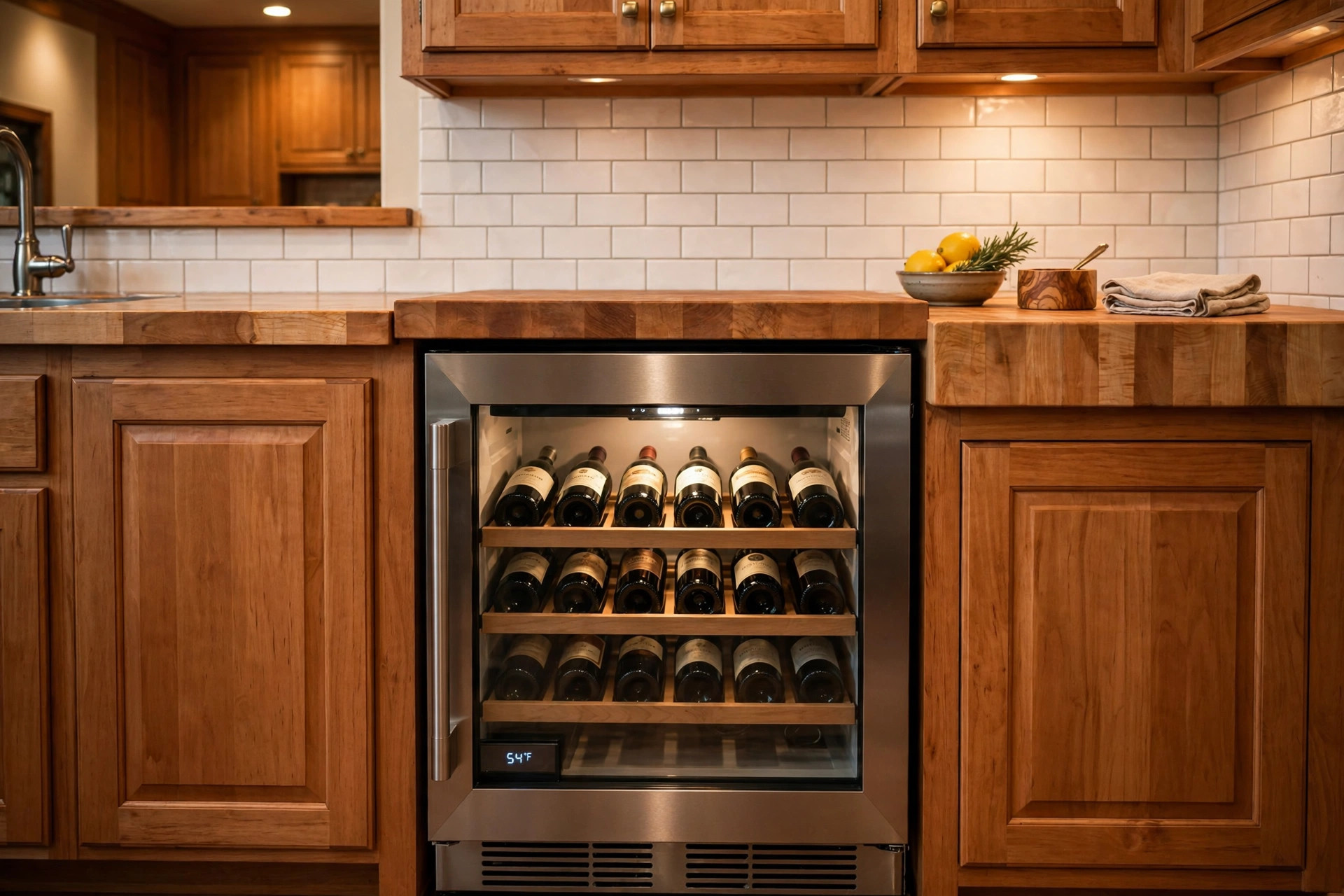

Many home owners love wine but lack a good place to store it. A kitchen counter stays warm. A full-size fridge runs too cold. This under counter wine fridges reviews buying guide USA will help you choose a small cooler that fits under a standard counter. It will keep reds and whites at the right temperature. It will also look fine in a modern kitchen or a home bar.
An under counter wine fridge slides into a 24-inch-wide cabinet opening. Most models stand about 34 inches tall. That height matches common counter heights. The door is often glass so you can see the bottles. The unit runs quiet. It costs less to run than a second full-size fridge. This guide reviews the main features that matter in the United States market. It also gives practical buying advice.
Why an Under Counter Wine Fridge Matters
Wine changes with heat and light. A bottle left on a warm counter ages fast. A bottle stored in a food fridge dries out because the air is too cold and too dry. An under counter wine fridge solves both problems. It holds a steady cool temperature between 45 and 65 degrees Fahrenheit. It keeps humidity near 60 percent. That range protects the cork and the taste.
Reviews of these units often stress steady temperature. Reviewers note that even a few degrees of change can harm a bottle over months. A good under counter wine fridge uses a compressor that cycles on and off. It does not swing far from the set point. Some units also have a small heater for cold rooms. That detail matters if your kitchen runs cold in winter.
Another reason to buy one is space. A tall freestanding wine cellar needs its own wall. An under counter unit uses space you already have. It fills a gap under the counter where a trash bin might sit. It fits under a home bar or a kitchen island. Home owners who read buying guides for kitchen cabinet doors often find that the wine fridge matches the cabinet style when the door frame is matched.
What to Look for Before You Buy: Under Counter Wine Fridges Reviews Buying Guide Usa
Read reviews with care. Many online reviews focus on looks. A few details matter more for daily use. Look at these points when you shop.
Size and Bottle Capacity
Under counter wine fridges usually hold 12 to 54 bottles. A 24-inch model holds 40 to 54 bottles. A 15-inch slim model holds 12 to 30 bottles. Measure your opening before you order. The width must fit with room to breathe at the back. Most built-in models vent from the front. That design lets you slide the unit tight against the back wall.
Check the bottle slots too. Standard 750-milliliter bottles fit all models. Large Pinot or Champagne bottles need wider slots. Some shelves pull out. Pull-out shelves make it easy to reach the back row.
Cooling and Temperature Zones
Single-zone units hold one temperature. They work well if you drink mostly one type of wine. Dual-zone units have two compartments. You can keep whites at 45 degrees and reds at 60 degrees in the same box. Dual-zone models cost more. Reviews often praise them for serving wine at the right temperature for guests.
Look for a digital control on the door or inside the unit. A lock on the control keeps children from changing the setting. Some models show the temperature on the outside glass. That feature helps you check the unit at a glance.
Noise Level
The unit may sit next to a table or a living room. Noise matters. Compressor models hum when they run. The best models stay near 40 decibels. That level is about as loud as a quiet library. Thermoelectric models run silent. They cost less but cool less well in hot kitchens. For more on picking quiet kitchen gear, see reviews on manufacturer sites and energy guides.
Types and Options
Stores in the United States sell several kinds of under counter wine fridges. The differences change the price and the use.
Built-In and Freestanding
Built-in models vent from the front grill. You can place them under a counter with no side gap. Freestanding models vent from the back and sides. They need air space around them. A freestanding unit under a tight counter can overheat. Read the manual for the clearance the maker asks for. Retailers such as Home Depot list the vent type in the spec sheet.
Single Zone and Dual Zone
A single-zone fridge is simple. It holds one set point. It suits drinkers who buy one kind of wine. A dual-zone fridge splits the box into an upper and lower section. Each section has its own control. Dual-zone units review well for mixed collections. They cost about 100 to 200 dollars more.
Compressor and Thermoelectric
Compressor models work like a small fridge. They cool well in warm rooms. They cost more and make a soft hum. Thermoelectric models use a fan and a chip. They run silent and use less power. They fail in hot garages or hot kitchens. They also have smaller capacity. For a kitchen in a warm state, a compressor model is the safer pick. Guides on GE Appliances explain the two systems in plain terms.
Cost and Price
In the United States, prices run from about 250 dollars to over 1,500 dollars. Small thermoelectric units cost 250 to 500 dollars. Standard 24-inch compressor units cost 600 to 1,000 dollars. High-end dual-zone models with wood shelves cost 1,000 to 1,500 dollars or more.
Reviews suggest that the 700 to 900 dollar range gives the best value. Units in that range hold 46 bottles. They have dual zones. They vent from the front. They run near 40 decibels. Cheaper units often lack a lock or a carbon filter. Price lists change often, so check current deals before you buy. Consumer Reports rates several models for cooling steadiness.
Delivery and install add cost. Most units weigh 60 to 100 pounds. Two people can slide one in. A plumber is not needed. Some stores charge 50 to 100 dollars for haul-away of an old unit. Plan the total cost before you order.
Care and Upkeep
An under counter wine fridge needs little care. Wipe the door glass with a soft cloth. Dust the front vent grill twice a year. A blocked grill makes the compressor run long and loud. Keep the unit level. A tilted unit can leak water from the drip tray.
Change the carbon filter if your model has one. The filter keeps odors out of the box. Most makers suggest a new filter every six to twelve months. Check the door seal each year. A loose seal lets warm air in. Press a dollar bill in the door and close it. If the bill pulls out with no drag, the seal needs care. Tips on Bob Vila cover basic upkeep for small fridges.
Do not overload the shelves. Air must move around the bottles. Stack bottles no more than one layer deep on each shelf. Leave the top slot open if the manual asks for air space. Clean spills fast. Wine stains the wood shelves of some models.
Once a year, pull the unit out and clean behind it. Dust builds up on the coils at the back of many models. A soft brush or a vacuum hose takes the dust off. Clean coils help the unit cool fast and run less. While it is out, check the power cord for cracks or wear. A worn cord is a fire risk and should be replaced by a tech.
If you leave home for a month or more, you can leave the unit running. Keep the door shut. Make sure the room stays within the maker’s temperature range. Some owners unplug the unit for long trips. If you unplug it, leave the door open a crack so mold does not grow inside. Wipe the inside dry first. When you return, let it cool for a few hours before you load bottles. These small steps keep the unit in good shape for years.
Safety
Wine fridges are safe when used with care. Plug the unit into a grounded outlet. Do not use a long extension cord. The cord should reach the wall with slack. Keep the back vent clear of paper and rags.
Glass doors can break if hit hard. Tell children not to climb on the door. Use the control lock if children can reach the panel. Some models weigh over 80 pounds when full. Anchor the unit if your floor slopes. A tipped unit can hurt a foot or a leg.
If the unit smells of burnt plastic, unplug it and call the maker. Do not open the back panel yourself. Repairs need a trained tech. The Spruce and This Old House sites give safe cleaning steps for small appliances.
Frequently Asked Questions
How wide is a standard under counter wine fridge? Most models are 24 inches wide. Slim models are 15 inches wide. Both stand about 34 inches tall. Measure your opening at three points. Cabinets can bow. Take the smallest width as your limit.
Can I put a freestanding wine fridge under a counter? You can, but it needs side and back air space. Without air, it overheats and fails early. A built-in model vents from the front. It is the right pick for a tight under-counter slot.
What temperature should I set for red and white wine? Keep whites between 45 and 50 degrees Fahrenheit. Keep reds between 55 and 65 degrees Fahrenheit. A dual-zone unit lets you serve both at once. A single-zone set at 55 degrees is a fair middle ground.
How loud are these units? The best compressor models run near 40 decibels. You may hear a soft hum in a quiet room. Thermoelectric models make almost no sound. Check the decibel rating in the spec sheet before you buy.
Do I need a special outlet or circuit? No. A standard grounded 110-volt outlet works. The unit draws little power. Do not share the outlet with a big heater or a second fridge if you can avoid it. Keep the cord off the floor where it can trip someone.
Can the fridge go in a garage or a patio? Most indoor models fail in very hot or very cold rooms. They work best between 60 and 90 degrees room temperature. A garage in summer can top 100 degrees. Check the maker’s room-temperature range in the manual. Some brands, such as Bosch, list indoor-only models.
A Short Final Word
An under counter wine fridge is a small buy with a big daily payoff. It keeps wine at the right temperature. It saves counter space. It looks clean in a kitchen or a home bar. Read reviews for cooling steadiness and noise before you shop. Measure your opening. Pick built-in venting for a tight slot. A mid-price dual-zone unit suits most American homes. Pair the install with your countertop plans — many buyers also check butcher block countertop guides for American homes and online deals on butcher block countertops when they redo the same stretch of counter.
References
Bob Vila. (n.d.). Home improvement advice. https://www.bobvila.com Bosch. (n.d.). Home appliances. https://www.bosch-home.com Consumer Reports. (n.d.). Product reviews and ratings. https://www.consumerreports.org ENERGY STAR. (n.d.). Energy efficient products. https://www.energystar.gov GE Appliances. (n.d.). Kitchen and home appliances. https://www.geappliances.com The Home Depot. (n.d.). Home improvement products. https://www.homedepot.com The Spruce. (n.d.). Home and garden advice. https://www.thespruce.com This Old House. (n.d.). Home renovation guidance. https://www.thisoldhouse.com Whirlpool. (n.d.). Home appliances. https://www.whirlpool.com
Was this guide helpful?

About Robert Taylor
The My Garden US editorial team writes practical, in-depth home and garden guides for American homeowners — tested advice, no fluff.
You May Also Like

Dishwasher Third Rack: A Guide for California Homes
June 30, 2026 0 views
Quartz Countertop Installation in Texas Homes: A Plain and Full Guide
January 28, 2026 0 views
Dual Fuel Ranges for Florida Homes: A Buyer’s Guide for USA Kitchens
June 21, 2026 0 views