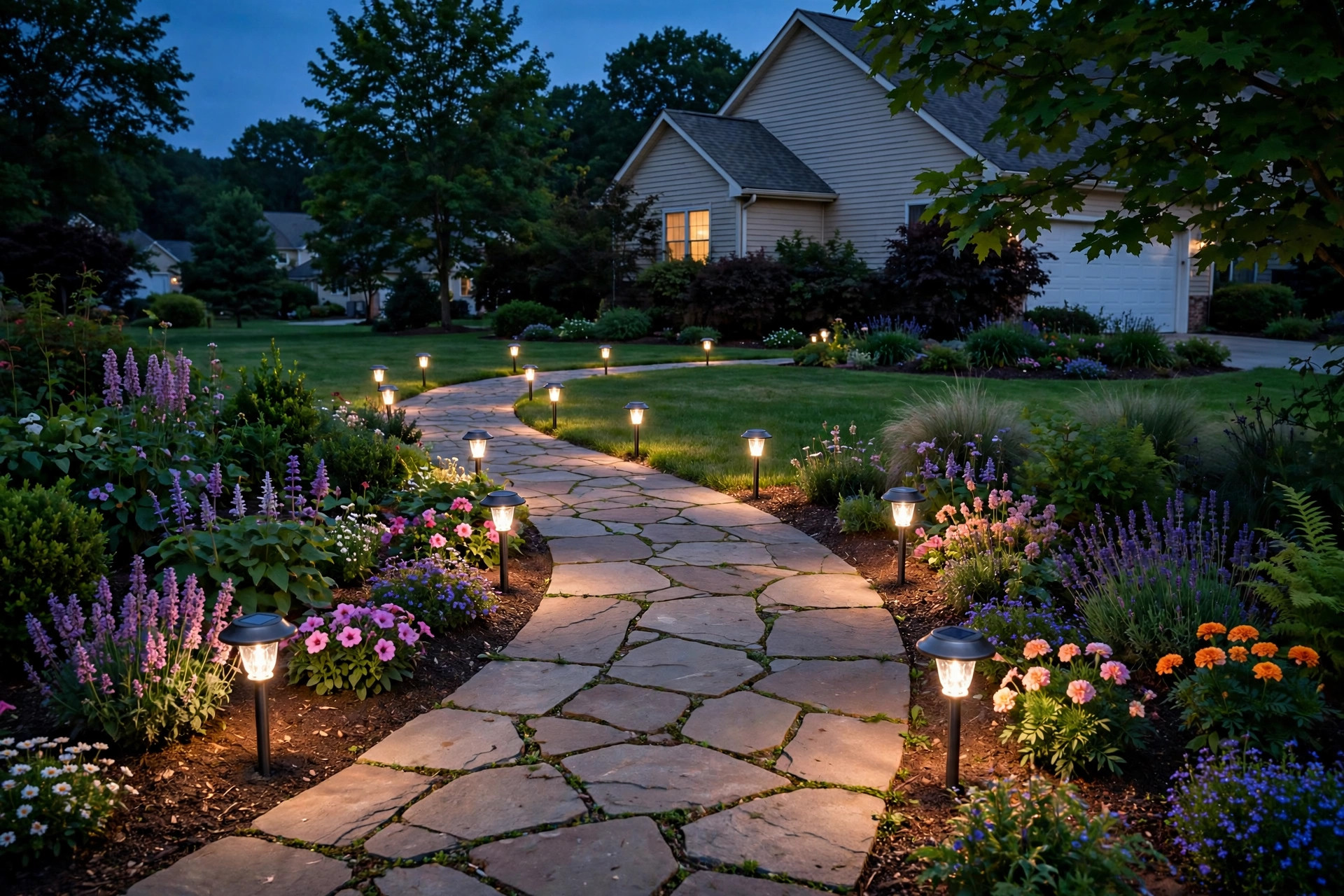

A dark walkway can be hard to read after sunset. A step you cannot see is a step you may miss. This solar path lights buying guide usa is written to help you choose lights that mark the path clearly and stay lit through the night. You do not need tools or wiring skills. You need only a few facts about brightness, panels, and batteries.
Solar path lights collect sun by day and give light by night. A small panel on each head turns daylight into stored power. At dusk a sensor turns the lamp on. At dawn it turns off. The cycle repeats on its own.
Why Solar Path Lights Matter
A lit path is a safer path. Guests, children, and older family members all move with more care when they can see where to step. Steps, low walls, and garden edges turn into trip hazards in the dark. A line of soft lights takes away that risk.
Light also marks the edges of a driveway or a front walk. Drivers see the line of the driveway sooner. That helps in a cul-de-sac or on a rural road where street lights are rare.
There is a third reason, and it is the plain pleasure of it. A garden that glows after dark looks cared for. The house looks lived in and watched. Many buyers in the United States put solar path lights near the front entry for exactly this reason: they cost little and they work at once.
What to Look for When You Shop: Solar Path Lights Buying Guide Usa
The boxes in the store can look the same. The print is small and the claims are large. Keep to the checks below and the choice gets simple.
Lumens and Brightness
Brightness is measured in lumens. A path light needs far less light than a porch lamp. A range of 5 to 15 lumens per light is right for most walkways. That level marks each step without glare. Very bright path lights can blind a guest for a moment. That defeats the point.
Look at the number on the box, not just the words “super bright.” The ENERGY STAR program keeps plain facts about outdoor lighting efficiency that help set a baseline. If a maker will not state the lumen count, pick another maker.
Warm white light, near 2700 Kelvin, reads kind to the eye. Cool white reads harsh in a garden. Most American buyers pick warm white for paths.
Solar Panel Quality
The panel is the engine. Larger panels and better cells gather more power on a short winter day. Monocrystalline panels catch light more fully than the older polycrystalline type. They cost a little more and they earn it.
A panel must face open sky. A light set under a tree or an eave will charge poorly. When you test a set, give the heads a full day of sun before you judge them. For a longer read on how sunlight turns into stored power, the guides at the U.S. Department of Energy give a clear plain-language outline.
Battery Capacity
The battery holds the day power for the night hours. Nickel-metal hydride batteries are common in good sets. Lithium batteries hold a charge longer and give more steady light. Either is fine if the maker states the type and the capacity.
A weak battery fades by midnight. A good one runs past dawn. If reviews keep saying “dead by ten,” the battery is too small for the claimed run time. Sets with replaceable batteries cost less over the years. You swap the cells instead of buying new lights.
Build Material and Weather Rating
Path lights live in rain, sun, and frost. Plastic bodies are cheap and they fade. Stainless steel and cast aluminum last much longer. Glass lenses beat plastic lenses, which cloud after a season or two.
Check the weather rating. IP44 or higher keeps rain out of the housing. If you live where winters are hard, a sturdier body pays for itself. Big home stores like The Home Depot and Lowe’s both list IP ratings on the product page, so compare before you buy.
Types of Solar Path Lights
Stake Lights
The stake light is the classic form. A short stem pushes into the soil and a small head sits on top. Sets of six or eight are the common pack. They suit straight walks, garden borders, and driveways. They are easy to move if you change your mind about the layout.
Bollard Lights
Bollard lights stand taller, near knee height, and throw a wider pool of light. They mark the edge of a patio or a long drive. They look more finished than stake lights and they cost more. Use them where the path needs fewer, stronger marks.
Decorative Lantern Styles
Lantern styles dress up the garden. Crackle glass, faux flame, and shepherd hook forms all appear in this group. They give softer light than a plain head. They suit front yards where looks matter. They still need the same sun and the same batteries as plain sets.
Matching the Light to the Yard
Small city yards do well with a set of six stake lights. Space them six to eight feet apart and stagger them left and right so the path reads clearly. A long farm drive may need two sets and a mix of heights.
Watch where the sun falls before you buy. Walk the path at midday. Note the spots that stay shaded. Plan the lights for the sunny spots. Shade is the main reason solar sets fail in real yards.
If your walk runs near trees, trim the lower limbs so the panels see the sky. Two hours of full sun beat six hours of dappled shade. This is also where a stronger battery helps: it stores more from a short charge window.
Cost and Price in the United States
Prices run wide. A basic six-pack of plastic stake lights sells for under twenty dollars. A well-made set in stainless steel with larger panels and lithium batteries runs forty to eighty dollars. Bollards sell in pairs or fours and cost more per light.
Pay by the quality of the parts, not by the count in the box. A ten-pack of weak lights fades in one season. A six-pack of good ones lasts five. The cost per year favors the better set.
Check what is in the box. Some sets add ground stakes and spare parts. Some do not. Retailers such as Lamps Plus and Lumens show full part lists and buyer reviews, which makes the comparison honest.
Prices dip in late summer when stores clear patio stock. If you can wait until August or September, last season colors often sell at a discount. The parts are the same. Only the packaging changes.
Installation and Placement
There is no wiring. There is no trench. Push the stake into soft soil. If the ground is hard, water the spot first or start the hole with a screwdriver. Do not hammer the light. The head will crack.
Keep lights a foot back from the path edge so mowers and string trimmers miss them. Aim the heads level. Tilted lights look sloppy and throw light into the grass instead of onto the path.
Turn each light on, or leave the pull tab in place, then let the set charge a full day. Walk the path after dark. Move any light that sits in a dark spot. Moving a stake light takes ten seconds.
Care and Upkeep
Wipe the panels once a month with a damp cloth. Dust and pollen cut the charge more than most buyers expect. A clean panel can add an hour of run time.
Check the batteries each spring. Swollen or leaking cells go in the recycling, not in the trash. Many towns take batteries at the curb on set days. If a set dims after two seasons, new batteries of the same type often bring it back.
Cut back plants that grow over the heads. A hosta leaf over a panel ends the charge for that light. Ten minutes of trimming each month keeps the whole set honest.
Safety Notes
Solar lights are low voltage and cool to the touch. They are safer than line-voltage garden lights around pets and children. The stakes are the main hazard. They are sharp enough to hurt a bare foot. Keep them out of play areas.
Do not place lights where they will blind drivers. Keep the heads low and the glow soft along a street-facing edge. A bright set near a road can distract more than it helps. For broader outdoor lighting ideas, see our guide to landscape spot lights.
When the season turns cold, plastic parts get brittle. Bring delicate sets in before the first hard freeze, or buy bodies rated for your zone. The bigger lighting brands such as Philips publish cold-weather notes on their outdoor lines that are worth a look.
Frequently Asked Questions
How many solar path lights do I need?
Count the length of the path in feet and divide by six. A thirty-foot walk needs about five lights. Space them evenly and stagger the sides. Start with fewer and add more after one night of testing.
Do solar path lights work on cloudy days?
They work, but they run for fewer hours. Panels still gather light through cloud cover. A good set stores enough for a cloudy night. Two cloudy days in a row will dim most sets. Larger panels and lithium batteries handle this best.
Why did my new lights stop working after one night?
Most new lights ship with the battery switch off or a pull tab in place. Flip the switch on and remove the tab, then give the set a full day of sun. The first night is often dim. Judgment should wait until the third night.
Can I leave them out in winter?
Yes, if the body is rated for cold. Snow cover blocks the panel, so brush the heads clear after a storm. Short days mean shorter run times. That is normal and not a defect. Indoor-outdoor storage advice from home guides like The Spruce matches what makers print on the box.
Are solar path lights bright enough for steps?
For marking steps, yes. For reading by, no. Path lights guide the eye to the edge of each step. If you need task light on a porch stair, pair them with a wired sensor porch light overhead.
Should I pick warm or cool white?
Warm white for garden paths. It blends with wood, stone, and plants. Cool white suits modern steel drives and security-minded entries. You can mix, but one color per path looks better.
How long do solar path lights last?
The LED heads often last five to ten years. The batteries last two to four years and can be replaced. The body wears first: cheap plastic fades in one or two summers, while steel and glass hold up much longer.
Where to See More Ideas
Solar path lights are one part of an outdoor lighting plan. They work well with patio string lights above a seating area and low-voltage spots near specimen trees. If you keep a battery-powered yard tool shed, makers like Greenworks publish sun and storage notes that apply to solar panels too.
A Final Word
Buy for the panel and the battery, not for the count in the box. Give each light open sky. Keep the panels clean. The right set will greet you at dusk for years and ask for nothing but a wipe and a trim. That is the whole bargain, and it is a good one.
References
ENERGY STAR. (n.d.). Energy efficient products. https://www.energystar.gov Greenworks. (n.d.). Battery-powered outdoor tools. https://www.greenworkstools.com Lamps Plus. (n.d.). Lighting and home decor. https://www.lampsplus.com Lowe’s. (n.d.). Home improvement products. https://www.lowes.com Lumens. (n.d.). Lighting and ceiling fans. https://www.lumens.com Philips. (n.d.). Lighting products. https://www.philips.com The Home Depot. (n.d.). Home improvement products. https://www.homedepot.com The Spruce. (n.d.). Home and garden advice. https://www.thespruce.com U.S. Department of Energy. (n.d.). Energy efficiency and renewable energy. https://www.energy.gov
Was this guide helpful?

About Sarah Mitchell
The My Garden US editorial team writes practical, in-depth home and garden guides for American homeowners — tested advice, no fluff.
You May Also Like
Indoor Wall Sconces for Texas Homes: A Plain Buyer Guide
August 31, 2026 0 views
LED Recessed Lights Deals Near Me: A Plain Guide to Buying Local
February 25, 2026 0 views
Under Cabinet Strips Reviews Buying Guide USA
February 4, 2026 0 views