
Introduction
Most homes waste power on outdoor lights. Old porch bulbs and yard floods burn energy all night. The bills add up. An energy efficient exterior lighting fixtures buying guide can help you change that. It shows you how to pick fixtures that use far less power and still light your home well.
Outdoor lights do more than help you see. They keep walkways safe. They greet guests at the door. They make a house look cared for from the street. And they can scare off intruders. New fixtures can do all of this while using a small fraction of the power that old lights need.
This guide walks you through the whole task. You will learn why efficient lights matter, what numbers to read on the box, which types fit which spots, what they cost, and how to keep them working for years. By the end, you will be able to shop with confidence and cut your outdoor lighting bill for good.
Why Energy Efficient Outdoor Lights Matter: Energy Efficient Exterior Lighting Fixtures Buying Guide
Outdoor lights often run for eight to twelve hours each night. That is a long time for any bulb to burn. An old 100-watt floodlight can use as much power in one night as a refrigerator uses in a day. Multiply that by a porch light, a garage light, and two path lights, and the cost grows fast.
New efficient fixtures change the math. A modern LED fixture can give the same light as an old 100-watt bulb while using only 12 to 15 watts. That is a cut of about 85 percent. Over a year, the savings can reach many dollars per fixture. With four or five fixtures on a house, the total is worth notice.
There is more at stake than money. Lights that run cooler last longer. You climb the ladder less often. You buy fewer bulbs. Efficient lights also put less load on the power grid. That means less fuel burned at the power plant.
Home value matters too. Buyers like a house that looks bright and safe at night. A neat row of path lights and a warm porch sconce can make a home stand out in the evening. Real estate writers have long noted that curb appeal helps a sale, and night appeal is part of it. You can read more about exterior upgrades at This Old House, where editors cover siding, lighting, and curb appeal projects in plain detail.
What to Look for When You Shop
Shopping for fixtures can feel like reading a foreign language. The box lists watts, lumens, Kelvin, and hours. Here is what each one means in plain words.
Lumens Tell You How Bright the Light Is
Lumens measure light output. The more lumens, the brighter the light. A soft porch light may need only 400 to 800 lumens. A security floodlight may need 1,500 to 3,000 lumens. Look at lumens first, not watts. Watts only tell you how much power the fixture uses. With efficient lights, watts are low even when the light is strong.
Color Temperature Sets the Mood
Color temperature is measured in Kelvin. A low number, near 2700K, gives a warm yellow light like an old bulb. A high number, near 5000K, gives a cool white light like daylight. For porches and patios, warm light near 2700K to 3000K feels welcoming. For driveways and security areas, cooler light near 4000K to 5000K can help you see more clearly. Pick one tone for the front of the house so the lights look like they belong together.
Ratings and Labels That Prove Efficiency
Look for the ENERGY STAR label. It marks products that pass strict tests for efficiency and quality. The U.S. Department of Energy also publishes plain guides to energy-saving lighting for homes. A fixture that carries the label will list its lumens, its watts, and its rated life in hours on the package. Many LED fixtures now rate for 25,000 to 50,000 hours. At ten hours a night, that is seven to thirteen years of use.
Weather Ratings Keep Water Out
Outdoor fixtures must stand up to rain, snow, and dust. The box may show an IP rating, such as IP44 or IP65. The higher the number, the better the seal against water and dust. A porch fixture under a roof can get by with a lower rating. A path light in an open yard needs a higher one. Also check that the fixture is listed by a safety lab such as UL or ETL for wet locations.
If your project includes work near the roofline, it helps to pair new lights with sound exterior repairs. A helpful companion read is our guide to weather resistant soffit and fascia repair for homeowners, which covers the trim boards where many eave lights mount.
Types of Exterior Lighting Fixtures
Different spots around a house need different fixtures. Here are the main types and where each one fits best.
Wall Sconces and Porch Lights
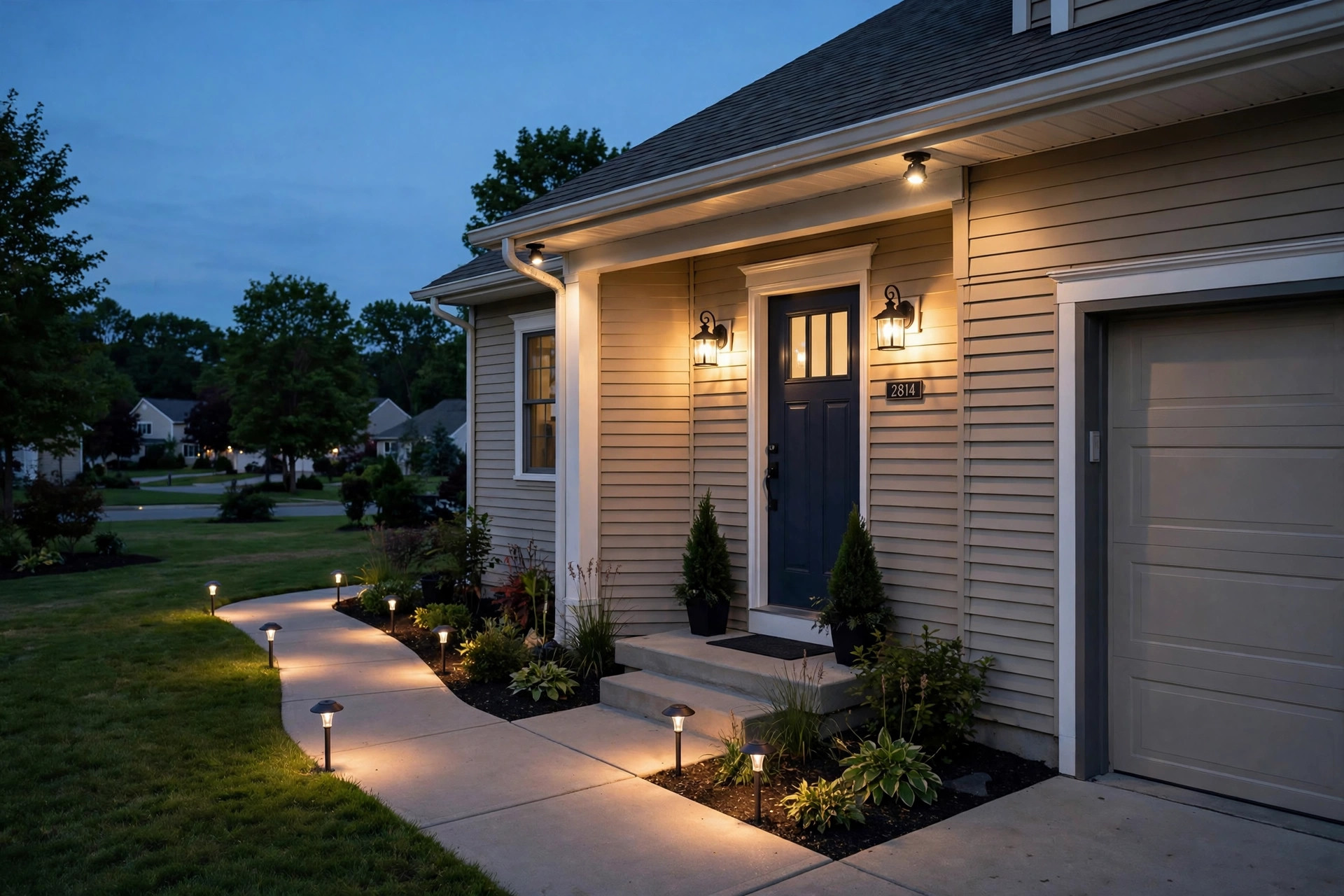
Sconces mount on the wall by a door or on a garage. They give soft, even light where people walk. Choose a fixture with a shade that points light down. This cuts glare and keeps light out of the night sky. Many sconces now come with built-in LED boards that never need a bulb change. Retailers such as Lowe’s and The Home Depot carry wide lines of LED sconces in styles from plain to classic.
Floodlights and Security Lights
Floodlights throw a wide beam over a driveway, a back yard, or a side gate. Motion sensors make them smarter. The light snaps on when it senses movement and shuts off after a set time. This saves power and startles intruders. Look for a sensor with a range you can adjust, so passing cars do not trip it all night. For renters and small buildings, options differ a bit; see our notes on professional grade exterior lighting fixtures for california apartments for ideas that suit shared walls and small lots.
Pathway and Landscape Lights
Path lights sit low along walks and driveways. They mark the edge of the step so no one trips. Landscape lights can wash a tree or a wall with soft light. Both types use little power because each head is small. Buy them in matched sets so the color and style agree. Space them six to eight feet apart for an even glow.
Solar Lights: No Wiring Needed
Solar fixtures charge by day and glow by night. They suit spots far from the house where running wire would cost too much. Their light is modest, so use them for accent, not security. Pick models with larger panels and replaceable batteries. A good solar light will list its run time on a full charge. In cloudy states, expect less run time in winter.
Style matters as well. The fixture should suit the house. A farmhouse looks right with barn-style gooseneck lights. A brick colonial suits lantern-style sconces. The siding itself sets the tone; makers like James Hardie and CertainTeed show how trim, siding, and fixtures can work as one design.
Cost and Price: What to Expect
Prices vary by type and build quality. Here are rough ranges for efficient fixtures in the United States.
– Solar path lights: 5 to 20 dollars each, often sold in sets of six or eight. – LED wall sconces: 25 to 120 dollars each. – Motion-sensor floodlights: 35 to 150 dollars each. – Low-voltage landscape kits: 60 to 250 dollars for a set with a transformer.
The fixture price is only part of the story. A wired fixture may need an electrician. A simple swap of one porch light can cost 75 to 150 dollars in labor. A new run of wire to a far corner of the yard can cost several hundred. Solar and battery lights skip this cost entirely.
Running costs are where efficient lights shine. Take a 15-watt LED floodlight that runs ten hours a night. That is 0.15 kilowatt-hours per night, or about 55 kilowatt-hours per year. At 15 cents per kilowatt-hour, the yearly cost is about eight dollars. The old 100-watt light it replaced would cost about 55 dollars a year for the same hours. The fixture often pays for itself in the first year or two.
Budget guides can help you plan the whole exterior at once. Our budget friendly vinyl replacement windows buying guide shows the same price-first method applied to another common exterior upgrade.
Care and Upkeep Through the Year
Efficient fixtures ask for little care, but a bit of upkeep keeps them bright.
Clean the lenses twice a year. Dust, pollen, and spider webs dim the light. Wipe the glass with a soft cloth and mild soap. Do not use harsh cleaners that can scratch plastic lenses.
Trim plants away from path lights. Bushes grow fast in summer and can block the beam. A quick trim in spring and fall is enough.
Check seals and gaskets each fall. Rubber seals dry out with age. If you see cracks, replace the gasket or the fixture. Water inside a fixture will kill the electronics long before the LED board wears out.
For solar lights, clean the panel. A dirty panel charges poorly. In snowy states, brush snow off the panels after storms. Replace rechargeable batteries every two to three years, or when run time drops sharply.
For wired systems, check the transformer and timers once a year. Make sure the timer still matches the season. Days grow short in fall, so lights may need to start earlier. A timer that is off by an hour wastes power or leaves the yard dark. Step-by-step maintenance ideas appear regularly at Family Handyman and Bob Vila, both of which keep plain-language upkeep guides for homeowners.
Safety Tips for Exterior Lighting
Lights make a home safer, but only if they are placed and wired well.
Light every step and change in level. Falls on dark stairs send many people to the emergency room each year. A small step light or a low path light can prevent a bad fall.
Do not blind your neighbors. Aim floodlights down at your own yard, not across the fence. Shades and shields help. Some towns have rules about light trespass. A quick check with the town office can save a dispute later.
Hire an electrician for new circuits. Swapping a fixture on an existing box is a fair do-it-yourself task for a careful homeowner who shuts off the breaker first. Running new wire, adding a circuit, or working in a wet location is a job for a licensed pro. The U.S. Consumer Product Safety Commission posts home electrical safety tips at cpsc.gov that are worth a read before any wiring work. The product testers at Consumer Reports also rate outdoor lighting for safety and build quality.
Keep lights away from dry mulch and leaves. Even cool-running LEDs have drivers that can get warm. Give fixtures a few inches of clear space. And never string indoor-rated cords or lights outside, even for a party. Rain and indoor cords are a bad mix.
Frequently Asked Questions
How many lumens do I need for a front porch?
A single porch light of 400 to 800 lumens suits most front doors. If the porch is large or the house sits far from the street, two sconces of 400 lumens each give a more even glow than one bright fixture. More light is not always better. Too much glare makes it harder to see faces and steps.
Do LED outdoor lights really last 25,000 hours?
Good ones do, in lab tests. Real life is a bit harsher. Heat, cold, and power surges can shorten life. Still, a well-made LED fixture often lasts five to ten years of nightly use. That is far longer than old bulbs, which might last one or two years outdoors. Buy from known brands and keep the receipt.
Are solar lights bright enough for security?
No. Solar lights suit paths, gardens, and accents. They do not throw enough light for a driveway or a dark corner where safety matters. For security, use wired LED floodlights with motion sensors. You can mix the two: solar along the garden bed, wired floods at the garage.
What color light is best for the front of the house?
Warm white, near 2700K to 3000K, suits most homes. It feels welcoming and flatters wood, brick, and siding. Cool white near 5000K can look harsh on a house front, though it works well for work areas like a driveway or a tool shed. Keep one color across the front so the house looks planned, not patched.
Can I put efficient fixtures on a timer or a smart plug?
Yes. Most LED fixtures work fine with timers, dusk-to-dawn sensors, and smart plugs. Check the box for the word dimmable if you plan to use a dimmer. Not all LEDs dim well. A dusk-to-dawn sensor is the simplest choice. It turns the light on at dark and off at dawn with no fuss.
Will new fixtures raise my home value?
They can help. Bright, neat outdoor lighting improves curb appeal, and buyers notice it during evening showings. No single fixture will set a price, but good lighting is part of a cared-for exterior. For broader ideas, browse the exterior project galleries at The Spruce, which often pair lighting with paint, trim, and landscaping updates.
Final Word
Good outdoor lighting does not have to cost much to run. Pick the right fixture for each spot. Read lumens, not watts. Choose warm light for the front door and strong light where safety matters. Keep lenses clean and timers set. Do these small things, and your home will look better, feel safer, and use far less power every night of the year.
References
Bob Vila. (n.d.). Home improvement advice. https://www.bobvila.com CertainTeed. (n.d.). Building materials and exterior products. https://www.certainteed.com Consumer Reports. (n.d.). Product reviews and ratings. https://www.consumerreports.org Family Handyman. (n.d.). DIY home repair and maintenance. https://www.familyhandyman.com James Hardie. (n.d.). Fiber cement siding and exterior products. https://www.jameshardie.com Lowe’s. (n.d.). Home improvement products. https://www.lowes.com The Home Depot. (n.d.). Home improvement products. https://www.homedepot.com The Spruce. (n.d.). Home and garden advice. https://www.thespruce.com This Old House. (n.d.). Home renovation guidance. https://www.thisoldhouse.com U.S. Consumer Product Safety Commission. (n.d.). Product safety information. https://www.cpsc.gov U.S. Department of Energy. (n.d.). Energy efficiency and renewable energy. https://www.energy.gov
Was this guide helpful?

About Jennifer Lee
The My Garden US editorial team writes practical, in-depth home and garden guides for American homeowners — tested advice, no fluff.
You May Also Like
Low Maintenance Siding Color Visualizer Tools Buying Guide
January 27, 2026 0 views
Reliable Stucco Exterior Repair in Arizona: A Homeowner’s Guide
September 8, 2026 0 views
Best Replacement Window Installation Near Me: A Simple Guide for Homeowners
August 25, 2026 0 views