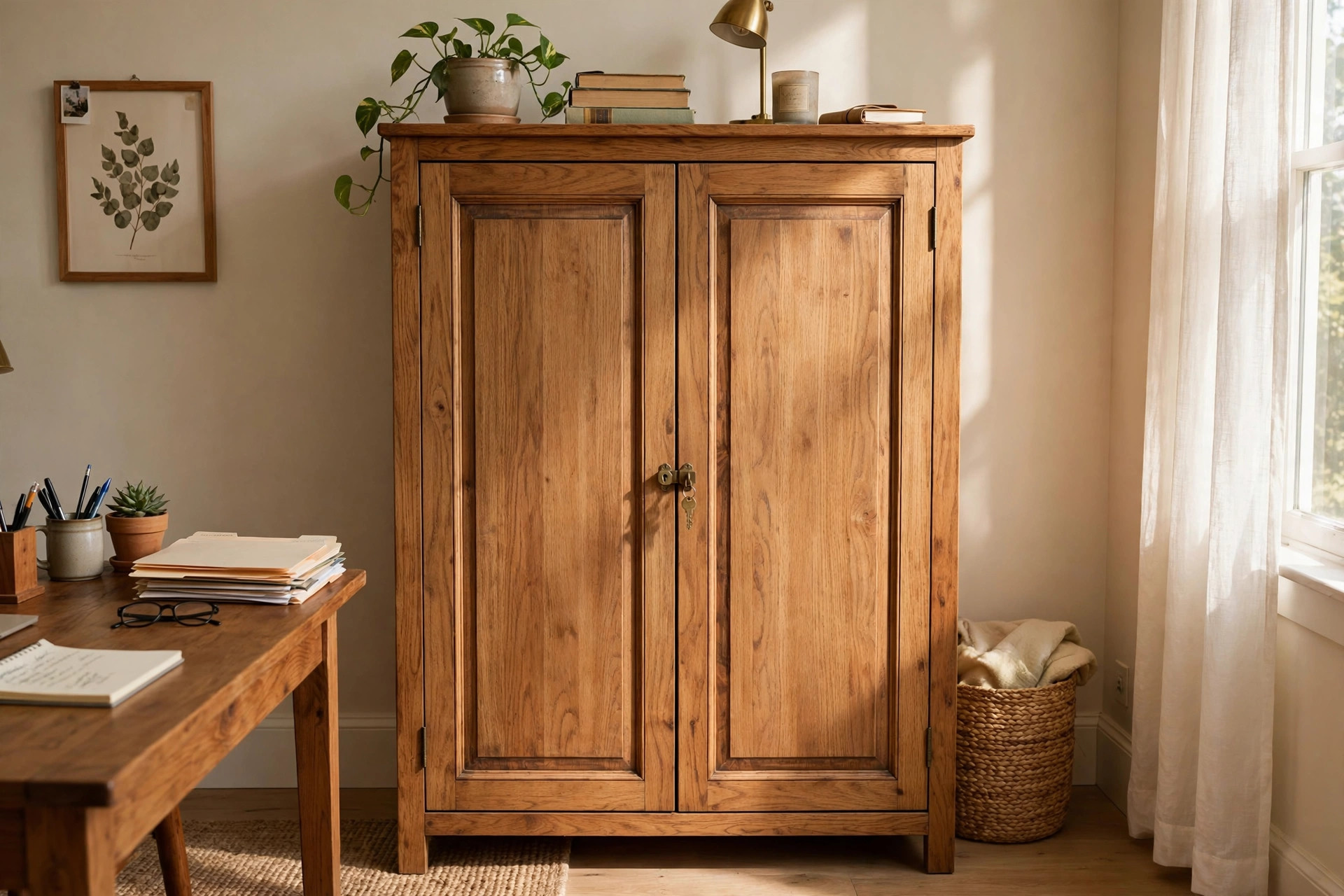

Many people now work from home. Papers pile up. Supplies spill across the desk. Tax files, contracts, and bills need a safe place. A home office storage cabinet with locking doors answers all these needs in one piece of furniture. It holds your work items. It hides clutter. And it locks, so private papers stay private.
Why It Matters
A home office is both a work space and part of your home. Friends, family, and guests may walk through it. Children may play near it. Without a locking cabinet, anyone can open a drawer and read a client file or a bank statement. A lock stops this. It gives you control over who sees your work.
A locking cabinet also helps with peace of mind. You can leave for the day and know your laptop, your checkbook, and your legal papers are safe behind a key. If you handle client data, a lock is not a luxury. Many clients expect their papers to be kept secure. A simple lock shows care.
There is a practical side too. A home office storage cabinet with locking doors keeps small items from getting lost. Stamps, keys, flash drives, and business cards each get a shelf. When every item has a place, you waste less time looking for things. Work moves faster.
Finally, a neat cabinet makes the room look better. Open shelves collect dust and look messy. A closed cabinet gives the room a calm, finished look. Guests see a clean office, not a pile of folders.
What to Look for When You Choose: Home Office Storage Cabinet with Locking Doors
Start with size. Measure your wall. Note the height of the ceiling and the width of the space. Leave room for the doors to swing open. A cabinet that blocks a walkway will annoy you every day.
Next, think about what you will store. If you store letter-size files, the shelves must be at least 12 inches deep. If you store binders, check the shelf height. Adjustable shelves are the best choice. You can move them as your needs change.
Look at the lock type. Most cabinets use one of three locks. A key lock is simple and cheap. Each cabinet comes with two keys. A combination lock uses a code, so there is no key to lose. An electronic lock uses a keypad or a fingerprint. It costs more but is easy to use. For most home offices, a good key lock is enough. Keep a spare key in a safe place, away from the cabinet.
Check how the cabinet is built. Solid wood and metal last the longest. Particle board costs less but can sag under heavy files. Look at the back panel. A thin back can bow out over time. Metal cabinets are strong and plain. Wood cabinets look warm and fit a home setting.
Doors matter too. Double doors open wide and let you see everything at once. A single door takes less room to swing. Sliding doors save space but only open half the cabinet at a time. Pick what fits your room.
Finally, look at how it reaches you. Some cabinets ship flat and need assembly. A full day of work with a screwdriver is common. Others ship whole and cost more to deliver. Read the shipping notes before you buy. For honest opinions on build quality, product testers at the Wirecutter office section are a fine place to start reading.
Types and Options
Wood Storage Cabinets
Wood cabinets suit a home office best. They look like home furniture, not office equipment. Oak, maple, and walnut finishes are common. Many wood cabinets have adjustable shelves and a key lock on the front. They cost more than metal but feel warmer. Solid wood holds heavy files well. Veneer over engineered wood is lighter and cheaper. Check that the veneer is thick enough to resist chips.
Metal Storage Cabinets
Metal cabinets are the workhorses. Steel models hold the most weight. They resist dents and scratches. Most come in gray, black, or white. They fit a garage-style or modern office. The locks on metal cabinets are often sturdier than those on wood ones. The weak point is the finish. Cheap paint can chip. Look for a powder-coated finish. It holds up better.
Tall vs. Short Cabinets
Tall cabinets use vertical space. They hold more but need a steady wall. Anchor a tall cabinet to the wall with the included bracket. Short cabinets, sometimes called credenzas, double as a printer stand or a coffee station. They hold less but are easier to move. If you rent your home, a short cabinet is kinder to the walls.
Fire-Resistant and High-Security Models
If you store wills, deeds, or backup drives, look at fire-resistant cabinets. They are tested to survive heat for 30 or 60 minutes. They cost much more. For most people they are not needed. But for papers that cannot be replaced, the cost is fair. High-security models add thicker steel and better locks. Retailers like Office Depot carry a wide range of these heavier models.
Cost and Price
Prices vary a lot. A small wood-look cabinet with a simple key lock can cost under one hundred dollars. These are fine for light use. They hold books, supplies, and small files.
Mid-range cabinets cost between two hundred and five hundred dollars. This is the sweet spot for most home offices. You get real wood veneer or sturdy steel, adjustable shelves, and a reliable lock. The doors close flush. The finish looks good for years.
Premium cabinets cost five hundred dollars and up. They may be solid hardwood or heavy steel. Some have electronic locks. Some are fire-rated. If you plan to keep the cabinet for twenty years, the extra cost pays off.
Watch for hidden costs. Delivery for a heavy cabinet can add fifty to one hundred dollars. Assembly service adds more. If you buy from a large marketplace such as Amazon, check the return policy. A cabinet that arrives damaged should be easy to return.
Sales happen often. Office furniture drops in price in January and again in late summer, when stores clear stock. Big sales events bring deep cuts too. Set a price alert and wait a few weeks if you can.
Care and Upkeep
Care is simple. Dust the cabinet once a week with a soft cloth. For wood, use a slightly damp cloth and dry it right away. Never soak wood. Water leaves marks and swells the fibers.
Keep the lock working well. Once a year, put a drop of graphite powder or a spray of dry lubricant in the keyhole. Turn the key a few times. Do not use oil. Oil collects dust and gums up the works. If the key sticks, do not force it. A stuck key can break off inside the lock.
Check the hinges twice a year. Tighten any loose screws. A sagging door puts strain on the lock. Most hinges need only a screwdriver. If a shelf starts to bow under heavy files, flip it over. The bend will even out. Or move the heaviest files to the bottom shelf, where the cabinet is strongest.
Keep the cabinet away from direct sun and heat vents. Sun fades wood finishes. Heat dries the wood and loosens joints. A spot along an inside wall is best.
Store a spare key outside the office. A desk drawer in another room works. If you lose the only key, a locksmith can open the cabinet, but it will cost money and may damage the lock.
Safety
Anchor tall cabinets to the wall. This is the most important safety step. A tall cabinet full of files is top-heavy. A child climbing the shelves can tip it over. The result can be serious. Most cabinets include an anti-tip bracket and screws. Use them. If you cannot drill into the wall, ask your landlord before you buy. Renters guides at Apartment Therapy discuss anchoring options for those who cannot drill.
Mind the weight on each shelf. Check the maker’s weight limit. Spread heavy items across shelves instead of stacking them on one. Put the heaviest items low. This keeps the cabinet stable.
Watch the sharp edges on cheap metal cabinets. Run a finger along the door edge before you load it. If an edge feels sharp, file it smooth or add edge guards. This matters most in homes with small children.
Lock the cabinet when you leave the room, not just when you leave the house. Visitors, repair workers, and curious children are the most common snoopers. A lock only works when it is used. Make locking a habit, like turning off the lights.
If you store medicine, cleaning products, or sharp tools in the cabinet, a lock keeps children out. This is one of the best reasons to choose a locking model over an open shelf. Poison control data shows that many home accidents involve items within a child’s reach.
Frequently Asked Questions
Do I really need locking doors on a home office cabinet?
You do if you store anything private. Tax papers, client files, passports, and bank statements all count as private. Even if you live alone, a lock protects you during a break-in. Thieves look for easy targets. A locked cabinet slows them down. For papers that matter, the small extra cost is worth it.
What is better for a home office, wood or metal?
Wood looks better in a home. It matches desks and bookcases. Metal is stronger and cheaper for the same size. If the office is in a spare bedroom, choose wood. If it is in a garage or a basement, metal is fine. Both can have good locks. Pick the look that fits the room.
Can I add a lock to a cabinet that has none?
Yes. A locksmith can add a cam lock to most wood and metal doors for a modest fee. There are also add-on locks that screw into the door frame. But a factory-installed lock is usually stronger and looks better. If you know you want a lock, buy a cabinet that comes with one.
How do I organize the inside of the cabinet?
Give each shelf a job. Top shelf for supplies you use daily. Middle shelves for active project files. Bottom shelf for archives you rarely touch. Use labeled boxes or file holders. Labels save time. Leave a little empty space on each shelf. A packed shelf is hard to use. Reorganize once a year and throw away papers you no longer need.
What should I do if I lose the cabinet keys?
First, check your spare. This is why you keep one in another room. If there is no spare, call the maker. Many cabinet makers can send a replacement key if you give them the lock number, which is stamped on the lock face. If that fails, a locksmith can pick the lock or drill it out. Drilling ruins the lock, so it is the last choice.
Will a locking cabinet fit in a small home office?
Yes. Measure first. Look for narrow cabinets, about 30 inches wide. Corner cabinets use dead space. Short cabinets under a window work too. Pair the cabinet with a small desk, like an ergonomic standing desk for a small home office, and a rolling file cabinet for home office organization to keep files close. Plan the layout on paper before you buy.
A Short Final Word
A home office storage cabinet with locking doors is a small buy that pays off every day. It keeps your papers private. It hides clutter. It makes the room look finished. Take your time. Measure your space. Pick a solid build and a good lock. Then enjoy an office where everything has a place, and every place is safe. Your work deserves that much order.
For more ideas on setting up the rest of your space, read our guides on the best office chair for long hours home office, the ergonomic standing desk for small home office, and the rolling file cabinet for home office organization.
Retailers such as IKEA and Wayfair offer many styles to browse, while specialist makers like Herman Miller, Steelcase, and UPLIFT Desk focus on ergonomic office furniture. Review sites including The Spruce and PCMag publish hands-on buying guides worth a look before you spend.
References
Herman Miller. (n.d.). Office furniture and ergonomic seating. https://www.hermanmiller.com IKEA. (n.d.). Home furnishings. https://www.ikea.com PCMag. (n.d.). Technology product reviews. https://www.pcmag.com Steelcase. (n.d.). Office furniture and workplace research. https://www.steelcase.com The Spruce. (n.d.). Home and garden advice. https://www.thespruce.com UPLIFT Desk. (n.d.). Standing desks and ergonomic office furniture. https://www.uplift-desk.com Wayfair. (n.d.). Furniture and home goods. https://www.wayfair.com Wirecutter. (n.d.). Product reviews from The New York Times. https://www.nytimes.com/wirecutter
Was this guide helpful?

About Emily Rodriguez
The My Garden US editorial team writes practical, in-depth home and garden guides for American homeowners — tested advice, no fluff.
You May Also Like
Adjustable Under Desk Keyboard Tray Ergonomic Guide for Home Offices
July 13, 2026 0 views
Adjustable Standing Desk Mat with Massage Bumps
June 8, 2026 0 views
Home Office Desk Riser for Treadmill Walking
January 17, 2026 0 views