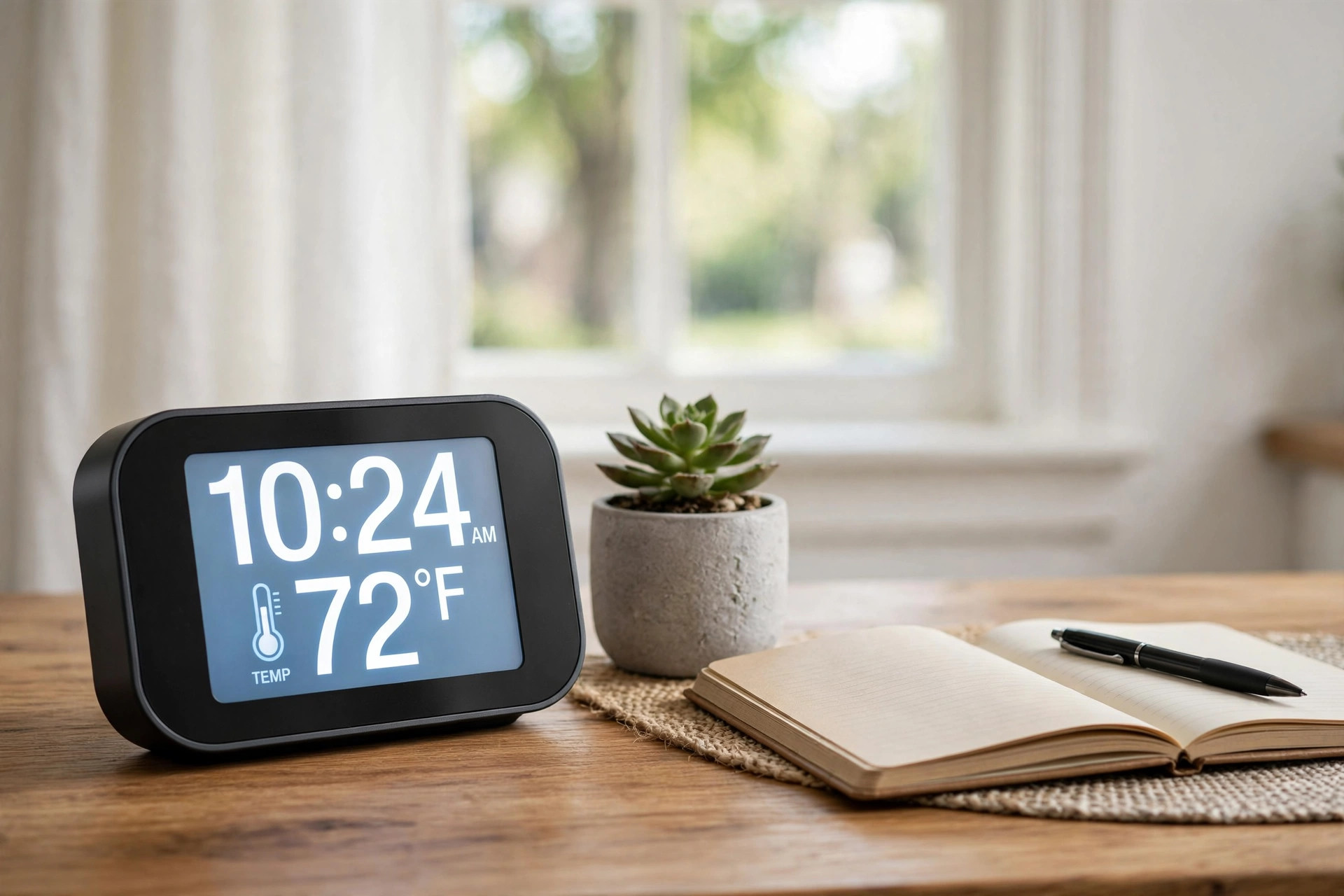

The best desk clock with temperature display office workers keep on their desks does two simple jobs. It tells the time, and it shows the temperature in the room. No computer screen is needed. No phone must be unlocked. One quick glance is enough. In a busy office, small tools like this make the day run smoother.
Many workers check the clock on the wall, but a wall clock is often too far to read. Others check a phone, but phones can bring distractions with them. A desk clock sits close by. It is always on and always easy to read. When it also shows the temperature, it gives one more useful piece of information. Room temperature affects comfort, focus, and even health. A warm room makes people sleepy. A cold room makes people tense. A small display on the desk can warn you before the room becomes a problem.
This guide explains how to find the best desk clock with temperature display office life can benefit from. It covers why such a clock matters, what to look for, the main types, prices, care, and safety. It ends with answers to common questions.
Why a Desk Clock With Temperature Display Matters
A desk clock serves the worker, not the room. A wall clock serves the whole room. When you sit at a desk, your eyes stay on your work. You do not want to turn your head to see the time. A desk clock sits in your line of sight. You see the time without moving. That small act saves time and keeps your mind on the task.
The temperature display adds a second layer of value. Office rooms do not always hold a steady temperature. Morning sun warms one side of the room. Air conditioning cools another. A meeting room full of people can turn warm in twenty minutes. A desk clock with a temperature sensor shows these changes as they happen. The worker can open a window, adjust a fan, or speak to the building manager. Small steps like these prevent headaches and tiredness.
Writers, designers, and office staff all benefit from a calm work area. Guides to the best home office setup for software developers often list small desk tools that reduce strain. A desk clock with temperature display belongs on that list. It is cheap, simple, and useful every single day.
What to Look for When You Choose One: Best Desk Clock with Temperature Display Office
Not all desk clocks are built the same. Some have large clear numbers. Others have tiny hard-to-read digits. Some show temperature within half a degree of accuracy. Others drift by three or four degrees. The following points help you pick well.
Display Size and Readability
The most important feature is a display you can read. Look for numbers at least one inch tall. Two inches is better for desks placed at arm’s length or more. High contrast matters. Dark numbers on a light screen, or bright light-emitting diode numbers on a dark screen, both work well. Check that the display is readable from your normal sitting angle. Some screens fade when viewed from the side.
Backlighting helps in dim rooms. Many office corners sit far from windows. A clock with an adjustable backlight keeps the time visible without becoming too bright. Some models dim at night and brighten in the morning. Test the dimming before you buy if possible.
Temperature Accuracy and Calibration
A temperature sensor is only useful if it is close to the truth. Good desk clocks stay within one degree of the real room temperature. Cheap models can drift by two or three degrees. That drift can mislead you into thinking the room is fine when it is not.
Some clocks allow calibration. Calibration lets you add or subtract a degree so the reading matches a trusted thermometer. If you work in a place where comfort matters, such as a home office with clients, calibration is worth having. Place the clock away from direct sunlight, lamps, and computer vents. Heat from these sources raises the reading and hides the true room temperature.
Power Source
Desk clocks run on batteries, on mains power, or on both. Battery models are easy to place anywhere. They need new batteries once or twice a year. Mains-powered models never need battery changes, but they need a free outlet and a cable that reaches the desk. Many workers prefer a clock with mains power and a battery backup. The backup keeps the time during a power cut.
Check how the backlight is powered. Some battery clocks keep the backlight off to save power. They light up only when you tap the clock. Mains-powered clocks can keep the backlight on all the time. Choose the option that fits your desk and your habits.
Extra Functions
Many desk clocks include more than time and temperature. Common extras are humidity readings, alarms, calendar dates, and weekday displays. A humidity reading is a good partner to temperature. Together they describe how the room feels. An alarm helps workers who must stop for meetings or breaks.
Some clocks show two time zones. This helps workers who call colleagues in other cities. Avoid clocks packed with features you will never use. Each extra feature adds buttons and menus. A simple clock that you understand is better than a complex one that confuses you.
Types of Desk Clocks With Temperature Displays
Four main types exist. Each suits a different desk and a different taste.
Digital LED and LCD Clocks
Digital clocks show the time in clear numbers. LED models glow with bright digits. LCD models use a flat screen. Both types often include temperature, humidity, date, and alarm functions. These clocks are the most common choice for offices. They are easy to read, and their prices are low. Retailers such as Amazon and Wayfair carry wide ranges of these clocks.
Analog Clocks With Temperature Rings
Analog clocks have hands and a round face. Some models add a small temperature dial or a digital window for temperature. These clocks suit traditional desks and reception areas. They look like furniture rather than electronics. Their style fits well with wood desks and classic office decor. Furniture guides on IKEA show how such classic pieces fit into calm work spaces.
Projection Clocks
Projection clocks shine the time onto a wall or ceiling. You can read the time without lifting your head from the pillow or the desk. Many projection clocks include a temperature display on the clock body itself. These clocks help night-shift workers and anyone who wants the time visible across the room. Office supply stores like Office Depot and Staples stock several projection models.
Smart and Connected Clocks
Smart clocks connect to home networks and show more data. They can display weather, calendar events, and room temperature from built-in sensors. They cost more and need a network connection. Reviews at Wirecutter and PCMag compare smart clocks with simpler models. For most office desks, a simple digital clock does the job. Smart clocks suit workers who want one device to show many things.
Cost and Price
Desk clocks with temperature displays are affordable. Basic battery models cost between ten and twenty dollars. Mid-range models with larger displays, alarms, and humidity sensors cost between twenty and forty dollars. Premium models with wood cases, atomic time sync, or smart features cost between forty and eighty dollars.
Price does not always mean quality. A twenty-dollar clock from a trusted brand can last longer than a fifty-dollar clock from an unknown maker. Product testing sites such as Consumer Reports and The Spruce publish buying guides that help buyers compare brands. Buy from stores with clear return policies. If the temperature reading is wrong or the display is hard to read, return the clock and try another.
Shipping and tax can add to the final cost. Office supply stores often sell these clocks in person, so you can see the display before you buy. Online stores offer more choices and lower prices. Either path works well.
Care and Upkeep
A desk clock needs little care, but small steps keep it accurate for years. Dust the display with a soft dry cloth once a week. Dust blocks light and makes numbers harder to read. Do not use water or glass cleaner on the screen. Liquids can seep inside and damage the electronics.
Replace batteries on time. Weak batteries cause the display to dim and the temperature sensor to drift. Write the battery type on a small label under the clock. This saves you from guessing when the time comes. If the clock uses mains power, check the cable once a year. A frayed cable is a fire risk and should be replaced.
Keep the clock away from heat sources. Do not place it on top of a warm printer or next to a sunny window. Heat shortens battery life and warps plastic cases. A cool, shaded spot on the desk is ideal. Workers who pair their desk tools with ergonomic seating, such as an adjustable height stool for standing desk breaks, often keep the clock at eye level on a shelf for the best view.
Check the temperature reading once each season. Compare it with a trusted thermometer. If the readings differ by more than two degrees, recalibrate the clock or replace it. Sensors age, and old sensors lose accuracy.
Safety
Desk clocks are safe devices, but a few rules apply. Use only the battery type printed in the manual. Mixing old and new batteries can cause leaks. Remove batteries if you will not use the clock for months. Leaked battery acid damages the clock and the desk surface.
Mains-powered clocks must meet local electrical standards. Look for a safety mark on the plug and the power supply. Do not run cables across walkways where people can trip. Keep cables behind the desk. If the clock becomes hot to the touch, unplug it at once and stop using it.
Small parts can be a hazard around young children. Keep desk clocks out of reach of toddlers. Button batteries are especially dangerous if swallowed. Store spare batteries in a closed container in a high drawer.
Frequently Asked Questions
How accurate are the temperature displays on desk clocks? Most desk clocks stay within one to two degrees of the true room temperature. Place the clock away from heat sources for the best reading. If accuracy matters, choose a model with calibration and check it against a trusted thermometer.
Do I need a clock that syncs with atomic time? Atomic time sync keeps the clock exact without manual setting. It is useful but not required. A normal quartz clock drifts by only a few seconds per month. Set it once and adjust it when the seasons change.
Can a desk clock help with office comfort? Yes. A temperature display shows when the room drifts out of the comfort range. Most people work best between sixty-eight and seventy-six degrees Fahrenheit. When the display shows the room moving outside that range, you can act early. Workplace guides from Steelcase and UPLIFT Desk note that small environmental controls improve focus.
What size display is best for a desk? Numbers between one and two inches tall work for most desks. Sit in your normal chair and test the view. If you must lean forward to read the time, the display is too small.
Are projection clocks worth the extra cost? Projection clocks cost more than basic digital clocks. They are worth it if you want to read the time from across the room or from bed during night shifts. For a normal desk, a standard digital clock is enough.
Where should I place the clock on my desk? Place it slightly to the side of your main work area, at eye level if possible. Avoid direct sunlight and heat vents. Creative workers using an adjustable drafting table for home art studio work often place the clock on a side shelf where it stays visible but out of the way.
A Short Final Word
The best desk clock with temperature display office workers choose is the one that fits their desk, their eyes, and their budget. It need not be smart. It need not be expensive. It must be easy to read and close to the truth. Time and temperature are small facts, but they shape the whole workday. Choose a clock that shows both well, care for it, and it will serve you for years.
References
Amazon. (n.d.). Online shopping. https://www.amazon.com Consumer Reports. (n.d.). Product reviews and ratings. https://www.consumerreports.org IKEA. (n.d.). Home furnishings. https://www.ikea.com Office Depot. (n.d.). Office supplies and furniture. https://www.officedepot.com PCMag. (n.d.). Technology product reviews. https://www.pcmag.com Staples. (n.d.). Office supplies and furniture. https://www.staples.com Steelcase. (n.d.). Office furniture and workplace research. https://www.steelcase.com The Spruce. (n.d.). Home and garden advice. https://www.thespruce.com UPLIFT Desk. (n.d.). Standing desks and ergonomic office furniture. https://www.uplift-desk.com Wayfair. (n.d.). Furniture and home goods. https://www.wayfair.com Wirecutter. (n.d.). Product reviews from The New York Times. https://www.nytimes.com/wirecutter
Was this guide helpful?

About Emily Rodriguez
The My Garden US editorial team writes practical, in-depth home and garden guides for American homeowners — tested advice, no fluff.
You May Also Like
Small Standing Desk With Wheels for Mobility: What to Know Before You Buy
February 15, 2026 0 views
LED Desk Lamp with Wireless Charging Base: A Practical Guide for Home Offices
May 30, 2026 0 views
Ergonomic Zero Gravity Office Chair Recliner: A Complete Buyer Guide
June 4, 2026 0 views