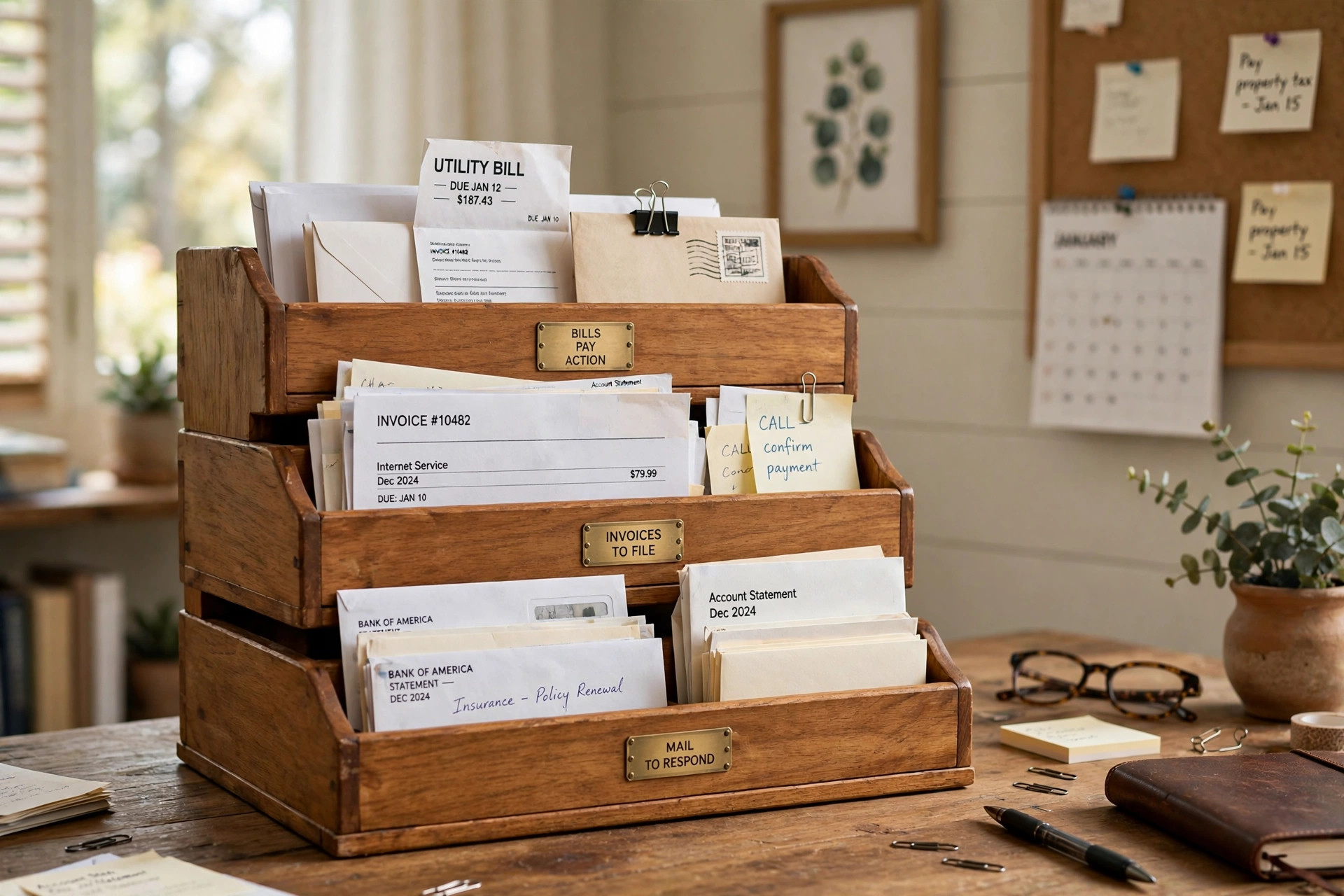

Every home office desk collects mail. Envelopes arrive each day. Bills stack up beside magazines and catalogs. Before long, the desk is a pile of paper and the worker is hunting for one lost invoice. A home office desk organizer for mail and bills solves this common problem. It is a tray or rack with slots that hold each piece of paper in its place. Incoming mail goes in one slot. Bills to pay go in another. Papers that are done go in a third. The system is plain, and it works.
More people now work from home. The desk must serve as an office, a mail room, and a filing corner all at once. A good organizer turns a messy desk into a calm work area. This guide explains why it matters, what to look for, which types are sold, what they cost, and how to keep one clean and safe.
Why a Desk Organizer Matters
A messy desk wastes time. Studies of office work have long shown that workers lose many minutes each day looking for papers. A lost bill is worse than a lost minute. Late payment brings fees. A missed due date can harm a credit record. A home office desk organizer for mail and bills keeps each paper where the eye can find it.
Order also lowers stress. A desk covered in envelopes makes the mind feel scattered. An organizer brings shape to the pile. The owner sees at a glance what needs action and what can wait. This small daily habit builds a feeling of control.
The organizer also guards privacy. Bills carry account numbers and personal facts. Loose mail on a desk can be seen by visitors, children, or repair workers. An organizer with a closed slot or a locking box keeps such papers out of sight. For workers who share the home office, this privacy is a real benefit.
A further gain is simple discipline. When mail has a home, the habit of sorting grows. The worker opens the envelope, reads it, and files it in the right slot. The desk stays clear without daily effort. Over months, the habit saves real hours.
What to Look For: Home Office Desk Organizer for Mail and Bills
Not every organizer suits every desk. A wise buyer weighs size, material, layout, and price before a choice is made. The points below are the ones that matter most.
Size and Desk Space
Measure the desk first. An organizer should sit on the desk without crowding the work area. For a small desk, a slim vertical rack with tall slots fits well. For a large desk, a wider tray with many sections is fine. Note the depth of each slot. Standard letter paper is eight and a half inches wide, so slots should be at least nine inches wide.
Think about wall space too. Some organizers hang on the wall above the desk. A wall mounted fold down desk for small spaces pairs well with a wall rack, since both save the desk top. If the desk sits under a shelf, a low tray may fit better than a tall tower.
Material and Build
Organizers are made of wood, metal, plastic, or cardboard. Wood looks warm and lasts long. Metal wire racks are light and easy to see through. Plastic trays are cheap and wipe clean. Cardboard or kraft paper models are the cheapest of all, but they wear out in a year or two.
Check the joints. Trays that stack should lock together firmly. Wire racks should not wobble. A heavy base keeps the unit from tipping when one side is full. Smooth edges matter as well, since the hand reaches into the slots many times a day.
Layout and Labels
The layout is the heart of the tool. A good home office desk organizer for mail and bills has at least three sections. One is for new mail. One is for bills to pay. One is for papers to file. More sections help larger households. A slot for each family member keeps personal mail apart.
Labels turn slots into a system. Some organizers come with label holders. Others accept small stickers. Clear labels such as “To Pay,” “To File,” and “To Read” remove all doubt. When the layout matches the daily routine, the organizer does its job well.
Types and Options
Shops sell many kinds of desk organizers. The main types are described below.
Stacking letter trays. These are the classic choice. Each tray holds one layer of paper. Trays stack on top of each other. They are simple, cheap, and easy to reach into. A set of three or four trays handles most homes.
Vertical sorters. These stand upright with tall slots. Mail stands on edge like books on a shelf. They save desk space because the base is small. They suit desks with little room.
Wall pockets. These hang on the wall or the side of a desk. They hold mail where the desk top stays fully clear. They work well in tight corners.
Desktop filing boxes. These hold hanging folders inside a box. They store more paper than trays. A rolling file cabinet for home office organization serves a bigger need, but a desktop box suits daily mail.
Combination units. Some units mix trays, slots, and small drawers. Drawers hold pens, stamps, and a checkbook. The mail sections handle paper. These units are larger and cost more.
Locking organizers. A home office storage cabinet with locking doors is the large answer to privacy. A small locking organizer covers the same need at the desk. The lock keeps bills with account numbers out of sight.
Retailers that carry office furniture often stock these types. The IKEA store shows many desk trays and wall pockets in simple designs. Wayfair lists a wide range of stacking trays and vertical sorters with customer reviews. For design-minded buyers, Herman Miller and Steelcase offer higher-end office accessories. Uplift Desk sells add-on trays that fit its standing desks. Review sites such as Wirecutter and PCMag test office gear and publish buying advice.
Cost and Price
Prices run from a few dollars to over one hundred dollars. A set of three plastic stacking trays often costs under fifteen dollars. Metal wire sorters sell for about twenty to forty dollars. Wooden units with drawers may cost fifty to one hundred dollars or more. Locking models add ten to twenty dollars for the lock.
The buyer should match price to need. A renter with a small desk may do well with a twenty-dollar sorter. A home business with many clients may need a larger filing box or a locking unit. Price often follows material and size, not brand name. A mid-price metal rack often outlasts a cheap plastic one.
Do not buy on price alone. A tray that tips over or cracks in six months costs more in the end. Read product reviews on store sites. Check the return policy. A good unit lasts for years of daily use.
Care and Upkeep
An organizer needs little care. Dust the trays each week with a dry cloth. Wipe plastic trays with a damp cloth when they look dirty. Wooden units clean well with a soft dry cloth; a damp cloth may spot the finish.
Empty the organizer each week. Papers should not live in the sorter forever. Paid bills move to a file box. Junk mail goes to the recycling bin. A weekly sweep of five minutes keeps the system honest. If a slot is always empty, remove the label or change it. If a slot always overflows, add a second one.
Check labels twice a year. Family needs change. A slot for school papers may become a slot for tax papers. Fresh labels keep the system current. This small effort is the whole secret of the tool.
Once a year, give the organizer a full review. Take every paper out and sort it by hand. Papers that belong in a file box move there. Papers that are done get shredded or recycled. Then dust each tray and slot. Look for cracked plastic or loose joints. Tighten screws or replace weak parts. A yearly check keeps the organizer working like new and stops clutter from creeping back.
Safety
Paper is a fire risk. Keep the organizer away from candles, space heaters, and hot lamps. A full tray of paper can feed a flame fast. A desk lamp with a hot bulb should sit at least a foot away.
Some metal organizers have sharp wire ends. Check new units for rough spots. Smooth any sharp point with a file or cover it with a small cap. Children should not climb on desk furniture or pull on wall pockets, which can fall.
Locks and small parts deserve care. A small key can be swallowed by a young child. Keep the key in a drawer, not on top of the unit. Teach children that the organizer holds private family papers.
Privacy is a safety issue too. Shred bills and bank letters before they go in the trash. A home office desk organizer for mail and bills is the first step. The shredder is the last step. Together they keep account numbers out of wrong hands.
FAQ
How many sections should a desk organizer have? Three sections are enough for most homes. One takes in new mail. One holds bills to pay. One holds papers to file. Larger families may add a slot for each person. Start with three and add more only when a slot overflows often.
Where is the best place to put the organizer on the desk? Place it at the back corner of the desk, away from the work area. The sorting zone should not crowd the keyboard or the writing space. If the desk is very small, a wall pocket above the desk keeps the top clear.
Can a desk organizer replace a filing cabinet? No. The organizer handles daily paper only. It is the inbox of the home. A filing cabinet or a storage box holds papers that must be kept for months or years. Use the organizer for the week and the file box for the year.
What is the best material for a desk organizer? Wood is strong and looks fine in a home office. Metal wire racks are light and let the user see the papers. Plastic trays are cheap and easy to clean. Each material works well. The choice is a matter of taste and budget.
How do I stop mail from piling up again? Open each envelope the day it arrives. Throw junk mail away at once. Put each bill in the “To Pay” slot. Then set one day a week to pay bills and file papers. The organizer only works when the weekly habit goes with it.
Is a locking organizer worth the extra cost? It is worth the cost when the desk is shared or visitors see the office. Bills show account numbers. Tax papers show income. A lock costs little and guards a lot. For a private office used by one person, an open tray is enough.
A Final Word
A home office desk organizer for mail and bills is a small tool with a large payoff. It costs little. It needs almost no care. Yet it brings order to the daily flow of paper. The desk stays clear. Bills get paid on time. Private papers stay private. Any worker with a home office gains from one. Choose a size that fits the desk, a material that lasts, and a layout that matches the week. Then let the habit do the rest.
See The Spruce for more detail.
References
Herman Miller. (n.d.). Office furniture and ergonomic seating. https://www.hermanmiller.com IKEA. (n.d.). Home furnishings. https://www.ikea.com PCMag. (n.d.). Technology product reviews. https://www.pcmag.com Steelcase. (n.d.). Office furniture and workplace research. https://www.steelcase.com The Spruce. (n.d.). Home and garden advice. https://www.thespruce.com UPLIFT Desk. (n.d.). Standing desks and ergonomic office furniture. https://www.uplift-desk.com Wayfair. (n.d.). Furniture and home goods. https://www.wayfair.com Wirecutter. (n.d.). Product reviews from The New York Times. https://www.nytimes.com/wirecutter
Was this guide helpful?

About Michael Thompson
The My Garden US editorial team writes practical, in-depth home and garden guides for American homeowners — tested advice, no fluff.
You May Also Like

Best Surge Protector with USB Ports for Desk: A Practical Buyer’s Guide
January 16, 2026 0 views
Home Office Standing Desk With Drawers Attached: A Complete Guide
May 13, 2026 0 views
Best Budget Standing Desk Under 300 Dollars
May 1, 2026 0 views