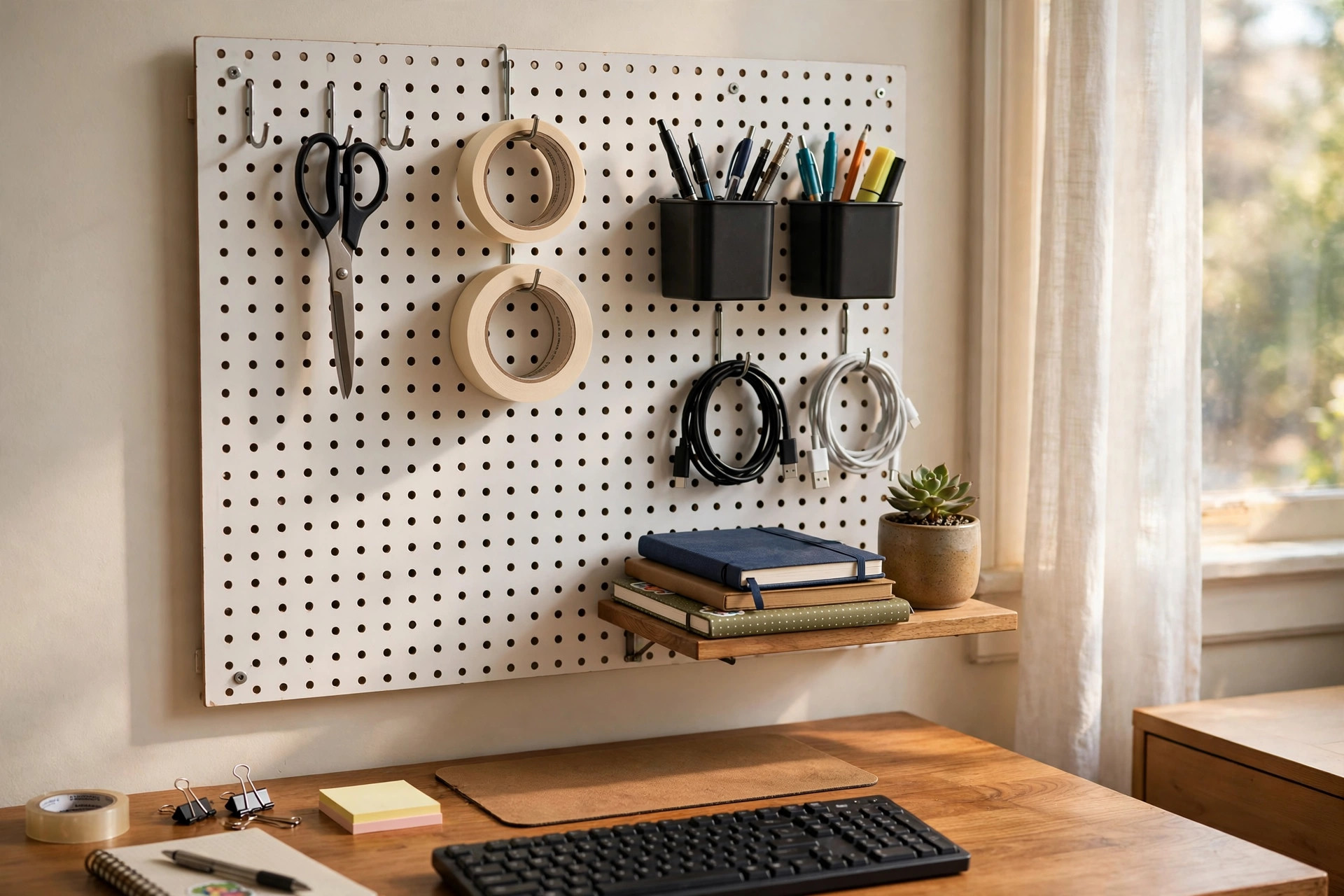

A home office pegboard wall organizer for supplies is a simple board with a grid of holes. Hooks, bins, and small shelves fit into the holes. It hangs on the wall above or beside a desk. It keeps pens, scissors, cables, and small tools in plain sight and easy reach.
Many home workers fight the same problem. The desk is full. Drawers are deep and dark. Things get lost. A pegboard turns wall space into storage space. It costs little. It takes an afternoon to hang. It changes the way a workday feels.
This guide explains why a pegboard helps, what types exist, how to choose one, what it costs, how to care for it, and how to mount it safely. It also answers common questions at the end.
Why a Pegboard Matters in the Home Office
Desk space is precious. A home office is often a corner of a bedroom or a nook under the stairs. Every inch of the desk top counts. When supplies sit on the desk, there is less room to work. Papers pile up. The screen feels crowded.
A pegboard lifts the clutter off the desk and puts it on the wall. The wall above the desk is often empty. It is wasted space. A pegboard uses it well. Each hook holds one tool. Each bin holds one kind of supply. You can see everything at a glance. You grab what you need and put it back in its place.
Order has a real effect on work. A clear desk helps a clear mind. Studies of work habits have long shown that people work faster when their tools are close and visible. A pegboard gives every item a fixed home. You stop hunting for scissors or a charger cable. Small minutes saved each day add up to real hours over a year.
A pegboard also grows with you. A drawer is fixed. A pegboard is not. You can move hooks in seconds. You can add a shelf when you buy a printer. You can take hooks off when you no longer need them. The board adapts to new jobs, new tools, and new habits.
It is cheap compared to most office storage. A bookcase takes floor space and costs much more. A filing cabinet is heavy and dull. A pegboard costs the price of a dinner out. It weighs little and ships flat. For a worker on a budget, it is one of the best buys in home office storage.
What to Look For When You Choose: Home Office Pegboard Wall Organizer for Supplies
Size and Fit
Measure the wall space above your desk first. A pegboard that is too wide looks bad and may hit a light switch or a window. A pegboard that is too small holds little. A common size is about two feet wide and three feet tall. That is enough for most desk supplies. If you have a long desk, two boards side by side look neat and hold more.
Leave a few inches between the top of the desk and the bottom of the board. You need room to lift tall items on and off the hooks. Four to six inches is a good gap. If you work standing, set the board’s middle at eye level and pair it with an ergonomic balance board for standing desk use.
Material
Most pegboards are made of hardboard, metal, wood, or plastic.
Hardboard is the classic choice. It is brown, light, and cheap. It has been sold in hardware stores for decades. It holds light supplies well. It can sag if it gets damp or if you hang heavy things on it.
Metal pegboards are steel with a powder coat finish. They are strong. They hold heavier items such as tools and small machines. They look modern. Some work with magnets as well as hooks. They cost more than hardboard.
Wooden pegboards are often made of pine, birch, or bamboo. They look warm and fine in a living room or bedroom office. They are strong enough for most supplies. They cost more than hardboard but less than metal in many cases.
Plastic boards are light and do not rust. They work well in damp rooms. They can feel less solid than the other kinds. For light office supplies they are fine.
Hole Size and Spacing
Most boards use the standard pattern: holes about one inch apart. Hooks made for this pattern are easy to find in any store. Some boards use wider spacing. That is fine, but check that hooks are sold for that spacing before you buy. Standard spacing gives you the most choice of hooks and bins.
Frame and Mounting
Some boards come with a frame. The frame looks neat and hides the edge. Some boards are bare. You can paint a bare board any color you like. White or light wood tones suit most rooms.
Look for a board with a mounting kit. A good kit has screws, wall plugs, and spacers. Spacers hold the board off the wall. The gap lets hooks pass through the holes. Without spacers, the hooks will not fit.
Types and Options
The Classic Hook Board
This is the simplest type. The board comes with a set of wire hooks. You hang scissors, tape, headphones, and cable coils on them. It suits a worker with a few tools and a love of simple order. It is the cheapest option.
The Bin and Shelf Set
Many boards come with small bins and shelves. Bins hold pens, clips, and sticky notes. Shelves hold a phone, a small plant, or a stack of envelopes. This type suits a worker with many small supplies. It turns the board into a full storage wall.
The Desk-Sized Wall Panel
Some panels are made to fit exactly above a standard desk. They are wider than they are tall. They may include a cork strip for notes and a small whiteboard for lists. They suit a worker who wants one panel to do many jobs.
The Freestanding or Clamp-On Board
Not every worker can drill holes in the wall. Renters often cannot. Some boards stand on the desk with feet, like a picture frame. Others clamp to the edge of the desk. These types cost more and hold less, but they need no screws.
The Decorative Panel
Some pegboards are made to look like furniture. They use wood slats, round pegs, or a brass frame. They cost more. They suit a worker whose office is in a shared living space and must look pleasant to guests.
Cost and Price
A basic hardboard pegboard with hooks often costs between fifteen and thirty dollars. That is enough for most needs. A set with bins and shelves may cost between thirty and sixty dollars. Metal and wood boards run from forty to well over one hundred dollars, based on size and finish.
Hooks and bins sold alone are cheap. A pack of hooks may cost five to ten dollars. Small bins may cost a few dollars each. You can start with a bare board and add parts over time.
Think about total cost before you buy. A cheap board with weak hooks may bend and drop your supplies. It is better to buy a mid-priced board with solid parts than to buy twice. Compare prices at big home stores and office shops. Online lists such as Wayfair and IKEA show many options with prices side by side.
If you pair the board with other storage, the bill grows. A small corner standing desk for apartment living or the best small desk for chromebook and homework may cost more than the pegboard itself. Plan the whole wall and desk together so nothing clashes.
How to Mount It Safely
Step One: Pick the Spot
Choose a wall that can hold the weight. Drywall holds a loaded pegboard only if you use the right anchors. A stud is better. Use a stud finder to find the wood beams behind the drywall. Mark them with a pencil.
Step Two: Mark and Level
Hold the board against the wall. Use a level to make it straight. Mark the screw holes with a pencil. A crooked board looks bad and drops things.
Step Three: Drill and Fix
Drill small pilot holes at your marks. Push in wall plugs if you are not drilling into a stud. Set the spacers on the screws. Fix the board to the wall. Tighten each screw until the board is firm but not bent.
Step Four: Load It Light First
Put light items on first. Test each hook. Then add heavier items. Check after a week that the screws are still tight. A board that sags or pulls away from the wall was fixed badly. Take it down and remount it before it falls.
Care and Upkeep
A pegboard needs little care. Dust it once a month with a dry cloth. A vacuum brush works well for the holes. If the board is wood, you can wipe it with a damp cloth. Dry it right away. Keep it away from steam and leaks. Dampness warps hardboard and swells wood.
Check hooks twice a year. Wire hooks can bend under heavy loads. Bend them back or replace them. Plastic bins crack with age. Replace a cracked bin before it breaks and drops its contents.
Repaint a bare board when it looks tired. Light sanding and a coat of paint make an old board look new. Use paint that suits the material. Latex paint works for hardboard and wood. Spray paint works for metal.
Review the layout once a year. Your work changes. Your tools change. Move hooks to match the new pattern of your day. A pegboard that no longer matches your work becomes wall art. A pegboard that matches your work saves you time every day.
Safety
A loaded pegboard can be heavy. A board full of tools may weigh twenty pounds or more. Mount it with screws that fit the wall type. In drywall, use toggle bolts or anchors rated for the weight. Do not trust tape or picture hooks for a loaded board.
Keep sharp tools on high hooks, out of the reach of small children. Scissors, craft knives, and pins should not hang at a child’s eye level. If children use the room, choose rounded hooks and keep sharp items in a closed bin with a lid.
Check the weight limit of each hook. A hook rated for two pounds should not hold a five-pound tool bag. Spread heavy items across many hooks. Put the heaviest items low and near the mounting screws.
Watch the cord load. Many workers hang power strips and chargers on a pegboard. Keep cords neat with clips. Do not overload one outlet. A neat cord keeps the board safe and makes it look clean.
For advice on safe mounting in homes with children, the U.S. Consumer Product Safety Commission publishes guides on wall anchoring and tip-over prevention that are worth reading.
Where to Buy and What to Read
Many kinds of home office storage are sold at large retailers. Wayfair lists hundreds of pegboard sets with buyer reviews. IKEA sells wall organization systems that fit small rooms. For honest test results, Wirecutter and PCMag review home office gear and rank the best picks.
For design ideas, The Spruce shows pegboard layouts in real rooms. Office furniture makers such as Herman Miller, Steelcase, and UPLIFT Desk sell higher-end panels and write guides on setting up a healthy workspace.
Before you buy, read a few reviews. Look for notes about hook quality and mounting hardware. A board with good reviews on both counts is a safe choice.
FAQ
How much weight can a pegboard hold?
It depends on the board and the wall. A hardboard panel fixed to studs can hold twenty to thirty pounds of supplies. A metal panel fixed well can hold more. Check the maker’s rating. Spread the load across many hooks. When in doubt, fix into studs, not bare drywall.
Can I use a pegboard in a rented home?
Yes. Many renters use freestanding boards that sit on the desk. Some use boards that clamp to the desk edge. If your lease allows small holes, you can mount a light board with anchors and fill the holes when you leave. Ask your landlord first. A small tube of filler and a dab of paint hide the marks.
What is the standard hole spacing?
Most boards use holes one inch apart, center to center. This is the standard pattern. Hooks made for this pattern fit. Some boards use wider spacing. Always check before you buy extra hooks.
How do I keep hooks from falling out?
Standard wire hooks can lift out when you take an item off. Small hook locks or peg locks solve this. They are cheap plastic clips that hold the hook in the hole. Many hook packs include them. You can also bend the top of the wire hook slightly for a tighter fit.
Is a metal or wood board better?
It depends on your taste and your tools. Metal holds more weight and looks modern. Wood looks warm and suits a living room. For light office supplies, both work well. Choose the one that matches your room and your budget.
Can a pegboard hold a monitor or a laptop?
No. A pegboard is for small supplies, not for heavy machines. A monitor or laptop is far too heavy. It needs a proper mount or stand. Do not hang electronics on pegboard hooks. Use the board for tools, cables, and small items only.
A Short Final Word
A home office pegboard wall organizer for supplies is a small buy with a big effect. It clears the desk. It puts tools in sight. It bends to fit your work. Choose a board that fits your wall and your budget. Mount it well. Keep it tidy. In a week you will wonder how you worked without it.
References
Herman Miller. (n.d.). Office furniture and ergonomic seating. https://www.hermanmiller.com IKEA. (n.d.). Home furnishings. https://www.ikea.com PCMag. (n.d.). Technology product reviews. https://www.pcmag.com Steelcase. (n.d.). Office furniture and workplace research. https://www.steelcase.com The Spruce. (n.d.). Home and garden advice. https://www.thespruce.com U.S. Consumer Product Safety Commission. (n.d.). Product safety information. https://www.cpsc.gov UPLIFT Desk. (n.d.). Standing desks and ergonomic office furniture. https://www.uplift-desk.com Wayfair. (n.d.). Furniture and home goods. https://www.wayfair.com Wirecutter. (n.d.). Product reviews from The New York Times. https://www.nytimes.com/wirecutter
Was this guide helpful?

About Michael Thompson
The My Garden US editorial team writes practical, in-depth home and garden guides for American homeowners — tested advice, no fluff.
You May Also Like

Ergonomic Laptop Riser for Standing Desk Height: What to Know Before You Buy
July 23, 2026 0 views
The Best Small Desk for Chromebook and Homework
June 2, 2026 0 views
A Portable Standing Desk for Working from Anywhere: What to Know Before You Buy
March 25, 2026 0 views