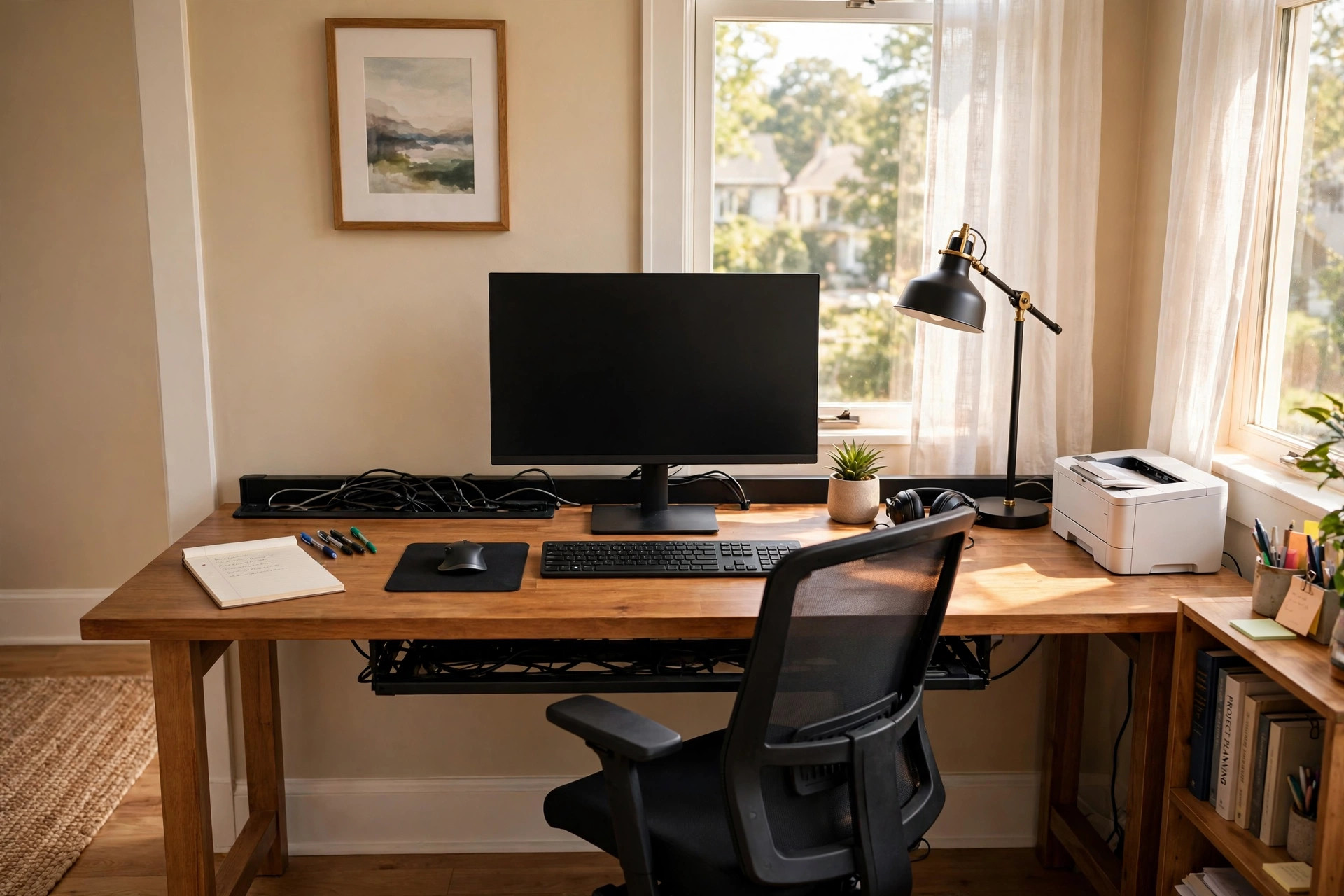

Most desks are built with right handed people in mind. Drawers sit on the right. The long wing of an L shaped desk extends to the right. Cable holes and modesty panels assume the worker sits one way. A left handed person uses the same desk every day, but the design fights them. This guide to the best home office desk for left handed users explains what to look for, which types suit left handed work, what they cost, and how to set one up the right way.
Why the Right Desk Matters for Left Handed Users
About one person in ten writes with the left hand. That minority deserves a desk that works the way they work. A left handed user who sits at a right handed desk must twist, reach across the body, and crowd the mouse or writing pad into a corner. Over a long workday, those small motions add up. The shoulder aches. The neck stiffens. The wrist bends at a bad angle. Studies of office ergonomics published over the past decades show that repeated awkward reaching raises the risk of strain in the shoulder and forearm.
A proper left handed desk layout fixes this. The writing pad sits on the left. The mouse or trackball sits on the left, where the dominant hand rests naturally. The phone, lamp, and reference books move to the right. The chair stays centered on the monitor. Nothing crosses the body line.
What to Look for When Choosing a Left Handed Desk: Best Home Office Desk for Left Handed Users
The first rule is simple. Look for symmetry, or look for a left handed return. A fully symmetrical desk, such as a straight rectangular top, lets the user arrange everything for the left hand without fighting built in features. An L shaped desk can work well too, as long as the return wing extends to the left side. Some makers sell corner desks in both right and left versions. Always check which version you are buying before you order.
The second point is the work surface. It should be wide enough for a keyboard, a mouse pad on the left, and room for papers. A depth of at least 28 to 30 inches gives room to place the monitor at a healthy viewing distance while keeping the keyboard and writing tools close. Shallow desks force the worker to push everything to the edges.
Drawers and storage matter more than most buyers think. On a left handed desk, the pencil drawer and the shallow supply drawers belong on the left, or the desk should be drawerless so the user can add a small rolling cabinet where they like. Many fine desks now come with no drawers at all, which is good news for left handed buyers. A drawerless top is neutral. It belongs to no hand.
Cable management is another quiet helper. A desk with a rear cable tray or grommet holes along the back lets the user route cords away from the left working zone. Look for a tray wide enough to hold a power strip, a monitor cable, a lamp cord, and a charger cable. Clean cords mean a clean work surface, and that matters on the side where the hand moves most.
Height adjustment is worth the money for many people. A sit stand desk lets the user raise the top for standing work and lower it for sitting. The best models keep the whole surface steady at every height, so the left handed layout never shifts. Check that the control panel can be mounted on either side of the desk.
Finally, think about the finish. A smooth matte top lets a mouse track well and lets paper slide without catching. Light colors brighten a small room. Dark wood tones suit a formal office. Edge banding should be smooth so the forearms rest without irritation.
Types of Desks That Suit Left Handed Users
Straight rectangular desks. This is the simplest and safest choice. A plain rectangle has no handedness. The user places the mouse on the left, the keyboard in the center, and the lamp and phone on the right. It suits small rooms, rented apartments, and anyone who wants a low fuss setup.
L shaped desks with a left return. An L shaped desk gives two work zones. For a left handed user, the main writing zone should be the long left wing, with the short wing on the right holding the printer, phone, or reference books. Many retailers sell L shaped desks in mirrored pairs, so look for the listing that names the left handed version. Product pages from makers such as IKEA and Wayfair often show the layout in a diagram, which makes the choice clear.
Standing desks. A height adjustable desk works the same for both hands, which is why left handed buyers love them. The frame has no drawers, no fixed return, and no side bias. The user arranges the top freely. Brands such as UPLIFT Desk offer frames in many sizes, and the broad top gives plenty of room for a left handed mouse zone. An ergonomic standing desk for small home office is a good pairing search if space is tight.
Corner desks. A corner desk uses the corner of the room and wraps the work surface around the user. For a left handed worker, the trick is to sit slightly left of center so the deep left wing becomes the main zone. Drawers, if any, should sit under the right wing or in a separate cabinet. Corner designs suit rooms where a long straight desk will not fit. In a tight bedroom, a small corner desk with drawers for apartment office keeps supplies close without crowding the left working zone.
Writing desks. A simple writing desk with four legs and a slim top is a fine pick for laptop work and light paperwork. It has no handed features at all. It costs less than a full office desk. Its limits show up with heavy gear, such as dual monitors and a printer, which need a deeper and stronger top.
Executive desks. A large executive desk offers deep drawers and a broad top, but many models fix the drawer pedestal on the right. Left handed buyers should look for models with a reversible pedestal or no pedestal at all. High end makers such as Herman Miller and Steelcase publish detailed layout drawings, which help a buyer confirm the handed layout before purchase.
Cost and Price Guide
Prices for the best home office desk for left handed users run in clear bands. A plain rectangular writing desk costs between 80 and 250 dollars. It is the cheapest path to a neutral, hand free layout. A mid range straight desk with cable management and a sturdier frame runs 200 to 450 dollars.
L shaped desks cost more because they use more material. Expect 250 to 700 dollars for a good model, with solid wood and reversible returns at the top of the range. Corner desks sit in the same band.
Standing desks start around 300 dollars for a basic two leg frame and run to 800 dollars or more for a wide top, a strong motor, and memory presets. A left handed buyer often finds the extra cost worth it, because a standing desk is truly neutral and lasts through many office changes.
Executive desks run 600 to 2,000 dollars. At that price, always confirm that the drawer pedestal can move to the left side or be removed. Retailers such as Office Depot and Staples list many models with clear price bands and customer photos that show the real layout.
A small rolling file cabinet, which many left handed users add to a drawerless desk, costs 60 to 150 dollars. It goes where the user wants it, which is the whole point.
Setting Up a Left Handed Desk Layout
Buying the desk is only half the job. The layout decides whether the desk truly serves a left handed worker. Follow these steps.
Place the monitor directly in front of the chair, at arm’s length. The top of the screen should sit at or just below eye level. Put the keyboard centered on the monitor. This part of the setup is the same for everyone.
Move the mouse or trackball to the left of the keyboard. Give it a full size pad with room to move. Left handed mouse users should also switch the primary button in the computer settings, so the index finger clicks as expected.
Keep the writing zone on the left. Pens, a notepad, and the phone sit within easy reach of the left hand. A best desk organizer set for small office desk keeps these tools tidy and stops them from sliding into the mouse zone.
Put reference books, the printer, and rarely used items on the right wing or on a shelf to the right.
Buyers who want tested product picks can check independent review sites such as Wirecutter and PCMag, which test desks for stability, build quality, and ease of assembly. Design and styling ideas appear at The Spruce, which covers home office layouts for all hand types.
Care and Upkeep
A desk lasts longer with small, regular care. Dust the top once a week with a soft cloth. Wipe spills at once, since standing liquid harms wood finishes and laminate edges. Use a coaster under hot drinks and a desk pad under heavy writing to protect the finish.
Check the screws and bolts twice a year. Desks loosen with daily use, and a wobbly desk strains the wrists. Tighten the frame, the legs, and any drawer slides. On a standing desk, check that the motor lifts smoothly and that the anti collision sensor still works.
Keep the weight within the maker’s limit. A standing desk that carries too much will lift slowly and wear out early. Spread heavy gear, such as printers and books, across the frame rather than piling them on one end.
For wood tops, apply a light furniture polish a few times a year. For laminate tops, warm water and mild soap are enough. Avoid harsh cleaners, which dull the finish and can harm the edge banding.
Safety
Desks seem harmless, but a few safety points deserve care. Anchor a tall hutch or bookshelf to the wall with the straps the maker provides. A tipping shelf can injure anyone who reaches for it.
Keep cables off the floor. A cord across the walkway is a trip hazard. Use the cable tray, and clip loose cords to the desk legs.
On a standing desk, keep fingers clear of the lifting columns when the desk moves. Teach children not to play with the height controls. Unplug the desk before moving it across the room.
Place the desk so the chair has room to roll back without hitting a wall or a door. A cramped exit is a hazard in an emergency. Leave at least 30 inches behind the chair.
Finally, mind posture. Even the best home office desk for left handed users cannot fix bad posture on its own. Keep both feet flat on the floor, the back against the chair, and the shoulders relaxed. Take a short break every hour to stand, stretch, and rest the eyes.
Frequently Asked Questions
Do left handed people need a special desk? No. They need a neutral or left arranged desk. A symmetrical rectangular desk works for anyone. An L shaped desk should have its return on the left side for a left handed user. The key is the layout, not a label that says left handed.
Can a right handed desk be used by a left handed person? Yes, with changes. Move the mouse to the left, shift the writing tools to the left, and move the lamp to the right. If the desk has a fixed right side drawer pedestal, place a small rolling cabinet on the left for daily supplies instead.
What is the best desk shape for left handed users? A straight rectangle is the safest choice because it has no hand bias. An L shaped desk with a left return is the next best, since it adds work space. A standing desk also suits left handed users well because the top is fully free to arrange.
Where should the mouse go on a left handed desk? The mouse goes on the left side of the keyboard, on a pad large enough for full arm movement. Switch the primary click button in the computer settings so the left index finger handles the main click.
How deep should a left handed office desk be? A depth of 28 to 30 inches suits most users. It holds the monitor at a healthy distance while leaving room for the keyboard, a left side mouse pad, and a writing area. Shallow desks under 24 inches feel cramped for a full left handed layout.
Is a standing desk good for left handed users? Yes. A standing desk has no fixed drawers or return wing, so the whole top can be arranged for the left hand. The control panel should mount on either side. Many left handed buyers rate this freedom as the best feature of the desk.
Final Word
The best home office desk for left handed users is not a rare specialty item. It is any well made desk that lets the left hand lead. Choose a neutral top or a left return, keep the mouse and writing tools on the left, move the lamp to the right, and give the whole layout room to breathe. A little thought at the start saves years of small daily strain. Buy the desk once, set it up with care, and let it serve the way you work.
References
Herman Miller. (n.d.). Office furniture and ergonomic seating. https://www.hermanmiller.com IKEA. (n.d.). Home furnishings. https://www.ikea.com Office Depot. (n.d.). Office supplies and furniture. https://www.officedepot.com PCMag. (n.d.). Technology product reviews. https://www.pcmag.com Staples. (n.d.). Office supplies and furniture. https://www.staples.com Steelcase. (n.d.). Office furniture and workplace research. https://www.steelcase.com The Spruce. (n.d.). Home and garden advice. https://www.thespruce.com UPLIFT Desk. (n.d.). Standing desks and ergonomic office furniture. https://www.uplift-desk.com Wayfair. (n.d.). Furniture and home goods. https://www.wayfair.com Wirecutter. (n.d.). Product reviews from The New York Times. https://www.nytimes.com/wirecutter
Was this guide helpful?

About Robert Taylor
The My Garden US editorial team writes practical, in-depth home and garden guides for American homeowners — tested advice, no fluff.
You May Also Like

The Best Home Office Setup for Software Developers
March 28, 2026 0 views
Adjustable Monitor Arm for Heavy 34 Inch Monitor: A Buyer’s Guide
February 2, 2026 0 views
Home Office Desk Grommet for Cable Pass Through: A Simple Guide
January 25, 2026 0 views