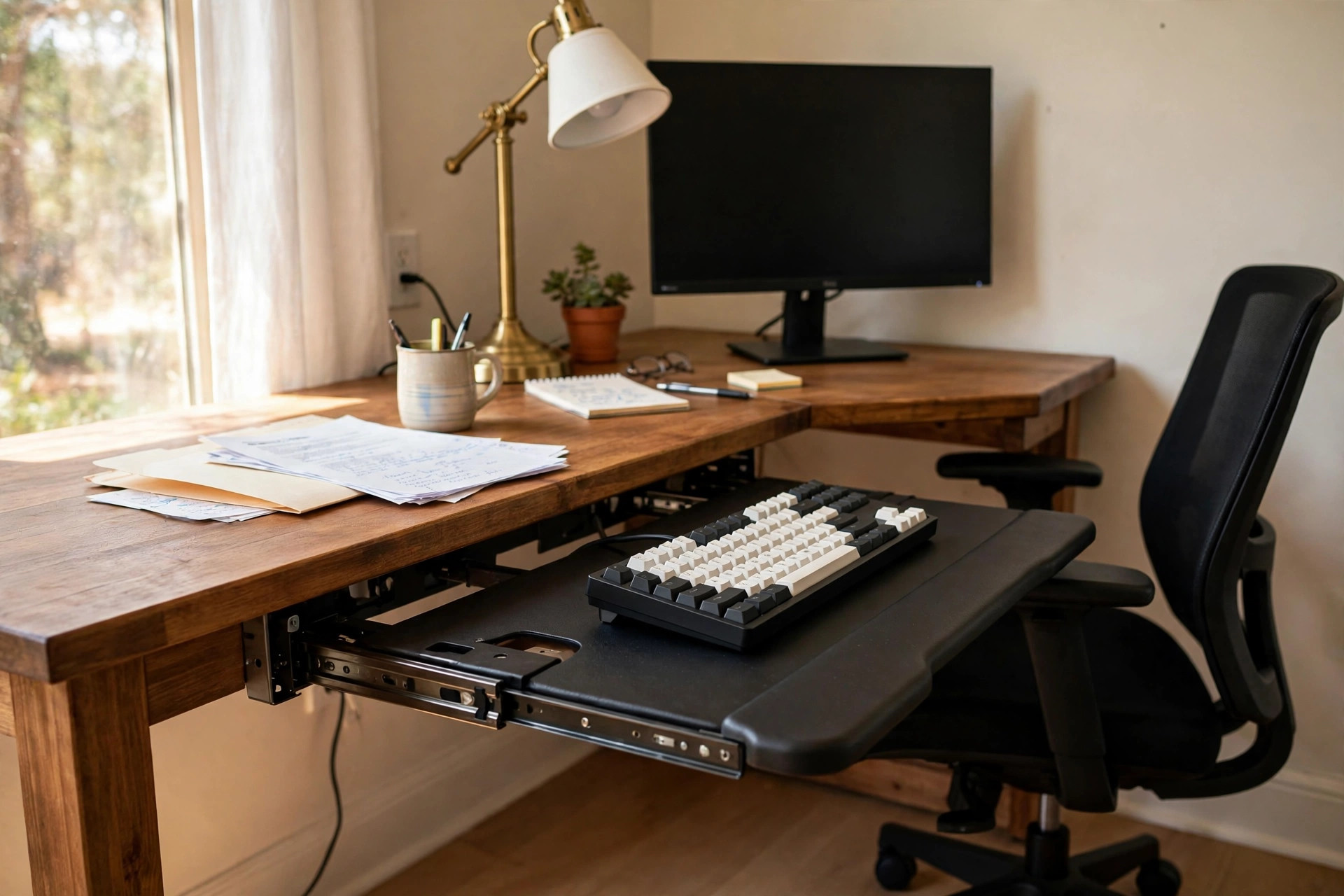

An ergonomic keyboard tray for corner desk setup is one of the simplest upgrades a home worker can make. The keyboard leaves the desk surface. The wrists rest in a level line. The arms fall at a natural angle. Over months of daily work, small changes like this decide whether typing feels easy or ends in pain. Corner desks are common in home offices. They fit into dead space and give plenty of surface area. Yet their shape creates a problem. The corner pushes the worker away from the desk edge. The keyboard ends up too far forward or too high. A keyboard tray solves this. It mounts under the desk and brings the keyboard back to the body, where it belongs.
This guide explains what an ergonomic keyboard tray is, why it matters for corner desks, how to choose one, what the types cost, how to keep it in good order, and what safety points to watch. It also answers common questions from people setting up a corner desk at home.
Why It Matters
Long hours at a keyboard place strain on the hands, wrists, shoulders, and neck. When the keyboard sits on the desk top, the desk is usually too high for typing. The desk must serve many tasks at once: writing, holding a monitor, leaving room for papers. Its height suits the eyes and the arms, not the hands. The worker lifts the shoulders slightly and bends the wrists back to reach the keys. This posture, held for hours, can lead to aches, numb fingers, and tired shoulders. Medical research and workplace health groups have long held that a neutral wrist posture lowers the risk of strain injuries. Decades of ergonomic study from Herman Miller support keeping the elbows near the body at roughly a right angle.
A keyboard tray lets the typing surface sit a few inches below the desk top. The elbows bend at about ninety degrees. The wrists stay straight. The shoulders drop. Steelcase, a long-time maker of office furniture, has also shown in its ergonomic research that small changes in work height have a large effect on comfort through the day.
The corner desk adds its own twist. The worker sits at the angle where two desk wings meet. The straight front edge that a normal tray expects is absent. A quiet keyboard helps in a shared room, but it does not fix posture. Only a tray made or adjusted for a corner can bring the keyboard close enough. Without it, the worker reaches forward, the arms extend, and the shoulders round. Over a full work year, that reach adds thousands of hours of strain. A proper tray for a corner setup returns the keyboard to the body and puts typing back on an even keel.
What to Look for When You Choose: Ergonomic Keyboard Tray for Corner Desk Setup
Size of the Tray Surface
The tray must hold the keyboard with room to spare. Measure the keyboard first, then add two to three inches on each side. A full-size keyboard needs a tray at least twenty-seven inches wide. A compact keyboard needs less. Many trays also include a mouse platform. For a corner desk, a wide mouse platform can hit the desk legs when the tray swings. Check the clearance under the desk before buying.
Height Adjustment
A good tray moves up and down. The range should cover at least five inches. This lets each worker set the keyboard at elbow height, whether seated or in a chair of any height. The adjustment should lock firmly. A tray that drifts down under the weight of the hands is worse than no tray at all.
Tilt Adjustment
The tray should tilt up and down a few degrees. A slight negative tilt, with the far edge lower than the near edge, keeps the wrists straight while the hands float over the keys. Some trays offer only flat mounting. Flat is acceptable. Tilt is better.
Mounting Type for a Corner Desk
This is the key point for a corner setup. Most trays mount on a track screwed under the desk. On a corner desk, the track must sit under the corner zone where the worker sits. Some desks have a center support beam or legs exactly where the track should go. Measure first. Corner-specific mounting kits place the track at an angle or use a swivel arm. A swivel arm tray can swing left and right. This suits the corner shape because the worker can pull the tray toward the chair and push it away to stand up.
Keyboard Tray for Corner Desk Setup and Mouse Space
Decide whether the mouse goes on the same tray or on the desk. A one-piece tray with a fixed mouse deck keeps everything aligned but is wide. A separate, adjustable mouse platform can swing independently. For corner desks with tight leg space, the separate platform often works better. Make sure the mouse surface is large enough for full arm movement.
Build Quality and Weight Capacity
The tray should hold the keyboard, the mouse, and the resting weight of the hands without flexing. Cheap trays wobble when the worker types hard. A wobble breaks focus and, over time, loosens the mount. Steel and heavy plastic trays last longer than thin ones. Read the weight rating. Fifteen pounds is a common minimum. Heavier is better for daily use.
How Corner Desks Shape the Choice
A corner desk is not one desk but two wings joined at an angle. The worker sits at the joint. The most common corner desk types are the L shape and the triangular corner unit. On an L-shaped desk, the tray mounts under the corner where the two wings meet, and it can swing toward either wing. On a triangular unit, the front edge is short, so a narrow tray or a center-mount arm fits best. If you are shopping for furniture as well, a small corner desk with drawers pairs well with an under-desk tray because the drawers sit clear of the tray’s swing path. Also note the desk’s edge thickness. Thick solid wood edges need longer screws or clamp mounts.
Types of Keyboard Trays
Standard under-desk tray. A flat or shaped platform on a sliding track. It pulls out to use and pushes back under the desk to clear the space. This is the most common type. It fits most corner desks with open knee space.
Swivel-arm tray. The platform hangs from an arm that swings left and right as well as forward and back. This type suits corner desks best because the worker can angle the keyboard exactly toward the chair. The arm adds height range too. It costs more and needs solid mounting. Independent product tests on Wirecutter give a clear sense of which swivel-arm models hold up under real typing.
Clamp-mount tray. No screws needed. A clamp grips the desk edge. This suits renters and people who do not wish to drill into the desk. The clamp must grip firmly; on thick or rounded desk edges it may not hold. For corner desks with a wide front edge, a clamp can sit off center and still work.
Sit-stand converter tray. Some trays attach to height-adjustable desks and move with the desk. These are less common but useful when the whole corner desk rises and falls through the day.
Drawer-style tray. Built into some desks as a pull-out drawer. It is simple and cheap but rarely adjusts in height or tilt. For light use it is fine. For full-time work, an adjustable tray is the better choice.
Cost and Price
Prices for an ergonomic keyboard tray for corner desk setup run from about twenty dollars to well over two hundred. A basic fixed tray with a simple slide track costs twenty to fifty dollars. It pulls out and pushes back but does not adjust in height or tilt. A mid-range tray with height and tilt adjustment costs fifty to one hundred twenty dollars. This is the sweet spot for most home offices. A premium swivel-arm tray with full motion and a separate mouse platform costs one hundred twenty to two hundred fifty dollars. Corner-specific kits with angled tracks sit in this range.
What the price buys is adjustment and stability. A fifty-dollar tray that holds firm beats a two-hundred-dollar tray with a loose arm. Before buying, check what is included: the track, the mounting screws, the wrist rest, and the mouse platform may be sold separately on some models. Retailers such as Wayfair and IKEA list trays across these price bands, which makes comparison shopping straightforward. Buying guides on The Spruce also break down what each price tier includes. For hands-on detail on mounting styles, product pages on UPLIFT Desk show how different track widths fit real desks, and PCMag reviews often compare mounting types side by side, which helps first-time buyers avoid paying for features they will not use.
For a home office that will see forty hours of typing a week, a mid-range adjustable tray is money well spent.
Installation and Care
Most trays install with a screwdriver and a drill in under an hour. Mark the track position under the desk while seated in the chair. The track should center on the body. Drill pilot holes to stop the wood from splitting. Drive the screws snug but not so tight that the board cracks.
For a corner desk, seat the chair at the corner and mark where the knees fall. The track must sit between the legs or supports, not over them. If a support beam blocks the spot, shift the track to one side and use a swivel arm to bring the tray back to center. Test the swing path. The tray should pull out and push back without striking the legs.
Care is simple. Wipe the tray surface with a damp cloth once a month. Check the mounting screws twice a year and tighten any that have worked loose. Oil the slide track lightly if it starts to drag.
Good task lighting pairs with the tray to complete the corner setup. With the keyboard lower and the light aimed at the work, eye strain and wrist strain fall together.
Safety
A keyboard tray is safe when it is mounted well and used with sense. Watch these points.
First, mounting strength. The track must grip solid wood or the desk’s structural rail, not thin veneer. A tray that pulls free can drop the keyboard onto the knees. Test the mount by pressing down firmly on the tray before regular use.
Second, pinch points. Sliding trays and swivel arms have joints that can pinch fingers. Keep fingers clear when pushing the tray back. Teach children in the home not to play with the moving parts.
Third, knee clearance. The tray hangs below the desk. Sit in the chair and check that the knees clear the tray and its track. If the knees strike the track, raise the chair or lower the track. Bruised knees are a common complaint with badly placed trays.
Fourth, cable strain. The keyboard cable or wireless receiver wire must have slack through the full motion of the tray. A tight cable tugs the keyboard and can yank the tray. Route cables loosely and check them after installation.
Fifth, posture habits. The tray sets the stage, but the worker must still sit back in the chair, keep the feet flat, and take short breaks. No tray replaces movement.
FAQ
Will a keyboard tray fit any corner desk? Most will, but not all. The desk needs open knee space under the corner and a solid surface for mounting. Desks with a thick center pedestal or a modesty panel may block the track. Measure before buying.
Is a keyboard tray better than a desk at the right height? A desk at exact typing height is ideal but rare. Most desks serve the monitor and the arms, so they stand too high for typing. A tray adds the missing lower surface without forcing the whole desk down. For corner desks, where the worker sits far from the edge, the tray’s reach matters even more.
Can I use a keyboard tray with a standing desk? Yes. Many trays mount to the moving desk top and rise with it. Choose a tray with enough height adjustment to suit both sitting and standing. Some workers pair a tray with a desk converter, but a full height-adjustable desk gives the smoothest result.
Do I need a wrist rest with the tray? A wrist rest helps during pauses but should not carry the wrists while typing. Resting the wrists on a pad while typing bends them back, which the tray is meant to prevent. Use the pad between bursts of typing.
How do I stop the tray from wobbling? Tighten all mounting screws and check that the track is level. Wobble often comes from a track that is not square to the desk edge. If the tray still shakes, the mount may be gripping weak board. Move the track to a sturdier spot or add a backing plate under the desk.
What is the best tilt setting? Start flat, then tilt the far edge down a few degrees until the wrists feel straight and the fingers fall naturally on the keys. Negative tilt of five to fifteen degrees suits most people.
A Short Final Word
An ergonomic keyboard tray for corner desk setup is a small purchase with a long payoff. It corrects the one flaw that corner desks share: the keyboard sits too high and too far away. With the tray mounted, adjusted, and kept in good order, typing becomes easier on the hands and the whole workday feels lighter. Choose a tray that fits the corner, mounts firmly, and adjusts in height and tilt. Set it once, check it twice a year, and let good posture do the rest.
References
Herman Miller. (n.d.). Office furniture and ergonomic seating. https://www.hermanmiller.com IKEA. (n.d.). Home furnishings. https://www.ikea.com PCMag. (n.d.). Technology product reviews. https://www.pcmag.com Steelcase. (n.d.). Office furniture and workplace research. https://www.steelcase.com The Spruce. (n.d.). Home and garden advice. https://www.thespruce.com UPLIFT Desk. (n.d.). Standing desks and ergonomic office furniture. https://www.uplift-desk.com Wayfair. (n.d.). Furniture and home goods. https://www.wayfair.com Wirecutter. (n.d.). Product reviews from The New York Times. https://www.nytimes.com/wirecutter
Was this guide helpful?

About Emily Rodriguez
The My Garden US editorial team writes practical, in-depth home and garden guides for American homeowners — tested advice, no fluff.
You May Also Like
Adjustable Height Stool for Standing Desk Break: A Practical Guide
September 29, 2026 0 views
Best Home Office Chair for Bad Posture Correction
August 1, 2026 0 views
Adjustable Standing Desk with USB Charging Ports: A Practical Buyer Guide
March 22, 2026 0 views