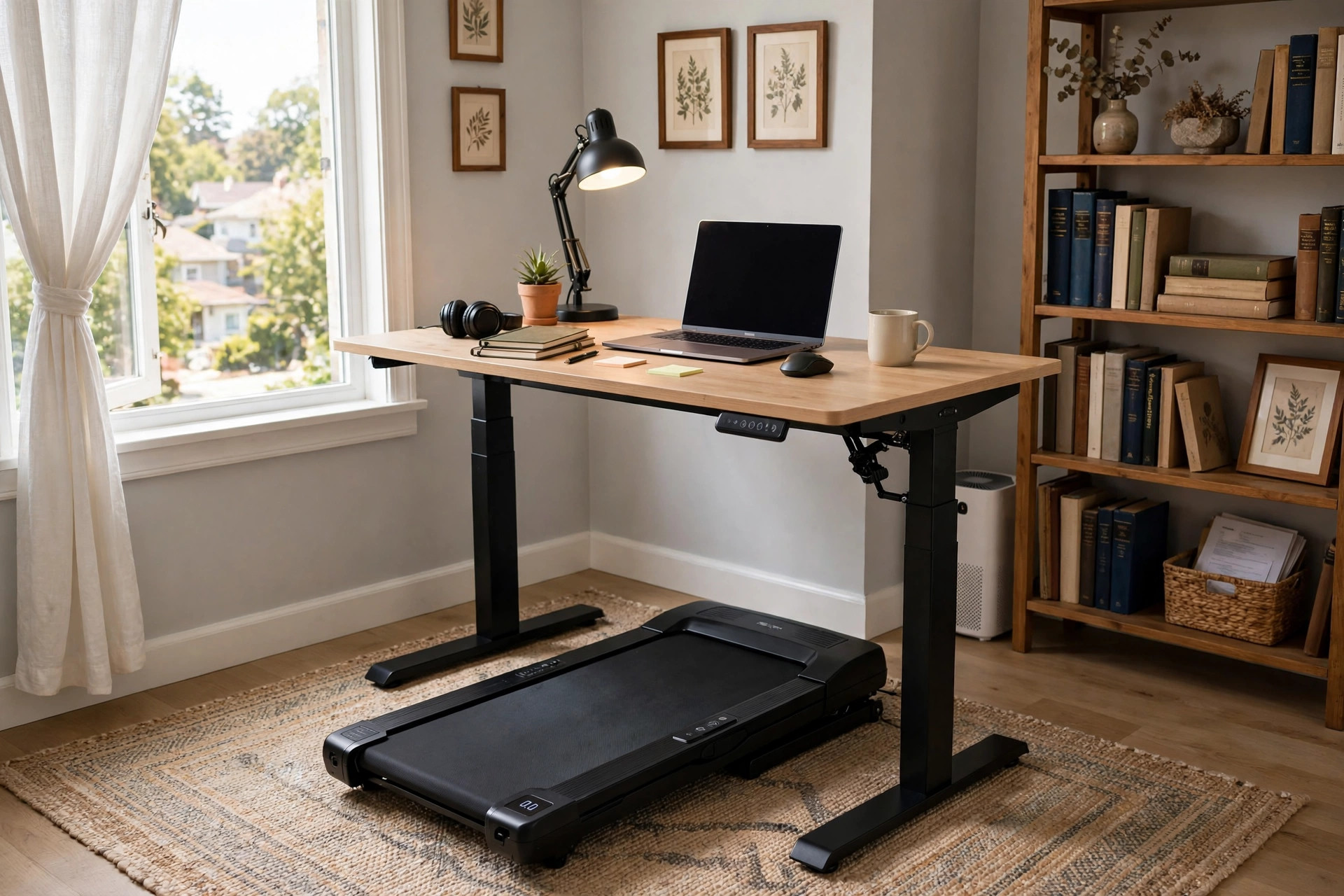

A compact treadmill desk for walking while working is a small walking treadmill that slides under a standing desk. It lets you walk at a slow pace while you type, read, or join calls. The walking belt is narrow and short. The motor is quiet. The whole unit often fits under a couch or bed when the workday ends. Many home workers now use one to break up long hours of sitting, and home office setup guides often list a walking treadmill among the best upgrades for a small workspace.
Why a Compact Treadmill Desk Matters
Most desk jobs keep a person seated for eight or more hours a day. Long sitting is linked to stiff backs, low energy, and slow blood flow in the legs. Short breaks help, but many people skip them when work gets busy. A compact treadmill desk for walking while working builds movement into the workday itself. You walk while you answer email. You walk while you review a report. No extra time is needed.
The pace is slow, usually one to two miles per hour. This is not exercise in the old sense. It is gentle, steady motion. At this pace most people can still type well and think clearly. Many users report that their afternoons feel less heavy. Their legs feel less restless. Some say they sleep better at night after a day of light walking. Health experts note that even light daily activity supports heart health and steadier energy, which makes gentle walking during work hours a sensible habit.
A compact unit matters most in a small home. A full treadmill takes up a whole corner of a room. A compact walking treadmill is made for tight spaces. It is shorter and lower than a running treadmill. Many models have no handrails, which saves space. Some fold in half. This makes the idea workable in an apartment office, a spare bedroom, or even a living room corner.
How to Choose the Right Compact Treadmill Desk: Compact Treadmill Desk for Walking While Working
Buying the right unit takes some thought. The market has many models, and they differ in ways that matter for daily use. The points below cover what to weigh before you buy.
Belt Size and Walking Area
A walking belt of about 40 to 45 inches long and 16 to 18 inches wide suits most adults. Taller walkers may want a longer belt so their stride feels natural. A belt that is too short forces short, choppy steps. That can feel awkward over a few hours. Measure the space under your desk first, then check the unit’s length and width against it.
Motor Power and Noise
Walking treadmills use smaller motors than running treadmills, often 1.5 to 2.5 horsepower. That is enough for slow walking. Noise matters more than power. A loud motor will annoy you on calls and may bother family in the next room. Look for models that advertise noise under about 55 decibels. Product testers and buying guides often publish measured noise figures, and reviews from real buyers often mention noise honestly, so read several before deciding.
Weight Capacity and Build
Most compact walking treadmills support 220 to 300 pounds. Pick one rated well above your weight for a longer motor life. A heavier frame feels more stable underfoot. Cheap, light frames can wobble at higher speeds. Check the product weight too. A unit under 60 pounds is easier to move and store.
Speed Range and Controls
A good walking treadmill goes from 0.5 to about 4 miles per hour. For working, you will use one to two miles per hour. The controls should be simple. Many models include a small remote you can keep on the desk. Some connect to a phone app that shows steps, time, and distance. A safety clip that stops the belt if you fall is a smart feature to have.
Desk Height Compatibility
Your desk must rise high enough for walking. When you walk, your elbows need to rest at desk height with your back straight. Most people need a desk surface between 40 and 48 inches high while walking. If your desk does not adjust, you may need an adjustable height desk converter for existing table to raise your monitor and keyboard to the right level. A portable standing desk for working from anywhere can also pair well with a walking treadmill in tight rooms.
Types of Compact Treadmill Desks
There are three main types on the market. Each suits a different kind of home office.
Under-desk walking pads. These are flat, rail-free units. They slide under a standing desk and store easily. They are the most common choice for walking while working. Most top out at about 3 to 4 miles per hour. They are light and often fold.
Folding walking treadmills. These fold in half for storage. Some fold flat enough to slide under a bed. They suit people who must clear the room each evening. Stores like IKEA and Wayfair sell compact home office pieces that pair well with a folding walking pad in a shared room. Folding joints add a weak point, so check reviews for long-term durability.
Two-in-one foldable treadmills. These have handrails that fold down flat. With rails up, they work as a light jogging treadmill. With rails down, they slide under a desk. They cost more and weigh more, but they serve two purposes in one machine.
Some buyers also look at full treadmill desks, where the desk is built onto the treadmill. Those are sturdy but large and costly. For a small home office, a separate walking pad plus a standing desk usually fits better and costs less.
Cost and Price
A compact treadmill desk for walking while working usually costs between 200 and 600 dollars in the United States. Basic walking pads start near 200 dollars. Mid-range models with better motors and app support run 300 to 450 dollars. Two-in-one models with folding handrails can reach 500 to 700 dollars.
Price often tracks motor quality and noise level. The cheapest models tend to be louder and may wear out faster under daily use. Spending a bit more often buys a quieter motor and a longer warranty. Most brands offer a one-year warranty on parts. Some offer two years on the motor. Read the warranty terms before you buy, since walking treadmills get heavy daily use.
Also budget for small extras. A good anti-fatigue mat is not needed, since you are walking, but a floor mat under the treadmill protects wood floors and cuts vibration noise. If your current desk does not adjust in height, a best laptop stand for standing desk posture can help set your screen at eye level while you walk.
Setting Up Your Walking Workstation
Good setup makes the difference between a tool you use daily and one that gathers dust. Follow these steps.
First, place the treadmill on a flat, hard floor. Put a thin mat under it to protect the floor and lower noise. Leave a few inches of clear space behind the belt for safety.
Second, set your desk height. Stand on the belt in your walking shoes. Raise the desk until your elbows bend at about 90 degrees when your hands are on the keyboard. Your monitor top should sit at or just below eye level. This keeps your neck straight.
Third, start slow. On day one, walk for 20 to 30 minutes at one mile per hour. Add time over two weeks. Most people settle at one to two hours of walking per workday, broken into blocks. Walking all day is not needed and can tire your feet.
Fourth, pick the right tasks. Reading, email, phone calls, and light typing suit walking well. Heavy spreadsheet work, precise design tasks, or long writing sessions may go better while standing still or sitting. Many users alternate between walking, standing, and sitting through the day.
Fifth, wear proper shoes. Supportive walking shoes or firm sneakers work best. Walking barefoot or in socks on a treadmill belt can cause blisters and offers no support.
Care and Upkeep
A compact treadmill desk for walking while working needs light but steady care. Dust is the main enemy. Wipe the belt and the area under the unit once a week. Dust that gets into the motor shortens its life.
Lubricate the belt as the manual directs, usually every few months or after a set number of miles. Most walking pads use silicone lubricant. Lift the belt edge, apply a thin line down each side, then walk slowly for a few minutes to spread it. A dry belt strains the motor and makes noise.
Check belt alignment now and then. If the belt drifts to one side, most models have small adjustment bolts at the rear. Turn them a quarter turn at a time until the belt runs centered.
Keep the unit away from damp rooms. Moisture harms the motor and the electronics. Unplug the treadmill when it will sit unused for days. Store folded units flat or as the manual shows, never standing on end unless the maker allows it.
If the belt slips or the motor smells hot, stop using the unit and check the manual. Continuing to run a struggling motor can burn it out. Most small problems are fixed by lubrication, belt tightening, or clearing dust from the vents.
Safety Tips
Walking treadmills are safe when used with care, but a few rules keep you out of trouble.
Start and stop the belt while standing on the side rails, not on the moving belt. Step on only after the belt is moving slowly. Keep the safety clip attached to your clothing so the belt stops if you slip.
Keep cords away from the walking area. Place the power cord against the wall. Keep pets and small children away from the unit while it runs. A curious dog near a moving belt is a common cause of home accidents.
Do not walk and carry hot drinks at the same time. Set coffee on the desk before you step on. Avoid loose clothing or long cords from headsets that could catch in the belt.
Take breaks. Even slow walking for many hours can strain feet, knees, and backs that are not used to it. Build up time slowly. If you feel pain, stop and rest. People with balance problems, heart conditions, or joint issues should ask a doctor before starting.
Place the unit where you have something steady nearby, like a desk edge or wall, in case you need to catch your balance. Good lighting matters too, so a well-lit desk area helps you see your footing and your screen.
Frequently Asked Questions
Can I really type well while walking on a treadmill desk?
Yes, at a slow pace. Most people type fine at one to two miles per hour after a week of practice. Your speed may dip slightly at first. Tasks that need fine mouse control, like detailed design work, are harder. For email, documents, and calls, most users adapt quickly.
How many calories does walking while working burn?
A 160-pound person walking at two miles per hour burns roughly 200 to 250 calories per hour. Over a two-hour walking workday, that adds up to 400 to 500 extra calories. The bigger gain is steadier energy and less stiffness, not just the calorie count.
Is a compact treadmill desk loud on video calls?
A good walking pad is quiet enough for calls. Noise under 55 decibels is about the level of soft conversation. Your microphone may still pick up a low hum, so test it on a call with a friend first. A mute button habit helps. Cheaper models can be louder, which is one reason to read noise reviews before buying.
Will it damage my floors?
On hard floors, place a mat under the unit to stop scratches and cut vibration. On carpet, most walking pads sit fine without a mat, but a mat keeps carpet fibers out of the motor vents. Move the unit now and then to air out the floor beneath it.
How long do compact walking treadmills last?
With daily use and basic care, most last three to five years. The motor and belt wear with miles. Lubricating the belt and keeping dust out of the vents extends life. Heavier users or all-day use will wear a unit faster. A longer warranty often signals a maker that trusts its motor.
Do I need a special desk to use one?
You need a desk that adjusts to walking height, roughly 40 to 48 inches for most adults. A full standing desk works best, and ergonomic desk makers as well as office furniture makers publish height charts that help you set the right level. If your desk is fixed, a desk converter or a portable standing desk for working from anywhere can raise your work surface to the right level.
A Final Word
A compact treadmill desk for walking while working is a simple idea that fits real life. It asks for no extra hours. It turns time you already spend at a desk into gentle movement. Choose a quiet model with the right belt size, set your desk at the right height, and start with short walking blocks. With steady care, the unit will serve you for years. Your legs, your back, and your afternoon energy may thank you.
References
Herman Miller. (n.d.). Office furniture and ergonomic seating. https://www.hermanmiller.com IKEA. (n.d.). Home furnishings. https://www.ikea.com Mayo Clinic. (n.d.). Diseases and conditions. https://www.mayoclinic.org PCMag. (n.d.). Technology product reviews. https://www.pcmag.com Steelcase. (n.d.). Office furniture and workplace research. https://www.steelcase.com The Spruce. (n.d.). Home and garden advice. https://www.thespruce.com UPLIFT Desk. (n.d.). Standing desks and ergonomic office furniture. https://www.uplift-desk.com Wayfair. (n.d.). Furniture and home goods. https://www.wayfair.com Wirecutter. (n.d.). Product reviews from The New York Times. https://www.nytimes.com/wirecutter
Was this guide helpful?

About Sarah Mitchell
The My Garden US editorial team writes practical, in-depth home and garden guides for American homeowners — tested advice, no fluff.
You May Also Like
Adjustable Foot Hammock for Under Desk Comfort: A Complete Guide
September 26, 2026 0 views
Ergonomic Desk Setup for Neck and Shoulder Pain: A Practical Guide
July 27, 2026 0 views
Ergonomic Neck Pillow for Office Chair Headrest: A Plain Guide for Desk Workers
May 8, 2026 0 views