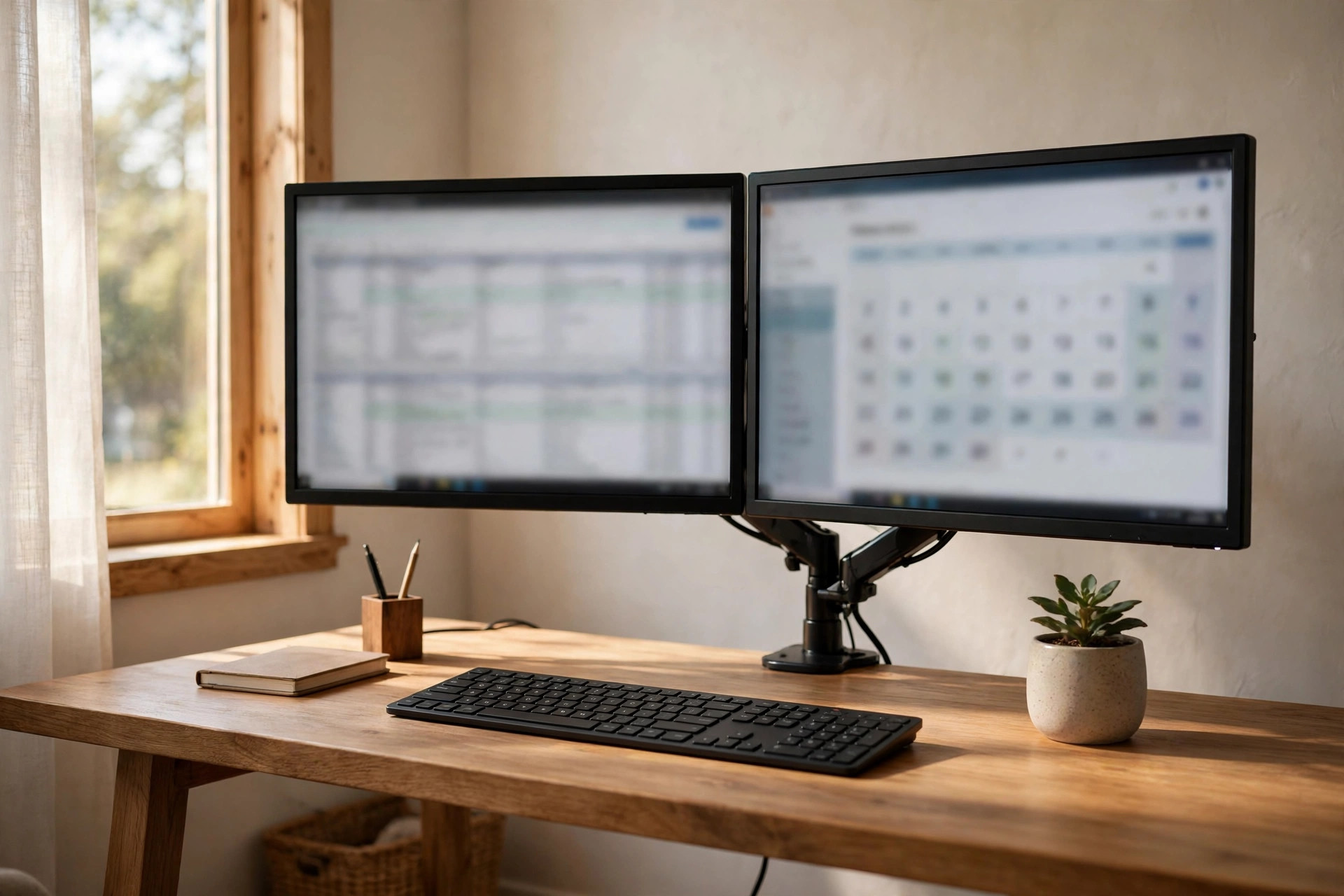

A Better Way to Hold Two Monitors
A home office runs better when the desk is clear and each screen sits at the right height. An adjustable monitor arm for dual screen setup is a metal arm, or a pair of arms, that clamps to the desk and holds two monitors in the air. It replaces the stands that come in the box. Those stands eat up desk space and lock the screens at fixed heights. The arm lets you move each screen up and down, tilt it forward and back, and swing it left or right. When two monitors must work side by side all day, the right arm makes the whole desk feel larger and the work feel lighter.
Two screens are common now. One screen shows the main work. The other holds email, notes, or a reference file. Many people also move between a work computer and a laptop. When both screens float at eye level, the neck stays straight and the eyes look slightly down at the top edge of each screen, as the doctors advise. That simple change cuts the ache that builds up after hours at the desk. A dual screen arm is one of the cheapest ways to fix a home office that was thrown together in a hurry.
Why It Matters: Adjustable Monitor Arm for Dual Screen Setup
Most monitors ship with a short stand that is made to fit in a small box. The stand gives you a screen that sits low and far back on the desk. You bend your neck to look down at it. Over weeks and months, that bend turns into a sore neck and stiff shoulders. A dual screen arm raises both monitors to eye level. You sit straight. Your head rests over your shoulders. The strain goes away in days.
Desk space is the second gain. Two stands take up two wide bases. With an adjustable monitor arm for dual screen setup, the only thing touching the desk is a small clamp at the back edge. Everything under the screens opens up. You can slide a keyboard, papers, and a coffee cup where the stands used to be. On a small desk, this is the difference between a crowded corner and a real work area.
The third gain is easy movement. Arms swing. You can pull a screen toward you to read small print, push it back to watch a video, or turn one screen toward a guest sitting beside you. When the day ends, you fold the arms back and the desk looks tidy. If you share the desk with a partner who is a different height, as many home offices are with a quiet keyboard for a shared home office on the same surface, each person can set the screens in seconds.
What to Look for When You Choose
Not every arm fits every desk. Start with the desk itself. Most dual arms use a C-clamp that grips the back edge of the desk top. The desk needs to be solid wood or a strong manufactured top. Thin hollow-core tops can bend under the weight, so check the thickness. A grommet mount is another choice. It drops through a hole in the desk, or through the gap where a cable tray sits, and bolts tight from below. This holds even more weight but needs a hole you can use.
Next, check the monitors. Arms hold screens by the VESA mount, which is the square pattern of screw holes on the back of most monitors. The common size is 75 by 75 millimeters or 100 by 100 millimeters. Your monitor must have these holes or come with an adapter. Check the weight of each monitor too. Every arm lists a maximum load per arm, often between 8 and 20 pounds. A 34 inch wide screen can weigh more than a small arm can hold. Add up the pounds and stay well under the limit.
Weight, Reach, and Adjustment
Three numbers tell you how an arm will behave. Weight capacity is the first. Give yourself a margin. If each screen weighs 12 pounds, do not buy an arm rated at 12 pounds per arm. Choose one rated at 15 to 20 pounds so the arm moves smoothly and holds its place.
Reach is the second. Reach is how far the arm can pull the screens toward you and how far back it can push them. A longer reach suits a deep desk. A shorter arm suits a shallow desk and keeps the screens from hanging past the front edge.
Adjustment type is the third. Gas spring arms use a piston, like the ones in car trunks, to hold the screen where you put it. They move with one hand and feel smooth. Spring arms are the most common choice for dual screen work. Mechanical arms use a hinge that you set and tighten. They are cheaper but need a tool to move. Pole mounts hang both screens on one vertical post. They are simple and strong but move less.
Types of Dual Screen Arms
Dual screen arms come in a few common forms. The most popular is the twin arm with a shared base. One clamp holds a post, and two arms reach out from the post. Each arm moves on its own. This form suits two screens of the same size.
The second form is two separate single arms side by side. You clamp one arm at the left back corner and one at the right back corner. This costs more but gives full freedom. It is the best choice when the two screens are different sizes, such as a 27 inch main screen next to a 24 inch side screen.
The third form is the stacked mount. One screen sits above the other. It saves width on a narrow desk. It works well when the main screen does the heavy work and the top screen holds charts or video calls. You will look up at the top screen, so do not put your main work there for long hours.
The fourth form is the wall mount for two screens. It bolts into wall studs and holds the screens away from the desk entirely. It gives the cleanest desk of all but needs a strong wall and some care with cable runs.
Cost and Price
A basic dual screen arm costs between 40 and 80 dollars. At this price you get a pole mount with two fixed arms. It holds the screens at the right height and frees the desk. It will not move as smoothly, and it may droop a little with heavy screens.
A mid-range arm costs between 80 and 160 dollars. This is the sweet spot for most buyers. You get gas springs, full tilt and swivel, and a load rating that handles 27 inch screens with room to spare. The arms move with one finger and stay where you set them.
Premium arms cost between 160 and 300 dollars. They hold very large or very heavy screens, move in extra directions, and come with clean cable covers. Big brands in this range publish detailed load charts and long warranties. Shoppers often compare prices and designs on large retail sites such as Wayfair and IKEA before they decide.
Beyond the arm, plan for small extras. A cable management kit, about 10 dollars, keeps power and video cords neat. A monitor light bar, about 30 dollars, cuts glare. If your monitors lack VESA holes, adapters cost about 15 dollars each.
Care and Upkeep
A monitor arm asks for little care. Once a month, wipe the arms and the post with a damp cloth to keep dust out of the joints. Check the clamp bolt every few months and tighten it by hand if it has loosened. Vibration from typing can slowly work it loose over a year.
Gas spring arms may need a tension reset once a year. The arm has a small screw, usually marked, that sets how much weight it balances. If a screen starts to drift down on its own, turn the screw a quarter turn and test. The manual that comes in the box shows the exact spot. Keep that manual. You will want it when you change monitors.
Cables deserve care too. Leave a little slack at each joint so the arm can move without pulling the cords. Bundle the slack with soft ties, not hard plastic, so the cables can breathe. When you dust behind the desk, check that no cable has caught on the arm.
Safety
A dual screen arm holds a lot of weight over your desk. Install it right. Tighten the clamp until it does not rock when you push the screens. If the desk top feels soft or thin, put a small board under the clamp to spread the load. A falling monitor breaks screens and can hurt hands.
When you hang the monitors, hold each screen with both hands until the VESA screws are tight. Four screws must be fully seated. If the screen wobbles, take it down and start over. Do not hang a screen that is heavier than the arm rating. Overload is the main cause of slow droop, and droop can become a sudden drop.
Keep the arm out of the path of swinging doors and away from the edge where children or pets can grab it. Run power cords so no one can snag them. If your office setup also includes a small standing desk nearby, give the arm room to swing without hitting the desk frame.
Route cables through the arm channels and off the desk edge. A tangled cable can pull tight when the arm moves and yank a plug loose. Once everything is set, swing each arm through its full range slowly and watch the cables before you call the job done.
Frequently Asked Questions
Can one arm hold two monitors of different sizes?
Yes. Choose two separate single arms, or a twin arm where each side moves on its own. Match the weight rating to the heavier screen. Keep the two screens at the same height so your eyes move level between them.
Will a dual screen arm fit my desk?
It fits most solid desks with a back edge at least two inches deep. It does not fit glass desks well, because clamps can crack glass, and it does not fit thin folding tables. If your desk top is hollow, add a backing plate under the clamp.
Do I need tools to install it?
You need one hex key, and it comes in the box. You will need a screwdriver only if your monitor screws are unusual. Most people finish the job in twenty to thirty minutes.
How much weight can a typical arm hold?
A mid-range dual arm holds 15 to 20 pounds per screen. That covers most 24 to 32 inch monitors. Very large or curved screens may weigh 25 pounds or more. Weigh your screens on a bathroom scale before you buy.
Does an arm reduce neck pain?
It can, when the screens sit at eye level and you sit straight. Pair the arm with a good chair, such as an ergonomic office chair with a footrest, and take short breaks each hour. No arm fixes bad posture on its own.
Can I add a third monitor later?
Some twin arms let you add a third arm to the same post. Others do not. If you think you will grow to three screens, buy a post system made for three, or plan for two separate arms plus a third single arm.
A Short Final Word
An adjustable monitor arm for dual screen setup is a small purchase that changes the whole feel of a home office. The desk clears. The screens rise to eye level. The neck and shoulders get a rest. Choose an arm that fits your desk, matches your monitors by weight and VESA size, and moves with gas springs. Install it with care, route the cables, and set each screen at the right height. In one afternoon the crowded desk becomes a clean, calm place to work.
For more background, see PCMag, Herman Miller, and Steelcase. For more background, see UPLIFT Desk, The Spruce, and Wirecutter.
References
Herman Miller. (n.d.). Office furniture and ergonomic seating. https://www.hermanmiller.com IKEA. (n.d.). Home furnishings. https://www.ikea.com PCMag. (n.d.). Technology product reviews. https://www.pcmag.com Steelcase. (n.d.). Office furniture and workplace research. https://www.steelcase.com The Spruce. (n.d.). Home and garden advice. https://www.thespruce.com UPLIFT Desk. (n.d.). Standing desks and ergonomic office furniture. https://www.uplift-desk.com Wayfair. (n.d.). Furniture and home goods. https://www.wayfair.com Wirecutter. (n.d.). Product reviews from The New York Times. https://www.nytimes.com/wirecutter
Was this guide helpful?

About Lisa Anderson
The My Garden US editorial team writes practical, in-depth home and garden guides for American homeowners — tested advice, no fluff.
You May Also Like

An Ergonomic Office Chair With Headrest for Tall Men
July 22, 2026 0 views
Ergonomic Balance Board for Standing Desk Use: A Plain Guide
March 28, 2026 0 views
Best Home Office Desk for Crafters and Sewing: A Practical Guide
June 1, 2026 0 views