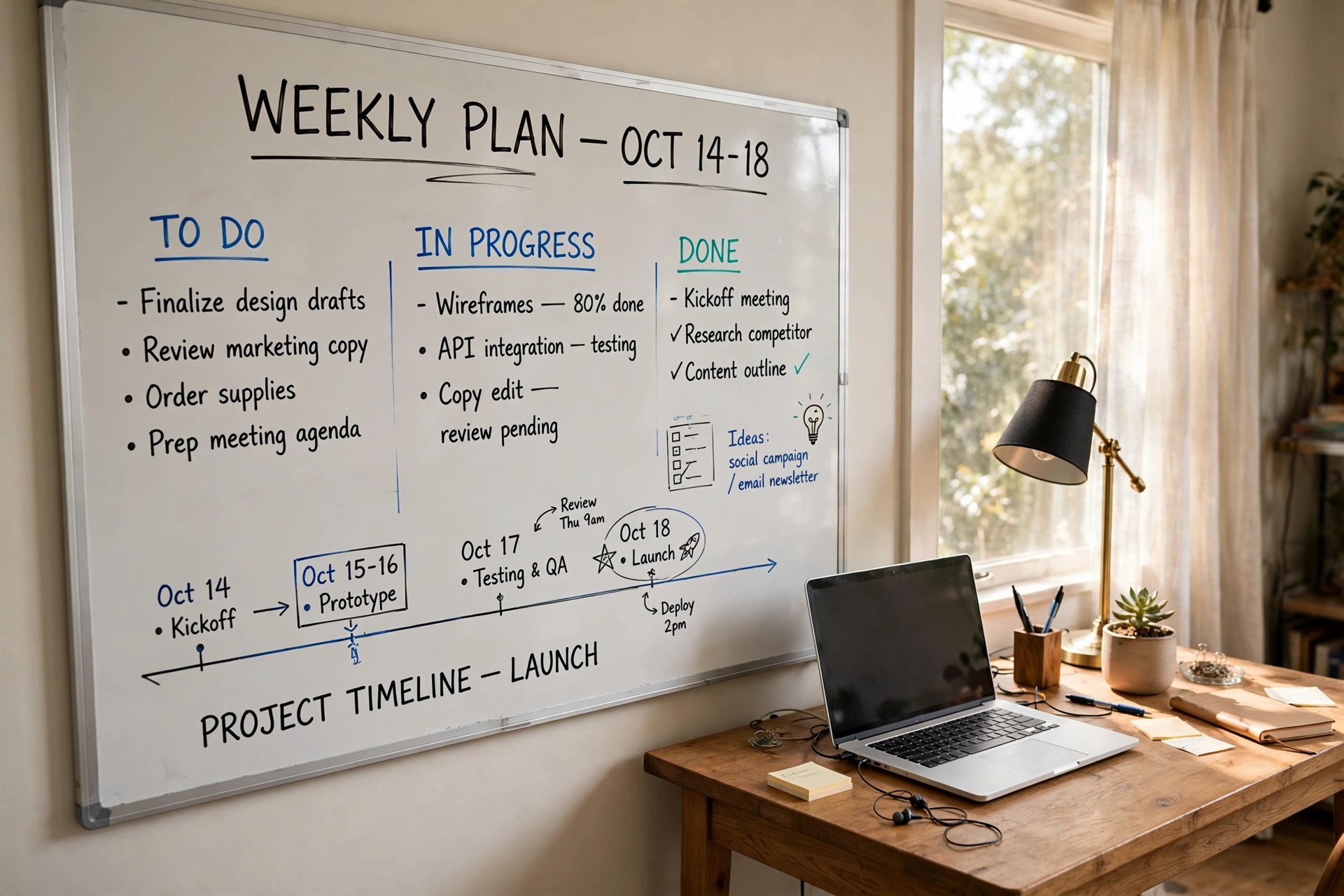

A home office whiteboard for remote team planning is one of the simplest tools a remote worker can buy. It hangs on the wall, asks for no power, and never needs a software update. Yet it can change how a workday feels. When the tasks, dates, and ideas for a whole team live on a board you can see from your desk, planning stops feeling scattered. This guide explains why such a board matters, how to choose one, what the options are, what they cost, and how to keep one in good shape.
Why It Matters
Remote teams meet through screens, but thinking still works best in the open. A home office whiteboard for remote team planning gives your thoughts a place to land. You can sketch a project plan in the morning, leave it up all day, and add to it as calls bring new facts. The board holds the plan so your mind does not have to.
Research into how people work has long shown that visible information gets acted on sooner than information buried in files. A list on a screen can be closed with one click. A list on the wall stays in view while you answer email, take calls, and drink coffee. For a remote team member, that steady presence matters. It keeps the team goal in sight even when no meeting is running.
A board also helps during video calls. When your camera shows the board behind you, teammates can see the same sketch you are talking about. You point, they follow, and the discussion moves faster. Product designers at companies known for thoughtful workspace ideas, such as those covered at Steelcase, have long treated the whiteboard as a shared thinking surface, not just a writing surface. The same idea works at home.
There is a third, quieter benefit. A home office whiteboard for remote team planning marks the boundary between work and home. When the board is full of notes, you are in work mode. When you erase it at the end of the day, the workday has a clear end. People who work from spare rooms and corners say this small ritual helps them stop thinking about work at night.
What to Look for When You Choose One: Home Office Whiteboard for Remote Team Planning
Buying a board is simple, but a few details decide whether you will enjoy using it for years or regret the purchase in a month. Work through these points before you buy.
Size and Mounting
Size comes first. A board that is too small gets cramped, and you stop using it. A board that is too large eats the only free wall in the room. For most home offices, a board between 36 and 48 inches wide works well. It holds a weekly plan, a few columns of tasks, and room for notes, without taking over the wall.
Mounting matters as much as size. Wall-mounted boards need solid anchors. Drywall alone will not hold a heavy board, so find the studs or use proper anchors. If you rent your home, a rolling board may be wiser, since it needs no holes. Some boards mount with adhesive strips, but those suit only small, light boards. Think about where the board will sit in relation to your camera. A board behind your desk shows up on video calls. A board on the side wall stays private but is still within reach.
Lighting is part of placement too. A board that faces a bright window will glare on camera, and the writing will be hard to read. Place the board on a wall that gets soft, even light. Good task lighting in the room helps the board read well on video.
Surface Quality
The writing surface is the heart of the board. The cheapest boards use melamine, a resin coating over a hard base. Melamine writes fine at first but can ghost over time, meaning old marks leave faint shadows after erasing. Ghosting annoys daily users.
The next step up is painted steel. It erases cleaner than melamine and holds magnets, which is useful for pinning printed pages with small magnets. Steel boards cost more but last longer in daily use.
The best common surface is porcelain on steel, sometimes called ceramic steel. It resists stains, erases cleanly after years of use, and takes magnets. For a home office whiteboard for remote team planning that will see daily writing, porcelain is the safest long-term choice. Retailers with wide office selections, such as IKEA, carry boards across these price and quality levels, which makes comparing surfaces easy.
Test the markers too. Use dry-erase markers made for whiteboards, never permanent markers. A permanent marker on a board is a common and painful mistake. Keep a bottle of whiteboard cleaner and a soft cloth nearby. Cheap paper towels can scratch melamine surfaces over time, so a microfiber cloth is a better habit.
Extras That Help Planning
Small extras can make a big difference for team planning. A board with a printed calendar grid saves you from drawing lines every month. Some boards come with a pen tray, which sounds minor until markers start rolling off your desk. Magnetic surfaces let you stick up printed agendas, charts, and sticky notes alongside your writing.
Some remote workers add a small bulletin board beside the whiteboard for printed items, keeping the whiteboard itself free for fresh thinking. If your office is a shared room, acoustic panels on the wall can cut echo on calls, which pairs well with a board that appears on camera.
Types and Options
Whiteboards for home offices come in a few main forms. Each suits a different room and work style.
Wall-Mounted Boards
The classic choice is a board fixed to the wall. It is always ready, never in the way, and looks tidy. Framed boards with aluminum trim suit most rooms and cost less than frameless glass boards. Frameless glass boards look modern and clean up well, but they cost more and show fingerprints. For a room that appears on video calls, a clean, simple frame reads best.
Wall-mounted boards work best when you have a free wall near your desk and permission to drill. They are the most stable option for daily writing, since the board never moves while you write.
Rolling and Standing Boards
A rolling board stands on a frame with wheels. You can pull it beside your desk for a planning session, then roll it into a corner when the day ends. Double-sided rolling boards give you two writing surfaces, which suits workers who track two projects at once.
Rolling boards suit renters and people who share a room with family life. They need no wall holes, and they can face the camera or face away as the moment requires. The trade is floor space. Even a modest rolling board takes up a corner of the room, so measure before you buy. Ergonomic furniture makers such as Herman Miller and workspace specialists like UPLIFT Desk treat mobile furniture as part of a flexible home office, and a rolling board fits that same idea.
Portable and Desk-Sized Boards
Small boards, sometimes called lap boards, are the size of a sheet of paper or a little larger. They are cheap and useful for quick sketches during a call, but they cannot hold a team plan. A middle option is a board that hangs over a door or leans on a desk easel. These suit very small rooms and tight budgets.
For serious remote team planning, a desk-sized board is a supplement, not a replacement. It is handy for drafting a diagram before you copy the final version onto the big board. Some workers keep one beside the keyboard for call notes and transfer the important points to the wall board afterward.
Cost and Price
Prices for a home office whiteboard for remote team planning run from under twenty dollars to several hundred. A small melamine board for a desk costs the least. A mid-size melamine wall board, around 36 by 48 inches, usually runs between thirty and eighty dollars. A painted steel board of the same size runs from eighty to one hundred fifty dollars. Porcelain boards of that size start near one hundred fifty dollars and climb from there. Large glass boards can pass three hundred dollars.
Markers and cleaners add a small yearly cost. A set of dry-erase markers runs a few dollars and lasts months with daily use. Whiteboard cleaner costs a few dollars a bottle. Budget one new set of markers and one bottle of cleaner per year, plus replacement markers as colors dry out.
When you weigh price against quality, think in years. A porcelain board that costs twice as much as a melamine board but lasts four times as long is the cheaper board. Reviews and buying guides, such as those published by Wirecutter and PCMag, often test boards for ghosting and durability, which can help you judge whether a low price is a real bargain.
Used boards are worth a look too. Offices close and schools upgrade, and solid porcelain boards appear in secondhand listings at half their new price. Check the surface for deep scratches and test it with a marker before you pay. A board that will not erase cleanly is no bargain at any price.
Care and Upkeep
A whiteboard lasts when it gets small, regular care. Erase it at the end of each day. Ink left on a board for weeks sinks in and stains, especially on melamine. A quick wipe each evening keeps the surface fresh.
Clean the board once a week with whiteboard cleaner or a damp microfiber cloth. Avoid harsh chemicals and rough scrub pads. They wear the coating and shorten the life of the surface. If a board starts to ghost, a deep clean with cleaner and a soft cloth often brings it back. Boards that never get cleaned slowly turn gray and hard to read.
Store markers flat or tip-down so the ink stays at the tip. Cap them after each use. A dried-out marker tempts people to press harder, and pressing harder can dent a cheap surface. Keep permanent markers far from the board. If someone does use one by mistake, writing over it with a dry-erase marker and then erasing both can sometimes lift the permanent ink. It does not always work, so prevention is the real rule.
Check the mounting once or twice a year. Tighten loose screws and check anchors. A board that shifts on the wall is annoying to write on and can fall. For rolling boards, check the wheel locks and the frame bolts. A stable board is a safe board.
Safety
Whiteboards are safe tools, but a few cautions apply. Mount wall boards into studs or with anchors rated for the weight. A large board can weigh twenty pounds or more, and a falling board can hurt someone and damage the wall. Follow the mounting instructions that come with the board, and do not improvise with weak hooks.
Keep the board away from heat sources. Boards near radiators or space heaters can warp, and marker fumes near heat are unpleasant. In a home with small children, mount the board high enough that toddlers cannot pull it down, and keep markers out of reach. Dry-erase markers are low-odor, but they are not toys.
Glass boards deserve extra care. They are heavy and can shatter if struck hard at an edge. If you choose glass, mount it exactly as instructed and keep heavy objects away from it. Check with safety resources such as CPSC guidance on wall-mounted household items if you are unsure about anchors in your wall type.
On video calls, think about what the board shows. Client names, passwords, salary notes, and personal details should never sit on a board that a camera can see. Erase sensitive items before calls, or angle the board away. Many remote workers keep a “camera side” of the board for public plans and a private side for sensitive notes.
FAQ
How big should a home office whiteboard for remote team planning be? For most people, 36 to 48 inches wide is the sweet spot. It fits a weekly plan with room for notes. Smaller boards fill up too fast, and larger boards overwhelm small rooms. Measure your wall and your reach before you buy.
Melamine, steel, or porcelain: which surface is best? Porcelain on steel is best for daily use because it resists ghosting and lasts for years. Painted steel is a good middle choice and holds magnets. Melamine is fine for light, occasional use but stains over time. Match the surface to how often you will write.
Can I use a whiteboard during video calls? Yes, and it works well. Place the board where your camera can see it, avoid window glare behind it, and write large enough to read on a small screen. Use dark markers, black or blue, for the best contrast. Erase anything private before the call starts.
Do I need a magnetic board? Not strictly, but magnets are handy for team planning. They let you pin printed agendas, charts, and photos next to your writing without tape. Steel and porcelain boards hold magnets. Melamine usually does not.
How do I remove old stains from a whiteboard? Wipe the board with whiteboard cleaner and a microfiber cloth. For stubborn ghosting, let the cleaner sit for a minute before wiping. Do not use abrasive pads or strong solvents, which damage the coating. If the board still shows shadows after a deep clean, the surface may be worn out.
Where can I learn more about setting up a home office? Home and office retailers with planning guides, such as IKEA and Wayfair, publish room ideas that include boards and planning walls. Workspace design articles from Steelcase and product guides from The Spruce cover layout and lighting in more depth.
A Short Final Word
A home office whiteboard for remote team planning will not write your plans for you. What it will do is give your plans a home. Choose a size that fits your wall, a surface that survives daily use, and a spot your camera can see. Keep it clean, keep it current, and erase it when the day ends. In a work life lived through screens, a simple board on the wall is a small anchor of clarity. Buy once, buy well, and let the board do the quiet work of keeping your team in sight.
Related guides on this site include ergonomic standing desk for small home office, best office chair for long hours home office, and affordable dual monitor setup for remote workers usa.
References
Herman Miller. (n.d.). Office furniture and ergonomic seating. https://www.hermanmiller.com HGTV. (n.d.). Home and garden ideas. https://www.hgtv.com IKEA. (n.d.). Home furnishings. https://www.ikea.com PCMag. (n.d.). Technology product reviews. https://www.pcmag.com Steelcase. (n.d.). Office furniture and workplace research. https://www.steelcase.com The Spruce. (n.d.). Home and garden advice. https://www.thespruce.com U.S. Consumer Product Safety Commission. (n.d.). Product safety information. https://www.cpsc.gov UPLIFT Desk. (n.d.). Standing desks and ergonomic office furniture. https://www.uplift-desk.com Wayfair. (n.d.). Furniture and home goods. https://www.wayfair.com Wirecutter. (n.d.). Product reviews from The New York Times. https://www.nytimes.com/wirecutter
Was this guide helpful?

About Michael Thompson
The My Garden US editorial team writes practical, in-depth home and garden guides for American homeowners — tested advice, no fluff.
You May Also Like

Ergonomic Vertical Mouse for Wrist Pain Relief
September 9, 2026 0 views
Home Office Label Maker for Filing Organization
May 21, 2026 0 views
Best Home Office Desk for Two Monitors: A Practical Buying Guide
January 21, 2026 0 views