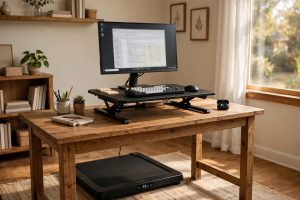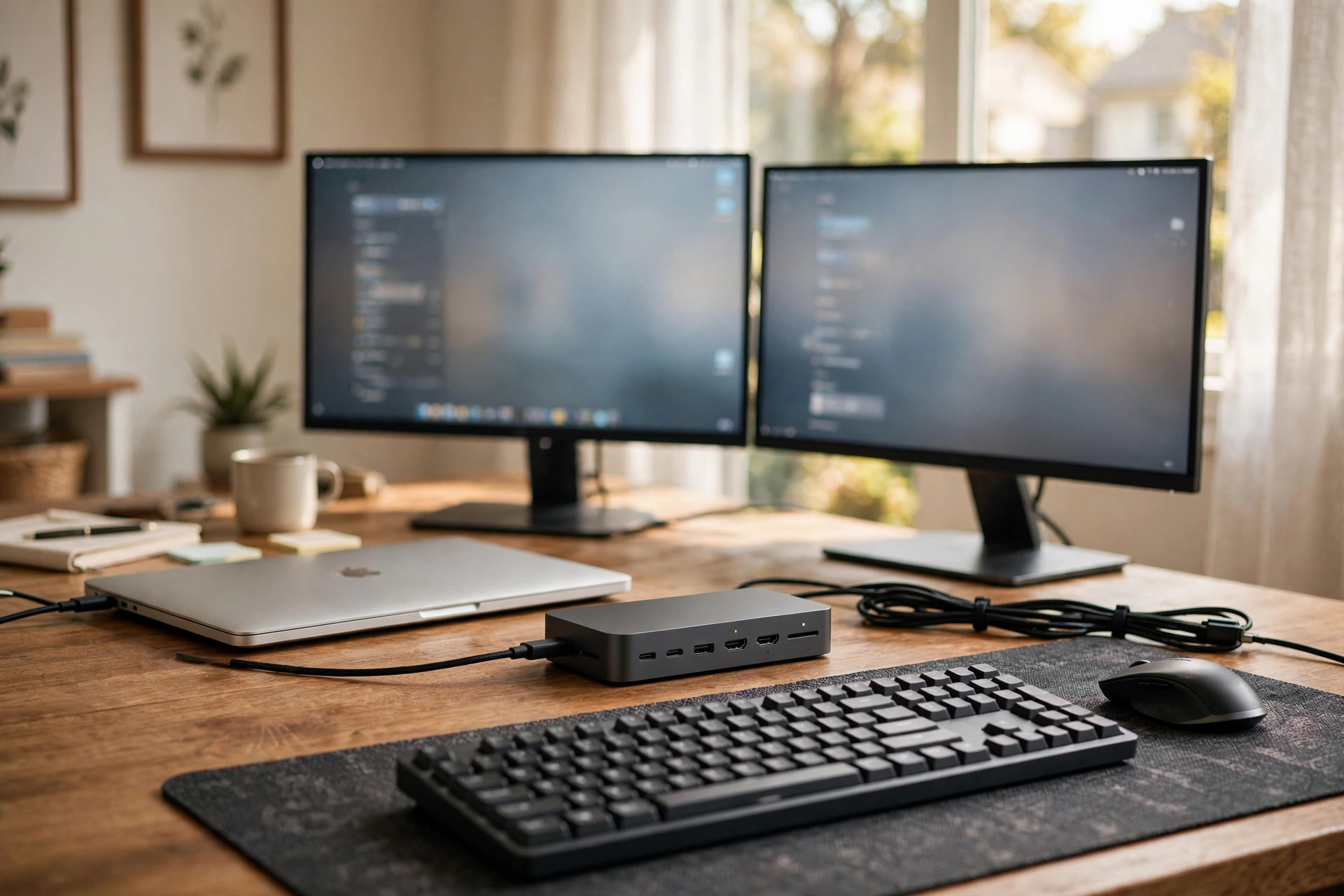
A USB C docking station for home office setup is a small box that sits on a desk. One cable goes from the box to the laptop. All the other wires plug into the box. Monitors, keyboard, mouse, printer, and the power cord each find a home there. The worker opens the laptop, plugs in one cable, and the whole desk comes to life. At the end of the day, one unplug ends it all. This simple idea has changed how many people work from home.
Before these stations became common, home workers lived in a tangle of wires. A laptop had only two or three ports, yet monitors, the power cord, the webcam, and the external drive each needed one. A USB C docking station for home office setup solves this by acting as a hub for everything at once.
The need has grown as millions of Americans now work from a spare bedroom or a corner of the living room. Their employers gave them a laptop. The laptop is fine for travel but poor for eight hours of daily work. A full desk with big screens helps the eyes, the neck, and the back. The docking station is the bridge between the travel computer and the full desk. It is one of the first upgrades a home worker should consider.
Why It Matters
The main gain is time. Think of a typical morning. A worker carries a laptop from the kitchen table to the desk. Without a dock, she must plug in the power cable, the monitor cable, the keyboard wire, and the mouse dongle. Each plug takes a few seconds and can come loose. With a dock, a single USB C cable waits on the desk. She sits down, plugs it in, and starts work. Over a year of workdays, those seconds add up to hours.
The second gain is comfort. A laptop screen sits too low. The neck bends down all day. The shoulders round forward. Backs ache and eyes tire. A proper home office setup lifts the screen to eye level, either on a stand or through external monitors. The docking station makes the external monitors possible. It also allows a full-size keyboard and mouse, which are kinder to the wrists. Comfort is not a luxury. It is what lets a person work well for years.
The third gain is a tidy desk. Cables multiply fast. They catch dust and pull at laptop ports, damaging them over time. A dock hides the mess: all the cables stay plugged into the dock behind the monitor, and only one clean cable reaches the laptop.
How to Choose the Right One: Usb C Docking Station for Home Office Setup
Not every dock fits every worker. A careful buyer thinks about four things before spending money: ports, power, monitors, and compatibility. A wrong choice means returns and frustration.
Ports and Connections
Ports are the holes on the dock where wires plug in. Count what you need. Most home workers need at least two monitor ports, four USB ports, one port for the wired internet cable, and a headphone jack. Look at your desk today. Count every cable you use. Add one or two more for the future. A dock with extra ports costs a little more but lasts longer, because your setup will grow.
Check the type of monitor ports. Older monitors use HDMI. Newer ones may use DisplayPort. Some docks have one of each, which is ideal. If both your monitors are HDMI, buy a dock with two HDMI ports. Direct connections are always better than adapters.
USB ports come in two shapes. The old rectangle shape is called USB-A. The small oval shape is called USB-C. Your keyboard and mouse probably use USB-A. Your phone charger may use USB-C. A good dock has both kinds. A gigabit ethernet port is worth having if your Wi-Fi is weak, because a wire is faster and steadier than wireless internet.
Power Delivery
A USB C docking station for home office setup can charge the laptop through the same single cable. This is called power delivery, and it is one of the best features. But not all docks deliver enough power. A small thin laptop may need 65 watts. A larger work laptop may need 90 or even 130 watts. Check your laptop’s power brick. It will list the wattage. Buy a dock that meets or beats that number.
If the dock is too weak, the laptop will charge slowly or drain while you work. You will end up plugging in the original charger too, which defeats the purpose of one cable. This is the most common mistake buyers make. When in doubt, choose the stronger dock. The price difference is usually small.
Monitors and Display Support
Two monitors are the standard home office upgrade. Before you buy, check what your laptop can drive. Most modern laptops with USB C can run two screens through a dock. Some older ones can run only one. This is a limit of the laptop, not the dock. Check your laptop maker’s website for the answer.
Resolution matters too. A basic dock may support two monitors at 1080p, which is standard high definition. A better dock supports 4K screens. If you own 4K monitors, pay for the dock that can feed them. Running a 4K monitor at a lower setting wastes the money you spent on the screen.
Compatibility With Your Laptop
USB C is a shape, not a promise. Just because a port looks right does not mean it does everything. The laptop’s USB C port must support DisplayPort Alt Mode, which lets video travel through the cable. Most business laptops from the last five years have it. Many cheap consumer laptops do not. Check the laptop manual or the maker’s support page.
Thunderbolt is a faster cousin of USB C. Thunderbolt docks cost more and do more. If your laptop has a Thunderbolt port, a Thunderbolt dock is worth the extra money. If it does not, a Thunderbolt dock will still work, but you pay for speed you cannot use. Match the dock to the laptop you actually own.
Mac and Windows users should also check the fine print. Some docks have limits on Apple computers, and a few features need special chips in the dock. Read reviews from people who use the same computer you do. Wirecutter and PCMag both publish detailed dock reviews with compatibility notes, and they are good places to confirm before you buy.
Types and Options
Docks fall into three broad groups. Knowing the groups helps you shop.
Portable travel docks are small and light, fitting in a jacket pocket. They have a few ports and cost the least, suiting people who work from many places. They are not a true home office solution, because they lack the ports and power for a full desk.
Full-size desktop docks are the real subject of this guide. They are about the size of a paperback book. They have ten or more ports, deliver strong power, and sit on the desk all day. This is the right choice for a permanent home office.
Thunderbolt docks are the premium group. They look like full-size docks but use the faster Thunderbolt connection. They can drive two 4K monitors at once and charge heavy laptops. They cost the most, often twice the price of a standard dock. Creative professionals and engineers tend to buy them. Office workers who write, plan, and meet on video rarely need them.
Cost and Price
Prices run in clear bands. A portable travel dock costs between twenty and sixty dollars. A full-size USB C dock costs between one hundred and two hundred fifty dollars. A Thunderbolt dock costs between two hundred fifty and four hundred dollars. These are typical American street prices. Sales bring them lower a few times a year.
What drives the price? Port count, power delivery strength, and Thunderbolt speed. A dock with fifteen ports and 100-watt charging costs more than a dock with eight ports and 65 watts. Brand name and long warranties add a little.
Think of the dock as furniture, not as a gadget. A good dock should last five years or more. Spending one hundred fifty dollars for five years of daily use is thirty dollars a year, a fair price for the hours it saves.
Furniture makers such as Herman Miller and Steelcase study how office equipment affects the body, and their research supports spending on ergonomics rather than skimping. Even a modest ergonomic zero gravity office chair recliner or a home office desk riser for treadmill walking can change how a workday feels, and the dock is part of that same system.
Setting It Up and Daily Care
Setup takes about twenty minutes. Start with everything unplugged. Place the dock behind or beside your main monitor. Plug the dock’s power brick into the wall. Connect each monitor cable to the dock. Connect the keyboard, mouse, and any other USB devices. Connect the wired internet cable if you use one. Leave the single USB C cable free on the desk where your laptop will sit.
Some docks need a small driver program to run multiple monitors. Download it from the maker’s website and install it before you plug in the laptop. Then connect the USB C cable. The screens should wake up. If they do not, check the laptop’s display settings and look for the new screens. Arrange them left and right to match your desk. This is also a good moment to lift your laptop or monitors to eye level. A best laptop stand for standing desk posture pairs well with a dock, since the raised laptop becomes a third screen or a video-call camera.
Daily care is simple. Dust the dock once a month. Keep drinks away from it. Do not stack papers on top, because docks get warm and need air. If you travel with the laptop, coil the USB C cable loosely. Tight bends break cables over time.
Every year or two, check for firmware updates. The dock maker may release small software fixes that improve monitor support. The update takes five minutes and keeps the dock working well with new laptop updates.
Safety
A dock is an electrical device. Treat it with the same care as any other. Use only the power brick that came in the box. A wrong charger can overheat the dock. Do not plug the brick into a cheap extension cord with ten other devices. A surge protector is better. If the dock ever smells hot or the plastic feels soft, unplug it at once and stop using it.
Cable safety matters too. Route the single cable so it does not pull. If the laptop sits at the edge of the desk, a tug on the cable can drag the whole machine down. Leave slack. Keep the cable off the floor where feet and chair wheels can crush it.
Data safety is worth a thought. Docks make it easy to plug in drives, so do not plug in a stranger’s USB drive at home or in a shared office. Malicious drives can carry harmful software. Back up your work on a regular schedule.
Desk makers and office suppliers publish safety and setup advice worth reading. UPLIFT Desk offers guides on cable routing and desk ergonomics, and The Spruce keeps a large library of home office setup articles written in plain language. Both are free to read. Retailers like IKEA and Wayfair sell a wide range of desks and monitor arms that pair well with a dock-based setup.
Frequently Asked Questions
Will a USB C docking station for home office setup work with my old laptop? It depends on the laptop’s ports. If the laptop has a USB C port that carries video, it will work. Many laptops from 2018 onward have this. Very old laptops with only rectangular USB ports cannot use a USB C dock. Check the manual for the words DisplayPort Alt Mode or Thunderbolt.
Do I still need my laptop charger? No, if the dock delivers enough power. The dock charges the laptop through the same cable that carries the video and data. Keep the original charger in your travel bag as a backup.
Can I connect three monitors? Some docks and some laptops can. Most standard USB C docks support two external monitors plus the laptop screen. Thunderbolt docks often support more. The limit usually comes from the laptop’s graphics chip, not the dock. Check your laptop maker’s specifications before you plan a three-screen desk.
Does a dock slow down the internet? No. A wired connection through the dock is usually faster and steadier than Wi-Fi. The dock’s ethernet port gives your laptop a direct wire to the router. Video calls drop less often. Large files upload faster.
Can I use one dock with two different laptops? Yes, and this is common in homes where two people share an office at different hours. Each person plugs in their own laptop when their shift starts. The monitors, keyboard, and mouse stay in place. Just make sure both laptops have compatible USB C ports.
A Short Final Word
A USB C docking station for home office setup is a quiet upgrade. It does not flash or beep. It sits behind the monitor and does its job. But it changes the workday in real ways. One plug instead of six. A full desk instead of a cramped laptop. A tidy workspace instead of a nest of wires. For a modest yearly cost, it pays for itself many times over in saved time and saved patience.
Buy for the laptop you own, not the one you dream of. Count your ports. Check your power needs. Read a review or two from people with the same machine. Then set it up once, route the cables neatly, and forget about it. The best office tools are the ones you stop noticing. A good dock is exactly that.
References
Herman Miller. (n.d.). Office furniture and ergonomic seating. https://www.hermanmiller.com IKEA. (n.d.). Home furnishings. https://www.ikea.com PCMag. (n.d.). Technology product reviews. https://www.pcmag.com Steelcase. (n.d.). Office furniture and workplace research. https://www.steelcase.com The Spruce. (n.d.). Home and garden advice. https://www.thespruce.com UPLIFT Desk. (n.d.). Standing desks and ergonomic office furniture. https://www.uplift-desk.com Wayfair. (n.d.). Furniture and home goods. https://www.wayfair.com Wirecutter. (n.d.). Product reviews from The New York Times. https://www.nytimes.com/wirecutter
Was this guide helpful?

About James Carter
The My Garden US editorial team writes practical, in-depth home and garden guides for American homeowners — tested advice, no fluff.