
This reading floor lamps reviews buying guide USA is written for readers in the United States who want a lamp that makes reading easy and pleasant. A good reading floor lamp puts steady light on your book. It keeps the rest of the room soft and calm. A bad lamp is too dim, too harsh, or placed in the wrong spot. That kind of lamp tires the eyes.
Many buyers read product reviews before they shop. That is a wise habit. Reviews show how a lamp works in a real home, not just in a store display. This guide shows how to read those reviews with care, and walks you through the main types of lamps, the features that matter, the prices you can expect, and the safety rules to follow. By the end, you will know how to pick a lamp that suits your chair, your room, and your budget.
Why a Good Reading Lamp Matters
Reading is one of the most common uses of a floor lamp. Millions of Americans read in a living room chair or a bedroom corner each night. The light from the ceiling is rarely enough for a book. It throws shadows across the page. It forces the eyes to work too hard.
A reading floor lamp solves this problem. It brings the light close to the page. It lets you aim the beam where you need it. Steady, even light on the page reduces strain. A lamp with the right brightness and color lets you read longer without tired eyes. For more on choosing bulbs that are kind to the eyes and the planet, see the guidance on energy efficient bulbs.
Good lighting also matters for mood. A warm pool of light in a corner makes a room feel calm. It marks out a place for rest. When the lamp uses an ENERGY STAR certified lamp, it also keeps the power bill low.
What to Look for in a Reading Floor Lamp: Reading Floor Lamps Reviews Buying Guide Usa
When you read reviews of floor lamps, keep a short list of features in mind. These are the points that separate a fine lamp from a poor one.
Brightness and Bulb Type
The best reading lamps give between 400 and 800 lumens at the page. That is about the same as a 40 to 60 watt old-style bulb. Check the review for the word lumens. If a review says the lamp is dim, believe it. You can always dim a bright lamp, but you can not make a dim lamp brighter.
Most new lamps use LED bulbs. LED bulbs use less power and last for many years. A trusted LED bulb maker sells bulbs in warm and cool colors. For reading, look for warm white light, around 2700 to 3000 kelvin. It feels close to the light of an old lamp and is easy on the eyes. Cool white light can feel harsh in a bedroom at night.
Shade and Light Direction
The shade shapes the light. A shade that points down puts light straight on the book. That is the best shape for reading. A torchiere shade points up and lights the ceiling. It is fine for room light but weak for a page. Many reviews note whether the shade can tilt or swing. A tilt shade lets you aim the beam at your book. That small detail makes a big difference.
Height and Placement
A reading lamp should stand so the bottom of the shade is about level with your shoulder when you sit. For most chairs, that means a lamp between 55 and 65 inches tall. Reviews often give the height of the lamp. Measure your chair before you buy. A lamp that is too tall shines in your eyes. A lamp that is too short throws light on your lap and not on the page.
Put the lamp beside or behind your shoulder, on the side of your writing hand. Right-handed readers do well with the lamp on the left side. This keeps the hand from casting a shadow on the page.
Switch and Controls
Look for a lamp with a simple switch. Many readers like a three-way switch or a step dimmer on the pole. A foot switch on the cord is handy when you are seated. Some newer lamps have touch controls on the pole. Reviews will say if the switch feels cheap or triggers by accident.
Types of Reading Floor Lamps
Four types work best for reading.
Arc Lamps
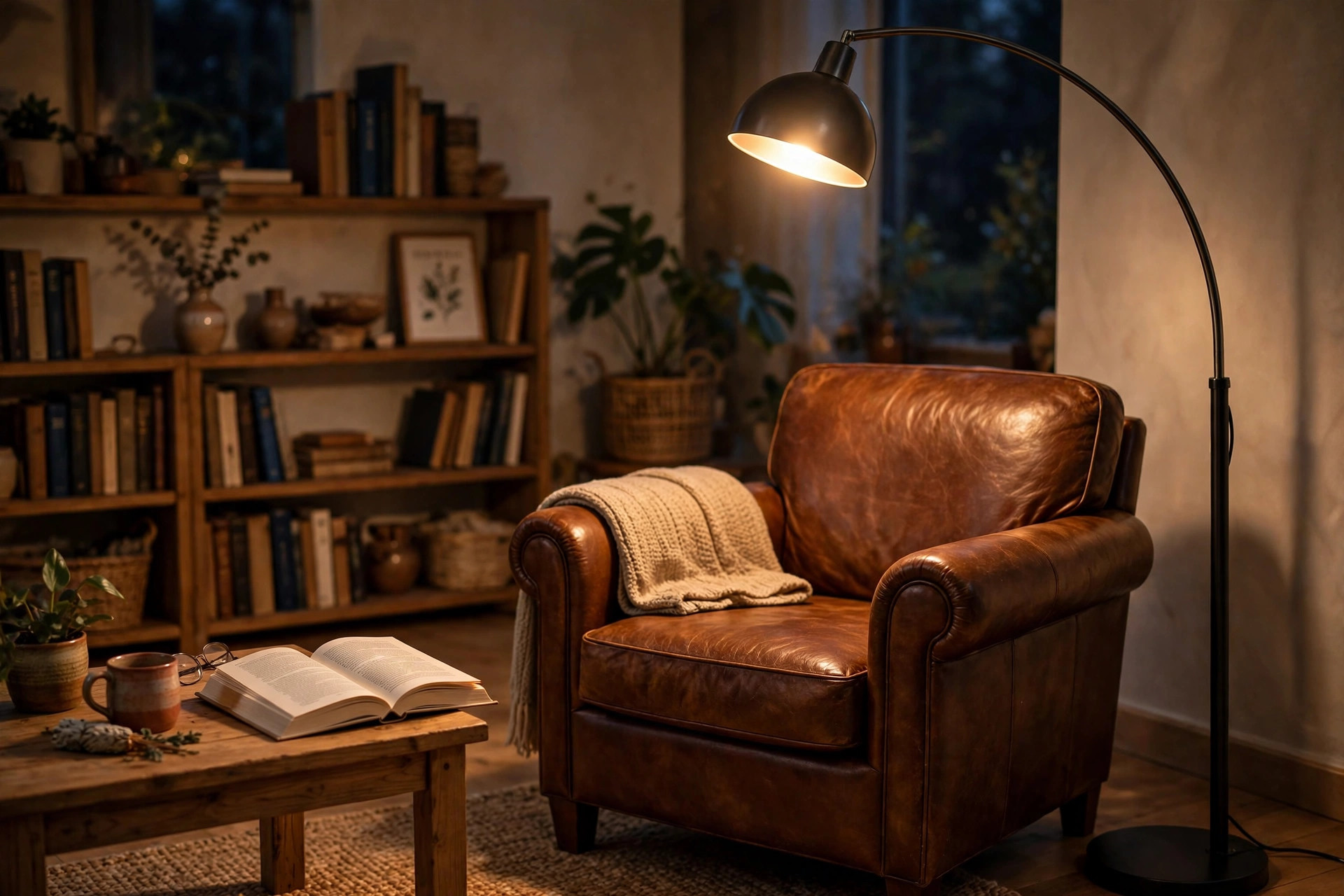
An arc lamp has a curved arm that reaches out over a chair or sofa. It needs no side table. It is a fine pick for a reading chair that sits away from a wall. Reviews often praise arc lamps for style. If you have pets or small children, a heavy base is a must.
Task Lamps With Adjustable Arms
These lamps have an arm or a neck that bends. You can move the head close to the book. Many have a swing arm or a gooseneck. Readers who like to aim the light just so will favor this type. Look in the reviews for words like sturdy joints. Loose joints are the most common complaint with this type.
Tree Lamps
A tree lamp has one pole with two or three heads at different heights. You can turn on one head for reading and leave the others off. Or you can light the whole room. Tree lamps suit people who want one lamp to do many jobs. Check the reviews to see if each head can be switched on its own. Some cheap models switch all heads together.
Torchiere With Reading Light
A torchiere points most of its light at the ceiling. Some models add a small reading light halfway down the pole. This type works well in a small room where you need both room light and a reading spot. Reviews will say if the reading light is bright enough to read by. Many are not, so read that point with care.
Shoppers who want more choices can browse floor lamp styles and lighting guides or look at affordable floor lamp options to get a sense of what is on the market.
How to Read Product Reviews Like a Buyer
Reviews are the heart of this reading floor lamps reviews buying guide USA. Here is how to use them well.
First, read the three-star and four-star reviews before the five-star ones. Mid-range reviews tend to be honest about both the good points and the flaws. Five-star reviews are often written right after the box is opened. One-star reviews are often written in anger over shipping damage, not the lamp itself.
Second, look for details about real use. A useful review answers questions like these: Is the light bright enough to read by at night? Does the switch feel solid? Does the lamp wobble when the arm is moved? Reviews that mention these points are more helpful than reviews that only say the lamp looks nice.
Third, check the date of the review. A lamp sold for five years may have changed parts. New reviews tell you about the lamp you will get today.
Fourth, count how many reviews agree on a point. If twenty people say the shade tilts loose after a month, that is a real flaw. If one person says the cord is too short, that may just be their room.
Fifth, look at the ratings from independent product ratings when you can. These test lamps in a lab and compare them side by side.
Finally, read the home lighting buying guides and floor lamp price lists from large stores. They often group lamps by price and feature, which makes side-by-side comparison easy.
For more background on lighting terms, the lighting guides from The Spruce and the curated lamp collections at Lumens are useful reading.
Cost and Price
Reading floor lamps in the United States fall into three price bands.
Budget lamps cost between 30 and 70 dollars. They are usually simple metal poles with a basic shade. They can be fine for a bedroom or a dorm room. Reviews in this band often mention thin parts and short cords. Expect a simple on-off switch and no dimmer.
Mid-range lamps cost between 70 and 180 dollars. This is the sweet spot for most readers. You will find sturdy bases, tilt shades, three-way switches, and better finishes like brushed nickel or dark bronze. Most lamps in this band use LED bulbs or take standard bulbs.
Premium lamps cost between 180 and 400 dollars and up. At this level you get designer looks, solid brass or wood parts, smooth dimmers, and very steady arms. Some high-end lamps have full-range dimmers and memory settings. Reviews in this band focus on finish quality and small details.
When you compare prices, include the cost of bulbs. A lamp that needs a special bulb can cost more each year than the lamp itself. Lamps that take standard medium-base LED bulbs are cheapest to run.
If you are lighting a whole home, you may also want to read our reading floor lamps buying guide for a shorter overview, our notes on bedroom table lamps for nightstands, and our guide to indoor wall sconces for hallways and baths.
Care and Upkeep
A reading floor lamp needs little care, but a few habits keep it working for years.
Dust the shade and the pole once a month. Dust on the shade blocks light and makes the lamp run warm. Use a dry cloth or a soft brush. Do not use water on paper shades.
Check the bulb now and then. LED bulbs last for years, but they do dim with age. If your reading light seems weaker than it used to be, try a new bulb before you buy a new lamp.
Tighten the joints once or twice a year. Swing arms and tilt heads loosen with use. Most lamps need only a small screwdriver or an Allen key, which often comes in the box.
Keep the cord in good shape. Do not run the cord under rugs or across doorways. If the cord feels hot or looks frayed, stop using the lamp at once.
Safety
Lamp safety is simple but worth a short section in any buying guide.
Buy lamps that carry a UL or ETL mark. This mark shows that a testing lab checked the wiring. Most lamps sold in the United States carry one of these marks. Reviews sometimes note a missing mark, and that is a warning sign.
Use the right bulb wattage. Every lamp has a sticker near the socket with a maximum wattage. Never put in a bulb above that number.
Keep the lamp steady. Place the base on a flat floor, not on the edge of a rug. If the lamp has a tall thin pole, push the base against a wall or a heavy chair. A lamp that falls can break a bulb and start a fire.
Keep shades clear of curtains and bedding. A hot bulb near cloth is a fire risk. LED bulbs run cool, which helps, but the rule still stands.
Unplug the lamp before you change a bulb or clean the socket. This is a small step that prevents shocks.
Frequently Asked Questions
How bright should a reading floor lamp be? Aim for 400 to 800 lumens at the page. That is enough to read a printed book with ease. If you read small print or do close work like sewing, aim for the higher end of that range. A lamp with a dimmer lets you set the level you like.
What color of light is best for reading at night? Warm white light, around 2700 to 3000 kelvin, is the most common pick for night reading. It feels soft and does not fight sleep the way cool blue light can. Some readers keep a cooler bulb for daytime study and a warm bulb for the evening.
Do I need a special bulb for a reading lamp? No. Most reading floor lamps take standard medium-base LED bulbs. Avoid very cheap no-name bulbs, which can flicker. Flicker causes eye strain even when you do not notice it.
Where should I place the lamp next to my chair? Place it beside your shoulder, slightly behind you, on the side of your writing hand. The bottom of the shade should sit near shoulder height when you are seated. This keeps light on the page and glare out of your eyes.
Are arc lamps safe for homes with children? They can be, if the base is heavy and wide. Look for a base that weighs at least 20 pounds for a full-size arc lamp. Place the base where no one will trip over it. Check reviews for notes about wobble before you buy.
How long do LED bulbs in reading lamps last? A quality LED bulb is rated for 15,000 to 25,000 hours. At three hours of reading a night, that is more than ten years. You will likely replace the lamp before you replace the bulb.
A Final Word
A reading floor lamp is a small purchase that pays you back every night. Take your time with the reviews. Match the lamp to your chair, your eyes, and your room. Buy a steady base, a shade that aims down, and a warm LED bulb. Keep the cord safe and the joints tight. With those simple steps, your reading corner will serve you well for many years.
References
Consumer Reports. (n.d.). Product reviews and ratings. https://www.consumerreports.org ENERGY STAR. (n.d.). Energy efficient products. https://www.energystar.gov IKEA. (n.d.). Home furnishings. https://www.ikea.com Lamps Plus. (n.d.). Lighting and home decor. https://www.lampsplus.com Lowe’s. (n.d.). Home improvement products. https://www.lowes.com Lumens. (n.d.). Lighting and ceiling fans. https://www.lumens.com Philips. (n.d.). Lighting products. https://www.philips.com The Home Depot. (n.d.). Home improvement products. https://www.homedepot.com The Spruce. (n.d.). Home and garden advice. https://www.thespruce.com U.S. Department of Energy. (n.d.). Energy efficiency and renewable energy. https://www.energy.gov
Was this guide helpful?

About Michael Thompson
The My Garden US editorial team writes practical, in-depth home and garden guides for American homeowners — tested advice, no fluff.
You May Also Like

Dining Room Chandeliers Reviews Buying Guide USA
September 5, 2026 0 views
WiFi Smart Bulbs: A Guide to the Best Online Deals in the USA
January 16, 2026 0 views
A Complete Guide to Outdoor Wall Lanterns for American Homes
January 22, 2026 0 views