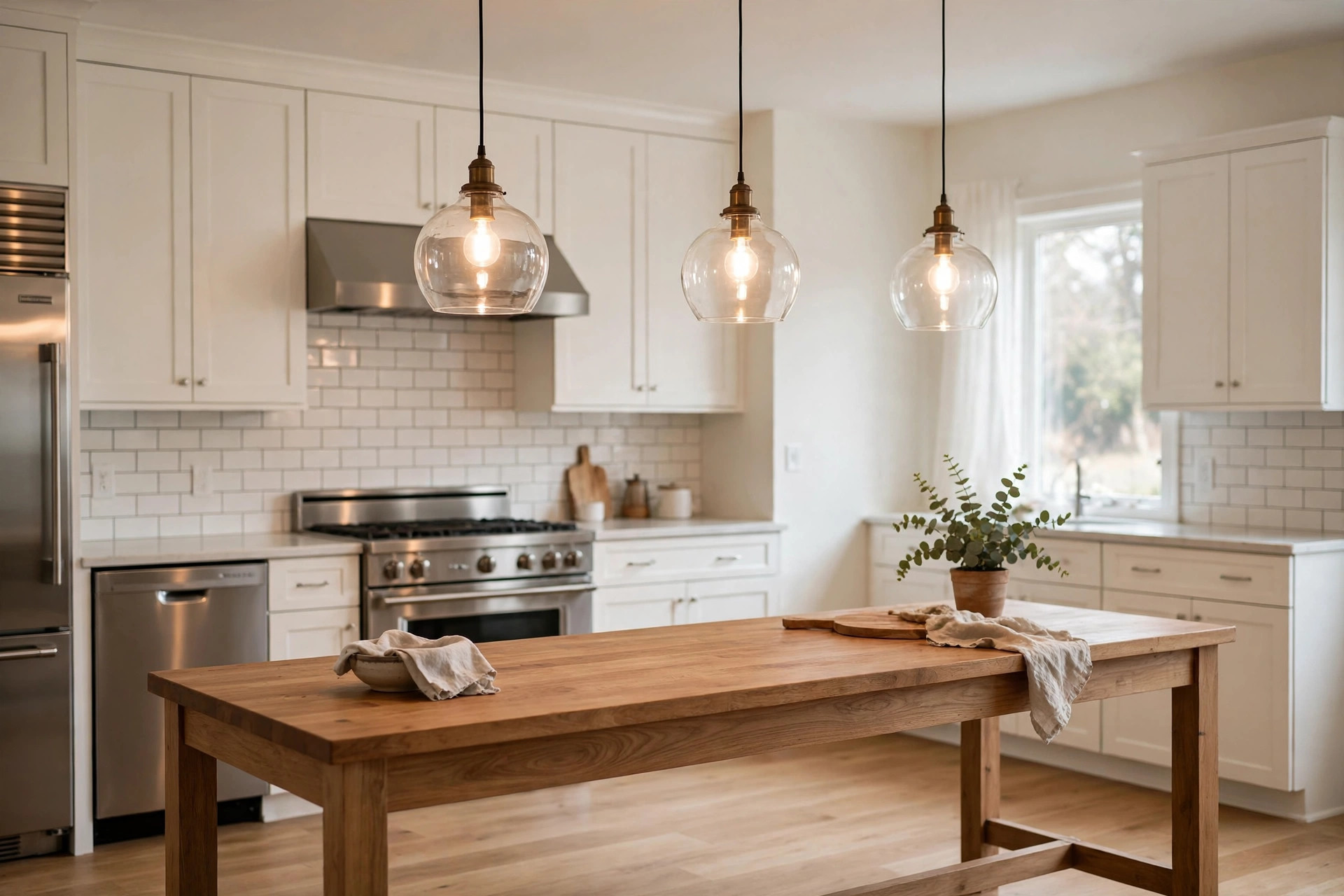

Many American kitchens have an island. The island is used for food prep, for schoolwork, and for morning coffee. The light over the island matters more than most people think. This kitchen island pendants buying guide usa will help you pick the right ones. It covers size, height, style, cost, and care. It uses plain words and simple facts.
A pendant light hangs down from the ceiling on a cord or a rod. Over a kitchen island, people often hang two or three of them in a row. They give light where work happens. They also shape how the whole kitchen looks.
Why Kitchen Island Pendants Matter
The kitchen is the most used room in many homes. Most of the work happens at the counter and the island. Good light there helps you chop, read, and serve food without shadows. Bad light makes the work harder and the room feel flat.
Pendant lights over the island do two jobs. They give task light for the work surface. They also give the room a focal point. A row of pendants can make an old kitchen look new. They can set a style for the whole room, from modern to farmhouse.
Many homes in the USA still use one dull ceiling light in the kitchen. That light is often too weak and too far from the work surface. Pendants fix this. They bring the light down to where it is needed.
What to Look For When Buying Kitchen Island Pendants: Kitchen Island Pendants Buying Guide Usa
Before you buy, think about these points. Each one affects how the light will look and work in your kitchen.
Size and Number
The size of the pendant should match the size of the island. A small pendant over a large island looks lost. A huge pendant over a small island feels heavy. A common rule is this: for an island of six feet or less, two medium pendants work well. For an island of seven feet or more, three pendants work well. Small islands of four feet or less can take one wide pendant or two small ones.
The width of each pendant should be about one quarter to one third of the island width. If the island is three feet wide, each pendant should be about eight to twelve inches wide. Measure the island first. Write the numbers down. Take a tape measure to the store or keep the numbers on your phone.
Hanging Height
The bottom of the pendant should sit about 30 to 36 inches above the counter top. This height keeps the light out of the eyes of people standing at the island. It also keeps the view clear across the kitchen. If the island is used as a dining spot, hang the lights a little higher, near 34 to 36 inches. If the island is mainly a work spot, 30 to 32 inches is fine.
For tall ceilings, the rule still works. You just need longer cords or rods. For low ceilings of eight feet, check that the pendant does not hang too low. A pendant that hangs too low will block the view and bump into tall people.
Light Output and Color
Look at lumens, not just watts. Lumens tell you how bright the light is. For task work over an island, about 300 to 500 lumens per pendant is common. Dimmable lights are a good idea. They let you turn the light bright for cooking and soft for dinner.
Color temperature is measured in Kelvin. Warm white is about 2700K. It feels cozy and fits most kitchens. Neutral white is about 3500K. It feels bright and clean. Cool white is 4000K and up. It can feel harsh in a kitchen. Most people pick 2700K or 3000K for kitchen pendants.
Bulb Type and Base
Most new pendants use LED bulbs. LEDs use less power and last longer than old bulbs. Many pendants come with bulbs built in. Others use standard bases, like E26, which take common screw bulbs. A standard base is easier to replace. A built-in LED can be hard to replace, so check the life rating. A rating of 25,000 hours or more is good.
Materials and Finish
Pendants come in glass, metal, wood, fabric, and more. Glass pendants let more light through. They work well over small islands. Metal pendants give a clean look and can focus light down. Fabric shades give soft light but can stain in a kitchen. The finish should match other parts of the kitchen, like the faucet or the cabinet handles. Common finishes are black, brass, chrome, and nickel.
Types and Options for Kitchen Island Pendants
There is a wide range of pendant styles on the market in the USA. Here are the main types.
Globe pendants have round glass shades. They give light in all directions. They suit modern and mid-century kitchens. They are easy to clean.
Drum pendants have wide round shades, like a drum. They give soft light. They suit large islands. They come in fabric, metal, and glass.
Mini pendants are small lights used in rows of three or four. They suit small islands. They are a good choice when the ceiling is low.
Industrial pendants have metal shades in a factory style. They are common in farmhouse and rustic kitchens. They focus light down on the counter.
Lantern pendants look like small lanterns. They have a classic shape. They suit traditional and coastal kitchens.
Geometric pendants use shapes like diamonds, hexagons, or cages. They give a modern look. They cast patterns of light and shadow.
Many buyers in the USA shop for lighting at large home stores and lighting shops. You can compare styles, finishes, and prices on the homepages of stores like Home Depot and Lowe’s. Specialty lighting shops such as Lamps Plus and Lumens carry a wide range of pendant designs. For product tests and ratings, Consumer Reports is a trusted source.
Cost and Price Guide
Pendant prices in the USA vary a lot. A simple mini pendant can cost 30 to 80 dollars. A mid-range glass or metal pendant can cost 100 to 300 dollars. A designer pendant can cost 400 dollars or more. Prices change with brand, material, and finish.
For a row of three pendants, most people spend 300 to 900 dollars on the lights alone. This does not count the cost to install them. If the wires are already in the ceiling, a handyman may charge 100 to 250 dollars per light to install. If new wires are needed, an electrician may charge 200 to 500 dollars or more per light. It depends on the house and the wiring.
LED bulbs save money over time. An LED uses about one tenth of the power of an old incandescent bulb. The bulb also lasts years. This lowers the electric bill and the cost of new bulbs. When you compare two pendants, look at the total cost over years, not just the price on the box.
Sales are common. Home stores run sales on lighting around holidays. Spring and fall are good times to buy. Online stores may offer lower prices, but check the return policy. A pendant that looks good on a screen may look different in your kitchen.
Care and Upkeep
Kitchen pendants collect grease and dust. The kitchen is full of steam and cooking oil. Light shades near the stove get dirty faster. Clean the shades every few months. Use a soft cloth and mild soap. Do not use harsh cleaners on glass or metal finishes. They can scratch the surface.
For glass pendants, take the shade off if it comes off easily. Wash it in warm soapy water. Dry it well before you put it back. For metal shades, wipe with a damp cloth. For fabric shades, use a vacuum with a soft brush. Check the cord or rod for dust too.
Check the bulbs once a year. LED bulbs last long, but they do dim over time. If the light looks weak, it may be time to change the bulb. Make sure the new bulb matches the base and the watt rating on the label. Do not use a bulb that is stronger than the fixture allows.
If a pendant uses a dimmer, make sure the dimmer works with LED bulbs. Old dimmers can make LED lights flicker. A new LED-rated dimmer costs about 20 to 40 dollars. It is a simple swap for most electricians.
Safety
Safety comes first with any light that hangs over a work space. The pendant should be wired by a qualified person if you are not sure how to do it. Turn off the power at the breaker before any work on the fixture. Test the wires with a voltage tester before you touch them.
Hang the pendant so it cannot swing into people. The cord or rod should be tight and level. Over a gas range or cooktop on the island, extra care is needed. Heat and steam rise from the cooktop. Keep lights high enough to stay clear of the heat. Check the rules in your area. Some local codes set a minimum height for lights over a cooktop.
Look for safety marks on the product. A UL listing or ETL listing means the product was tested by a lab. This is common on lighting sold in the USA. Avoid no-name lights with no marks. They may not meet safety rules.
The Consumer Product Safety Commission posts recalls for faulty electrical products. It is wise to check for recalls on any light you buy. The ENERGY STAR program lists lighting that meets strict rules for power use and life. ENERGY STAR certified lights are a safe bet for quality. The U.S. Department of Energy also posts plain guides on home lighting and LED use.
Frequently Asked Questions
How many pendants do I need over my kitchen island?
For most islands, two or three pendants are right. An island of four to six feet takes two medium pendants. An island of seven feet or more takes three. The goal is even light along the whole island. Space the pendants evenly. Leave the same gap on each end of the island.
What is the best height for kitchen island pendants?
The bottom of the shade should sit 30 to 36 inches above the counter top. This is the most common rule in the USA. It keeps the light out of the eyes of people at the island. For high ceilings, use longer cords or rods. The height from the counter stays the same.
Should the pendants match the other lights in the kitchen?
They do not have to match exactly. But they should fit the same style. If the kitchen has black hardware, black pendants fit well. If the kitchen has brass details, brass pendants fit well. The finishes do not need to be the same brand. They just need to look like they belong together.
Are LED pendants better than old-style bulbs?
Yes, for most kitchens. LEDs use less power and last longer. They give off less heat. Many LED bulbs can be dimmed. The light color is close to old bulbs now. The price of LED pendants has come down. Over a few years, an LED pendant costs less than one with old bulbs.
Can I install kitchen island pendants myself?
If the wires and the box are already in the ceiling, a handy homeowner can often do it. The job takes basic tools. But if new wires are needed, call an electrician. Wiring work must meet local codes. Bad wiring can cause fires. When in doubt, hire a pro. The cost is worth the safety.
What if my island is also a dining table?
Use dimmable pendants. Bright light works for cooking and work. Soft light works for meals. Hang the lights a little higher than the normal range. This keeps the view clear for people sitting at the island. Some people add a separate light, like bedroom table lamps for other rooms, but for the island itself, dimmable pendants are the best choice.
Final Word
Picking kitchen island pendants is not hard. Measure the island. Pick the right size and number. Hang them at the right height. Choose a light color that fits the room. Buy from a trusted seller and check for safety marks. This kitchen island pendants buying guide usa gave you the basics. Take your time, compare options, and you will find lights that work well and look good for years.
For more lighting ideas around the home, see guides on sensor porch lights and outdoor wall lanterns. Product help and home guides from Philips, This Old House, Bob Vila, and The Spruce can help you learn more before you buy.
References
Bob Vila. (n.d.). Home improvement advice. https://www.bobvila.com Consumer Reports. (n.d.). Product reviews and ratings. https://www.consumerreports.org ENERGY STAR. (n.d.). Energy efficient products. https://www.energystar.gov Lamps Plus. (n.d.). Lighting and home decor. https://www.lampsplus.com Lowe’s. (n.d.). Home improvement products. https://www.lowes.com Lumens. (n.d.). Lighting and ceiling fans. https://www.lumens.com Philips. (n.d.). Lighting products. https://www.philips.com The Home Depot. (n.d.). Home improvement products. https://www.homedepot.com The Spruce. (n.d.). Home and garden advice. https://www.thespruce.com This Old House. (n.d.). Home renovation guidance. https://www.thisoldhouse.com U.S. Consumer Product Safety Commission. (n.d.). Product safety information. https://www.cpsc.gov U.S. Department of Energy. (n.d.). Energy efficiency and renewable energy. https://www.energy.gov
Was this guide helpful?

About Jennifer Lee
The My Garden US editorial team writes practical, in-depth home and garden guides for American homeowners — tested advice, no fluff.
You May Also Like

WiFi Smart Bulbs Deals Near Me: A Practical Buying Guide
February 14, 2026 0 views
Deck Cap Lights Deals Near Me: A Plain Guide to Buying Right
March 2, 2026 0 views
Under Cabinet Strips Buying Guide for USA Kitchens
March 2, 2026 0 views