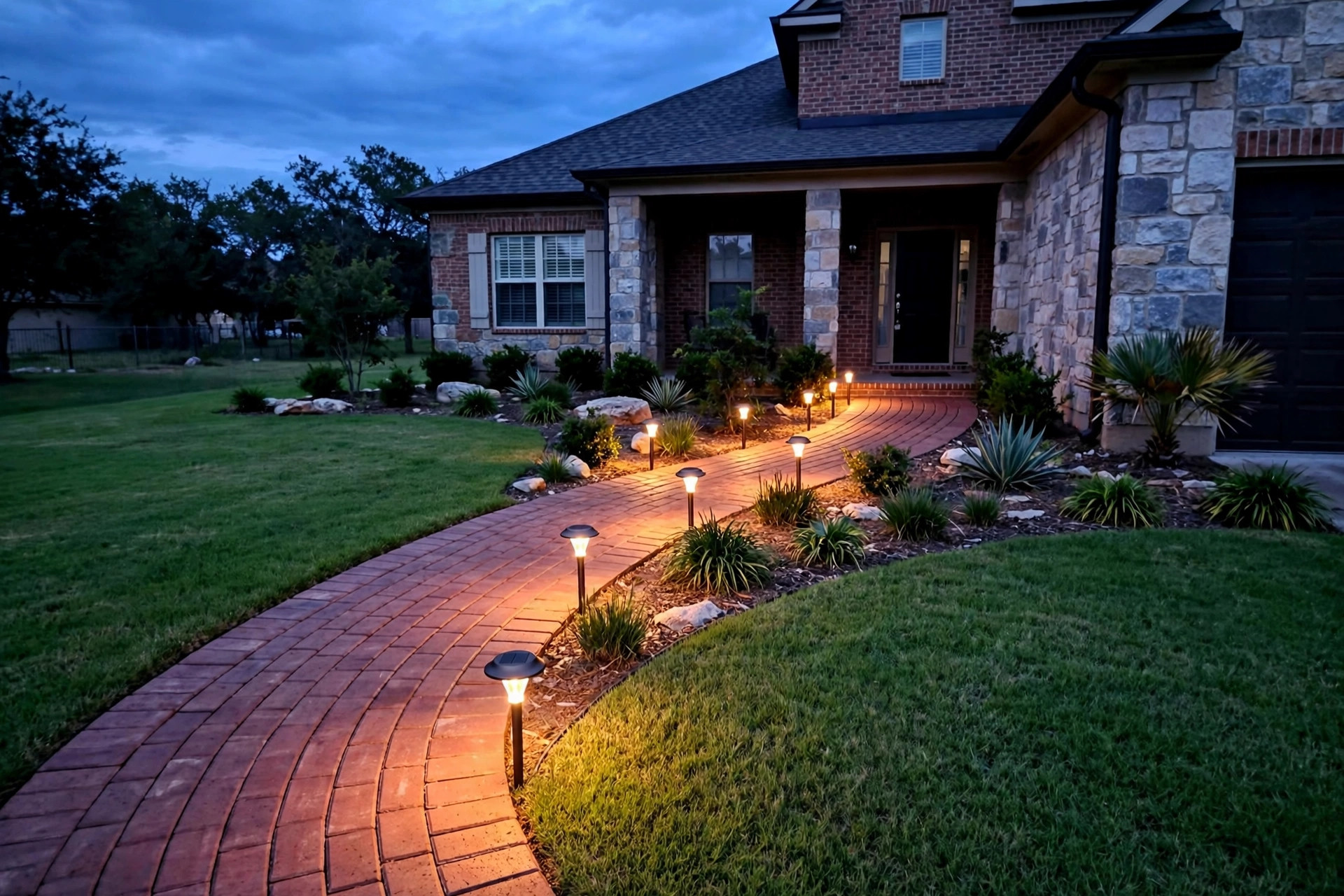

Many Texas homeowners want a safe, bright walkway without raising the electric bill. Solar path lights texas homes usa shoppers choose most often are small lights that sit along a path, charge in the Texas sun all day, and glow on their own at night. They need no wiring and no outlet. This guide explains how they work, which kinds suit Texas weather, what they cost, and how to keep them bright for years.
Why Solar Path Lights Matter in Texas
Texas homes get more strong sun than most states. This gives solar lights a clear edge. A small panel on top of each light collects energy all day. At night a sensor turns the light on by itself. There is no wire to bury and no switch to flip. The walk stays lit on a dark night, and guests can see each step.
Safety is the first gain. A dark path can hide a raised edge, a wet spot, or a loose stone. Falls on home walkways cause many injuries each year. A row of path lights marks the edge of the walk and shows where the step ends. The U.S. Consumer Product Safety Commission and the Department of Energy both note that good outdoor lighting lowers the risk of trips and falls at home.
Curb appeal is the second gain. A lit walkway makes a house look cared for. Real estate writers at the HGTV website and home guides often list outdoor lighting among the cheapest ways to raise the look of a front yard. Texas evenings run warm for much of the year, so many families spend time outside after dark. A lit path makes the yard feel welcoming.
Cost is the third gain. Solar lights run on sun, not on the power grid. There is no monthly cost to run them. A set of six or eight lights costs little, and many last several years. For a Texas home with long sunny days, the charge comes free.
How Solar Path Lights Work: Solar Path Lights Texas Homes Usa
The design is simple. Each light has a small solar panel, a rechargeable battery, a light sensor, and an LED bulb. In the day the panel charges the battery. When light falls, the sensor shuts the lamp off and the charging starts again. When light fades at dusk, the sensor turns the LED on, and the battery feeds the bulb all night.
Most models use nickel-metal hydride or lithium batteries. Lithium cells tend to hold a charge longer and handle heat better, which matters in a Texas summer. LEDs use little power, so one day of charge can give six to ten hours of light. Some models add a motion sensor, so the light burns dim until someone walks near, then it brightens.
What to Look for When You Choose
Not every solar light suits Texas weather. Texas brings hard sun, long heat waves, dust, hail, and heavy rain. Look for these points before you buy.
Brightness. Brightness is rated in lumens. For a path, 10 to 50 lumens per light is enough in most yards. A 10-lumen light gives a soft glow. A 50-lumen light throws a clear pool of light on the walk. For dark driveways or long paths, pick the higher end. Outdoor lighting makers such as Philips explain that path lights need only moderate lumens because the light sits close to the ground.
Battery size and run time. Check how many hours the light runs after a full charge. In Texas summer, a full charge comes fast. In winter or on cloudy days, a small battery may fade before morning. Look for lights that promise eight hours or more. Lithium batteries are the better pick for heat.
Panel quality. Larger panels catch more sun. Monocrystalline panels, often dark blue or black, charge better than thin film panels. If your yard has tree shade, place the lights where they catch at least six hours of direct sun, or buy lights with a remote panel on a cable.
Build and weather seal. Texas storms bring driving rain and wind-blown dust. Pick lights rated IP44 or higher. IP65 is best for open yards. Metal or heavy plastic bodies last longer than thin, light ones. A glass or thick plastic lens resists hail better than a thin film cover.
Color of light. Warm white, around 2700 to 3000 Kelvin, feels soft and homelike. Cool white, around 5000 Kelvin, feels bright and crisp and shows detail better. Many Texas homes use warm white near the front door and cool white near the driveway. Some sets let you switch between colors.
Stake and mounting. Most path lights come with a ground stake. Texas soil can be hard clay in summer. Soak the ground or use a screwdriver to start the hole before you push the stake in. For rock-hard ground, some lights can mount on a small base with screws.
If you also plan to light the porch wall, read about outdoor wall lanterns as a matching choice.
Types and Options
Solar path lights come in several styles. Each suits a different yard.
Classic stake lights. A small lamp head on a stake. This is the most common type. They cost the least and install in minutes. Good for straight walks and garden beds.
Lantern-style path lights. A larger head shaped like an old lantern. They cast light in all directions and look classic near brick or stone walks. They cost more but add charm.
Bollard lights. Tall, slim posts, often one to two feet high. They throw light down in a wide circle. They suit modern Texas homes with clean lines and long driveways.
Disk and flat lights. Low round lights that sit almost flat on the ground. They mark the edge of a path without blocking the view. They work well along pool decks and patios.
Motion-sensor lights. These burn dim all night and jump to full bright when they sense motion. They save battery and add a layer of security near side gates and back doors. Lighting guides at Lumens and Lamps Plus list motion models among the best for security-minded homes.
Color-changing and smart lights. Some sets offer color modes for holidays or parties. A few link to a phone app. These cost more and need more care, but they add fun for outdoor events.
For deck edges and stair tops, many Texas homes pair path lights with deck cap lights, which sit on the rail and light the steps from above.
Cost and Price
Prices vary by brand, brightness, and material. A pack of six basic stake lights often sells for fifteen to forty dollars. Mid-range sets with metal bodies and brighter LEDs run forty to ninety dollars for six or eight lights. High-end bollard or lantern sets can cost fifteen to forty dollars per light.
Big home stores such as Home Depot and Lowe’s carry wide ranges in-store in Texas, so you can see the build quality before you buy. Online shops give more choice and often lower prices.
Think in terms of cost per light and cost per year. A cheap plastic light may last one summer in Texas heat. A sturdier metal light may last four or five years. The dearer light often costs less per year. Batteries wear out in two to three years in hot climates. Many models take standard AA-size rechargeable cells, so you can swap in new batteries instead of buying new lights.
There is no install cost. You place the stakes and walk away. There is no electrician bill and no trench to dig. This makes solar path lights one of the cheapest outdoor upgrades a Texas homeowner can make.
Care and Upkeep
Solar path lights need little care, but a few habits keep them bright.
Clean the panels. Dust and pollen coat the panels in Texas. Wipe each panel with a damp cloth every few weeks in spring and summer. A dirty panel can cut charging by half.
Trim plants. Bushes and grass grow fast in Texas. Keep plants back so they do not shade the panel or cover the lens.
Check the stakes. Wind and rain can tilt the lights. Straighten them after storms so the panels face up and south when possible.
Replace batteries. When lights grow dim even after a sunny day, the battery is likely worn. Open the battery case, note the size, and fit new rechargeable cells of the same type. Do not use regular throwaway batteries in most models.
Store during hail season. North Texas gets hail in spring. If a bad storm is forecast, you can pull the lights and set them in the garage for a day. This simple step can save the lenses.
Energy guides from ENERGY STAR note that solar lighting keeps working even during power outages, which is a real plus during Texas storm season.
Safety
Solar path lights are low voltage and safe to handle. Still, follow a few rules.
Place lights where they mark the walk edge but do not block it. Keep them out of the mowing path if you can, or pull them before you mow. Check that the light does not shine into a neighbor’s window or into drivers’ eyes on the street.
If you buy lights with glass lenses, keep broken pieces away from kids and pets. Pick plastic lenses if children play near the path.
For dark areas near the house wall, consider indoor wall sconces or outdoor-rated sconces to fill the gap between the path lights and the door.
Frequently Asked Questions
How long do solar path lights last in Texas heat? The light body can last three to six years if it is well made. The battery usually lasts two to three years in Texas heat before it holds less charge. You can replace the battery in most models and keep the light going.
Do solar path lights work on cloudy days? Yes, but they charge less. Panels still gather light through clouds, just at a lower rate. After a full cloudy day, run time may drop to four or five hours. A larger panel and a bigger battery help on grey days.
Will they survive a Texas hailstorm? Small hail is usually fine for sturdy lights. Large hail can crack thin lenses. Metal bodies with thick lenses hold up best. If a severe storm is coming, pull the lights inside for the night.
How many lights do I need for my walkway? Space them six to eight feet apart for a soft guide. For a bright, clear path, space them four to six feet apart. A forty-foot walk needs about six to eight lights. Walk the path at night after you place them and move any that leave dark gaps.
Can I leave them out all winter? Yes. Texas winters are mild in most areas. The lights charge less on short days but still work. Wipe the panels after dust storms and check the stakes after wind.
Do solar path lights attract bugs? Warm white LEDs attract fewer bugs than old-style bulbs. Cool white light attracts a bit more. If bugs bother you, pick warm white and place lights a few feet from seating areas.
A Short Final Word
Solar path lights are a small buy with a big payoff for Texas homes. They light the walk, they cost nothing to run, and they ask for little care. Pick sturdy lights with good batteries, place them in full sun, and clean the panels now and then. Your path will glow each night, and your electric bill will not move a cent.
References
ENERGY STAR. (n.d.). Energy efficient products. https://www.energystar.gov Lamps Plus. (n.d.). Lighting and home decor. https://www.lampsplus.com Lowe’s. (n.d.). Home improvement products. https://www.lowes.com Lumens. (n.d.). Lighting and ceiling fans. https://www.lumens.com Philips. (n.d.). Lighting products. https://www.philips.com The Home Depot. (n.d.). Home improvement products. https://www.homedepot.com The Spruce. (n.d.). Home and garden advice. https://www.thespruce.com U.S. Department of Energy. (n.d.). Energy efficiency and renewable energy. https://www.energy.gov
Was this guide helpful?

About Emily Rodriguez
The My Garden US editorial team writes practical, in-depth home and garden guides for American homeowners — tested advice, no fluff.
You May Also Like
Vanity Light Bars for Florida Homes USA: A Complete Guide
June 15, 2026 0 views
Garage Shop Lights: How to Find the Best USA Online Deals
February 5, 2026 0 views
Bedroom Table Lamps Florida Homes USA: A Complete Buying Guide
March 19, 2026 0 views