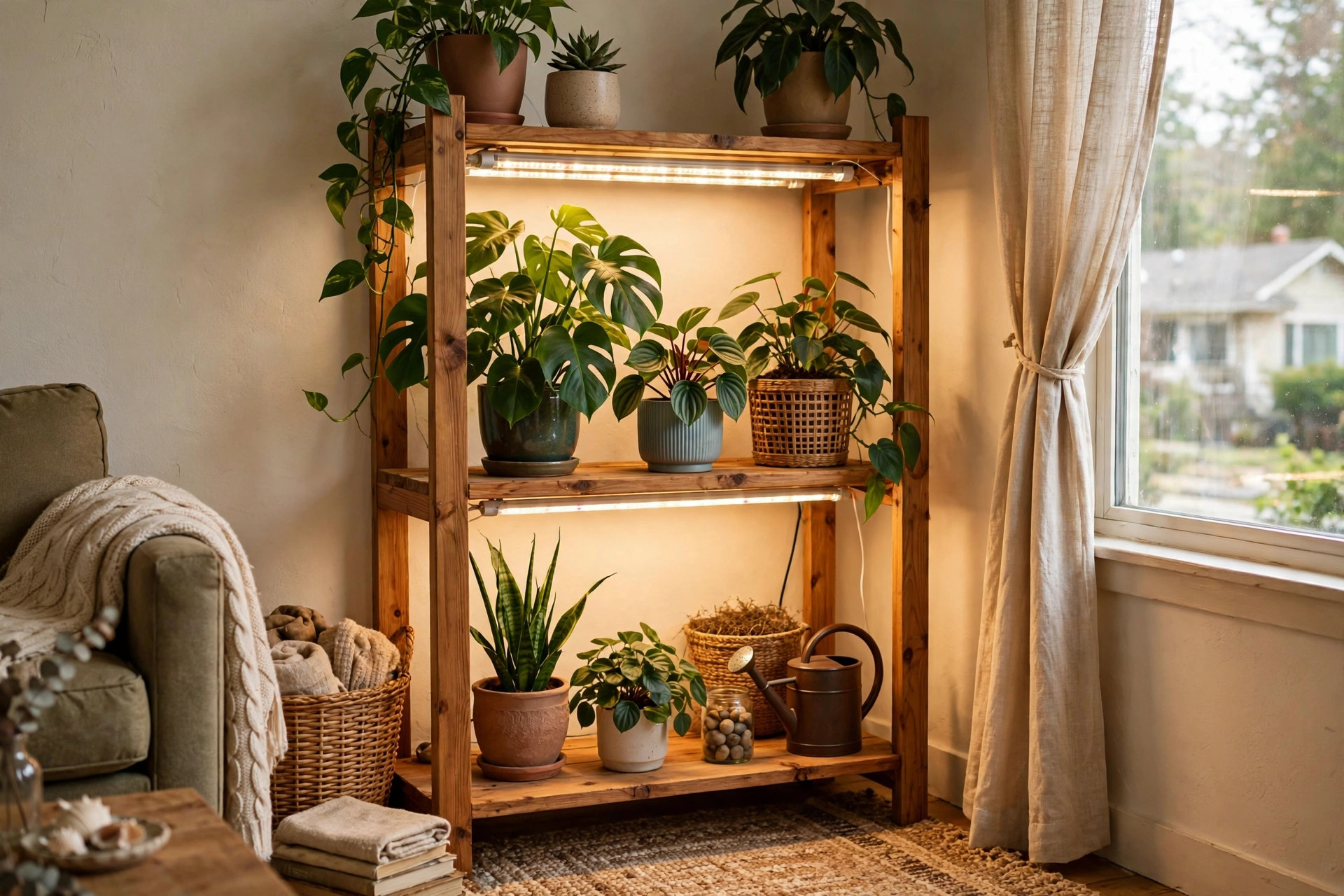

This indoor grow lights American homes guide is written for people who love houseplants but live in homes where the light is too weak. Many American houses have small windows, shaded yards, or rooms that face the wrong way. When plants do not get enough light, they stretch toward the window, drop leaves, and lose color. A good grow light can fix that. It gives plants the steady light they need to grow strong, green, and full. This guide explains the main types of grow lights, how to pick one, how to set it up, what it costs to run, and how to keep it safe in your home.
Why Indoor Grow Lights Matter
Plants make their food from light. This process is called photosynthesis. When a plant gets too little light, it cannot make enough food. It grows tall and thin. Its leaves turn pale or yellow. It may stop growing altogether. Gardeners call this “leggy” growth. It is the most common sign of weak light.
Most houseplants come from places near the equator, where light is strong all year. An American home in winter is very different. Days are short. The sun stays low in the sky. A window that seems bright to your eyes may give a plant only a small part of the light it needs. Your eyes adjust to dim rooms, but plants cannot adjust in the same way.
A grow light closes this gap. It adds light where daylight is weak or missing. It lets you keep plants in any room, not only the rooms with big south windows. It lets you start seeds early and grow herbs in the kitchen in January.
How Plants Use Light: Indoor Grow Lights American Homes Guide
To choose a grow light, it helps to know what plants actually use. Plants do not care about how bright a light looks to a person. They respond to the color and the amount of light they receive.
Light Color
White daylight has many colors mixed together. Plants use red and blue light most. Blue light helps leaves and stems grow strong. Red light helps plants flower and set fruit. Older grow lights gave a pink or purple glow because they mixed only red and blue. Newer lights look white to the eye but still give plants the red and blue they need. This is called full spectrum light. It is easier on your eyes and still feeds your plants well.
Light Amount
The amount of light is just as important as the color. A light that is too far from the plant gives little help. Growers talk about “foot candles” or “PPFD,” but a home gardener does not need these numbers. The simple rule is this: low light plants, like pothos and snake plants, need only a little extra light. Bright light plants, like succulents and citrus trees, need much more. Put the light closer for bright light plants and farther away for low light plants.
Types of Indoor Grow Lights
There are three main types of indoor grow lights sold today. Each has strengths and limits.
Fluorescent Lights
Fluorescent tubes and compact bulbs were the common choice for many years. They are cheap to buy and give off little heat. They work well for seedlings and for low light houseplants. Shop light fixtures with two T8 or T5 tubes can cover a shelf of young plants at a low cost. The weakness is strength. Fluorescent lights are not very bright. Plants that need strong light will still stretch under them. Bulbs also lose power over time and need replacement every year or so.
LED Grow Lights
LED grow lights are now the most popular choice for American homes. They use far less electricity than old style bulbs, last for many years, and give off very little heat, so they can hang close to plants without burning leaves. Many models let you hang one bar or panel over a shelf and cover many plants at once. Full spectrum LED panels give a natural white light that looks fine in a living room. Prices have fallen a great deal. A small LED panel for a few houseplants costs little more than a good lamp. This is the best choice for most home growers today. Guides from Philips and the U.S. Department of Energy explain how LED lights save energy while giving strong, steady output.
High Intensity Discharge Lights
High intensity discharge lights, often called HID, include metal halide and high pressure sodium lamps. These are very strong lights used by greenhouses and serious indoor farmers. For a normal home, they are usually too much. They run hot and use a great deal of electricity. Unless you grow a large indoor garden, you can skip HID lights and choose LED instead.
How to Choose the Right Grow Light
Start with your plants. Make a list of what you grow or want to grow. Herbs and leafy greens need moderate light. Flowering plants and fruit plants need strong light. Then match the light to the need. For a small collection of houseplants on one shelf, a two foot LED bar or a small full spectrum panel is enough. For a tall plant, like a fiddle leaf fig or a small citrus tree, choose a stronger panel that can hang above it. Lighting shops such as Lumens carry indoor grow lights for houseplants in many sizes for these setups.
Check the size of the area the light covers. Makers often state this on the box or the product page. Measure your shelf or your plant area before you buy. A light that covers a two foot square will not serve a four foot shelf. It is better to buy one light that fits than to buy two that are too small.
Look for a timer or buy one separately. Plants need a rest period in darkness, just as they need light. Most houseplants do best with twelve to sixteen hours of light each day. A simple plug in timer from a store like Lowe’s or Home Depot can turn the light on and off for you. This keeps a steady schedule even when you forget.
Read the label for safety marks. A good light will carry a mark from a testing body, such as UL or ETL. This mark shows that the light passed safety tests for use in a home. Cheap lights with no mark can be a fire risk. Spend a little more for a marked, well made unit.
Setting Up Your Grow Light
Good placement matters more than an expensive light. Follow these steps for a sound setup.
Hang or Mount the Light
Most grow lights hang by chains or wires. Hang the light so it sits directly over the plants. Keep it level. Light that shines at an angle leaves part of the plant in shadow. Adjustable chains let you raise the light as plants grow.
Set the Distance
Distance controls how much light the plant gets. As a starting point, hang LED panels twelve to eighteen inches above low light houseplants. For bright light plants, move the light to eight to twelve inches above the leaves. Fluorescent tubes can sit closer, four to eight inches above the plants, because they run cool. Watch the plants for two weeks. If leaves turn pale or bleached, the light is too close. Move it up. If stems stretch toward the light, it is too far away. Move it down. The plants will tell you what they need.
Set the Timer
Plug the light into a timer. Set it for twelve to sixteen hours of light per day, based on your plants. Keep the schedule steady. Plants respond to regular day and night cycles. A good grow light timer schedule for plants is one you can keep every day without thought.
Check the Room
Grow lights add light but also a little heat. In a small closed room, the air can dry out. Keep a small dish of water near the plants if the air gets very dry. Make sure the light does not shine into bedrooms at night. The bright light can disturb sleep.
Cost and Electricity Use
Grow lights are cheaper to run than many people fear. A small LED panel often uses between twenty and sixty watts. If it runs fourteen hours a day, it may add only a few dollars a month to the electric bill. Larger panels use more, but LED lights are far more efficient than old bulbs. The ENERGY STAR program lists efficient lighting products and explains how to read the labels. When you compare two lights, check the watts. Lower watts for the same coverage means lower running cost.
The purchase price varies. A small LED grow bulb that screws into a normal lamp socket can cost less than a dinner out. A two foot LED bar for a shelf is a moderate cost. A large full spectrum panel for a tall plant or a wide garden shelf costs more, but it can last five to ten years. Over time, the running cost matters more than the purchase price. A cheap light that uses many watts will cost more in the long run than a good LED that sips power.
When you plan the whole room, remember that grow lights are only one part of home lighting. A home may also need general lighting for reading, cooking, and dining. A guide to installing LED recessed lights can help with ceiling lights, advice on choosing a chandelier for the dining room covers that space, and tips for buying pendants for a kitchen island help over the counter. Planning all your lighting together gives a better result than treating each room alone.
Care and Upkeep
Grow lights need little care, but a few simple habits keep them working well.
Dust the light every month or two. Dust on the surface blocks light. A dry cloth is enough.
Check the hanging chains and mounts twice a year. Make sure screws are tight and the light does not swing. A light that falls can break plants and damage the floor.
Replace fluorescent tubes when plants slow down, usually once a year. The tubes may still shine, but they give less useful light as they age. LED panels do not need bulb changes. They slowly dim over many years.
Clean the timer and check that it still clicks on and off at the set times. Timers can wear out. If the schedule drifts, plants may get too much or too little light.
Keep a simple log. Note when you hung the light, how far above the plants it sits, and how many hours it runs. If you change something and the plants respond, the log helps you learn what works.
Safety Tips
Grow lights are electric devices. Treat them with care.
Keep water away from the light. Do not mist plants directly under a bare light unless the light is rated for damp use. Water and electricity do not mix. Place a tray under plants to catch drips.
Do not overload outlets. One or two small grow lights on a normal outlet are fine. A whole room of large panels may need its own circuit. If a breaker trips, that is a warning. Do not just reset it and add more. Ask an electrician.
Let the light cool before you touch it. LED lights run cool, but some still warm up.
Keep cords neat and off the floor. Use cord clips to run wires along the wall or the shelf. This keeps them away from water and feet. Check cords for cracks or bare wire once a year.
Do not look straight into a strong LED panel. It can hurt your eyes. When you work under the light, turn it off or wear simple sunglasses. Shops that sell lighting, such as Lamps Plus, often note this warning on strong task lights as well.
Frequently Asked Questions
How many hours a day should indoor grow lights run?
Most houseplants do well with twelve to sixteen hours of light each day. Seedlings and herbs often like sixteen hours. Mature foliage plants often like twelve to fourteen. Always give plants a dark rest period of at least eight hours. A timer makes this easy.
Can I leave grow lights on all day and night?
No. Plants need darkness as part of their daily cycle. Constant light can stress plants and waste electricity. Set the timer and let the plants rest at night.
Do grow lights work for any houseplant?
Yes, but the amount of light must match the plant. Low light plants need only a little help. Bright light plants need a strong light placed close. Read about each plant before you set up the light.
Are LED grow lights better than fluorescent ones?
For most homes, yes. LED lights use less power, last longer, and run cooler. Fluorescent lights still work for seedlings and small setups, and they cost less to buy.
Will grow lights raise my electric bill a lot?
A small LED setup adds only a few dollars a month. The exact amount depends on the watts and the hours it runs. Check the watt rating on the box and multiply by your hours.
Where should I place the grow light?
Directly above the plants, close enough to give strong light but far enough to avoid burning leaves. Start with twelve to eighteen inches for most LED panels and adjust based on how the plants respond.
A Final Word
A grow light is a simple tool with a big payoff. It turns a dark corner into a place where plants can thrive. It lets you garden through winter. Start small. Pick a good full spectrum LED light that fits your space. Hang it well, set a steady timer, and watch your plants. They will show you, leaf by leaf, that the light is working.
References
ENERGY STAR. (n.d.). Energy efficient products. https://www.energystar.gov Lamps Plus. (n.d.). Lighting and home decor. https://www.lampsplus.com Lowe’s. (n.d.). Home improvement products. https://www.lowes.com Lumens. (n.d.). Lighting and ceiling fans. https://www.lumens.com Philips. (n.d.). Lighting products. https://www.philips.com The Home Depot. (n.d.). Home improvement products. https://www.homedepot.com The Spruce. (n.d.). Home and garden advice. https://www.thespruce.com U.S. Department of Energy. (n.d.). Energy efficiency and renewable energy. https://www.energy.gov
Was this guide helpful?

About Emily Rodriguez
The My Garden US editorial team writes practical, in-depth home and garden guides for American homeowners — tested advice, no fluff.
You May Also Like
Garage Shop Lights: How to Find the Best USA Online Deals
February 5, 2026 0 views
Kitchen Track Lighting Where to Buy USA: A Complete 2026 Guide
February 27, 2026 0 views
Ceiling Fans Lights: Where to Buy in the USA
June 10, 2026 0 views