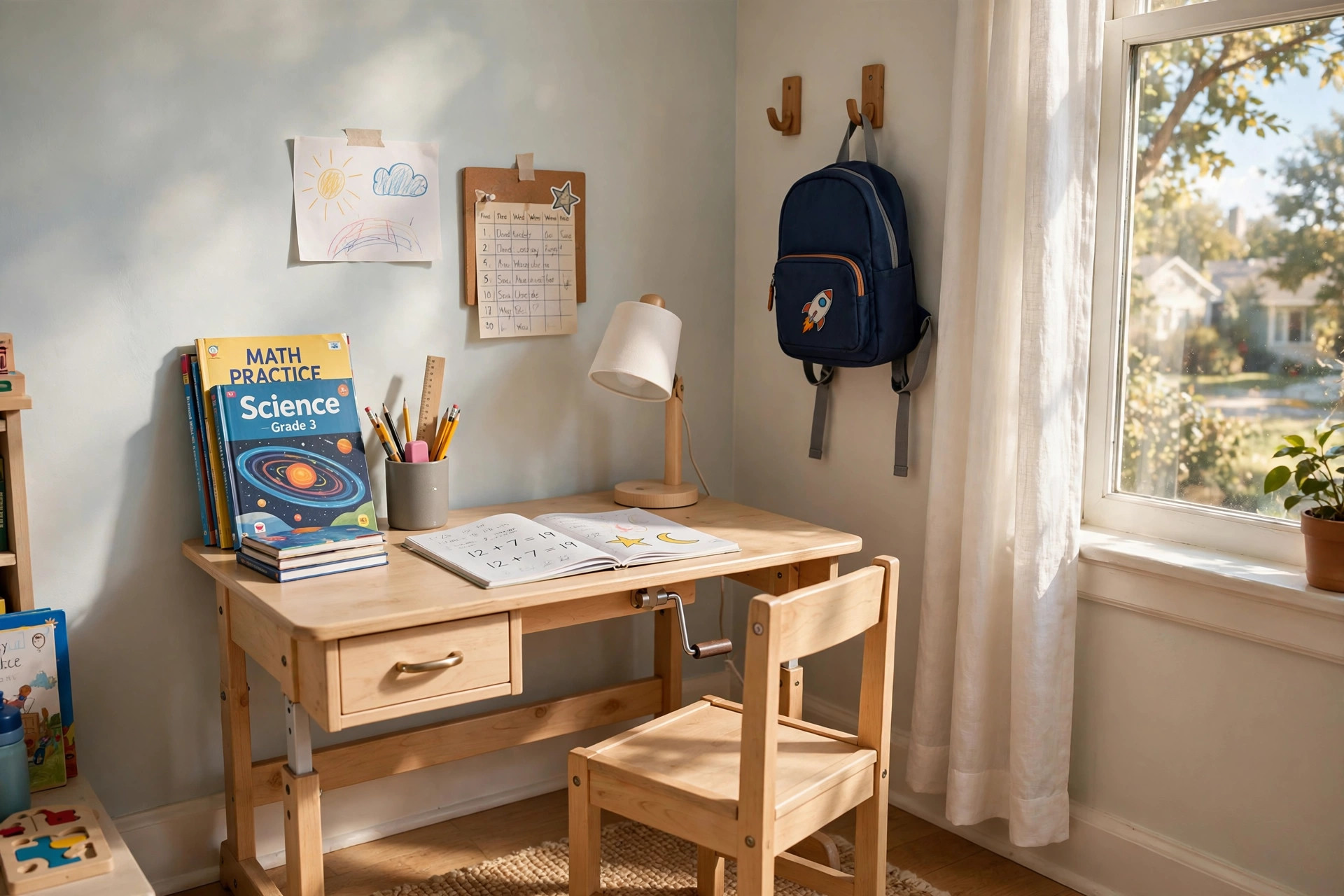

A small adjustable desk for kids homework station is one of the most useful things a parent can buy for a school-age child. It gives the child a fixed place to sit and study. It is small enough to fit in a bedroom corner or a shared living room. And because the height can be changed, it keeps working as the child grows taller year after year.
Many families buy a regular table or let the child work on the kitchen table. That works for a while. But a kitchen table is too high for a young child. It causes bad posture. It also means the child must clear away books and pencils before every meal. A homework station solves both problems at once. It stays put. It fits the child.
This guide covers what matters when you shop, the main types of desks, what they cost, how to care for one, and the safety points to check.
Why a Homework Station Matters
A child who has a set place to work tends to sit down and start faster. The desk becomes a signal. When the child sits at the homework station, it is time to study. Teachers and family counselors have noted this for decades. A steady spot cuts down on wandering and fussing.
Good posture is the second reason. A desk that is too high pushes the child’s shoulders up. A desk that is too low makes the child hunch. An adjustable desk lets you set the height so the child’s feet rest flat on the floor and the arms rest at a right angle.
The third reason is simple space. Many homes do not have a spare room for study. A small adjustable desk for kids homework station takes up little floor space. When the child’s schoolbooks, pencils, and papers have one home, the rest of the house stays calmer.
Parents often ask how a kids desk differs from a simple small table. A plain table is fixed at one height. A child grows fast between ages six and twelve. An adjustable kids desk rises with the child, often from about 20 inches to about 30 inches.
How to Choose the Right Desk: Small Adjustable Desk for Kids Homework Station
Start with size. Measure the spot where the desk will stand. Write down the width, depth, and the space the chair will need behind it. A small adjustable desk for kids homework station usually runs 28 to 40 inches wide and 16 to 24 inches deep. Bring a tape measure to the store or check the listed size online before you order.
Check the height range next. Look for a desk that adjusts from around 20 inches up to at least 29 or 30 inches. That range covers most children from first grade through middle school. The change should be simple. Crank handles work well and give fine control. Push-button electric motors work too, but they add cost and need an outlet.
Look at the work surface. It should be smooth and easy to wipe. Kids spill drinks and drop paint. A sealed wood or laminate top stands up to daily use. A slight tilt option is a bonus for drawing and reading. If the top tilts, make sure it locks flat for writing.
Storage matters more than most parents expect. A desk with a shallow drawer or a side hook keeps pencils and rulers off the surface. But too many shelves can eat into leg room. For a small desk, one drawer or one small shelf is enough. You can add a rolling cart beside the desk later for books and papers.
Stability is not to be skipped. Push the desk in the store or read reviews of its frame. A wobbly desk makes handwriting harder. Steel or solid wood legs beat thin plastic. The desk should not rock when a child leans on it.
Weight limit is worth a glance. Most kids desks hold 50 to 110 pounds. That is plenty for books, a lamp, and a tablet.
Finally, think about the chair. The desk is only half of the station. The chair should let the child’s feet touch the floor. An adjustable chair is ideal. The desk and chair must be sized together, not bought apart.
Types of Adjustable Desks for Children
There are four common types. Each suits a different home and budget.
Crank-adjust kids desks. These are the most common. A hand crank raises or lowers the top. They are strong, simple, and need no power. A child can turn the crank with adult help. Prices are moderate. They are the safest pick for most families. Independent reviews, such as the desk tests at the Wirecutter, check how smoothly these mechanisms run under daily use.
Electric sit-stand kids desks. A small motor does the lifting at the push of a button. They adjust smoothly and often include a memory setting. They cost more and need a wall outlet. They suit older children who like to stand while they work. Reviews on PCMag compare standing desk motors and note which ones run quiet enough for a home.
Tilt-top drawing desks. The top tilts up like a drafting table. They are made for art and reading as well as writing. Look for a model that locks flat for homework and tilts for drawing. A lip or pencil stop keeps supplies from sliding off. IKEA sells several child work tables with tilt tops and simple height settings.
Wall-mounted fold-down desks. These bolt to the wall and fold up when not in use. They save the most floor space. They are fixed in height, though, so they do not grow with the child in the usual way. Some parents pair one with an adjustable chair. A floating shelf desk for tiny bedroom office shows the same space-saving idea; read our piece on the floating shelf desk for tiny bedroom office.
A related choice worth a look is a desk with a built in shelf for books. For older students who need book storage at the desk, our guide to the small desk with built in bookshelf for students covers that style in full.
Cost and Price: What to Expect
Prices for a small adjustable desk for kids homework station run in clear bands. A simple crank desk from a large retailer usually costs between 80 and 180 dollars. These are sturdy enough for daily homework. Wayfair lists many models in this range with buyer photos that show real size.
Mid-range desks, from about 180 to 350 dollars, add better materials, smoother cranks, tilt tops, or nicer finishes. Brands known for office furniture, such as Steelcase and Herman Miller, publish ergonomic guidance that explains why a well-built frame matters for posture over long study hours.
Electric kids desks run from about 250 to 500 dollars. The motor and control panel drive the price. Upright-style makers such as UPLIFT Desk offer small frames that some parents adapt for a child’s station, though they are priced like adult furniture.
Used desks are worth a thought. Schools and offices sell off child-size furniture at low prices. Just test the height mechanism before you pay. A crank that slips or a motor that hums and stalls is not a bargain.
Delivery and assembly add cost too. Many desks ship flat, and assembly takes 30 to 60 minutes with basic tools.
When you compare prices, divide the price by the years of use. A 150-dollar desk that serves from age seven to age twelve costs about 25 dollars a year.
Setting Up the Station
Pick a spot with good light. A desk near a window is ideal for daytime work. The light should come from the side, not from behind the screen or straight into the child’s eyes. For evening work, add a desk lamp with a warm bulb. Guides on The Spruce explain how to place a lamp so it lights the work without glare.
Keep the chair and desk matched. Seat the child and check: feet flat on the floor or on a footrest, knees and elbows at about a right angle. Adjust the desk first, then the chair. Recheck every six months.
Keep supplies within reach. A pencil cup, a small tray for papers, and a hook for the schoolbag cover daily needs. Anything used less than weekly belongs in a closet or shelf, not on the desk.
Add a reading lamp if the room is dim. If the desk is electric, run the cord along the wall with clips so it does not snag.
For families setting up a shared corner, a college-style desk can work for teens. Our guide on the best home office desk for college students dorm covers larger desks that suit older students sharing small rooms.
Care and Upkeep
A kids desk takes daily wear. A little care keeps it working for years.
Wipe the top once a week with a damp cloth and mild soap. Dry it after. Keep harsh cleaners away from laminate and painted tops. They dull the finish. For crayon or marker marks, a soft eraser sponge usually lifts them without scratching.
Check the height mechanism twice a year. For a crank desk, turn the crank through its full range and listen for grinding. A drop of light oil on the screw keeps it smooth. For an electric desk, run it from low to high and watch for jerks or stalls.
Tighten the bolts every six months. Kids lean, push, and climb. Screws loosen. A quick pass with the right wrench takes five minutes and stops wobbles before they start.
Keep the desk dry. Do not let a plant pot sit right on the top. Water rings stain wood and swell particle board. Use a mat under drinks.
If the top tilts, check the lock each month. A tilt lock that slips can drop books on small fingers. Replace worn knobs at once.
When the child outgrows the desk, pass it on. A clean, working adjustable desk sells well secondhand or serves a younger sibling.
Safety Points
Safety comes first with any children’s furniture.
Stability. The desk must not tip. Test it by pressing down on the front edge. Wide feet and a low center of weight help. If the desk feels tippy, bolt it to the wall with an anti-tip strap. This is the same rule used for bookcases.
Pinch points. Crank handles and scissor-style legs can pinch fingers. Show the child how the crank works and set a rule: only an adult changes the height. Keep small siblings away while the desk is moving.
Weight on top. Do not let children climb or sit on the desk. Most kids desks are rated for books and supplies, not body weight. The weight limit is printed in the manual.
Edges and corners. Rounded corners are kinder than sharp ones. If the desk has sharp edges, stick-on corner guards made for child safety cost little and fit most tops.
Cords. Electric desks have power cords. Route them so a child cannot trip or pull the desk over.
Materials. Look for desks with low chemical emissions. Solid wood and steel are safe bets. For pressed-wood tops, check that the product meets standard indoor air rules.
Placement. Keep the desk away from windows a child could climb through and away from blind cords. Put it where you can see the child work. A desk facing into the room lets a parent glance over without hovering.
FAQ
At what age should a child get a homework desk? Most children are ready around age five or six, when school homework begins. Set the desk to its lowest height for a first grader. Early use builds the habit.
How high should the desk be for my child? Seat the child in the chair with feet flat. Measure from the floor to the child’s elbow. That is about the right desk height. Recheck every few months. Children grow in spurts.
Is an adjustable desk worth it over a fixed table? Yes, for most families. A fixed table fits for a year or two. An adjustable desk fits for five or six years. The cost per year is lower, and the posture is better the whole time.
Can the child adjust the height alone? Older children can learn to use a crank safely. Younger children should have an adult do it. Set the house rule early.
What size fits a very small bedroom? Look for a top around 28 inches wide and 16 to 20 inches deep. That holds a book, a notebook, and a pencil cup. A fold-down or wall-mounted style saves even more room.
Should the desk tilt for writing? A flat top is best for writing. A slight tilt helps for reading and drawing. If you buy a tilt-top desk, make sure it locks fully flat.
A Short Final Word
A small adjustable desk for kids homework station is a plain, honest piece of furniture. It does not need to be costly or fancy. It needs to be steady, the right size, and able to grow with the child. Measure your space. Pick a simple crank model if the budget is tight. Add a good chair and a lamp. Set it up with care, check it twice a year, and it will serve through grade school and beyond. The habit of sitting down to work in one’s own spot is worth far more than the desk itself.
References
Herman Miller. (n.d.). Office furniture and ergonomic seating. https://www.hermanmiller.com IKEA. (n.d.). Home furnishings. https://www.ikea.com PCMag. (n.d.). Technology product reviews. https://www.pcmag.com Steelcase. (n.d.). Office furniture and workplace research. https://www.steelcase.com The Spruce. (n.d.). Home and garden advice. https://www.thespruce.com UPLIFT Desk. (n.d.). Standing desks and ergonomic office furniture. https://www.uplift-desk.com Wayfair. (n.d.). Furniture and home goods. https://www.wayfair.com Wirecutter. (n.d.). Product reviews from The New York Times. https://www.nytimes.com/wirecutter
Was this guide helpful?

About Sarah Mitchell
The My Garden US editorial team writes practical, in-depth home and garden guides for American homeowners — tested advice, no fluff.
You May Also Like

Adjustable Laptop Desk for Bed and Couch Use
January 5, 2026 0 views
Home Office Standing Desk With Drawers Attached: A Complete Guide
May 13, 2026 0 views
Best Home Office Desk for College Students Dorm: A Guide to Small-Room Study Furniture
February 27, 2026 0 views