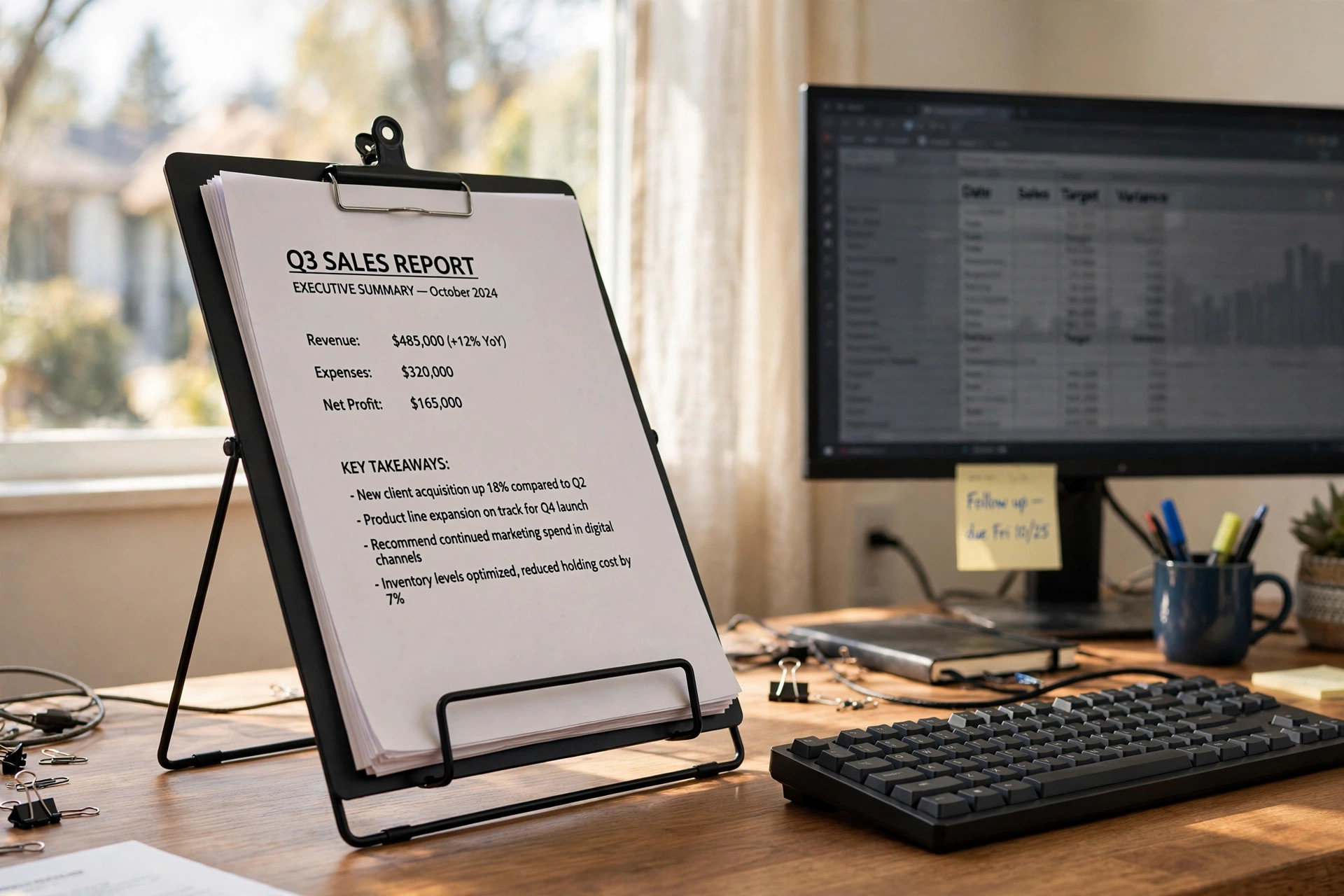

If you type from paper all day, the best document holder for typing at desk may be the most useful tool you do not own yet. A typist who works from printed pages looks down at the desk, then up at the screen, then down again. This happens hundreds of times a day. Each glance down bends the neck forward. Over weeks and months, that small bend turns into a stiff neck, sore shoulders, and tired eyes.
A document holder lifts the paper to a comfortable height. It places the page beside the monitor or just below it, at an angle that keeps your head in a natural position. Your eyes can move between the paper and the screen with little effort. This guide explains why that matters, which types of holders exist, how to choose one, what they cost, and how to use one well.
Why It Matters for Daily Typing Work
The Neck Strain Problem
Office workers who type from documents face a well-known pattern of pain. The human head weighs about ten to twelve pounds. When the head tilts forward, the muscles of the neck and upper back carry much more than that. Looking down at papers on a flat desk for hours each day can cause headaches, tight shoulders, and a burning feeling between the shoulder blades. Ergonomics experts call the solution “neutral posture”: ears over shoulders, eyes level with the top of the screen, and paper raised to match.
A document holder is one of the simplest ergonomic fixes. It does not need power or assembly skills. It sits on your desk and holds your papers upright at an angle, like an open book on a small lectern. Many typists report that neck pain drops within the first week of use. The holder also reduces eye strain, because the paper sits at the same distance from your eyes as the screen, so your eyes do not refocus constantly.
Productivity Gains You Can Measure
There is a second benefit that office managers care about. When a document lies flat on the desk, the typist loses her place each time she looks away. She must search for the last line she read. With the best document holder for typing at desk, the page stays in front of her eyes at a fixed angle. A small line guide or slider can mark the current line. This steady setup speeds up data entry, billing work, medical transcription, and any task that moves words from paper to screen. Workers often finish copy-typing tasks faster with fewer errors, since they never lose their place on the page.
For the home office, the gains matter just as much. Many people now work from small desks where space is tight. A best desk organizer set for small office desk can keep supplies neat, but a document holder solves a different problem: it turns the desk into a proper typing station where paper and screen work together instead of fighting for space.
What to Look for When Choosing One: Best Document Holder for Typing At Desk
Size and Paper Capacity
Think about the papers you handle most. Most holders fit standard letter-size sheets, eight and a half by eleven inches. If you work with legal-size documents or wide spreadsheets, look for a holder with a wider back panel and a stronger clip. Some models hold a single sheet at a time, which suits short letters. Others hold thick stacks of up to two hundred sheets, which suits long reports and bookkeeping files. A heavy-duty holder with a firm ledge will keep a thick stack from sliding.
Angle and Height Adjustment
The best holders adjust both the tilt angle and the height. A fixed stand works for some people, but adjustable stands fit many more body types and desk setups. Look for a holder that tilts from flat to nearly upright. A holder that sits beside the monitor should put the paper at roughly the same height as the screen center. If you pair the holder with a best laptop stand for standing desk posture, match the paper height to your raised laptop screen so your eyes travel on a level line.
Clip and Page Guides
The clip at the top of the holder should grip firmly without tearing the page. Spring clips are common and reliable. Some holders use a magnetic strip or a rubber band instead of a clip, which suits fragile or thick papers. A sliding line guide is a welcome extra: it is a small ruler that moves down the page as you type, marking your current line so you never lose your place. If you type long documents, this small feature saves more time than any other.
Stability and Build Quality
A holder must not slide when you turn a page or pull a sheet free. Rubber feet or a heavy base keep it in place. Metal holders cost more than plastic ones but last longer and feel steadier. Look at the hinge, too. A good hinge holds the chosen angle without slipping. Cheap plastic hinges loosen after a few months and the holder slowly folds flat, which defeats the purpose. Reading desk reviews from ergonomic specialists can help you judge build quality before you buy; detailed buying advice appears on sites such as the Wirecutter and PCMag, which test office gear carefully.
In-Line vs. Side Placement
Some holders are wide and sit between you and the keyboard, just below the monitor. This “in-line” style keeps the paper directly in your line of sight, which suits heavy data entry. Others are narrower and sit to the left or right of the monitor, which leaves desk space open for a mouse or phone. If you use a adjustable monitor arm for dual screen setup, a slim side holder fits well between two screens without crowding either one.
Types and Options Compared
Stand-Style Holders
The stand style is the classic choice. It is a small frame, usually metal or plastic, with a back panel, a bottom ledge, and a top clip. You set it on the desk and lean it at your chosen angle. Stand holders are cheap, light, and easy to move. They suit most typists and most papers. The best models adjust in both height and tilt and hold at least fifty sheets. This style is the right pick when you want the best document holder for typing at desk without spending much.
Arm-Mounted Holders
An arm-mounted holder clamps to the desk edge or to a monitor arm and floats the paper on an adjustable arm. These cost more, but they free up desk space entirely. You can swing the holder into position when you need it and push it aside when you do not. Arm models suit shared desks and tight corners, where every inch of surface counts. Many mount to the same post as a monitor arm, so the paper and screen move as a pair.
Copy Holders With Sliding Arms
Some designs borrow from the old “copy holder” idea: a weighted arm with a paper grip that slides along a track. These are less common today but still useful for bookkeeping and transcription work. They hold many sheets and the sliding arm marks your place precisely. They suit professionals who type long documents every day and want the smoothest page tracking available.
Budget and Premium Picks
Budget holders sell for under twenty dollars. A simple plastic stand with a spring clip does the job for light use, such as paying bills or typing short letters. Mid-range holders cost between twenty and fifty dollars and add metal frames, better hinges, and line guides. Premium holders run from fifty dollars to over one hundred and fifty dollars. These include arm-mounted designs, heavy-duty stack holders, and models built to hospital or office-grade standards. For a full-time typist, the mid-range is usually the sweet spot: sturdy enough for daily use without paying for features you will not touch.
Cost and Price Guide
Prices for document holders span a wide range because the category covers simple stands and complex arms. Here is what to expect when you shop at major office retailers and furniture stores.
– Under $20: Basic plastic stands with fixed or slightly adjustable angles. Good for students and light home use. Retailers such as IKEA and Wayfair often list affordable options in their desk accessories lines. – $20 to $50: Adjustable metal stands with line guides and non-slip feet. The best value for daily typing work. Many well-reviewed models sit in this band. – $50 to $100: Heavy-duty holders with large capacity and smooth hinges, plus some entry-level arm-mounted models. Suits accountants, medical billers, and legal assistants. – $100 and up: Premium arm-mounted holders and professional ergonomic systems from office furniture makers such as Herman Miller and Steelcase. Built for all-day professional use.
Watch for shipping costs and return policies when you order online. A holder that looked sturdy in photos may wobble on your real desk, so buy from a store that accepts easy returns. Office supply guidance on The Spruce also compares home office accessories and can help you set a budget before you shop.
Care and Upkeep
A document holder asks for almost no maintenance, but a few habits keep it working well for years. Wipe the back panel with a damp cloth every few weeks; dust makes paper stick and slide in unpredictable ways. Check the hinge screws twice a year and tighten any that have loosened. If the rubber feet wear thin, replace them with small adhesive bumper pads so the holder does not scratch your desk or slide during use.
Keep the holder out of direct sun for long hours if it is plastic, since heat can warp thin panels. Metal holders need no special care beyond a wipe-down. If your holder has a sliding line guide, clean the track now and then so the guide moves smoothly. When you travel with a stand-style holder, fold it flat and place it in a bag so the clip does not bend out of shape.
Safety and Ergonomics
The whole point of a document holder is health, so set it up correctly. Place the holder so the paper sits at the same distance from your eyes as your monitor, usually about twenty to twenty-six inches. The top of the paper should sit at or just below eye level. If you raise your screen with a stand, raise the paper to match. Your neck should stay upright and your eyes should do the moving.
Do not lean the paper so far back that glare from your desk lamp washes out the text. Angle the holder slightly away from direct light. If you wear bifocals or reading glasses, you may need the paper a little closer than the screen; adjust until your eyes feel relaxed at both positions.
Take breaks even with perfect posture. Every twenty minutes, look at something twenty feet away for twenty seconds. Roll your shoulders and turn your head gently from side to side. No holder can replace movement. If you feel pain that lasts more than a week, see a doctor or a physical therapist rather than hoping a desk tool will fix it.
Frequently Asked Questions
Where should I place the document holder on my desk?
Place it between your keyboard and your monitor if you type mostly from paper, since this keeps the paper in your direct line of sight. Place it to the side of the monitor if you type mostly from the screen and check the paper only now and then. Either way, keep the paper at the same viewing distance as the monitor.
Can a document holder work with a laptop?
Yes. Raise your laptop on a stand so its screen sits at eye level, then put the holder beside it at the same height. Use an external keyboard and mouse if possible, so your hands stay in a comfortable typing position while your eyes stay level.
What size documents can a holder take?
Most holders fit letter-size sheets. Wider models fit legal-size sheets and open books. If you type from bound books or thick manuals, choose a holder with a wide base and a strong ledge, and look for one rated for several hundred sheets.
Is a document holder better than typing from a tablet?
For most typists, yes. A tablet screen sits flat or at a fixed angle and forces the same downward glance as paper on a desk. A holder raises the paper to eye level and costs far less than a second screen. A tablet still wins when your source text is digital and you need to zoom or search within it.
How much should I spend on a document holder?
For daily use, forty to seventy dollars buys a sturdy adjustable model that lasts for years. Under twenty dollars works for occasional use. Spend more only if you need an arm-mounted design or hold very thick stacks every day.
Do document holders work for left-handed typists?
Yes. Most holders are symmetrical and work the same for left and right-handed users. If you keep the holder on the left side of the monitor, make sure the clip opens from the top or center so your dominant hand can change pages easily.
A Short Final Word
The best document holder for typing at desk is a small purchase with a large daily effect. It lifts your papers to eye level, calms your neck, and keeps your place on the page while you type. Choose an adjustable model that fits your paper size, set it at the same distance as your monitor, and give it a week. Many typists wonder, after that week, how they ever worked without it.
See UPLIFT Desk for more detail.
References
Herman Miller. (n.d.). Office furniture and ergonomic seating. https://www.hermanmiller.com IKEA. (n.d.). Home furnishings. https://www.ikea.com PCMag. (n.d.). Technology product reviews. https://www.pcmag.com Steelcase. (n.d.). Office furniture and workplace research. https://www.steelcase.com The Spruce. (n.d.). Home and garden advice. https://www.thespruce.com UPLIFT Desk. (n.d.). Standing desks and ergonomic office furniture. https://www.uplift-desk.com Wayfair. (n.d.). Furniture and home goods. https://www.wayfair.com Wirecutter. (n.d.). Product reviews from The New York Times. https://www.nytimes.com/wirecutter
Was this guide helpful?

About Emily Rodriguez
The My Garden US editorial team writes practical, in-depth home and garden guides for American homeowners — tested advice, no fluff.
You May Also Like
Best Standing Desk for Gaming and Work Combo: A Complete Guide
June 21, 2026 0 views
The Best Home Office Setup for Software Developers
March 28, 2026 0 views
Ergonomic Saddle Stool for Standing Desk Alternative: A Practical Guide
March 4, 2026 0 views