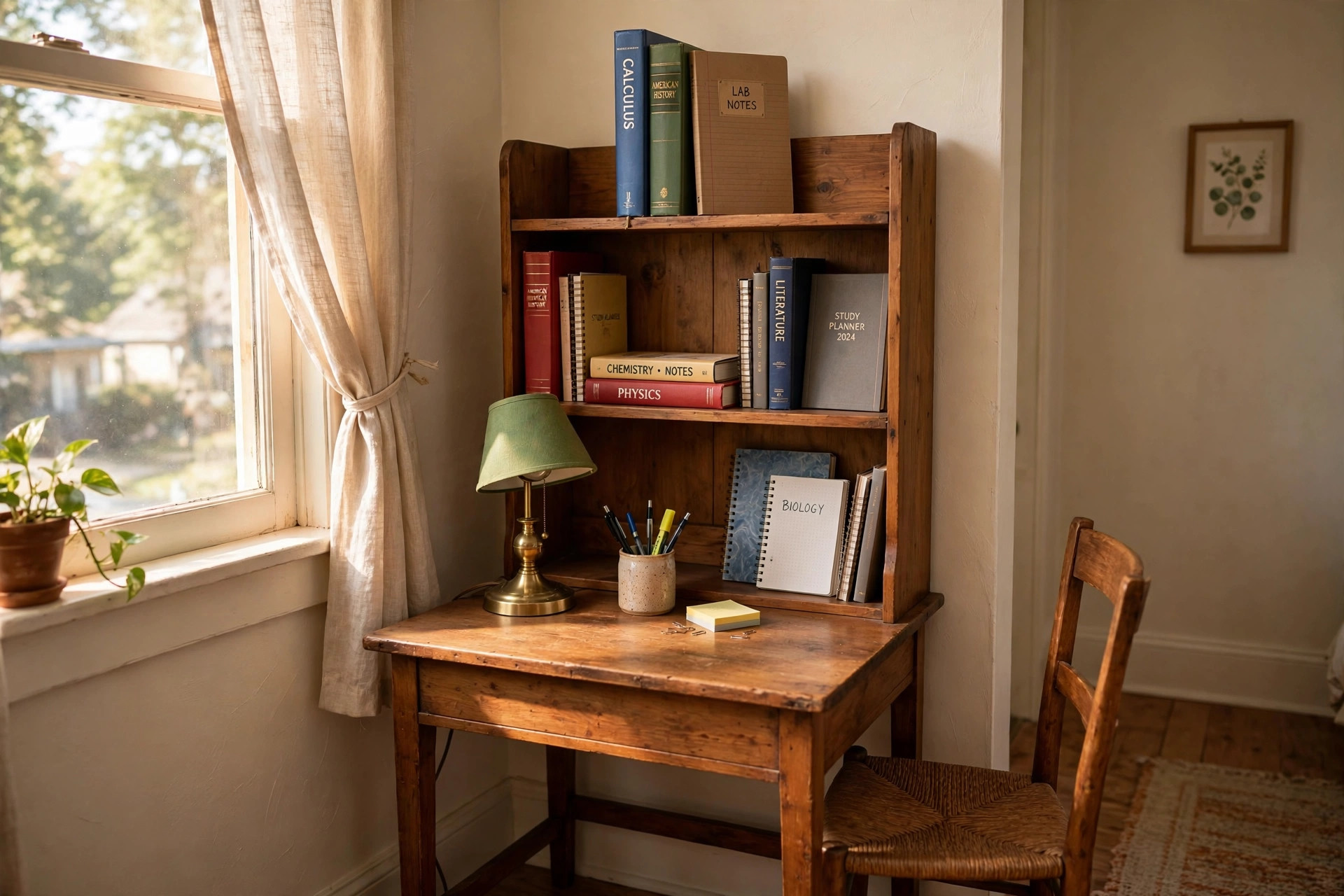

A small desk with built in bookshelf for students is one of the best answers for a small room. It gives a child or teen a place to read, write, and do homework. It also holds books, notebooks, and school supplies on shelves that sit right above or beside the work top. When floor space is short, this one piece of furniture does the work of two.
Parents buy these desks for bedrooms, dorm rooms, and small apartments. Students like them because everything they need is within arm’s reach. This guide explains why the desk matters, what to look for before you buy, what types exist, what they cost, how to set one up, how to care for it, and how to keep it safe. It also answers common questions at the end.
Why a Small Desk with a Bookshelf Matters
A student needs a quiet corner that belongs to work. A kitchen table shared with the whole family is not a study space. A desk gives the student a fixed spot. The brain learns to link that spot with study. Over time, sitting down at the desk makes it easier to start.
The built in bookshelf adds a second gain. Books do not pile up on the floor. Notebooks do not get lost under the bed. When books stand on shelves in plain sight, the student sees them and uses them. Teachers have long said that children read more when books are easy to reach.
Space is the third reason. A separate desk and a separate bookcase take up two footprints. A small desk with built in bookshelf for students takes up one. In a room that is ten feet by ten feet, that saved space is large. The room still has space for a bed, a chair, and a path to the door.
There is also the money side. One piece costs less than two pieces bought apart. For families on a budget, that counts.
What to Look For When You Choose: Small Desk with Built in Bookshelf for Students
Size of the Work Top
The desk top must fit the way the student works. For a young child, a top of 28 to 32 inches wide is enough for a workbook and a pencil box. For a middle school student, 36 inches wide is a good mark. High school and college students who use a laptop should look for 40 inches or more. The top should be deep enough for a book to lie open, about 18 to 22 inches.
Measure the room first. Mark the spot with tape on the floor. Leave room to push the chair back. Leave room to open drawers. A desk that blocks a closet door is the wrong desk, no matter how nice it looks.
Shelves and Storage
Count the shelves. Two or three shelves hold a school year of books. Check the height between shelves. Tall text books need nine to twelve inches of clear space. Adjustable shelves are a fine thing to have. The shelves can move as the books change.
Look at the depth of the shelves. Six to eight inches hold most school books. Some desks add a small drawer for pens and small items. A drawer keeps the work top clear. If the desk has no drawer, a best pen holder organizer for office desk keeps writing tools in order on the top.
Build and Material
Most student desks are made from engineered wood, solid wood, or metal and wood mixed. Engineered wood costs less and looks smooth. Solid wood costs more and lasts longer. Metal frames are strong and light. Check the weight limit in the product facts. A desk should hold books, a laptop, and a lamp without a shake.
Look at the edges. Smooth, rounded edges are safer for young children. Sharp corners can hurt. Look at the finish. A finish that resists scratches and water will look good longer.
Height and Chair Fit
The desk height must match the chair and the student. Most desks stand 28 to 30 inches high. The student should be able to sit with feet flat on the floor and elbows near the height of the top. If the desk is too high, the child will lift the shoulders. If it is too low, the child will hunch.
Pair the desk with a good chair. A best ergonomic office desk chair for back pain shows how much a right chair matters for long study hours. For young children, look for a chair with a height that can change as they grow.
The Hutch or Upper Shelf
Many small desks carry a hutch. A hutch is the shelf unit that stands on the back of the desk top. It adds storage without adding floor space. Check that the hutch does not block light from a lamp. Check that it is fixed well to the desk. Some hutches come off, which helps when moving the desk through a door.
Types and Styles of Student Desks
The Classic Study Desk with Shelves
This is the most common type. A plain desk top with two or three open shelves above it. It fits any room. It is often the lowest in price. Brands on sites like IKEA and Wayfair sell many versions of this style.
The Corner Desk with Bookshelf
A corner desk uses the corner of the room, which often sits empty. The shelves wrap along one or both sides. This type gives a wide work area while taking little room. It works well for students who spread out maps, large books, or art supplies.
The Desk with Hutch and Cabinet
This type adds closed storage. Behind small doors, the student can keep papers and supplies out of sight. Closed doors cut visual clutter. Some students study better when the desk looks clean. The closed cabinet also keeps dust off stored items.
The Ladder Desk with Shelves
A ladder desk leans back. The shelves get smaller as they rise. The base holds the work top. It looks light and takes little floor space. The trade off is a smaller work top and narrow shelves. It suits students with few books and a laptop.
Standing Options
Some students like to stand while they read or work at a computer. An adjustable standing desk with usb charging ports shows how desks can change height during the day. A few student desks now offer a hand-adjusted height. This is a newer trend and costs more.
Cost and Price: What You Should Expect
Prices for a small desk with built in bookshelf for students run in clear bands.
Budget desks cost 60 to 150 dollars. They use engineered wood and simple shelves. They serve well for three to five years. For a growing child who will need a larger desk later, this band is a fair choice.
Mid range desks cost 150 to 350 dollars. They use thicker boards, better joints, and nicer finishes. Many have adjustable shelves and a drawer. They can last through middle school and high school.
High end desks cost 350 to 800 dollars or more. They use solid wood or strong metal frames. They often come from office furniture makers like Herman Miller and Steelcase, which build for long daily use. Some offer sit to stand tops, like the desks from UPLIFT Desk. For a college student who will use the desk every day for years, the extra cost can pay off.
Watch for extra costs. Delivery fees add up for heavy items. Some sellers charge for the parts to fix the desk to the wall. A wall anchor kit costs a few dollars and is worth it.
Shop with a list. Compare the same size and features across stores. Home goods guides on The Spruce and product reviews on Wirecutter can help you judge build quality before you buy. Check the return rules. A desk that arrives damaged should be easy to send back.
Setting Up the Desk in the Room
Place the desk where light falls well. Near a window is best. Natural light cuts eye strain. If the desk must face a wall, add a lamp. The lamp should light the work top from the side the student does not write with. That keeps the writing hand from making a shadow.
Keep the shelves in order. Put books the student uses each day on the lowest shelf. Put books used less often higher up. Heavy books go on the lowest shelf. This keeps the desk steady.
Fix the desk to the wall. Tall shelf units can tip forward if a child climbs them. A simple strap or L bracket stops this. The CPSC gives free guides on fixing furniture to walls. This small step is the most important safety step in this guide.
Add small helpers. A desk lamp, a bookend pair, and a small clock are enough to start. Do not crowd the top. A clear work top invites work. A crowded one invites a mess.
For small items, use boxes or bins. Sites like The Container Store sell bins that fit desk shelves. Label each bin. Labels help young children put things back in the right place.
Think about cords. If the student uses a laptop, run the cord along the back of the desk. A cord clip or a short cable tie keeps it neat. Keep cords off the floor where feet can catch them.
Care and Upkeep
Dust the desk once a week. Dust holds grit that can scratch the finish. Use a soft dry cloth. For marks, use a damp cloth and dry the spot at once. Do not soak the top. Water can swell engineered wood.
Tighten the screws twice a year. Desks loosen with daily use. A loose desk shakes. Check the shelf pins too. Pins that hold the shelves can slip if the shelf is bumped.
Keep the desk out of strong sun. Sun fades the finish over time. Keep it away from heaters and damp walls. Heat dries wood and loosens joints. Damp air can warp boards.
If a scratch shows, a furniture marker in a matching color hides it. These markers cost little and work well on engineered wood.
Safety Notes for Parents
Buy a desk with a stable base. Wide legs or a full back panel resist tipping. As noted above, fix any tall unit to the wall. This rule holds for every shelf unit in a child’s room, not just the desk.
Check for small parts. Desks sold for young children should have no loose small parts a child could swallow. Read the age marks on the box.
Check the finish. Look for desks with low chemical fumes. A strong smell on a new desk should fade in a day or two in a room with fresh air. If the smell stays strong, move the desk out and ask the seller about it.
Round or covered edges are best for rooms where small children play. Corner guards made of soft rubber fit sharp desk corners and cost little.
Keep the area around the desk clear. A chair with wheels needs space to roll. A bag on the floor behind the chair is a trip risk. Teach the student to push the chair in when done.
Frequently Asked Questions
What size desk is best for a student?
It depends on the age. For grades one to five, a top about 30 inches wide works. For middle school, 36 inches. For high school and college, 40 inches or more. Depth of 18 to 22 inches fits an open book and a laptop side by side. Measure the room and the chair before you buy.
Is a desk with a hutch better than one with open shelves?
Both have merit. A hutch gives more shelf space in the same footprint. Open shelves cost less and let the student see every book. A hutch can block light, so add a lamp if the room is dim. For small rooms, a hutch wins on storage. For tight budgets, open shelves win on price.
How much weight can these desks hold?
Most student desks hold 50 to 100 pounds on the top. Shelves often hold 15 to 25 pounds each. Read the product facts for the exact numbers. Do not stack heavy books above the stated limit. If the shelf bows, take books off at once.
Can the desk be used for a computer as well as books?
Yes. Most students use the desk for both. Leave space for the laptop to the side of the open book area. Add a small stand to lift the laptop screen to eye height. This helps the neck. A desk with a cable hole in the back keeps cords neat.
What is the best material for a student desk?
Solid wood lasts the longest but costs the most. Engineered wood with a good finish is the best value for most families. Metal frames are strong and light, and they suit modern rooms. Avoid very thin boards. Press the top in the store or check reviews for notes on sturdiness.
Where should the desk go in a small bedroom?
Near a window is best for light. A corner works well for corner desks. Keep the desk away from the bed so the student links the desk with work and the bed with rest. Leave a clear path to the door. Do not place the desk where its chair blocks a closet.
A Short Final Word
A small desk with built in bookshelf for students is a small buy that shapes big habits. It gives a student a place of their own. It keeps books in sight and in order. It fits rooms where a full office set would never fit.
Buy for the age the student is now, not the age you wish they were. Measure twice. Fix the unit to the wall. Keep the top clear and the shelves in order. Do that, and the desk will serve through many school years. Reviewers such as PCMag test desks under daily laptop use, and their notes can help you judge sturdiness before you buy.
References
Herman Miller. (n.d.). Office furniture and ergonomic seating. https://www.hermanmiller.com IKEA. (n.d.). Home furnishings. https://www.ikea.com PCMag. (n.d.). Technology product reviews. https://www.pcmag.com Steelcase. (n.d.). Office furniture and workplace research. https://www.steelcase.com The Container Store. (n.d.). Storage and organization products. https://www.containerstore.com The Spruce. (n.d.). Home and garden advice. https://www.thespruce.com U.S. Consumer Product Safety Commission. (n.d.). Product safety information. https://www.cpsc.gov UPLIFT Desk. (n.d.). Standing desks and ergonomic office furniture. https://www.uplift-desk.com Wayfair. (n.d.). Furniture and home goods. https://www.wayfair.com Wirecutter. (n.d.). Product reviews from The New York Times. https://www.nytimes.com/wirecutter
Was this guide helpful?

About Lisa Anderson
The My Garden US editorial team writes practical, in-depth home and garden guides for American homeowners — tested advice, no fluff.
You May Also Like

Adjustable Monitor Arm for Dual Screen Setup
June 23, 2026 0 views
The Best Desk Pad with Wireless Charging Mat: A Complete Buyer’s Guide
April 12, 2026 0 views
Best Surge Protector with USB Ports for Desk: A Practical Buyer’s Guide
January 16, 2026 0 views