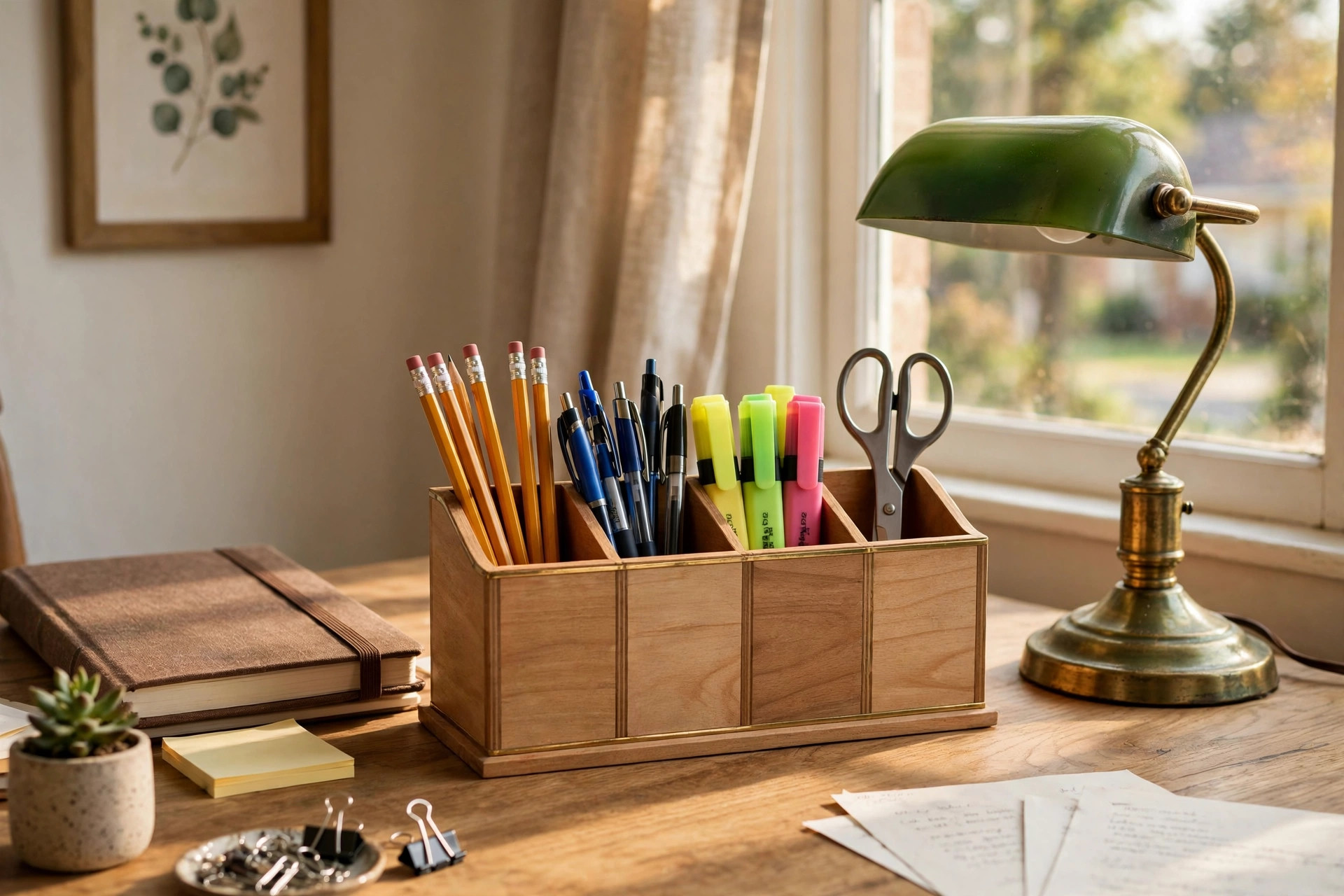

A desk is a working surface, and every working surface performs better when it is in order. The best pen holder organizer for office desk use is a small, plain tool that does a large job: it gathers the pens, pencils, markers, scissors, and sticky notes that tend to spread across the whole surface and gives each of them a home. Without it, a desk slowly becomes a field of loose objects. Papers slide under coffee cups. A favorite pen vanishes inside a drawer. Time that should go to work goes instead to searching.
This guide explains what makes a pen holder organizer worth buying, how to choose among the many types on the market, what prices to expect, how to care for the one you buy, and what safety points to keep in mind. The advice applies to anyone setting up a home office, a study corner, or a shared workspace.
Why a Pen Holder Organizer Matters
A desk in order supports a mind in order. That old saying has held up through many changes in office life. Studies of work environments keep returning to the same finding: clutter raises mental effort and slows people down. When writing tools are sorted and visible, a person reaches once and takes what is needed. When they are loose, the same person reaches three times and still ends up with a dry highlighter.
A pen holder organizer also protects the tools themselves. Fountain pens stored point-down dry out and clog. Markers left uncapped stain wood and paper. Scissors left open can cut fingers and fray cords. A good organizer holds each item upright, capped, and apart from its neighbors. It lengthens the life of small supplies that would otherwise be replaced again and again.
There is a cost argument too. A survey of office workers by a workplace research group found that many employees spend several minutes each day looking for misplaced desk items. Over a year, those minutes add up to hours. A holder that costs less than a lunch can return that time many times over.
Finally, a tidy desk presents a tidy image. For workers who appear on video calls from a home office, the desk is often visible behind them. A neat organizer with straight rows of pens sends a better signal than a pile of loose supplies. It is a small detail, but details are what cameras notice.
What to Look For When Choosing One: Best Pen Holder Organizer for Office Desk
Size and Compartment Count
Start by measuring the space the holder will occupy. Most office desks allow a footprint of about four to six inches square for a pen holder. A holder larger than that begins to eat into the working area. A holder much smaller tips over when loaded with heavy scissors and metal pens.
Compartment count matters as much as footprint. A single-cup holder suits a person who keeps only a few pens. Most users do better with three to five compartments. That number allows pens in one section, pencils in another, scissors and letter openers in a third, and small items like paper clips or USB drives in the rest. Holders with adjustable dividers let the user change the layout as needs change.
Material
Pen holder organizers are made from several common materials, and each has strengths:
– Metal mesh: Strong, ventilated, and inexpensive. Dust passes through rather than collecting at the bottom. It can scratch wooden desks, so many models include small rubber feet. – Wood and bamboo: Warm in appearance and kind to desk surfaces. Heavier than mesh, which helps stability. Bamboo resists moisture well. – Leather or leather-look vinyl: Quiet and professional in appearance. Best suited to executive desks and meeting rooms. – Plastic and acrylic: Light and easy to clean. Clear acrylic lets the user see contents at a glance, though it shows scratches over time. – Fabric and canvas: Soft and portable. Good for students and for desks that double as tables, but harder to clean.
Choose the material that matches the desk and the room. A glass desk pairs well with acrylic or metal. A traditional wooden desk pairs well with wood or leather.
Stability
A holder full of pens is top-heavy by nature. Look for a wide base, some weight in the bottom, or a low center of gravity. Rotating holders, which spin on a bearing, need an especially steady base because the turning motion shifts the load. Holders meant for monitors or shelves may include adhesive or clamp mounts; these trade portability for firmness.
Extra Features
Some organizers add features beyond pen storage. A holder with a phone slot keeps a mobile upright for calls and messages. One with a small drawer hides sticky notes and business cards. Another with a built-in charger top keeps a phone topped up, though such models cost more and add a cord to manage. Extra features are worth paying for only if the user will use them every day. An unused drawer is just a place where dust collects.
Types and Options
The market offers a wide range of designs. The main families are described below.
Cup and Tumbler Styles
The simplest design is a single open cup, round or square. It holds a dozen pens and takes up little room. It is the cheapest option and the easiest to clean. Its weakness is sorting: everything sits together, and small items sink to the bottom.
Multi-Compartment Holders
These have two or more sections, often of different heights and widths. They are the most popular type for home offices because they separate tools by kind. Many include a slot for a phone or a tray for clips. Shoppers who want a broader system may pair one with a best desk organizer set for small office desk to manage paper, mail, and devices alongside writing tools.
Rotating Carousels
A carousel turns on a central pivot so every compartment can face the user. It is useful on large desks where the holder sits out of arm’s reach. It is also a good choice for shared desks, where two people use supplies from opposite sides. The moving parts add cost and can wear with time, so choose a model with a metal bearing rather than a plastic one.
Drawer Organizers
Flat trays that sit inside a desk drawer keep supplies sorted out of sight. They suit people who want a clear desktop at all times. Drawer organizers work best in desks with shallow drawers; deep drawers bury small items. Some users combine a drawer tray with a small office supply organizer caddy for desk that can move between rooms.
Wall and Monitor Mounts
For very small desks, holders that clip to a monitor or hang on a wall free the whole surface. These are popular in dorm rooms and compact home offices. Check that the mount fits the monitor frame or wall type before buying, since returns of opened accessories are not always accepted.
Desk Sets
A desk set is a group of matching pieces: pen holder, paper tray, card box, and sometimes a clock or bookend. Sets give the desk a unified look and cost less per piece than buying separately. The trade-off is flexibility. If the pen holder in the set is too small, the whole set suffers.
Cost and Price
Prices for pen holder organizers run from a few dollars to well over a hundred. The range reflects material, brand, and added features.
| Price range | What to expect | |—|—| | Under $10 | Basic mesh cups, simple plastic cups, fabric pouches | | $10 to $25 | Multi-compartment mesh, bamboo, wood, acrylic styles | | $25 to $50 | Leather-look holders, rotating carousels, brand-name designs | | $50 and above | Real leather, designer sets, holders with charging or smart features |
For most home offices, the sweet spot lies between $10 and $25. In that range the buyer gets solid construction, several compartments, and a design that will not look out of place for years. Shoppers on a tight budget should not worry: a well-made mesh cup under $10 can serve for a decade.
Where the holder is bought affects the price. Large retailers such as Wayfair and IKEA carry wide ranges at low prices. Review sites like Wirecutter test popular models and publish measured results, which helps buyers compare quality before they spend. Buying two or three small organizers at once can also save money compared with one large designer piece.
Keep in mind the total cost of the desk setup. A pen holder is one part of an organized workspace. Buyers furnishing a whole home office may also look at a rolling file cabinet for home office organization for paper storage, and compare the combined cost against a single large desk set.
Care and Upkeep
A pen holder organizer needs little care, but regular attention keeps it clean and working well.
Weekly: Empty the holder and shake out dust and paper scraps. Wipe the inside with a damp cloth. This takes one minute and stops ink stains from setting.
Monthly: Check pens and markers. Throw away dried-out markers and empty pens rather than letting them take up space. Wipe the outside of the holder. For wood holders, a light rub with furniture polish keeps the finish fresh. For leather-look models, a damp cloth is enough; harsh cleaners can crack the surface.
Yearly: Inspect the base and feet. Replace worn rubber feet on metal holders so they do not scratch the desk. For rotating models, a drop of light machine oil on the bearing keeps the spin smooth. For drawer trays, check that dividers have not warped.
Ink spills deserve quick action. Most ink washes off plastic, metal, and acrylic with soap and water if it is fresh. On wood and fabric it can leave a mark, which is one more reason to keep a few spare liners or trays inside the compartments.
Safety
Pen holder organizers are low-risk items, but a few points deserve note.
Keep sharp tools point-down and sheathed. Scissors, craft knives, and letter openers should go in a tall compartment with blades down. This keeps fingers safe when reaching in blindly.
Watch the weight on high shelves. A full metal holder weighs more than it looks. Do not place it on a shelf edge where a bump could send it down.
Check materials around children. Small parts such as clips and thumbtacks stored in a holder are choking hazards for toddlers. Households with small children should use a holder with a lidded compartment or store sharp and small items out of reach.
For rotating and mounted models, confirm that moving parts cannot pinch fingers. Quality standards for office accessories are discussed by consumer groups such as PCMag, which reviews desk gear for safety as well as function.
Frequently Asked Questions
How many compartments should a pen holder organizer have?
Three to five compartments suit most users. One section for pens, one for pencils and markers, one for scissors and tools, and one or two small sections for clips, drives, and notes. People with very few supplies can use a single cup; heavy users may want six or more sections.
What is the best material for a pen holder organizer?
There is no single best material. Metal mesh is strong and cheap. Wood and bamboo look warm and stay put. Acrylic shows contents clearly. Leather suits formal desks. Match the material to the desk surface and the room’s style, and choose rubber feet or a felt base to protect the desk.
How do I keep my pen holder from tipping over?
Choose a holder with a wide, weighted base and keep heavy items such as scissors low and centered. Do not overload tall, narrow cups. For a rotating carousel, a steady desk surface matters most, since the spin adds sideways force.
Can a pen holder organizer hold more than pens?
Yes. Most holders store scissors, letter openers, rulers, highlighters, sticky notes, paper clips, and small electronics such as USB drives. Some have phone slots or drawers for cards and keys. Avoid heavy objects such as staplers or tape dispensers, which belong elsewhere on the desk.
How often should I clean my desk organizer?
A quick weekly shake-out and wipe is enough for most holders. Do a deeper clean monthly: empty it fully, wipe every surface, and discard dead pens. Makers of ergonomic office furniture such as Herman Miller and UPLIFT Desk note that clean, ordered work surfaces support better posture and focus, and the same principle applies to small accessories.
Where can I find ideas for styling my desk?
Home and office publications offer photographed examples of organized desks in many styles. The Spruce publishes buying guides and setup ideas for home offices of every size, which can help a buyer picture how a new holder will fit the whole desk.
A Final Word
The best pen holder organizer for office desk use is not the most expensive or the most decorated. It is the one that fits the desk, holds the tools at hand, stays upright through daily use, and looks right in the room. Measure the space, count the compartments, choose a material that suits the desk, and keep the price in the range where quality meets sense. Then keep the holder clean and sorted, and it will quietly pay for itself in time saved and calm gained.
References
Herman Miller. (n.d.). Office furniture and ergonomic seating. https://www.hermanmiller.com IKEA. (n.d.). Home furnishings. https://www.ikea.com PCMag. (n.d.). Technology product reviews. https://www.pcmag.com Steelcase. (n.d.). Office furniture and workplace research. https://www.steelcase.com The Spruce. (n.d.). Home and garden advice. https://www.thespruce.com UPLIFT Desk. (n.d.). Standing desks and ergonomic office furniture. https://www.uplift-desk.com Wayfair. (n.d.). Furniture and home goods. https://www.wayfair.com Wirecutter. (n.d.). Product reviews from The New York Times. https://www.nytimes.com/wirecutter
Was this guide helpful?

About Robert Taylor
The My Garden US editorial team writes practical, in-depth home and garden guides for American homeowners — tested advice, no fluff.
You May Also Like
An Affordable Dual Monitor Setup for Remote Workers USA Can Count On
January 15, 2026 0 views
Adjustable Standing Desk with Memory Presets USA: A Plain Guide for Home Offices
January 19, 2026 0 views
Ergonomic Office Chair Mesh Back with Lumbar: A Complete Guide
September 11, 2026 0 views