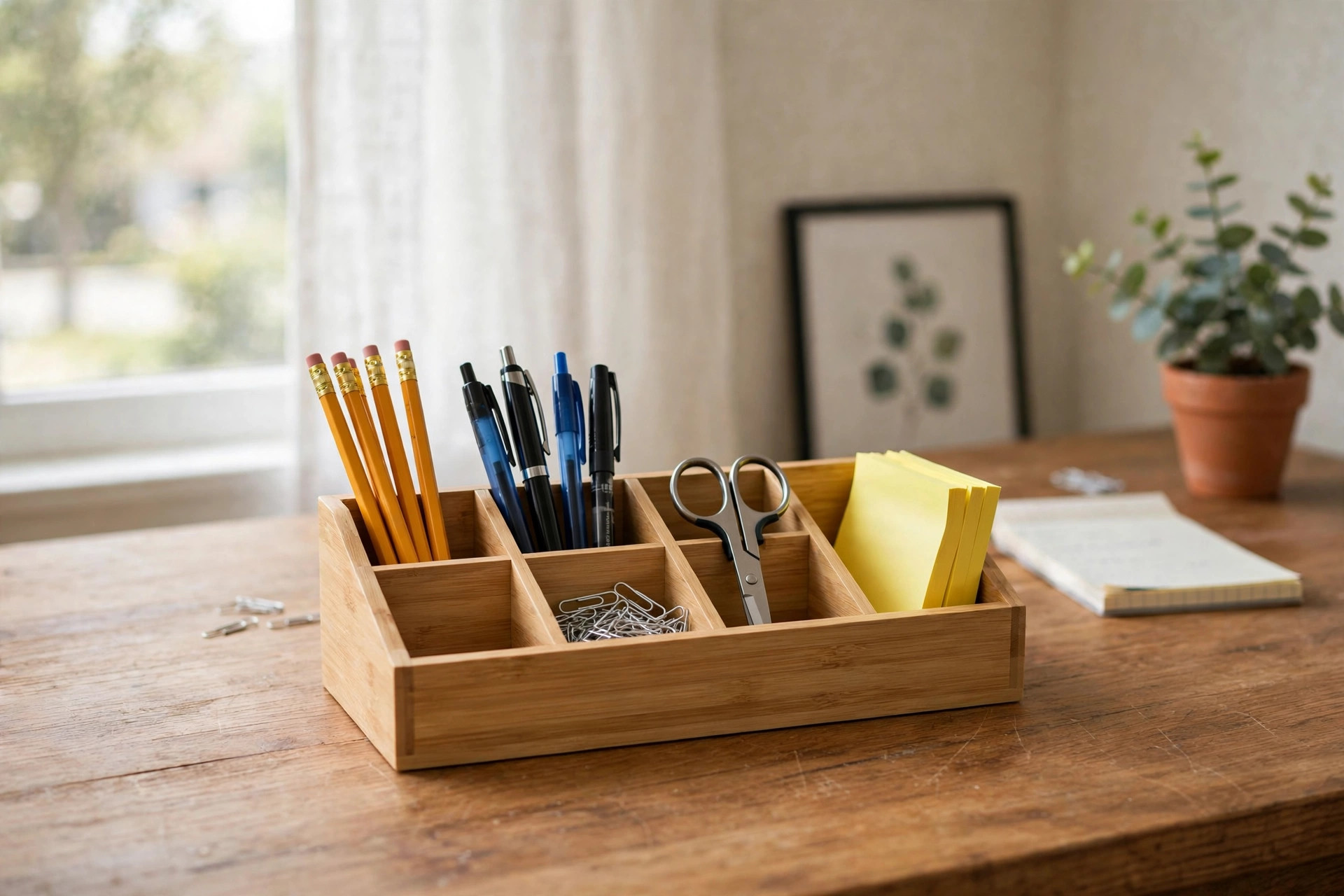

A small office supply organizer caddy for desk is one of the simplest tools a home worker can buy. It is a compact tray or box with sections. It sits on the desk and holds pens, pencils, scissors, tape, clips, and sticky notes. When supplies have a fixed home, the desk stays clear. Work goes faster. Fewer minutes are lost to hunting for a pen.
The idea is old. Office workers have used desk trays and pencil cups for decades. The modern caddy is a step up. It has more sections. It has a handle. Many models can be carried from room to room. This guide explains why it matters, what to look for, the main styles, what it costs, and how to keep it clean and safe.
Why a Desk Caddy Matters
A messy desk costs time. Studies of office work from the late twentieth century found that workers lose many hours each year to searching for misplaced items. Pens roll under papers. Scissors hide in drawers. A caddy solves this by giving each item a place.
The benefit is clearest on a small desk. A small corner desk with drawers for apartment office has little surface room. Every inch counts. A caddy holds a dozen supplies in the space of a single book. It keeps the center of the desk free for the keyboard, the laptop, or the page you are writing on.
A caddy also helps with shared spaces. Many homes now have one desk used by two people. A shift worker uses it by day. A student uses it by night. A caddy with a handle lets each person pick up their supplies and put them away in seconds. No sorting. No arguments about borrowed pens.
For the home office that must look tidy on video calls, the caddy is a quiet helper. It groups small clutter into one neat object. The camera sees a clean desk. The worker sees everything within arm’s reach.
What to Look for When You Choose One: Small Office Supply Organizer Caddy for Desk
Shoppers face dozens of models. The differences are real. Here is what to check before you buy.
Size and Footprint
Measure the desk first. A small office supply organizer caddy for desk should take up no more than about one square foot. On a desk that is 40 inches wide or less, look for caddies under 9 inches wide. Check the height too. Tall caddies can block the view of a monitor. Low, wide caddies sit well in front of a screen.
Think about depth. Some caddies have one large center bin. Others have many small slots. Count your supplies before you shop. List them: pens, pencils, markers, scissors, tape, stapler, clips, sticky notes, phone, ruler. Then match the list to the caddy.
Compartments and Layout
The best layouts have three kinds of space. First, tall slots for pens and scissors. Second, shallow wells for clips, pins, and erasers. Third, one open bin for the phone or a small notebook. This mix covers most needs.
Removable dividers are a plus. They let you change the layout as needs change. A caddy with fixed walls locks you in. A caddy with movable walls grows with you.
Check the bottom of each well. Deep, smooth wells are easy to clean. Wells with sharp corners trap dust. A small lip around the top edge stops pens from rolling out.
Materials
Most caddies are made of plastic, metal, wood, or fabric. Each has trade-offs.
Plastic is light and cheap. It wipes clean. Cheap plastic can crack, and thin plastic tips over when full. Look for thick, solid plastic with a heavy base.
Metal, often steel wire or sheet metal, lasts for years. It looks sharp in a modern office. Metal can scratch a desk. Felt pads on the base fix that problem.
Wood and bamboo bring warmth. They suit a classic desk. Wood is heavier, which adds stability. It needs a little more care to keep clean.
Fabric caddies with stiff sides are soft and light. They fold flat for travel. They stain more easily than hard materials.
If you want a full setup, pair the caddy with a best desk organizer set for small office desk that adds trays and risers. The caddy handles the small items. The set handles paper and files.
Common Types and Styles
Caddies come in several forms. Each suits a different kind of worker.
Handled tote caddies. These look like small toolboxes with a center handle. They carry well. They suit people who work in more than one room. A teacher who grades papers at the kitchen table can carry the tote along.
Rotating carousels. These spin on a base. Every slot is reachable with a turn. They hold many items in a small footprint. They work best on a deep desk where the spinning top will not knock things over.
Tiered caddies. These stack two or three trays. They give more storage per inch of desk space. Short workers may find the top tier hard to reach. Put rarely used items up top.
Wall and rail caddies. Some models hook onto a desk edge or a rail. They free the desk surface entirely. They need a desk edge thick enough for the clamp.
Drawer-style mini chests. These have small pull-out drawers instead of open wells. They hide clutter. They suit workers who want a clean look. Small drawers can stick if they fill with dust, so wipe the runners now and then.
For readers who use design guides, sites like IKEA and Wayfair show many of these styles in room settings. The pictures help you judge scale against a real desk.
Cost and Price
Prices are modest. Most small office supply organizer caddy for desk models sell between 8 and 35 dollars.
Under 12 dollars buys a simple plastic caddy. It will hold pens and clips. It may not last more than a year of daily use.
From 12 to 25 dollars you find the sweet spot. This range holds sturdy plastic, wire metal, and bamboo models with good dividers. For most home offices, this is all you need to spend.
From 25 to 50 dollars you get premium materials. Leather-wrapped caddies, solid wood, and designer brands sit here. The function is the same. You pay for looks and feel.
Do not forget shipping costs when you order online. A 10 dollar caddy with 8 dollar shipping is an 18 dollar caddy. Retailers such as Home Depot and The Container Store list store stock online, so you can check local pickup and skip the shipping fee.
Bulk packs make sense for offices with many desks. A pack of six often costs less per unit than six single buys. For one home desk, buy one good caddy rather than two cheap ones.
Care and Upkeep
A caddy needs little care. A quick routine keeps it clean for years.
Empty it once a month. Shake out dust and crumbs. Throw away dried pens and bent clips. This takes five minutes.
Wipe the wells with a damp cloth. For plastic and metal, a drop of dish soap in warm water is enough. For wood and bamboo, use a barely damp cloth and dry at once. Do not soak wood. It will swell.
Fabric caddies can go in the washing machine if the label allows it. Air dry them. Do not put stiff fabric caddies in a hot dryer. The stiffening can warp.
Check felt pads on the base twice a year. Worn pads let metal caddies scratch the desk. Replacement pads cost little at any hardware store.
Refill with care. Do not overload. A caddy stuffed to the top defeats its purpose. If supplies no longer fit, move the overflow to a drawer or a home office storage cabinet with locking doors. The caddy should hold only what you use each day.
Guides at The Spruce and Wirecutter cover desk cleaning routines that fit well with this monthly habit.
Safety
A desk caddy is a safe product, but a few points deserve care.
Keep sharp items point down. Scissors and craft knives should sit with blades down in a tall slot. A blade left loose in a shallow well can cut a reaching hand.
Keep small items away from small children and pets. Paper clips, pins, and eraser caps are choking hazards. If the desk is in a shared family room, choose a caddy with a lid or store it on a high shelf when not in use.
Mind the weight. A full metal caddy can weigh several pounds. Place it where it will not be knocked off the desk edge. A fall can dent a floor or hurt a foot.
Check stability on glass desks. Smooth glass plus a smooth plastic base can slide. A non-slip mat under the caddy stops the drift.
For homes with sit-stand desks, fasten the caddy before you raise or lower the desk. A sudden stop can slide items off an open tray. Makers like UPLIFT Desk, Herman Miller, and Steelcase publish desk safety tips that apply to any item kept on a moving surface.
Frequently Asked Questions
What size caddy fits a small desk? For desks under 40 inches wide, choose a caddy under 9 inches wide and under 6 inches tall. Measure the free space on your desk before you order. Leave room for the keyboard and a notebook.
Is a handled caddy better than a fixed tray? It depends on how you work. A handled caddy suits people who move between rooms. A fixed tray suits people who work at one desk all day. If you are unsure, the handled type is more flexible.
What should I put in the caddy, and what should I leave out? Put in the items you touch daily: pens, pencils, scissors, tape, clips, sticky notes, and a phone. Leave out files, chargers, and bulky tools. Those belong in drawers or on shelves. A good rule is this: if you use it every hour, it earns a spot.
How do I stop the caddy from sliding around? Use a caddy with a heavy base or rubber feet. On slick desks, add a small non-slip mat. Keep the heaviest items in the center so the caddy stays balanced.
Can a caddy replace a desk drawer? For light daily supplies, yes. It cannot replace a drawer for files, tablets, or private items. Many workers use both: the caddy for daily tools, drawers for the rest.
How often should I clean it? Empty and wipe it once a month. A five minute routine is enough. Replace worn felt pads and toss dried pens at the same time. Review sites such as PCMag note that simple upkeep habits extend the life of most desk gear by years.
A Final Word
A small office supply organizer caddy for desk is a small buy with a large payoff. It cuts clutter. It saves time. It makes a small desk feel larger. Choose one that fits your desk, matches your supply list, and suits the way you work. Keep it clean. Do not overload it. Pair it with good light, such as best task lighting for home office desk setup, and your desk will serve you well for years.
References
Herman Miller. (n.d.). Office furniture and ergonomic seating. https://www.hermanmiller.com IKEA. (n.d.). Home furnishings. https://www.ikea.com PCMag. (n.d.). Technology product reviews. https://www.pcmag.com Steelcase. (n.d.). Office furniture and workplace research. https://www.steelcase.com The Container Store. (n.d.). Storage and organization products. https://www.containerstore.com The Home Depot. (n.d.). Home improvement products. https://www.homedepot.com The Spruce. (n.d.). Home and garden advice. https://www.thespruce.com UPLIFT Desk. (n.d.). Standing desks and ergonomic office furniture. https://www.uplift-desk.com Wayfair. (n.d.). Furniture and home goods. https://www.wayfair.com Wirecutter. (n.d.). Product reviews from The New York Times. https://www.nytimes.com/wirecutter
Was this guide helpful?

About David Wilson
The My Garden US editorial team writes practical, in-depth home and garden guides for American homeowners — tested advice, no fluff.
You May Also Like
A Home Office Chair Mat for Carpet Protection: A Plain Guide
July 24, 2026 0 views
Compact Desk With Keyboard Tray for Small Room
April 9, 2026 0 views
Ergonomic Wrist Rest for Keyboard and Mouse: A Practical Guide
August 24, 2026 0 views