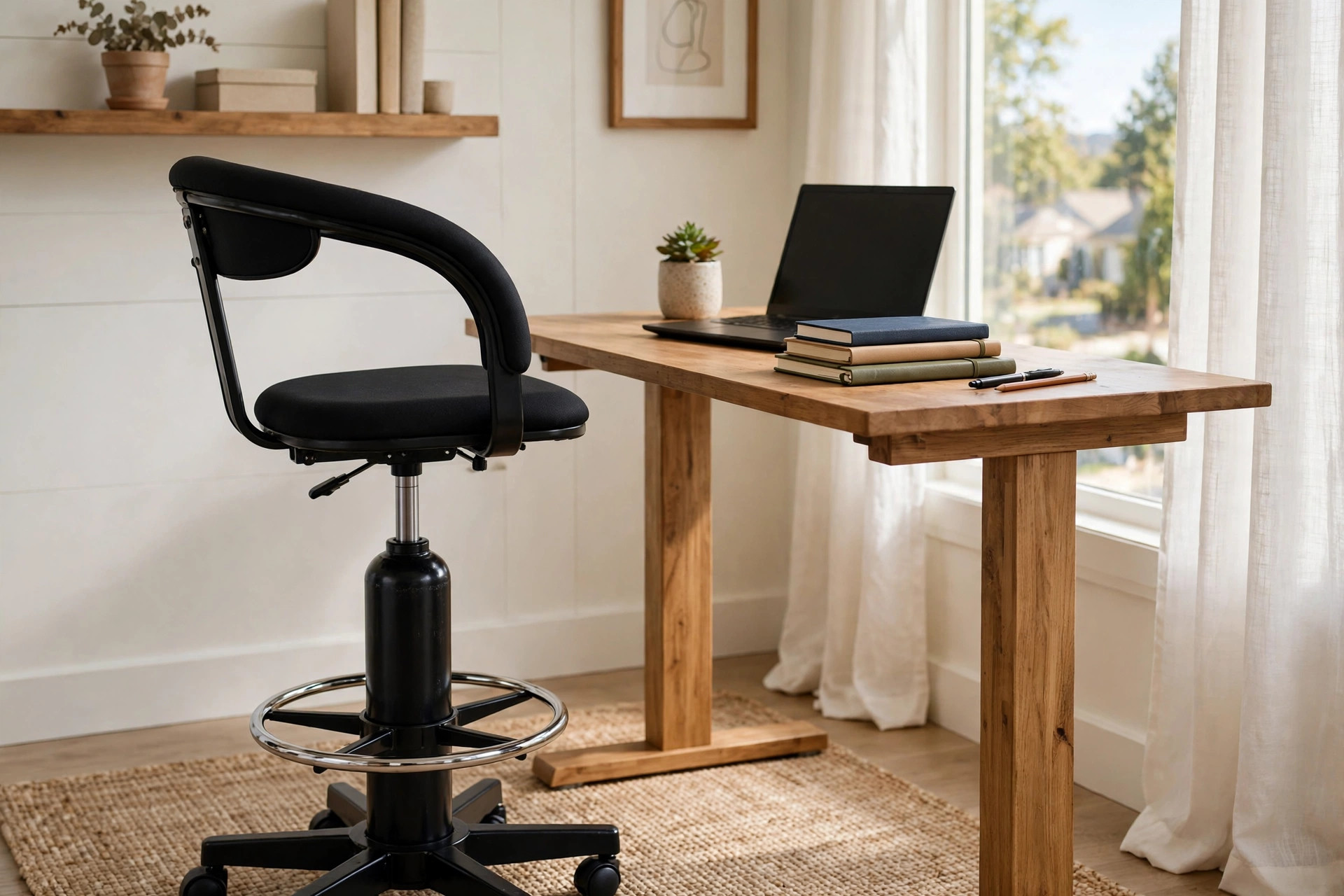

Many home offices now use tall desks. Standing desks, studio tables, and artist work surfaces sit much higher than a normal desk. An adjustable drafting chair for tall desk users is made for this kind of workspace. It lifts the seat far above the height of a normal office chair. It also gives the feet a place to rest. This guide explains what these chairs are, how to pick one, what they cost, and how to care for them. It is written in plain terms so that any buyer can follow along.
Why a Drafting Chair Matters for Tall Desks
A normal office chair raises to about twenty inches at the seat. Many standing desks and studio tables reach forty inches or more. If you sit on a normal chair at such a desk, your arms sit too low. Your shoulders rise up. Your neck bends down. After an hour, the body feels the strain.
An adjustable drafting chair for tall desk users solves this problem. Its seat can rise to thirty or even thirty-six inches. This puts your elbows near the height of the desk. Your arms rest in a neutral position. Your back stays straight against the backrest. The body holds a balanced posture, even during long hours of work.
Tall desks are common in many fields. Designers use them for drawing boards. Musicians use them for mixing consoles. People who work from home use standing desks for much of the day. A drafting chair lets them sit high when they want a rest, without lowering the desk each time.
Good posture is not a small matter. When the seat is too low, the knees rise above the hips. The lower back rounds. The spine carries weight in the wrong way. When the seat is at the right height, the feet rest on a support and the thighs slope down a little. The spine keeps its natural curve. An adjustable drafting chair for tall desk users makes this easy to reach.
What to Look For When You Choose: Adjustable Drafting Chair for Tall Desk Users
Seat Height Range
This is the most important number. Look at the lowest and highest seat height of the chair. A good drafting chair goes from about eighteen inches to at least twenty-eight inches. Chairs made for very tall desks reach thirty to thirty-six inches. Measure your desk first. Then choose a chair that fits. The right seat height puts your elbows close to desk level while your feet rest on the ring.
Footrest Ring
When you sit high, your feet cannot reach the floor. A footrest ring gives them a place to rest. Most drafting chairs have a ring on the gas cylinder. The ring should move up and down so you can set it where your feet fall. Some rings are fixed in place. Adjustable rings are better. A steady footrest keeps the legs from going numb during long sessions. Pair the chair with an ergonomic footrest for under desk at home if your setup needs extra support.
Backrest and Lumbar Support
Look for a backrest that moves with you. A small curve at the lower back keeps the spine in shape. Some chairs have a tilt lock. This lets you lean back a little and hold the position. A backrest that slides up and down suits people of different heights. Long hours at a tall desk make back support more important, not less.
Armrests
Drafting chairs come in several styles. Some have no arms at all. Some have loop arms. Some have arms that move up and down. No arms give full freedom at a drawing board. Adjustable arms help when you type for hours. Flip-up arms let you push the chair close under the desk. Choose based on your daily tasks. If you sketch or draft by hand, arms may get in the way.
Base and Casters
A five-star base with smooth casters rolls across hard floors. On carpet, a wide base gives more stability. Check the weight limit of the chair. Most drafting chairs hold 250 pounds. Stronger models hold 300 pounds or more. The base is the foundation of the chair, so it should feel solid when you sit down.
Materials
Fabric breathes and feels warm to the touch. Mesh lets air pass through and suits warm rooms. Vinyl and leather look clean and wipe down fast. For a home office, fabric or mesh works well for daily use. Office furniture makers such as Herman Miller and Steelcase offer high quality fabrics and meshes that stand up to years of use.
Types and Options
The Drafting Stool
The drafting stool is the simplest type. It has a tall seat and a footrest ring but no backrest. It suits work that needs constant movement, like sketching or cutting. It costs less than a full chair. It does not support the back, so it is not the best choice for long computer sessions.
The Classic Drafting Chair
The classic drafting chair looks like an office chair on a tall stand. It has a backrest, a padded seat, and a footrest ring. Many models have tilt and lock features. This is the most popular type for home offices. It balances comfort and price. Independent product review sites test many of these models and publish detailed rankings.
The Ergonomic High-Back Chair
The ergonomic high-back drafting chair adds full lumbar support and headrest options. The seat and back often move together. Some models use mesh backs for airflow. These chairs cost more, but they serve people who sit for eight hours or more each day. They suit tall desk users with back pain or posture problems.
The Artist and Lab Stool
Artist chairs and lab stools use a saddle or round seat with a tall base. They let the sitter perch at an angle. They suit short bursts of work rather than full days. They are easy to clean and fit into small studios. They pair well with drawing tables and easels.
Cost and Price
Drafting chairs come in three price bands. The band you choose depends on how many hours you sit each day.
Entry-level chairs cost between eighty and one hundred fifty dollars. They have a basic gas cylinder, a fixed or adjustable ring, and simple fabric. They work fine for two to four hours of daily use. Quality varies, so read buyer guides before you choose.
Mid-range chairs cost between one hundred fifty and three hundred dollars. They add better lumbar support, smoother cylinders, and stronger bases. The fabric lasts longer. They suit people who work from home five days a week. Many well known furniture retailers and IKEA carry models in this range.
Premium chairs cost three hundred dollars and up. Some reach six hundred dollars or more. They use top grade mesh, full ergonomic controls, and heavy duty bases. They are built for daily professional use over many years. They are a sound investment if the chair is your main work seat.
Remember to count the full cost. Some chairs ship free. Others charge for freight. You may need a mat for hard floors. If your desk does not move up and down, you might add an adjustable height desk converter for existing table to get the best of both worlds.
Care and Upkeep
A drafting chair lasts longer with simple care. Check the screws every few months. Sit on the chair and rock gently. If you hear a rattle, tighten the bolts. This takes five minutes and prevents bigger problems.
Wipe the gas cylinder with a dry cloth once a month. Dust on the cylinder can wear the seal. A light spray of silicone lubricant keeps the height adjustment smooth. Do not use oil that drips, because it will stain the floor.
Clean the seat material as needed. Vacuum fabric seats to remove dust. Wipe vinyl seats with a damp cloth. Mesh backs can be brushed lightly. Home care advice sites such as The Spruce publish cleaning guides for every fabric type.
Check the footrest ring. Make sure the clamp holds tight. A loose ring slides down and leaves your feet with no support. Tighten the knob until the ring holds firm at your chosen height.
Replace the casters if they roll poorly. Casters snap out on most chairs. New casters cost little and make the chair feel new again. Keep the floor free of cords so the casters do not catch.
Safety
Every drafting chair has a weight limit. Never go above it. The limit is printed in the manual and on many product pages. Going over the limit can bend the cylinder or crack the base.
Do not stand on the seat. Drafting chairs are tall, and standing on the seat can tip the chair over. Consumer safety agencies such as the CPSC warn against standing on office seating of any kind.
Set the footrest ring before you sit down. A ring that is too high or too low changes your posture. Sit with your feet flat on the ring and your thighs level or sloping down.
Place the chair on a flat, level floor. Tall chairs are less stable on uneven ground. A chair mat on carpet gives the casters a smooth surface and keeps the chair steady.
Keep small children off the chair when it is set high. The tall seat is a fall risk. Lower the chair to its lowest setting when you are not using it.
Frequently Asked Questions
How high should the seat go for my desk?
Measure from the floor to the top of your desk. Subtract about ten to twelve inches. That number is your target seat height. For a forty-two inch desk, you need a seat near thirty inches. Pick a chair whose range includes that number.
Can I use a drafting chair with a standing desk?
Yes. This is one of the most common uses. Raise the desk to standing height when you want to stand. Sit on the drafting chair when you want to rest. You do not need to lower the desk each time. Sit-stand desks from makers like UPLIFT Desk pair naturally with tall seating.
Is a drafting chair good for my back?
It can be, if you choose well. Pick a chair with lumbar support and a backrest that adjusts. Sit with your feet on the ring and your back against the rest. Take breaks and walk every hour. No chair fixes posture on its own, but the right chair helps a great deal.
Do drafting chairs work on carpet?
Yes, but pick a wide five-star base for stability. A chair mat helps the casters roll and protects the carpet. Hard-floor casters and carpet casters are different, so check what your chair includes. Online marketplaces list replacement casters for every floor type.
Should I get arms or no arms?
It depends on your work. If you draw, sketch, or move a lot, no arms give freedom. If you type for hours, adjustable arms reduce shoulder strain. Flip-up arms offer both. You can flip them up when you need space and down when you need support. A laptop stand for standing desk posture can also help if your screen sits too low.
How long does a drafting chair last?
A good chair lasts five to ten years with care. Entry-level chairs last three to five years. The gas cylinder is often the first part to wear. Many makers sell replacement cylinders, so you can repair the chair instead of replacing it.
A Short Final Word
An adjustable drafting chair for tall desk users is a simple tool with a clear job. It puts your body at the right height for a tall desk. It supports the back, rests the feet, and keeps posture sound through long days. Measure your desk. Set a budget. Pick the seat range, ring, and backrest that fit your body. With the right chair, a tall desk becomes a comfortable place to work for years to come.
References
Amazon. (n.d.). Online shopping. https://www.amazon.com Herman Miller. (n.d.). Office furniture and ergonomic seating. https://www.hermanmiller.com IKEA. (n.d.). Home furnishings. https://www.ikea.com Occupational Safety and Health Administration. (n.d.). Worker safety and health. https://www.osha.gov PCMag. (n.d.). Technology product reviews. https://www.pcmag.com Steelcase. (n.d.). Office furniture and workplace research. https://www.steelcase.com The Spruce. (n.d.). Home and garden advice. https://www.thespruce.com U.S. Consumer Product Safety Commission. (n.d.). Product safety information. https://www.cpsc.gov UPLIFT Desk. (n.d.). Standing desks and ergonomic office furniture. https://www.uplift-desk.com Wayfair. (n.d.). Furniture and home goods. https://www.wayfair.com Wirecutter. (n.d.). Product reviews from The New York Times. https://www.nytimes.com/wirecutter
Was this guide helpful?

About James Carter
The My Garden US editorial team writes practical, in-depth home and garden guides for American homeowners — tested advice, no fluff.
You May Also Like

Best Home Office Lighting for Zoom Meetings
April 18, 2026 0 views
Home Office Paper Tray Organizer Stackable: A Practical Guide
April 28, 2026 0 views
Home Office Cable Raceway for Wall Mounted TV: A Practical Guide
April 27, 2026 0 views