
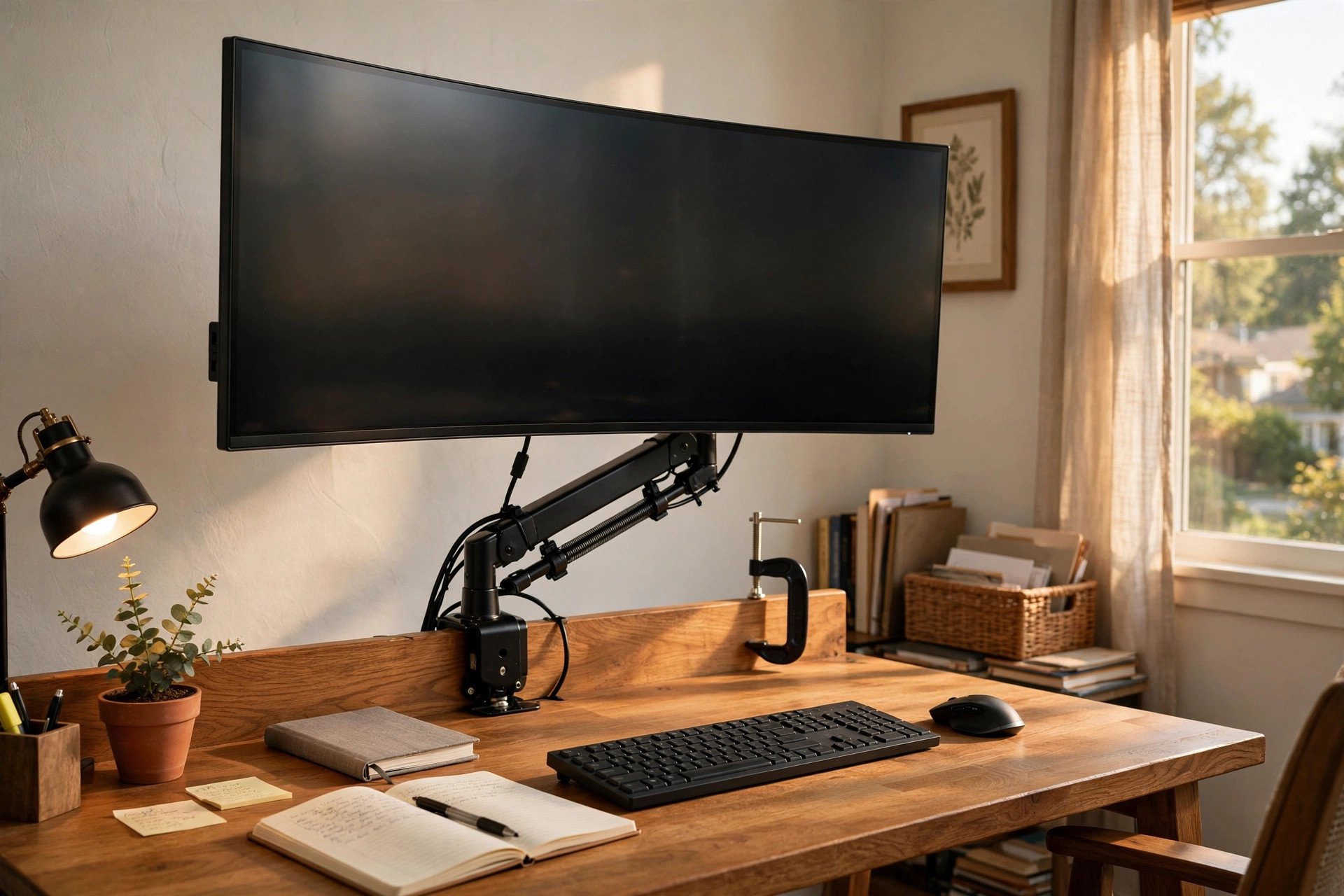

A 34 inch monitor is a fine thing. It shows more of your work. It shows more of your game. It shows more of your film. But it is heavy. Many 34 inch models weigh between 12 and 25 pounds. Some ultrawide models weigh more. The plastic stand that comes in the box is often weak. It wobbles. It takes up half the desk. And it does not let you set the screen where your neck and eyes want it.
An adjustable monitor arm for heavy 34 inch monitor use solves these problems at once. It bolts to the back of the desk or through a hole in the desk. It holds the screen in the air. It lets you move the screen up, down, forward, back, and side to side. A good one moves with one light push and stays where you put it. This guide explains why it matters, what to look for, what it costs, and how to set one up with care.
Why a Strong Arm Matters for a Big Screen
Most monitor stands were built for small screens. A 34 inch panel is a different beast. It is wide. It is tall. It can weigh as much as a small dog. When a heavy screen sits on a weak stand, three problems follow.
First, the screen sags. You set it in the morning. By lunch it has dropped a half inch. You tilt it back up. By dinner it has dropped again. A cheap stand cannot hold the weight.
Second, the desk shakes. Every keystroke rocks the screen. Every bump of the desk sends the image wobbling. This is hard on the eyes and hard on focus.
Third, your body pays. A fixed stand keeps the screen too low. You bend your neck down all day. Your shoulders round forward. By evening your neck aches and your upper back feels tight. Over weeks and months, this posture can cause real pain.
An adjustable monitor arm for heavy 34 inch monitor use fixes the root cause. The arm clamps to the desk edge with real force. The screen hangs from steel, not plastic. You raise the top of the screen to eye level or just below it. You sit straight. Your neck rests in a neutral line. Office ergonomics research has long shown that a neutral neck position cuts strain during long work days.
There is a second gain. Space. A 34 inch monitor with its factory stand can eat up a full square foot of desk. An arm lifts the screen clear of the surface. Under it you can place a notebook, a keyboard tray, or a lamp. For a small home office, that extra room is worth a lot. Shoppers browsing home office setup guides often cite clutter as a top complaint, and a floating screen is one of the simplest fixes.
What to Look for When You Choose One: Adjustable Monitor Arm for Heavy 34 Inch Monitor
Not every arm can carry a heavy 34 inch display. A light arm built for a 24 inch office screen will fail here. It may hold for a week. Then the joints will slip. Look for these points before you buy.
Weight Rating and VESA Pattern
Check the weight rating first. It is the most important number on the box. Find your monitor’s true weight with its stand removed. You can find it in the manual or on the maker’s site. Then buy an arm rated for at least 20 percent more. If your screen weighs 20 pounds, choose an arm rated for 24 pounds or more. This margin keeps the springs and joints from working at their limit.
Next, check the VESA pattern. This is the square of bolt holes on the back of your monitor. Most 34 inch screens use 100 by 100 millimeters or 75 by 75 millimeters. A few use 100 by 200. The arm you buy must match. Adapters exist, but a direct match is always safer. Reviews of tested monitor arms usually list both weight ratings and VESA patterns in their spec tables, which makes comparison easy.
Mount Type: Clamp, Grommet, or Wall
A desk clamp is the most common mount. It grips the back edge of the desk like a C. It needs a desk edge about two inches thick or less, though some heavy duty models handle thicker tops. No drilling is required. This is the best choice for renters and for anyone who may move the desk later.
A grommet mount bolts through a hole in the desk. Many office desks have a cable hole near the back. If yours does, the grommet mount uses it and holds very firm. It is the most stable choice for very heavy screens.
A wall mount bolts the arm to a wall stud. It frees the desk completely. But it needs a solid wall and a stud finder. You must drill. For most home offices, a desk clamp or grommet mount is plenty.
Range of Motion and Gas Spring Quality
A good heavy duty arm uses a gas spring inside. The gas spring counterbalances the screen’s weight. You push the screen up or down with one finger. A cheap friction arm fights you at every move, and with a heavy 34 inch panel that fight is tiring.
Check the tilt range too. You want at least 45 degrees of tilt, forward and back. Check the swivel. A 180 degree swivel lets you turn the screen to show a client or a family member. Also check the screen rotation. Some arms turn the screen into portrait mode. That is less useful on a 34 inch ultrawide, but it can still help with long documents.
Cable management matters more than people think. A 34 inch screen carries a power cable, a display cable, and often a USB cable. Loose cables snag when the arm moves. Look for arms with clips or channels along the arm that hold the cables in place.
Types and Options on the Market
Heavy monitor arms come in three broad families. Each has its place.
Single heavy duty arms. These carry one screen. They are the most stable choice for a heavy 34 inch monitor. A single arm gives the full weight rating to your one screen. If you own one big ultrawide and plan to keep it that way, start here.
Dual arms with a high rating. Some workers pair a 34 inch center screen with a smaller side screen. A few heavy duty dual arms can do this. Read the rating per arm, not for the pair. If each arm is rated for 22 pounds, your 34 inch screen must weigh less than that. Pairing a big screen with a light one works well, but two heavy screens on one pole is a risk.
Pole and rail systems. These use a vertical steel pole with arms that slide up and down on it. They hold a great deal of weight. They look plain. They suit a workshop or a trading desk more than a pretty home office. But for sheer strength at a low price, they are hard to beat.
When you compare models, look beyond the price. Read long term owner reports. Wirecutter’s tested monitor arm picks are a useful starting point, since they test stability over months, not minutes.
One more option to know: if you already run two screens, an adjustable monitor arm for dual screen setup can sometimes be adapted for one heavy screen plus a light side screen. Check the per-arm rating with care before you try it.
Cost and Price: What to Expect
Prices run wide. Here is what the market looked like at the time of writing.
Budget arms for heavy screens run from about 60 to 120 dollars. These are simple pole arms or basic clamp arms with high weight ratings. They hold the screen up. They do not move with much grace. For a fixed home desk where you set the screen once and leave it, they work fine.
Mid range arms run from about 120 to 220 dollars. This is the sweet spot for most buyers. You get a real gas spring, smooth motion, good cable clips, and a clamp that grips with confidence. Most of these carry 22 to 33 pounds, which covers nearly every 34 inch monitor on the market.
Premium arms run from about 220 to 400 dollars and up. These come from office furniture makers and ergonomic specialists. They move like a dream. They last for years. They often carry the longest warranties, sometimes ten years or more. If your desk is your office eight hours a day, the extra cost is easy to justify.
Watch for hidden costs. A grommet kit may be sold apart. A laptop tray attachment costs extra. And if your desk edge is very thick, you may need an extended clamp, also sold apart.
Pair your arm with ergonomic desk accessories that match its quality. A fine arm with a poor chair still leaves your body unhappy. Also consider best task lighting for home office desk setup so the bright screen does not fight a dim room.
Installing Your Arm in an Afternoon
Set aside one to two hours. Work on a clear floor or bed, not on the desk. Lay a towel down to protect the screen.
Start by removing the factory stand. Most 34 inch monitors have a quick release button or four screws. Save the screws and the stand. You may need them if you move or sell the screen.
Bolt the VESA plate to the back of the monitor. Tighten the four screws snug. Do not overtighten. You can crack the plastic back.
Next, fix the mount to the desk. For a clamp, slide it onto the back edge and tighten the bolt by hand, then give it a quarter turn with a wrench. For a grommet mount, drop the bolt through the cable hole and tighten the nut under the desk. The mount should not rock when you push it.
Now lift the monitor onto the arm. This is a two person job with a heavy 34 inch screen. One person holds the screen. The other guides the VESA plate into the arm’s receiver and tightens the lock screw. Do not rush this step. A dropped ultrawide is an expensive mistake.
Adjust the gas spring tension. Most arms have a hex bolt at the joint. If the screen sinks, tighten the spring. If the screen will not stay down, loosen it. Move the screen up and down a few times until it holds any position with a light push.
Run the cables. Plug in power and video before you tidy them. Then clip them along the arm with slack at each joint. The cables must not pull when the arm swings. Finally, set the height. Sit in your chair. Look straight ahead. The top of the screen should sit at or just below eye level, about an arm’s length away.
If you want to save money on the rest of the setup, an affordable dual monitor setup for remote workers usa can show how to build out the whole desk on a budget.
Care and Upkeep
A good arm needs little care. Dust it once a month with a dry cloth. Check the clamp bolt every few months. Desks shift with the seasons. Wood swells and shrinks. A bolt that was tight in winter may be loose in summer.
Watch the gas spring. If the screen starts to sink over time, adjust the tension bolt a quarter turn. This is normal wear, not a fault. If the arm makes a grinding sound, stop moving it and check for a loose screw at the joint.
Keep liquids away from the desk edge near the clamp. A spill can warp a wood desk top and weaken the grip. A simple desk mat under the work area helps.
When you move the desk, take the monitor off the arm first. Move the arm and the screen as separate pieces. Arms are strong in the up and down plane. They are not built to take a sideways shock in a moving truck.
Safety Notes
Safety matters because a 34 inch screen is heavy enough to hurt. Always use two people to mount and unmount the screen. Never stand a heavy monitor on a wobbly folding table with a clamp mount. The table can tip.
Check the desk itself. Thin glass tops and cheap particle board can crack under a clamp. If your desk top is thin, place a steel plate or a thick plywood pad above and below the clamp to spread the load. Many office furniture guides note that the desk must be part of the plan, not an afterthought.
Keep children in mind. A child who hangs on a floating screen can pull the whole desk over. If young children use the room, choose the grommet mount, which is harder to upset, and keep the screen pushed back toward the wall.
Do not exceed the weight rating. The rating is not a suggestion. An overloaded gas spring can fail without warning, and a 20 pound screen dropping onto a desk edge can break the screen, the desk, and whatever sits below it.
If you drill for a grommet mount, check for power cables and pipes first. A simple stud finder with a wire warning is cheap insurance.
Frequently Asked Questions
Can one arm really hold a 34 inch ultrawide? Yes, if the rating is right. Many arms made for heavy screens carry 22 to 33 pounds. Most 34 inch monitors weigh 12 to 25 pounds without their stand. Match the rating to your screen’s true weight, and leave a margin of at least 20 percent.
Will the arm fit my desk? Most clamps fit desk edges up to two inches thick. Measure your desk edge before you order. If your desk is thicker, look for an extended clamp model or use a grommet mount through a cable hole.
Does the VESA pattern always match? No. Most 34 inch screens use 100 by 100 millimeters, but some use 75 by 75 or 100 by 200. Check your monitor’s manual. Buy the arm to match. Adapters exist, but they add a weak point.
Is a gas spring arm worth the extra cost? For a heavy screen, yes. A friction arm fights you every time you adjust it. A gas spring arm moves with a light push and holds its place. With a 20 pound screen, that difference matters every day.
Can I use the arm with a standing desk? Yes. Arms work well with height adjustable desks. Just leave extra cable slack so the cables do not pull when the desk rises. Some owners add a cable spine to keep everything tidy.
How long does a good arm last? A well built arm lasts five to ten years. The gas spring is the part most likely to tire. Premium makers offer long warranties, sometimes ten years, which tells you how long they expect the arm to serve.
A Short Final Word
A heavy 34 inch monitor deserves better than a wobbly plastic stand. An adjustable monitor arm for heavy 34 inch monitor use gives you a steady screen, a clear desk, and a neck that thanks you at the end of the day. Buy for the weight rating first. Match the VESA pattern. Choose the mount that suits your desk. Take an afternoon to install it with care, and check the bolts now and then. It is a small job with a daily payoff.
For more reading, seating and workstation ergonomics explain how the screen, chair, and desk work as one system. Budget shoppers can compare desk and office furniture to build out the rest of the room, and renters may like the low commitment of affordable desk options.
References
Herman Miller. (n.d.). Office furniture and ergonomic seating. https://www.hermanmiller.com IKEA. (n.d.). Home furnishings. https://www.ikea.com PCMag. (n.d.). Technology product reviews. https://www.pcmag.com Steelcase. (n.d.). Office furniture and workplace research. https://www.steelcase.com The Spruce. (n.d.). Home and garden advice. https://www.thespruce.com UPLIFT Desk. (n.d.). Standing desks and ergonomic office furniture. https://www.uplift-desk.com Wayfair. (n.d.). Furniture and home goods. https://www.wayfair.com Wirecutter. (n.d.). Product reviews from The New York Times. https://www.nytimes.com/wirecutter
Was this guide helpful?

About Michael Thompson
The My Garden US editorial team writes practical, in-depth home and garden guides for American homeowners — tested advice, no fluff.
You May Also Like
Ergonomic Desk Setup for Neck and Shoulder Pain: A Practical Guide
July 27, 2026 0 views
How to Choose a Home Office Storage Box for Tax Records USA
May 19, 2026 0 views
Home Office Desk Lamp with USB Charging Station: A Practical Buying Guide
January 31, 2026 0 views