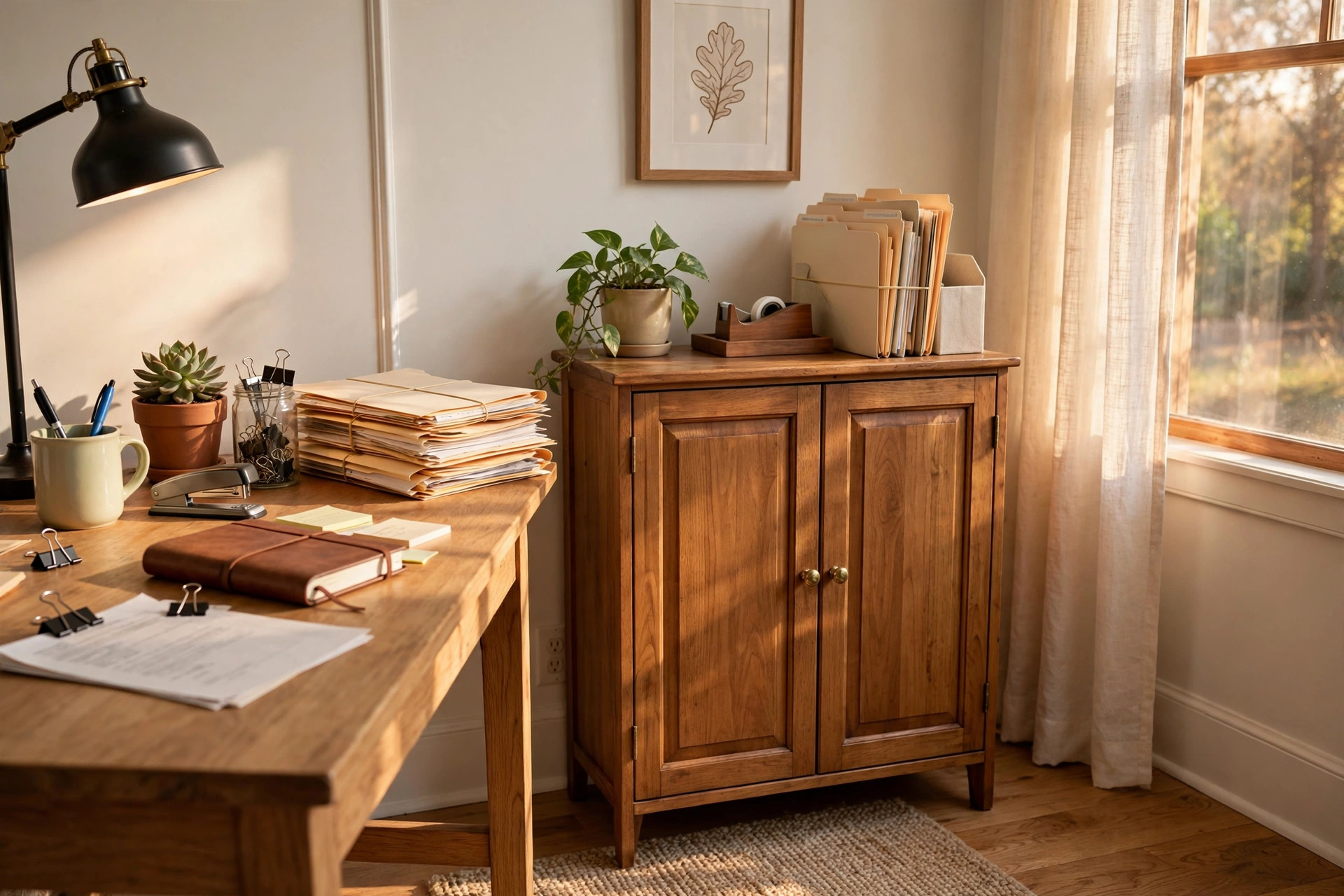

Why Papers Pile Up — And Why a Small Bookshelf With Doors for Office Documents Helps
A home office gathers paper fast. Bills land on the desk. Tax forms arrive in the mail. School letters wait for a reply. Printer paper stacks up beside the laptop. Before long the desk is full and nothing can be found. A small bookshelf with doors for office documents solves this common problem in a simple way. It gives every paper a home. It hides the clutter behind doors. And it fits in a room that has no space for a full file cabinet.
Open shelves look nice, but they collect dust. Paper on open shelves fades in sunlight and curls at the edges. Doors change all that. They block dust. They block light. They keep papers flat and clean for years. They also make the room look calm. A tidy shelf with closed doors reads as one neat piece of furniture, not a wall of paper. This matters in a spare bedroom or a corner of the living room that serves as the office. Guests see order, not chaos.
A small bookshelf also keeps documents within reach. When the tax form or the insurance card is needed, the doors open and the binder is right there. No digging through drawers.
Why It Matters: Order, Protection, and Privacy: Small Bookshelf with Doors for Office Documents
Paper is fragile. Heat, sun, dust, and damp air all damage it over time. Legal papers, birth records, and tax files deserve better than a pile on a chair. Doors on a bookshelf guard against all three common threats. They keep out the daily dust that settles on open shelves. They cut the sunlight that bleaches ink. They slow the damp air that warps thin sheets. These are small facts, but they protect papers that may need to last for decades.
Privacy is a second reason. An office bookshelf often holds bank letters, medical forms, and school reports. On open shelves, any visitor can read the labels. Behind doors, the papers stay private. A set of doors can also carry a small lock. That matters for homes with children or shared rooms. It matters for people who run a small business from home and must keep client papers safe. One locked shelf is often all it takes to meet basic care standards for private records.
Order is the third reason. Documents that have a fixed place get put back. Documents that have no place end up on the desk and the kitchen table. A small shelf with doors turns filing into a habit that takes ten seconds. Open the doors, slide the binder in, close the doors. Done.
What to Look for When You Shop
Start with size. Measure the wall or corner where the shelf will stand. Then measure the doorways and halls it must pass through on delivery day. A small bookshelf is usually 24 to 36 inches wide and 12 to 16 inches deep. That depth fits standard binders and letter-size boxes. Tall units reach 60 to 72 inches. Low units sit under a window at 30 to 36 inches. Pick the height that suits the room. A tall shelf gives more storage. A low shelf doubles as a surface for a printer or a lamp.
Next, check the shelves inside. Adjustable shelves are worth the extra cost. They let the owner fit tall binders on one row and small boxes on another. Fixed shelves force papers into boxes that do not fit. Count the shelves and note the distance between them. At least one row should clear a standard three-ring binder, which stands about 11.5 inches tall.
Then study the doors. Solid doors hide everything and block the most dust. Glass doors show the contents while still keeping dust out, which helps when the shelf holds books too. For pure document storage, solid doors are the calmer choice. Check how the doors close. Magnetic catches are simple and quiet. Hinges should feel firm, not loose.
Look at the back panel. A full back panel keeps dust out and stiffens the frame. A thin paper back is a sign of a cheap build. Also check the base. Levelers or small feet help on uneven floors. A shelf that rocks will pull at its screws over time.
Finally, think about weight. Paper is heavy. A shelf of binders can weigh more than 100 pounds. The maker should state a weight limit per shelf. Solid wood and thick engineered boards handle the load best. Thin particleboard bows under paper weight in a year or two. If the price seems low, read the weight rating before buying.
Common Types and Options
The two-door cabinet shelf is the most common type. It stands like a small wardrobe and opens to reveal two to four shelves. Many makers sell it in white, black, and wood tones, so it matches most desks.
The hutch-top shelf sits on a desk or a credenza. It adds two or three rows of closed storage above the work surface. This type suits people who want papers close at hand while they work. It saves floor space, which matters in a small bedroom office. Measure the desk first to make sure the hutch fits its depth.
The credenza style is low and wide. It holds papers on the bottom shelves and leaves the top free for a printer or a lamp. It works well under a window or along a hall wall.
Some buyers prefer a home office bookshelf with closed storage bins, which pairs a shelf frame with fabric or plastic bins behind the doors. The bins slide out like drawers. This is a kind office solution for loose papers that do not deserve full binders. Label each bin and the system runs itself. See our guide on a /home-office-bookshelf-with-closed-storage-bins/ for a full look at that option.
For tight corners, a corner bookshelf for small home office storage uses space that often goes to waste. These units are shaped to sit across a corner, with doors that swing open at an angle. They hold fewer papers than a full-width shelf, but they rescue dead space.
A compact bookshelf for home office closet setup is built for converted closets, which many renters use as offices. These units are narrow and shallow. They fit inside a standard closet frame and close up neat when the workday ends.
Locking models add a key or a combination lock to the doors. They cost more, but they suit anyone who stores client files, medical papers, or a home business ledger. A simple cam lock is enough for most home use. Pair the shelf with a lockable filing cabinet for home business documents when the paper load grows beyond what a small shelf can hold.
Cost and Price Ranges
Prices for a small bookshelf with doors for office documents run wide. A simple flat-pack unit from a mass retailer starts near 60 dollars. These models use thin engineered boards and basic hinges. They work for light loads and short-term use. Expect to tighten the screws once a year.
The mid-range, from about 120 to 300 dollars, is the sweet spot for most buyers. Shelves in this band have thicker panels, adjustable shelves, and better hinges. They handle a full load of binders without bowing. Home guides at The Spruce often review models in this band.
Above 300 dollars, buyers find solid wood fronts, soft-close hinges, and fine finishes. These pieces last for decades and suit a formal home office. Custom and semi-custom cabinet shops can build a shelf to exact wall dimensions, but that can pass 800 dollars. Most home offices do not need that level.
Watch for hidden costs. Delivery fees for furniture can add 30 to 80 dollars. Factor the cost of binders, boxes, and labels too. A bare shelf holds nothing well until it has organizers inside.
Care and Upkeep
A closed bookshelf needs little care, but a few habits keep it strong for years. Dust the top and the door fronts once a month. Use a soft dry cloth. On wood finishes, a damp cloth followed by a dry one lifts grime without harm. Never soak the panels. Water swells engineered boards and lifts veneer.
Open the doors once in a while and dust the shelves. Paper sheds tiny fibers. These collect in corners and draw pests if left for years. While the doors are open, check for sagging shelves. A shelf that bows under binders should be moved to a lower slot or given a center support. Most sagging happens slowly, so a yearly check catches it early.
Tighten hinge screws once a year. Doors that drag or hang crooked usually need only a quarter turn of a screwdriver. Oil a squeaky hinge with a single drop of light machine oil. Keep liquids away from the shelf. A coffee spill on a top surface can seep into seams and stain the finish.
Sunlight still reaches a closed shelf through windows. If the shelf stands near a window, the side in the sun may fade over the years. In damp rooms, leave a small gap between the shelf back and the wall so air can move. This stops mildew behind the unit.
For shoppers comparing flat-pack designs, IKEA publishes care guides for its storage lines that apply to most engineered-wood shelves. Review sites like Wirecutter also test how well common bookcases stand up to years of heavy paper loads, which is worth reading before a purchase.
Safety at Home
A bookshelf full of paper is heavy, and heavy furniture can tip. Anchor every tall shelf to a wall stud with the strap or bracket that comes in the box. This is the single most important safety step. Tip-over injuries harm thousands of people each year, and children are at the greatest risk. The anchor takes ten minutes to install. Do it the day the shelf arrives.
Place the heaviest binders on the lowest shelves. This lowers the center of gravity and makes tipping far less likely. Never let children climb the shelves or swing on open doors. Teach them that the shelf is not a ladder.
Check the doors for pinch points. Soft-close hinges reduce the chance of caught fingers, which matters in a busy family home. If the shelf has glass doors, confirm the glass is tempered. Tempered glass breaks into dull pebbles instead of sharp shards. Keep a clear path in front of the doors so they can open fully without hitting a chair or a person.
Fire safety counts too. Keep the shelf away from space heaters and fireplaces. Paper burns fast. A working smoke alarm in the office room is a must. The U.S. Consumer Product Safety Commission offers free guides on anchoring furniture, and ergonomic office design resources from office furniture makers explain how to lay out a safe, comfortable work corner.
Frequently Asked Questions
How much weight can a small bookshelf with doors hold? It depends on the build. Light flat-pack models often rate each shelf for 15 to 25 pounds. Mid-range units rate 30 to 50 pounds per shelf. A full shelf of binders can weigh 40 to 60 pounds, so check the rating before loading. When in doubt, spread heavy binders across several shelves and keep the heaviest ones low.
Will the doors really keep dust off my papers? Yes, to a large degree. Doors block the daily settling of dust that coats open shelves. Some dust still enters through small gaps, so an occasional wipe is wise. But papers behind doors stay far cleaner than papers on open shelves.
What size fits a standard home office? Most home offices suit a shelf 30 to 36 inches wide and 60 to 72 inches tall. In a very small room, a 24-inch-wide unit or a low credenza works better. Always measure the space twice and leave room for the doors to swing open.
Is solid wood better than engineered wood for document storage? Solid wood is stronger and lasts longer, but it costs more. Good engineered wood with thick panels handles paper weight fine for many years. The weak point is usually thin back panels and cheap hinges, not the shelf boards themselves. Read reviews and check the per-shelf weight rating rather than judging by material alone.
Can I lock a small bookshelf with doors? Many models accept an add-on cam lock, and some come with locks built in. A lock keeps children, guests, and roommates out of private papers. For serious business records, a locking shelf plus a fire-rated box is a sensible pair. Office product reviews at PCMag cover several locking storage options for home offices.
Where should I place the shelf in the room? Near the desk, but not where the doors hit the chair. Against a solid wall is best for anchoring. Keep it out of direct sun and away from heat vents. If the office is a shared room, a shelf with solid doors along one wall reads as neat furniture and keeps work papers out of sight. Retailers with wide ranges of styles, such as Wayfair, let buyers filter by width so the unit fits the exact wall.
A Short Final Word
A small bookshelf with doors for office documents is a quiet workhorse. It costs less than most office furniture. It fits rooms that have no space to spare. And it turns a pile of paper into a system that works every day. Measure the space, pick sturdy shelves with good doors, and anchor it to the wall.
Shoppers who want to compare many models side by side can browse The Home Depot and Lowe’s, both of which carry office storage from many brands. Those studying full-room setups may also learn from Steelcase and standing desk guides from UPLIFT Desk, which show how storage fits into a healthy work corner.
References
Herman Miller. (n.d.). Office furniture and ergonomic seating. https://www.hermanmiller.com IKEA. (n.d.). Home furnishings. https://www.ikea.com Lowe’s. (n.d.). Home improvement products. https://www.lowes.com PCMag. (n.d.). Technology product reviews. https://www.pcmag.com Steelcase. (n.d.). Office furniture and workplace research. https://www.steelcase.com The Home Depot. (n.d.). Home improvement products. https://www.homedepot.com The Spruce. (n.d.). Home and garden advice. https://www.thespruce.com U.S. Consumer Product Safety Commission. (n.d.). Product safety information. https://www.cpsc.gov UPLIFT Desk. (n.d.). Standing desks and ergonomic office furniture. https://www.uplift-desk.com Wayfair. (n.d.). Furniture and home goods. https://www.wayfair.com Wirecutter. (n.d.). Product reviews from The New York Times. https://www.nytimes.com/wirecutter
Was this guide helpful?

About James Carter
The My Garden US editorial team writes practical, in-depth home and garden guides for American homeowners — tested advice, no fluff.
You May Also Like
Wall Mounted Folding Desk with Chalkboard: A Smart Space Saver
April 27, 2026 0 views
Small Standing Desk for Laptop Only Use: A Practical Guide
March 17, 2026 0 views
Adjustable Desk Fan With USB Charging Port: A Plain Guide for a Cooler Desk
September 20, 2026 0 views