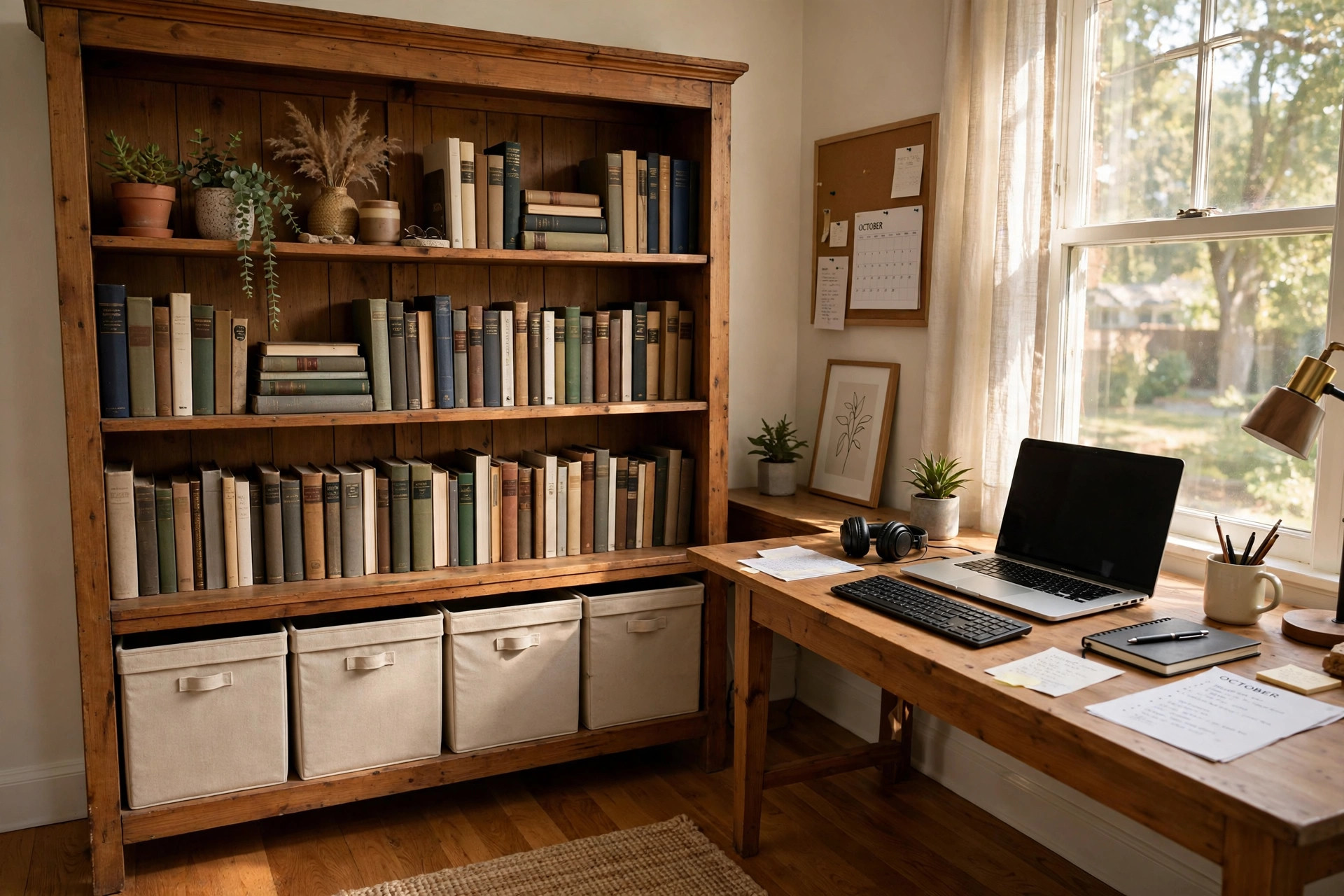

A home office bookshelf with closed storage bins is one of the most useful pieces of furniture for anyone who works from home. It does two jobs at once. The open shelves hold books, files, and things you reach for every day. The closed bins hide the rest: cables, ink cartridges, stationery, chargers, and the small clutter that makes a room feel messy. When the bins shut, the office looks calm. When you need something, you open a bin and find it.
Many home offices serve as guest rooms, living rooms, or corners of a bedroom. In those cases, closed storage matters even more. A shelf with open boxes full of papers looks untidy to anyone who walks by. A shelf with clean bin fronts looks like a planned piece of furniture. That is why this style of bookcase has become so common in home workspaces across the country.
This guide explains why a home office bookshelf with closed storage bins matters, how to choose one, the types you can buy, what you will pay, how to care for it, and how to use it safely. It also answers the questions buyers ask most often.
Why It Matters
A tidy office helps a worker think. Studies of office design have long shown that visual clutter raises stress and breaks focus. Paper stacks, tangled cords, and loose supplies pull the eye and the mind. Closed bins solve this in a simple way. They put a door between the worker and the mess.
A home office bookshelf with closed storage bins also saves space. A separate bookcase and a separate cabinet take up two walls or two corners. One unit that does both jobs fits in a single spot. For workers in small rooms, that difference matters.
There is a third benefit. Closed bins protect what is inside them. Papers stay free of dust. Supplies stay dry. Items that fade in sunlight, such as printed photos or colored paper, last longer behind a bin front. For people who store tax records, bills, or medical papers at their desk, that protection is worth a great deal.
Retailers that sell home office furniture now list closed-storage bookcases as a distinct group. You can browse wide selections at places like IKEA and Wayfair, where filters let you sort by width, material, and color. Advice sites such as The Spruce also explain how closed storage changes the look and feel of a small room.
How to Choose: Home Office Bookshelf with Closed Storage Bins
Measure the Space First
Measure the wall where the bookcase will stand. Write down the width, the height to the ceiling, and how far the unit can stick out into the room. Leave at least two inches of clearance on each side so the unit does not crowd the wall. Check that doors or drawers near it can still open.
Depth is easy to forget. A home office bookshelf with closed storage bins often runs 12 to 16 inches deep. That is enough for books and bins, but a deep unit in a narrow room can block a walkway. Tape the footprint on the floor with painter’s tape before you buy. Walk around it. Sit at your desk and look at it. This simple test stops many bad purchases.
Pick the Right Bin Style
Bins come in several styles. Flip-down bins tilt forward and work well for papers you use daily. Sliding bins save space because no door swings out. Lidded basket bins lift off and are easy to carry to the desk. Hinged cabinet doors suit items you touch once a week.
Think about what will go inside each bin. Daily papers do best in bins that open fast. Back-up supplies can sit behind doors you open rarely. Some workers label each bin with a small tag. Labeling sounds fussy, but it keeps the system working after the first month.
Match the Material to the Load
Particleboard with a laminate finish is common and low in price. It holds books well on short spans, but long shelves can sag under heavy loads. Solid wood costs more and holds weight for decades. Metal frames with wood shelves give a modern look and strong support.
For design ideas and product reviews of office furniture built to last, readers often turn to Herman Miller and Steelcase, two makers known for sturdy workspace pieces. Reviews at Wirecutter also test how bookcases hold up under real book weight.
Check the Back Panel and Hardware
A thin back panel keeps dust out and stops small items from slipping behind the unit. Wall anchors should come in the box. If they do not, buy them. A tall bookcase full of books can weigh over 150 pounds. It must be fixed to a wall stud.
Types and Options
Freestanding Bookcases with Bin Rows
This is the most common type. Three to five open shelves sit above or beside a row of closed bins. It works in almost any room and needs no wall work beyond anchoring. Most models are 30 to 48 inches wide.
Wall-Mounted Shelves with Closed Cabinets
Some systems hang on wall rails. Open shelves mount at eye level and closed cabinets mount below. The floor stays clear, which helps in very small rooms and makes cleaning easy. These systems often cost more because the rail hardware is sold apart.
Modular Cube Units with Bin Inserts
Cube shelving uses square openings. Fabric or wood bins slide into the cubes you want to close. You can change the mix over time: close a cube this year, open it next year. This type suits renters because it comes apart flat and moves well.
Corner and Narrow Units
Narrow towers, some only 12 inches wide, fit beside a desk or in a hall nook. Corner bookcases turn a dead corner into storage. Both types usually hold fewer books, so they suit offices where most files live on a computer.
For small-space layout ideas, Apartment Therapy shows many real rooms that mix open and closed storage. Builders and remodelers writing at Family Handyman also cover wall-anchoring methods for tall furniture.
Cost and Price
Prices vary with size, material, and brand. A small laminate bookcase with fabric bins often sells for 60 to 120 dollars. Mid-range wood-look units with solid bin doors run 150 to 350 dollars. Solid wood bookcases with fitted closed storage can cost 400 to 900 dollars or more. Modular wall systems may pass 1,000 dollars once rails and bins are added.
Closed storage adds to the price. Expect to pay 20 to 40 percent more than a plain open bookcase of the same size. The extra cost buys the bins, doors, hinges, and handles. For many buyers, the tidy look is worth it.
Watch for delivery fees. Large bookcases often ship freight, which can add 50 to 100 dollars. Some stores offer free pickup at a local warehouse. Flat-pack units cost less to ship but need an hour or two of assembly. Check whether the price includes the bins. Some listings show the bookcase with bins in the photo but sell them apart.
Comparison shoppers use PCMag and The Home Depot to check prices across brands before they buy. The Container Store is another good place to study bin sizes, since bins must fit the shelf openings exactly.
Care and Upkeep
Dust the open shelves once a week with a dry cloth. Once a month, pull out the bins and dust inside them. Crumbs, paper dust, and dead batteries collect in bins faster than people expect.
Keep liquids away from the unit. A coffee spill on laminate can seep into seams and swell the board. Use coasters on the top surface. If the bookcase stands near a window, turn it so sun does not bake one side. Sun fades finishes and warps thin panels over time.
Tighten screws and cam locks once a year. Wood and board shift with the seasons, and hardware loosens. Check the wall anchors at the same time. A unit that has stood firm for years can work loose after a move or an earthquake.
Do not overload the bins. A bin full of old magazines can weigh 30 pounds or more. Heavy bins strain hinges and make doors sag. Move rarely used heavy items to lower bins, where the weight sits near the floor.
For step-by-step furniture care routines, Uplift Desk and office setup guides at major retailers publish useful checklists. If you pair your bookcase with other gear, such as adjustable armrest pads for office chair comfort, a small shelf caddy can keep the parts in one bin.
Safety
Anchor every bookcase that stands taller than 30 inches. Children climb. Pets bump into things. Earthquakes shake rooms. A wall anchor costs a few dollars and takes ten minutes to fit. The United States Consumer Product Safety Commission reports injuries each year from tipping furniture, and most of them are preventable.
Place the heaviest items on the lowest shelves and in the lowest bins. This keeps the center of gravity near the floor. Never let a child climb the shelves to reach a top bin. Store cleaning chemicals and sharp tools in bins with locks if children visit the office.
Check weight limits in the manual. A shelf rated for 25 pounds should not hold 40 pounds of textbooks. Spread heavy books across several shelves instead of stacking them on one. If a shelf bows in the middle, unload it at once and move the load lower.
Keep cords out of the bins. Chargers and power strips hidden in a closed bin can trap heat. If you must store a power strip in the office, keep it in the open where air moves. Leave a gap behind the unit for plugs and cables.
Workers who secure their rooms may also look at a home office door lock for private workspace and an adjustable monitor light bar for eye care as part of a safer, more comfortable setup.
Frequently Asked Questions
What size bookcase fits a small home office?
A unit 30 to 36 inches wide and 12 to 14 inches deep fits most small rooms. Tape the footprint on the floor first. If the room is very tight, a narrow tower of 12 to 18 inches wide beside the desk works well.
Are closed bins better than open baskets?
Closed bins hide clutter and keep out dust, so they look tidier. Open baskets make it easier to see what is inside. Many workers mix the two: closed bins for messy supplies, open baskets for items they grab daily.
How much weight can the bins hold?
Most bins hold 10 to 25 pounds each. Check the manual for your model. Store heavy items like books and files on the shelves or in low bins, and light items like stationery in high bins.
Can I add bins to a bookcase I already own?
Often yes. Measure the shelf openings first: height, width, and depth. Buy bins made for those sizes. Modular cube systems sell inserts in standard sizes. For fixed-shelf bookcases, look for bins with a little clearance so they slide in and out.
Do I need to anchor the bookcase if it feels stable?
Yes. A full bookcase feels stable until a child climbs it or the floor shakes. Use the wall anchors that came in the box, or buy a kit. Fix it to a wall stud, not just drywall.
How do I keep the bins organized?
Give each bin one job: one for cables, one for ink, one for bills. Label the fronts. Once a month, open every bin and throw out what you no longer need. A small habit keeps the system working for years.
A Short Final Word
A home office bookshelf with closed storage bins is a simple answer to a common problem. Papers, cables, and supplies have to live somewhere. Open shelves show them to the world. Closed bins put them away. Measure your wall, pick a bin style that fits your habits, anchor the unit, and keep the bins to one job each. Do that, and the bookcase will keep your office calm for many years.
References
Apartment Therapy. (n.d.). Home design ideas and inspiration. https://www.apartmenttherapy.com Family Handyman. (n.d.). DIY home repair and maintenance. https://www.familyhandyman.com Herman Miller. (n.d.). Office furniture and ergonomic seating. https://www.hermanmiller.com IKEA. (n.d.). Home furnishings. https://www.ikea.com PCMag. (n.d.). Technology product reviews. https://www.pcmag.com Steelcase. (n.d.). Office furniture and workplace research. https://www.steelcase.com The Container Store. (n.d.). Storage and organization products. https://www.containerstore.com The Home Depot. (n.d.). Home improvement products. https://www.homedepot.com The Spruce. (n.d.). Home and garden advice. https://www.thespruce.com UPLIFT Desk. (n.d.). Standing desks and ergonomic office furniture. https://www.uplift-desk.com Wayfair. (n.d.). Furniture and home goods. https://www.wayfair.com Wirecutter. (n.d.). Product reviews from The New York Times. https://www.nytimes.com/wirecutter
Was this guide helpful?

About Jennifer Lee
The My Garden US editorial team writes practical, in-depth home and garden guides for American homeowners — tested advice, no fluff.
You May Also Like

Home Office Desk With Side Return Extension: A Complete Buyer’s Guide
January 26, 2026 0 views
Home Office Filing Cabinet Lateral Two Drawer: A Complete Guide
February 6, 2026 0 views
Best Home Office Desk for Left Handed Users: A Practical Buying Guide
June 23, 2026 0 views