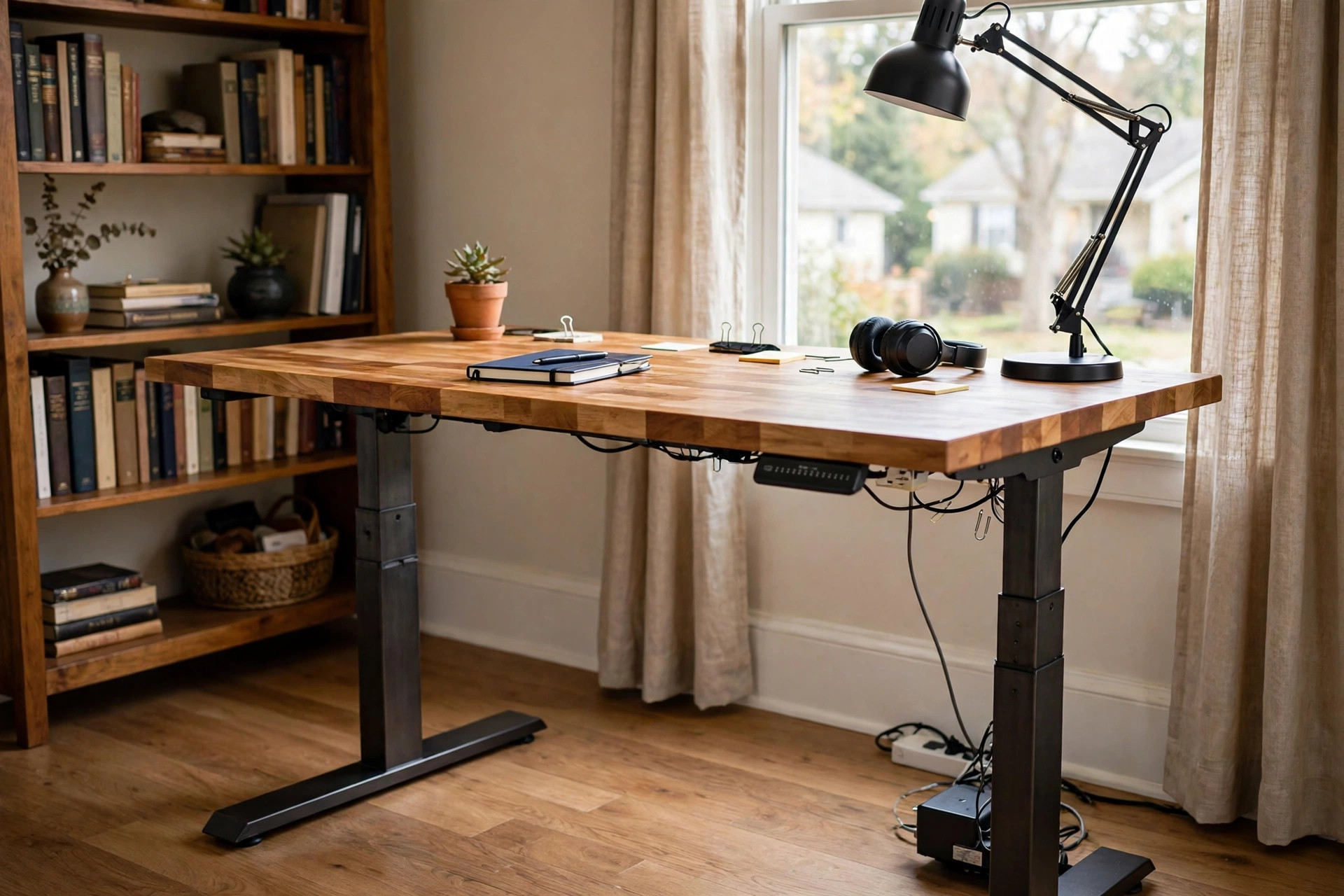

Many home office workers want a standing desk but do not want to buy a full desk set. The solution is simple. Adjustable height desk legs only for DIY projects give you the frame and the lift system without a tabletop. You supply the top. You can use a wood slab, a door blank, or a piece of butcher block. The result is a custom sit-stand desk that fits your room and your budget.
This idea has grown fast. Home offices are now common across the United States. People work from apartments, spare rooms, and basements. A prebuilt standing desk may not fit the space. It may cost too much. It may look wrong in the room. Buying only the legs and building the rest yourself solves these problems at once.
Why It Matters
Sitting all day takes a toll on the body. Back pain, stiff necks, and poor posture are common among desk workers. Doctors have said for years that movement through the day helps. A sit-stand desk lets you change position. You sit for a while. You stand for a while. Your body gets a break.
A full standing desk from a brand name can cost many hundred dollars. When you buy adjustable height desk legs only for a DIY build, you skip the branded top. You choose your own surface. Old wood, a salvaged table top, or a cut from the lumber yard all work. The savings can be large. Many builders finish the whole project for less than the price of a mid-range desk.
There is also the matter of fit. Standard desks come in standard sizes. Your room may need a corner desk, a narrow desk, or an extra long desk. When you build it yourself, the top can be any size or shape. The legs do the lifting. The top does the rest.
How to Choose: Adjustable Height Desk Legs Only for Diy
Start with the load you need. Desk leg frames carry the top plus your gear. A single monitor and a laptop weigh little. Two large monitors, a docking station, and a heavy wood top weigh much more. Check the weight rating of the leg set. Pick one rated well above your total load. A frame rated for 200 pounds will handle most home office setups with room to spare.
Next, look at the height range. Most adult users need the desk surface to reach about 48 inches for standing. Some frames lift from 25 inches to 50 inches. That range fits most people. Tall users should check the top end. Short users should check the low end. The frame should match your body, not the other way around.
Stability matters most when the desk is raised. A frame that wobbles at full height will drive you mad. Look for wide feet. Look for thick steel columns. Two-stage and three-stage columns are the common types. Three-stage columns lift smoother and reach higher. They cost more but feel more solid.
Decide between electric and manual lift. Electric frames use a motor and a small control box. You press a button and the desk rises. Manual frames use a hand crank or gas springs. Electric is easier. Manual is cheaper and never needs a plug. For a desk against a wall with outlets nearby, electric is the easy pick. For a garage or shed office, manual may be the better fit.
Check the frame width. Most leg sets fit tops between 42 and 72 inches wide. Some stretch wider. Measure your tabletop first. Make sure the frame matches. The feet should sit a few inches inside the edges of the top.
Look at the control box and memory settings. Some electric sets let you save two or three height presets. You press one button for sit and one for stand. It is a small feature, but you will use it every day.
Types and Options
Two-leg frames are the standard. They sit at the back or center of the top. They work for most desks up to 72 inches wide. They are simple to build with and easy to find.
Three-leg frames fit corner desks. They form an L shape. They lift evenly on all three sides. If your home office has a corner free, this shape gives you a lot of surface in a small room.
Single-column legs work for small desks and laptop stands. One strong column holds a narrow top. They are best for light use. They are not meant for heavy monitor arms and large wood tops.
Electric frames are the most popular. They lift at about one and a half inches per second. They run quiet. They come with a handset, a motor, and a control box. Wiring is simple. Most people finish the setup in under an hour.
Crank frames are a solid low-cost option. You turn a handle to raise the desk. It takes about 40 turns to go from sit to stand. There is no motor to fail. There are no wires to hide. They suit simple setups.
Pneumatic and gas-spring legs are the third type. They lift with the push of a lever. You guide the top up with your hands. They move fast. They work well for light tops. Heavy tops can make them hard to control.
Some leg sets come with a crossbar between the legs. The bar adds stiffness. It also gives you a place to mount a cable tray. If your frame lacks a bar, you can add one later with a simple wood brace under the top.
Cost and Price
Prices vary by type and lift power. Basic manual leg sets start near 80 dollars. Crank frames run from 100 to 180 dollars. Entry-level electric two-leg frames run from 200 to 350 dollars. Heavy-duty three-stage electric frames run from 350 to 600 dollars. Three-leg corner frames cost more, often 400 to 700 dollars.
The tabletop is your other cost. A laminate door blank from a home store can cost under 60 dollars. A butcher block slab can run 100 to 250 dollars. A slab of live-edge hardwood can cost 300 dollars or more. Some builders spend nothing. They reuse a table top they already own.
Add small parts to the budget. Wood screws, cable clips, and a power strip add up to about 30 dollars. A cable management tray costs 20 to 40 dollars. Monitor arms mount on the top and cost 30 to 100 dollars each. Even with these extras, a full DIY build often costs half of a brand-name standing desk.
Watch for sales. Home office gear goes on sale in late summer and around the holidays. Leg sets from online stores change price often. A patient buyer can save 50 dollars or more by waiting a few weeks.
Care and Upkeep
Electric frames need little care. Keep dust off the columns. Wipe them with a dry cloth now and then. Do not let cords hang where they can catch on the frame. Check the screws that hold the top to the frame once a year. Tighten what is loose.
Grease the moving parts of crank frames once a year. A light machine oil on the screw shaft keeps the crank smooth. Keep the gearbox dry. If the crank starts to grind, stop and look for a loose bolt before you force it.
Pneumatic legs can lose pressure over many years. If the desk starts to sink under load, the gas springs may be worn. Most makers sell replacement cylinders. Swapping them takes a wrench and a few minutes.
For the tabletop, follow the rules of the wood. Oil-finished tops need a fresh coat of oil once or twice a year. Laminate tops need only a damp cloth. Watch for water rings from coffee cups. A simple desk mat under your work area stops most damage.
Cable care is part of upkeep too. As the desk rises and falls, cables stretch and relax. Give them slack. Use a cable tray under the top. Tie power cords together with soft ties, not zip ties pulled tight. Check the bundle every few months.
Safety
A heavy top can hurt if it drops. Always build with the frame lowered. Attach the top while the legs are at their lowest setting. Never work under a raised desk. Never let children operate the controls unsupervised.
Pinch points are real. Fingers can get caught between the moving columns and the top. Keep hands clear when the desk is in motion. Teach everyone in the house this rule. Electric frames with anti-collision sensors stop when they hit something. The sensor helps, but it is not a full guard.
Watch the floor. Wide feet can trip people in small rooms. Place the desk where feet do not stick into walkways. If you use a floor mat for standing, keep it flat so it does not slide under the feet.
Electrical safety is simple. Plug the control box into a grounded outlet. Do not run the cord under rugs. Do not overload the power strip. Keep liquids away from the control box and the handset.
Check the weight limit and respect it. Overloading the frame strains the motor. It also makes the desk less stable at full height. If you plan to add more gear later, buy a frame with headroom now.
FAQ
Can I attach adjustable height desk legs to any tabletop? In most cases, yes. The top must be stiff enough to span the frame. Solid wood, plywood at least one inch thick, and butcher block all work well. Thin particle board can sag and is a poor choice for a wide desk. The top should also be flat so it sits flush on the frame rails.
How long does the build take? A simple two-leg build takes about one to two hours. You will drill pilot holes, bolt the legs to the top, plug in the motor, and run the first up-down cycle. Corner frames take longer because of the extra leg and alignment. Plan a full afternoon for your first L-shaped build.
Do electric leg sets need special wiring? No. They plug into a standard wall outlet. The set comes with a control box and a handset. You route the cables with the clips in the box. No electrician is needed. Just make sure the cord can reach your outlet at both sit and stand heights.
Will the desk wobble when raised? A good frame will not. Wide feet, thick columns, and a proper crossbar keep the desk steady. Cheap frames with narrow feet may sway at full height. Read reviews that mention stability. If you are tall, a three-stage frame will feel more solid at the top of its range.
Can I add these legs to a desk I already own? Yes, in many cases. Remove the old fixed legs or the old base. Check that the old top is thick and strong enough. Then bolt the new adjustable frame to it. Some builders keep an adjustable height desk converter for existing table setups in mind and compare the two paths before they start. A converter sits on top of the old desk. Legs replace the old base outright.
What pairs well with a DIY standing desk? A best laptop stand for standing desk posture keeps your screen at eye level when you stand. Good task lighting cuts eye strain. Some workers add a compact treadmill desk for walking while working later. Build the desk first. Add gear one piece at a time.
Choosing Where to Buy
Many large stores sell leg sets and frames. Department-style home stores carry basic models in the aisle and more online. Furniture sellers list full ranges with reviews from real buyers. Office furniture makers publish detailed specs on weight limits and lift speed. Review sites test frames for stability and noise. It helps to read across a few of these before you pick.
Shoppers often start with IKEA for simple frames and tabletop ideas. Wayfair lists a wide range of leg sets with buyer reviews. Herman Miller publishes ergonomic guidance that helps with height settings. Steelcase offers research on posture and work habits. UPLIFT Desk specializes in frames and accessories for standing desks. The Spruce runs how-to guides on home office builds. Wirecutter tests office gear and ranks frames on stability. PCMag reviews tech-heavy home office setups and gear.
A Final Word
Adjustable height desk legs only for DIY builds are one of the smartest buys in home office gear. You get the lift system you need and skip the parts you do not. Your desk fits your room. Your desk fits your budget. And it fits your body, because you set the heights yourself.
Take your time with the measurements. Pick a frame stronger than you think you need. Choose a top you will enjoy looking at every day. The build is not hard. The payoff is a desk that moves with you for years.
References
Herman Miller. (n.d.). Office furniture and ergonomic seating. https://www.hermanmiller.com IKEA. (n.d.). Home furnishings. https://www.ikea.com PCMag. (n.d.). Technology product reviews. https://www.pcmag.com Steelcase. (n.d.). Office furniture and workplace research. https://www.steelcase.com The Spruce. (n.d.). Home and garden advice. https://www.thespruce.com UPLIFT Desk. (n.d.). Standing desks and ergonomic office furniture. https://www.uplift-desk.com Wayfair. (n.d.). Furniture and home goods. https://www.wayfair.com Wirecutter. (n.d.). Product reviews from The New York Times. https://www.nytimes.com/wirecutter
Was this guide helpful?

About Robert Taylor
The My Garden US editorial team writes practical, in-depth home and garden guides for American homeowners — tested advice, no fluff.
You May Also Like
Home Office Acoustic Panels to Reduce Echo: A Plain Guide
March 3, 2026 0 views
Adjustable Monitor Arm for Heavy 34 Inch Monitor: A Buyer’s Guide
February 2, 2026 0 views
Ergonomic Desk Setup for Neck and Shoulder Pain: A Practical Guide
July 27, 2026 0 views