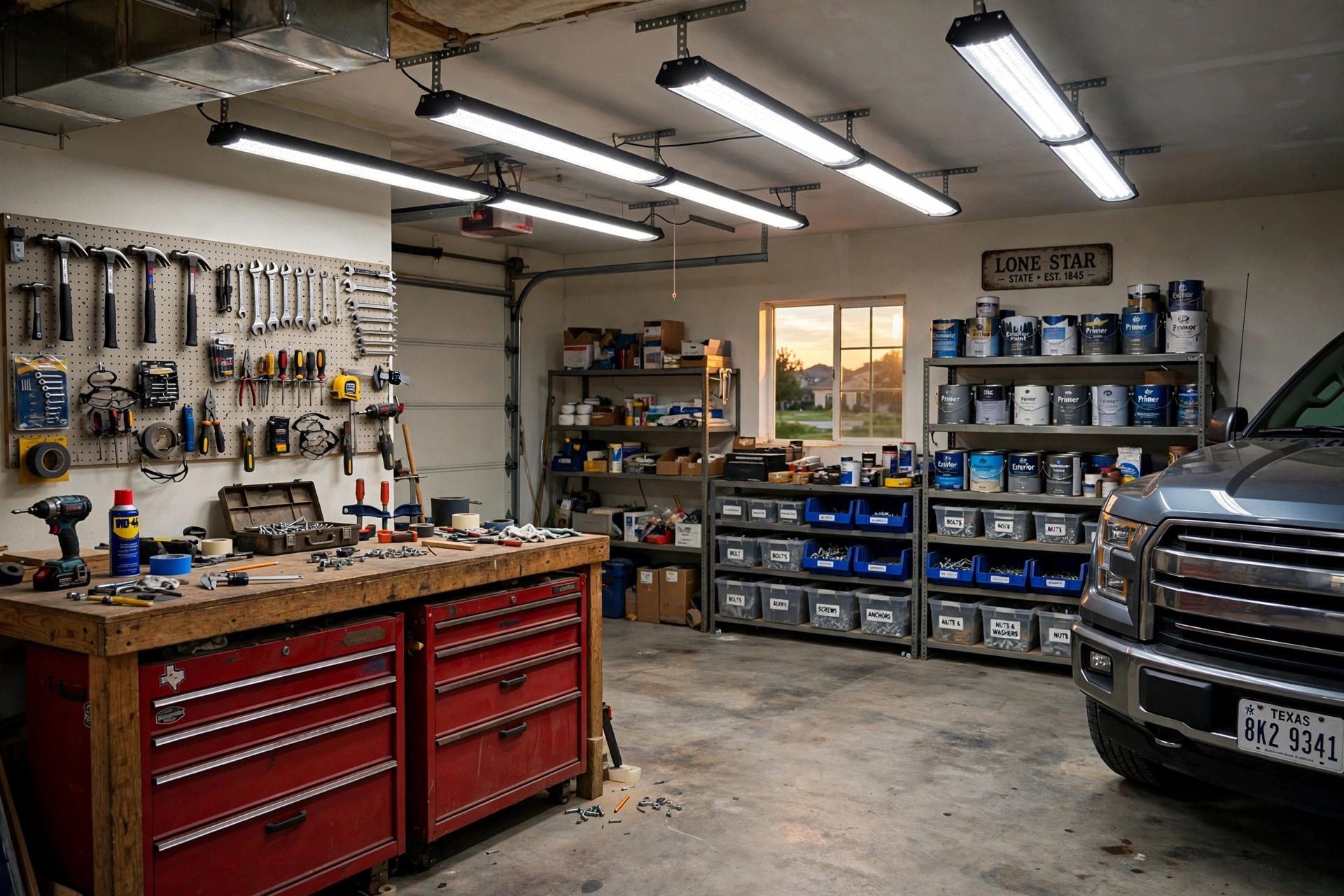

A Texas garage works hard. It holds trucks, tools, ladders, and lawn gear. Many families also use it as a workshop. They fix cars, build shelves, and finish projects late into the evening. Good light makes all of this safer and easier. That is why so many owners search for garage shop lights texas homes usa. The right fixtures cut glare, kill shadows, and keep colors true. They also stand up to Texas heat, which can climb past 100 degrees in summer. Heat shortens the life of cheap bulbs and old ballasts. It can turn a closed garage into an oven by late afternoon. This guide explains what to look for, what each type costs, and how to keep your lights running for years. The advice is plain and practical. You do not need an electrician’s training to follow it.
Why Good Light Matters in a Texas Garage
Most Texas garages pull double duty. They store the cars and they serve as the home workshop. You may change oil there, sharpen mower blades, or wire a new outlet. Each of these tasks needs clear, even light. Poor light leads to mistakes. You can strip a bolt, miscut a board, or miss a step on a ladder. Strong shop lighting lowers these risks.
Texas weather adds its own pressure. Summer heat beats down on garage roofs and attic space. Old fluorescent tubes hate heat. Their ballasts fail faster when the air is hot. Light output also drops as the tubes age in warm air. Modern LED shop lights handle heat far better. They run cooler and hold their brightness longer. The U.S. Department of Energy notes that LEDs use far less energy than older lamp types and last much longer, which matters in a garage that gets used every day.
Shadows are another problem. A single bare bulb in the middle of a big Texas garage leaves dark corners. Open truck hoods, tall shelves, and workbenches all throw shadows. When you cannot see the bolt head or the cut line, work slows down. Eye strain sets in. Multiple fixtures spread across the ceiling fix this. They push light into every corner. Two or four well-placed shop lights beat one very bright one.
There is also the evening factor. Texas families often work in the garage after dinner to dodge the daytime heat. From May through September, the coolest working hours may start at eight in the evening. At that hour the sun is gone. Your lights become the whole work environment. Bright, steady light keeps a late project safe. Flickering or dim light does the opposite. It tires your eyes and hides trip hazards like cords, oil pans, and saw horses.
How to Choose Shop Lights for a Texas Home: Garage Shop Lights Texas Homes Usa
Shopping for shop lights is simple once you know the key numbers. Four things matter most: brightness, color, durability, and fit for your space. Get these right and the rest falls into place. If you want a full side-by-side comparison of models, see the garage shop lights buying guide.
Brightness: How Many Lumens You Need
Lumens measure how much light a fixture gives off. Watts measure power use. With LEDs, watts no longer tell you much about brightness. Always shop by lumens. For a typical two-car Texas garage, aim for 30,000 to 50,000 total lumens. That usually means four fixtures of about 10,000 lumens each, hung in a grid across the ceiling.
For a single-car garage or a small work bay, 15,000 to 25,000 total lumens is enough. For a large shop with 12-foot ceilings, go higher. Light falls off fast with height. A fixture that is bright at eight feet looks dim at fourteen feet. High ceilings call for high-bay fixtures, which throw a tight, powerful beam downward. ENERGY STAR certified LED fixtures meet tested standards for efficiency and light quality, which makes them a safe starting point when you compare boxes at the store.
Color Temperature and Color Rendering
Color temperature is measured in Kelvins. For a workshop, 4000K to 5000K works best. This range looks like clean daylight. It shows true colors, which matters when you match paint, stain wire, or check engine oil. Lower numbers like 2700K look warm and cozy. They suit living rooms, not workbenches. Higher numbers above 6000K look harsh and blue. They can cause glare on metal and tools.
Color rendering index, or CRI, tells you how true colors look under the light. Pick a CRI of 80 or higher. A CRI of 90 is better for fine work like painting or electronics. Most quality LED shop lights from makers like Philips list both numbers right on the box, so you can compare before you buy.
Fixture Durability in Heat and Dust
Texas garages get hot and dusty. Sawdust, drywall dust, and road grit float in the air. Look for fixtures with a sealed or dust-resistant housing. An IP65 rating means the fixture keeps out dust and can take a spray of water. That is a plus in a garage that doubles as a wash bay.
Check the rated operating temperature. Good LED shop lights list a range, often up to 113 or 122 degrees Fahrenheit. Cheap fixtures may only be rated to 104 degrees. In a Texas garage in August, attic-side ceiling air can pass that limit. A fixture that runs too hot will dim early and die young. Retailers such as The Home Depot list temperature ratings in the product specs online, so you can check before you drive to the store.
Types of Garage Shop Lights
Linkable LED shop lights are the most popular choice. They are long bars, usually four feet, that daisy-chain together. You wire power to the first one and link the rest with short cords. This makes it easy to light a long Texas garage with one switch. Most models give 4,000 to 10,000 lumens per bar.
LED high-bay lights suit tall shops. They hang from chains or hooks and focus light straight down. A 100-watt high bay can replace an old 400-watt metal halide fixture while using a quarter of the power. They are common in three-car garages and detached Texas workshops with high ceilings. Specialty lighting shops like Lumens carry a wide range of high-bay styles if you want to compare designs.
LED wraparound fixtures replace old fluorescent troffers. They mount flush to the ceiling and spread light wide. They look neat in a finished garage. Retrofit LED tubes are the budget path. You swap them into your old fluorescent fixtures, sometimes bypassing the old ballast. This costs less than new fixtures but keeps the old housing, which may lack a heat rating.
Wall packs and motion floods belong outside, but they pair well with a shop project. Many Texas owners add them to the driveway and side doors while they upgrade the interior. Independent test data from Consumer Reports can help you judge which brands hold up over time. Big-box retailers like Lowe’s stock linkable bars, high bays, and tubes side by side, which makes in-person comparison easy. For a wider style selection, Lamps Plus carries many utility and workshop fixtures online.
Cost and Price
Prices vary by type and brightness. A single four-foot linkable LED shop light bar usually costs between 30 and 80 dollars. A two-pack or four-pack brings the per-fixture price down. High-bay fixtures run 60 to 150 dollars each. Wraparound LED fixtures sit in the 50 to 120 dollar range. Retrofit tubes cost 10 to 25 dollars per tube, plus your time to install them.
Installation costs depend on what is already wired. If your garage has outlets or junction boxes where you want the lights, you can hang linkable bars yourself in an afternoon. If you need new circuits or a new switch, an electrician in Texas typically charges 150 to 400 dollars for the job, depending on the panel distance. Get a quote before you buy fixtures so you can plan the full budget.
Energy cost is where LEDs earn their keep. A 10,000-lumen LED shop light uses about 80 watts. The old fluorescent fixture it replaces might use 150 watts or more for less light. Run four LED fixtures for four hours a day and you use about 1.3 kilowatt-hours daily. At Texas residential rates, that is roughly 15 to 20 cents a day. Old technology would cost nearly double for worse light. Over a ten-year fixture life, the savings are large. To compare current shelf prices, browse the garage shop lights for sale listings at major home stores.
Care and Upkeep
LED shop lights need little care, but a small routine keeps them bright. Dust is the main enemy. A thin film of dust on the lens can cut light output by 10 percent or more. In a woodworking shop it builds up fast. Wipe the lenses with a dry microfiber cloth every few months. Do this with the power off and the fixture cool.
Check mounts once a year. Hanging chains and hooks can loosen from vibration, especially near garage doors. Tighten any loose screws. Look for yellowing lenses, which signal heat damage or cheap plastic. A yellowed lens blocks light and should be replaced.
Keep spare link cords and mounting hardware in a drawer. Linkable systems use brand-specific cords. If one fails, you want the spare on hand. Also keep the instruction sheet. It lists the max number of fixtures you can link on one power feed. Exceeding that limit can overload the first cord in the chain. Step-by-step upkeep tips are also covered by Family Handyman, which publishes many garage project guides.
Safety
Garage lighting is electrical work, so treat it with respect. Always turn off the breaker before you wire anything. Test with a non-contact voltage tester before you touch a wire. Texas homes often have older panels with poor labeling, so verify, do not guess.
Match the fixture to the space. If your garage gets wet from rain blowing in or from washing the truck inside, choose fixtures rated for damp locations. Look for the UL or ETL damp-location mark on the label. Do not hang standard indoor-only fixtures where they can get wet.
Watch the circuit load. A standard 15-amp garage circuit can handle about 1,440 watts of continuous load. Four LED shop lights at 80 watts each use 320 watts, which leaves plenty of room. But if the same circuit feeds power tools, a freezer, and a charger, the total can add up. Add up the watts before you plug in more gear.
Keep fixtures clear of stored items. Do not stack boxes against a hot-running fixture. LED lights run cooler than old halides, but they still need air flow around the heat sink. Leave at least a few inches of clearance. The U.S. Consumer Product Safety Commission offers guidance on home electrical product safety that every DIY owner should read.
Frequently Asked Questions
How many shop lights do I need for a two-car garage in Texas? Most two-car garages need four fixtures of about 10,000 lumens each. Hang them in a grid so light reaches every corner. If your ceiling is over ten feet, use high-bay fixtures or add a fifth light. For current local pricing, check garage shop lights deals near me.
Are LED shop lights really better than fluorescent tubes in Texas heat? Yes. Fluorescent tubes lose brightness and wear out faster in hot air. Their ballasts also fail sooner. LEDs run cooler, hold full brightness in heat, and last two to three times longer. They also use about half the power for the same light.
What color temperature is best for garage work? Pick 4000K to 5000K. This daylight-like range shows true colors for paint, wiring, and mechanical work. Avoid warm 2700K bulbs, which make detail work harder, and avoid harsh 6500K lamps, which cause glare.
Can I install linkable shop lights myself? In most cases, yes. Linkable bars plug into a standard outlet or wire to an existing junction box. You can hang them with the included chains or flush-mount brackets. If you need a new circuit run from the panel, hire a licensed electrician.
Do shop lights work with a garage door opener on the same circuit? Usually yes. LED shop lights draw little power and do not create the interference that old fluorescents sometimes caused with opener remotes. If you notice range problems with your remote, move the receiver antenna away from the light fixture.
A Final Word
Good garage lighting is one of the best upgrades a Texas homeowner can make. It costs less than most tool purchases and pays off every time you walk into the garage. Bright, even LED light makes work faster, safer, and more pleasant. It stands up to Texas heat and shrugs off dust. For more ideas on lighting every room well, the guides at The Spruce are a helpful next read. Pick fixtures with the right lumens, daylight color, and a solid heat rating. Hang enough of them to kill the shadows. Then enjoy a workshop that works as hard as you do.
References
Consumer Reports. (n.d.). Product reviews and ratings. https://www.consumerreports.org ENERGY STAR. (n.d.). Energy efficient products. https://www.energystar.gov Family Handyman. (n.d.). DIY home repair and maintenance. https://www.familyhandyman.com Lamps Plus. (n.d.). Lighting and home decor. https://www.lampsplus.com Lowe’s. (n.d.). Home improvement products. https://www.lowes.com Lumens. (n.d.). Lighting and ceiling fans. https://www.lumens.com Philips. (n.d.). Lighting products. https://www.philips.com The Home Depot. (n.d.). Home improvement products. https://www.homedepot.com The Spruce. (n.d.). Home and garden advice. https://www.thespruce.com U.S. Consumer Product Safety Commission. (n.d.). Product safety information. https://www.cpsc.gov U.S. Department of Energy. (n.d.). Energy efficiency and renewable energy. https://www.energy.gov
Was this guide helpful?

About David Wilson
The My Garden US editorial team writes practical, in-depth home and garden guides for American homeowners — tested advice, no fluff.
You May Also Like
Reading Floor Lamps for Texas Homes: A Practical Buying Guide
May 14, 2026 0 views
Reading Floor Lamps Reviews Buying Guide USA
February 21, 2026 0 views
Bedroom Table Lamps for California Homes USA: A Simple Guide
September 18, 2026 0 views