
A Bright Start for Indoor Gardeners
Many homes in America do not get enough sunlight for plants. North facing windows stay dim. Apartments have short days in winter. Herbs, seedlings, and houseplants need light to live, and window light is often too weak. This indoor grow lights reviews buying guide usa readers can use will help you pick the right lamp with plain facts. You do not need a botany degree. You need to know the main types, the right size, and a few simple rules. With the right light, a tomato seedling, a basil pot, or a full shelf of tropical plants can grow well indoors all year.
Why Indoor Grow Lights Matter: Indoor Grow Lights Reviews Buying Guide Usa
Plants turn light into food. The process is called photosynthesis. Without enough light, stems grow long and thin. Leaves turn pale. Flowers fail to open. A window may look bright to you, but to a plant it is dim. Light drops fast as you move away from glass. In winter, short days make the problem worse.
Grow lights give plants the light they miss. Good reviews of indoor grow lights in the USA all point to the same result. Steady light for twelve to sixteen hours a day keeps plants compact and green. Seedlings started under lamps in February grow stronger than ones started on a sill in March. Houseplants keep their color through dark months. Herbs stay full instead of fading by January.
The right light also saves money. A cheap lamp that uses too much power and grows little is a poor buy. A well chosen lamp costs a few dollars a year to run and lasts many seasons. That is the heart of this guide. Pay for what works, and skip what does not.
Types of Indoor Grow Lights
Three families of lamps serve indoor gardeners. Each has strengths and weak points. The U.S. Department of Energy notes that light color and output both shape how plants respond, so the type you pick should match what you grow.
LED Grow Lights
LED lights are now the first choice for most buyers. They use little power. They run cool. A good LED panel or bar can last 50,000 hours or more. Many LED grow lights mix red and blue diodes with white ones to make a full spectrum. The pink or purple glow looks odd, but white “sun-like” LED models also exist and work well.
LEDs come as screw-in bulbs, flat panels, and long bars. Bulbs fit in desk lamps for one or two plants. Panels and bars cover a shelf or a four foot tray. Top reviews of indoor grow lights in USA stores often praise LED bars for even coverage. Watch for honest wattage. Some labels print the “replacement” watts instead of real watts drawn from the wall. Look for the actual draw.
Fluorescent Grow Lights
Fluorescent tubes, especially T5 shop-style tubes, were the standard before LEDs took over. They cost little to buy and give good light for seedlings and leafy greens. Tubes run cooler than old incandescent bulbs, though hotter than LEDs. Bulbs last about 20,000 hours, then dim and should be replaced.
Fluorescent fixtures are cheap and easy to find. A two tube four foot fixture can start hundreds of seedlings. They work well hung close to plants, two to four inches above the leaves. For fruiting plants like tomatoes, fluorescent light is usually too weak in the later stages. Many growers start seeds under tubes and move plants under LEDs later.
HID Lights: HPS and Metal Halide
High intensity discharge lamps include high pressure sodium (HPS) and metal halide (MH) bulbs. These were the workhorses of large indoor gardens for decades. They put out very strong light. HPS bulbs push flowering and fruiting. Metal halide bulbs give bluish light that suits leafy growth.
HID lamps have real drawbacks. They use a lot of power. They run very hot and need distance from plants plus good air flow. Bulbs must be replaced every year or so because output fades. For a home grower with a shelf or a tent, LED models are usually cheaper to run and safer to handle. HID still shows up in big setups, but most home reviews now favor LEDs.
What to Look For When You Buy
Reviews help only when you know what the numbers mean. These points matter most.
Full spectrum. Plants use blue light for leaf growth and red light for flowers and fruit. A full spectrum lamp gives both. For houseplants and herbs, a white full spectrum light works fine and looks nicer in a living room than a purple one.
Actual wattage. The watts a lamp draws from the wall tell you its real power. For leafy greens and herbs, about 20 to 30 watts per square foot of growing area is a solid rule. Fruiting plants want 30 to 50 watts per square foot. Do not trust a box that says “1000W” if the fine print shows 100 watts drawn.
PPFD and coverage. PPFD measures light that reaches the plants. Many makers hide it. Good ones publish a PPFD map showing how light spreads over a set area. Even coverage matters more than a hot center spot. Hanging height changes everything. Follow the maker’s height chart.
Timer. Plants need dark hours too. A built-in timer that runs the light for a set schedule is a real help. If your lamp has none, a cheap plug-in timer works. Smart bulbs with timers show how handy scheduled light can be, and grow lamps benefit the same way.
Heat and safety marks. Look for UL or ETL listed fixtures. These marks mean the product passed safety tests. ENERGY STAR certified lighting is another good sign, since it marks products that meet strict efficiency rules. Avoid no-name lamps with no safety marks, especially ones that run hot near wood shelves.
Daisy chaining. Some LED bars link in a chain so one plug runs several bars. This keeps cords tidy on a wide shelf.
How to Choose the Right Size
Start with your growing space. Measure the shelf or tray in feet. A two foot by four foot tray is eight square feet. For herbs, multiply by 25 watts. That tray needs about 200 real watts. A single four foot bar fixture that draws 200 watts would cover it well.
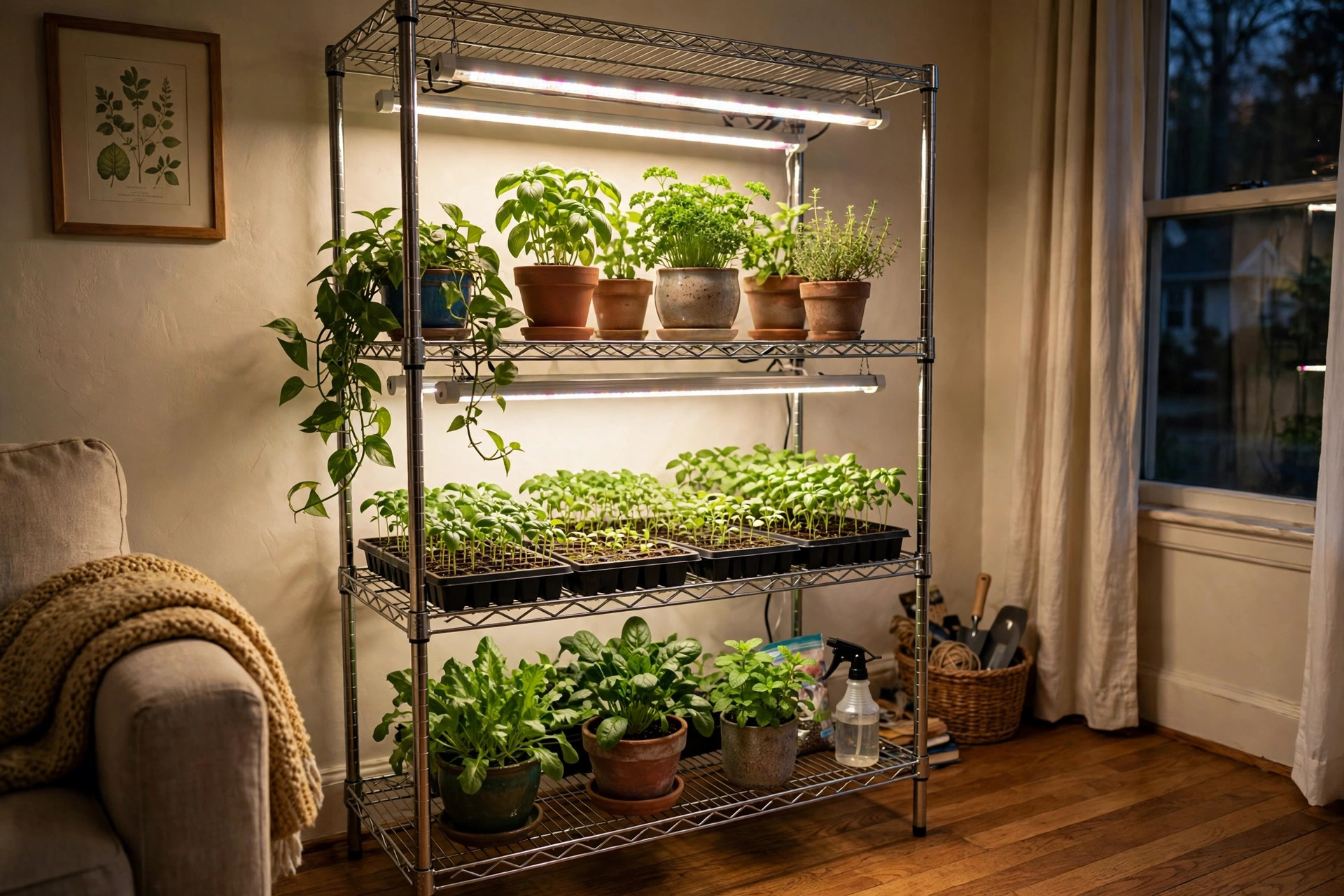
For a few houseplants on a table, one screw-in LED grow bulb in a clamp lamp is enough. Hang or place it about 12 inches above the leaves. For a wire shelf with four tiers, put one LED bar per tier. Shop-style fixtures hung on short chains work the same way and let you raise the light as plants grow.
Match the lamp to the plant. Seedlings and lettuce thrive under mild light. Orchids and succulents want brighter light and longer days. Tomatoes and peppers want the most light of all. When a review says a lamp “burns” plants, it is often too strong and too close. When a review says plants are “leggy,” the lamp is too weak or too far. Keep leaves six to eighteen inches from the lamp, and watch the plants. They will tell you the truth.
Cost and Price Ranges
Grow light prices vary widely. Here is what buyers in the USA usually pay.
Small screw-in LED grow bulbs cost 10 to 25 dollars each. They suit one or two plants. Two foot and four foot LED bars run 30 to 90 dollars per bar. A full four foot two-bar fixture for a seedling tray costs 60 to 130 dollars. Larger LED panels for a four by four foot grow tent run 150 to 400 dollars. Fluorescent T5 fixtures cost 40 to 80 dollars, plus 10 to 20 dollars per replacement tube. HID kits start around 120 dollars but use more power each month.
Running cost stays low with LEDs. A 200 watt fixture running 14 hours a day uses about 2.8 kilowatt hours daily. At 15 cents per kilowatt hour, that is about 13 dollars a month. Fluorescent and HID setups cost more to run for the same light. Large stores like Home Depot and Lowe’s carry the full range, and specialty shops such as Lumens and Lamps Plus stock design-friendly fixtures for living spaces.
Buy the smallest lamp that fits your space and plant count. A giant panel over two basil pots wastes power and money. Start small. Add more light later if your plants ask for it.
Care and Upkeep
Grow lights need little care, but a few habits keep them strong.
Dust the lamps every month. Dust blocks light. A soft dry cloth is enough. Do not spray water on a hot lamp. Check hanging chains and cords twice a year. Replace fluorescent tubes when they dim, about once a year for heavy use. LEDs fade slowly. After five to seven years of daily use, output may drop enough to matter for fruiting plants.
Keep a simple log. Write the date you start using a lamp and the hours per day. This helps you know when to replace it. Group plants by light need on the same shelf. Herbs and greens can share a tier. Bright-light plants get their own brighter tier. Turn plants a quarter turn each week so all sides get light. If you use under-cabinet strip lights for small kitchen herbs, the same care rules apply on a small scale.
Safety Tips
Electricity, heat, and water meet in indoor growing. Treat the setup with care.
Plug lamps into a grounded outlet. Use a power strip with a built-in breaker for a shelf of lamps. Keep all plugs and timers above the floor and away from watering cans. Drip trays under pots catch spills. Never hang a hot lamp so close to wood that the wood feels warm. Follow the maker’s clearance distances.
Water in the morning so leaves and soil dry under the light. Wet soil plus warm lamps can breed mold in still air. A small fan moves air and makes stems stronger. Keep lights off the recommended dark hours. Plants rest at night, and so should the wiring. Buy fixtures from trusted brands and check for UL or ETL marks on the box before you buy. Cheap unlisted lamps have caused shelf fires, so this step is worth the money.
Frequently Asked Questions
How many hours a day should grow lights run?
Most plants need 12 to 16 hours of light per day. Seedlings and leafy greens do well at 14 to 16 hours. Fruiting plants like tomatoes want 14 to 18 hours during early growth. Houseplants are happy with 12 hours. Always give 6 to 8 hours of full dark. A timer makes this easy.
Can grow lights replace sunlight completely?
Yes, for many plants. Grow lights give the light energy plants need, and indoor gardeners raise full crops of lettuce, herbs, and even tomatoes under lamps alone. What lamps cannot replace is good air flow and proper watering. Keep those right, and plants will thrive without any sun.
Are purple grow lights better than white ones?
Not really. Purple lights look strange because they mix red and blue diodes and leave out green. Plants use red and blue most, so purple lights work. White full spectrum lights give the same red and blue plus other colors. They work just as well for most plants and look much nicer in a home. Many top indoor garden guides now favor white lights for living spaces.
How close should the light be to the plants?
It depends on the lamp. Fluorescent tubes sit 2 to 4 inches above seedlings. LED bars often sit 12 to 18 inches above the leaves. Strong LED panels may need 18 to 24 inches. Start at the maker’s suggested height. If leaves bleach or curl, raise the lamp. If stems stretch, lower it.
Do grow lights raise the electric bill a lot?
With LEDs, no. A typical home shelf setup draws 50 to 200 watts. At 14 hours a day, that costs about 3 to 13 dollars a month at average USA rates. Old-style HID lamps cost two to three times more to run for similar light. That is why most new buyers choose LED.
Can I use regular LED bulbs instead of grow lights?
Regular LED bulbs can keep low-light houseplants alive, but they are weak for real growing. They lack the red and blue output that plants use best. For herbs, seedlings, or vegetables, a true grow light gives far better results. Seed suppliers like Burpee and garden stores like Gardener’s Supply Company explain which crops need strong light and which do fine with less.
A Short Final Word
The best indoor grow light is the one that fits your space, your plants, and your budget. For most homes, a white full spectrum LED bar or bulb from a listed brand is the right answer. Measure your shelf. Count your plants. Buy honest wattage, hang it at the right height, and put it on a timer. Your plants will do the rest. Read reviews, but read the plants first. Green, compact growth is the best review any lamp can earn.
References
Burpee. (n.d.). Seeds, plants, and gardening supplies. https://www.burpee.com ENERGY STAR. (n.d.). Energy efficient products. https://www.energystar.gov Gardener’s Supply Company. (n.d.). Gardening tools and supplies. https://www.gardeners.com Lamps Plus. (n.d.). Lighting and home decor. https://www.lampsplus.com Lowe’s. (n.d.). Home improvement products. https://www.lowes.com Lumens. (n.d.). Lighting and ceiling fans. https://www.lumens.com Philips. (n.d.). Lighting products. https://www.philips.com The Home Depot. (n.d.). Home improvement products. https://www.homedepot.com The Spruce. (n.d.). Home and garden advice. https://www.thespruce.com U.S. Department of Energy. (n.d.). Energy efficiency and renewable energy. https://www.energy.gov
Was this guide helpful?

About David Wilson
The My Garden US editorial team writes practical, in-depth home and garden guides for American homeowners — tested advice, no fluff.
You May Also Like
Ceiling Fans Lights for Sale USA: A Full Buying Guide for American Homes
August 27, 2026 0 views
Solar Path Lights Buying Guide USA
May 14, 2026 0 views
Garage Shop Lights: Where to Buy in the USA
March 8, 2026 0 views