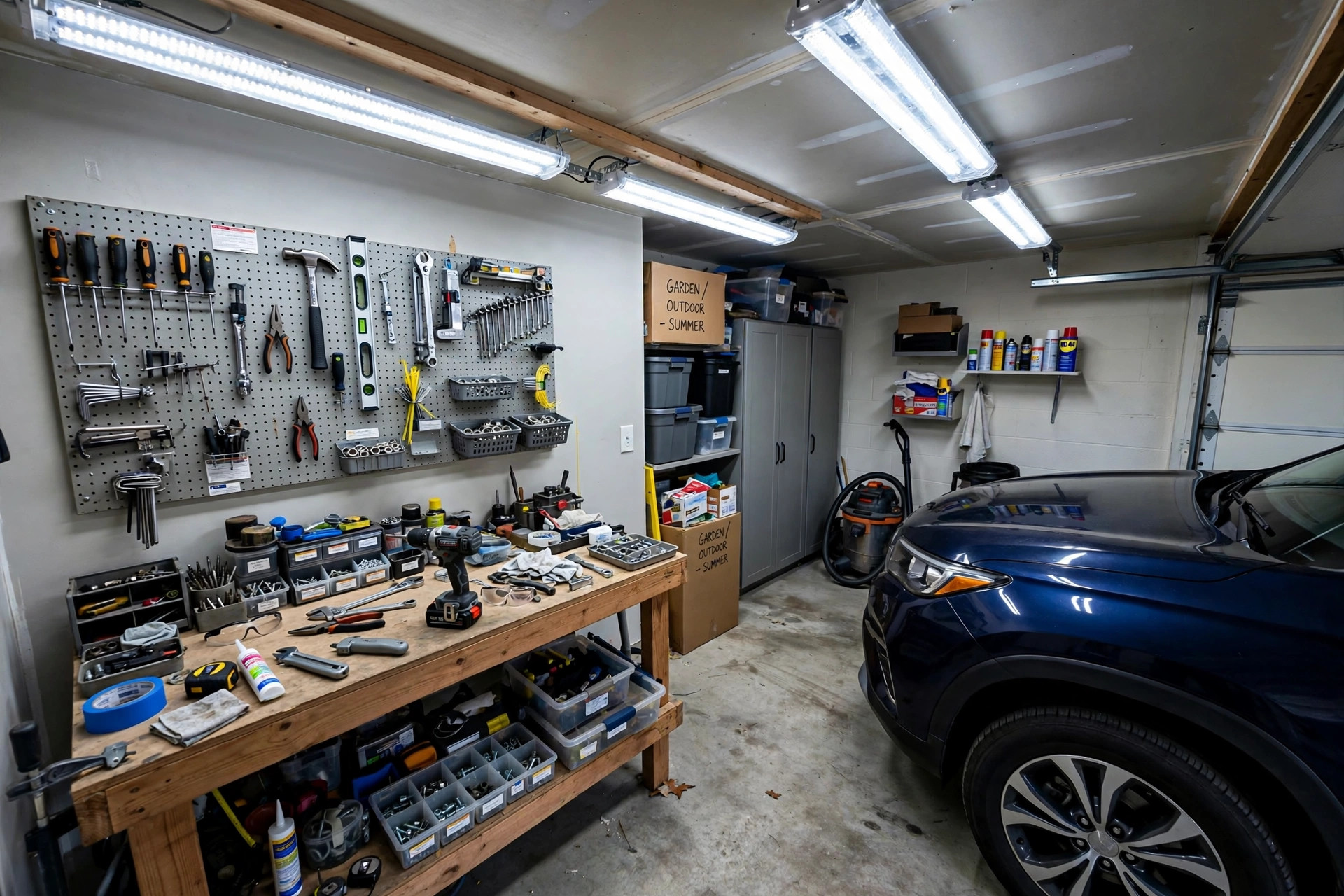

A garage is more than a place to park the car in many American homes. It holds the tools, the workbench, and the weekend projects. It may hold the lawn mower, the paint cans, and the boxes that never found a shelf. Good light makes all of this work better and safer. This garage shop lights buying guide USA explains the choices step by step. It covers how much light you need, which fixtures to buy, and what prices to expect across the country. Read it once, and you can shop with a clear plan.
Why Good Light Matters in a Garage or Shop
Poor light causes real problems in a garage. Tools left on the floor become trip hazards. A dark corner hides oil spills. Reading a tape measure in shadow leads to bad cuts. Wiring a lamp with weak light is simply not safe.
Good light fixes these troubles at the root. It lets you see the edge of a board before the saw touches it. It shows the true color of paint before you brush it on. It lets you find the right wrench on the first try instead of the third.
There is also comfort to consider. Eyes grow tired fast under dim, flickering tubes. A bright, steady light lets you work longer in the evening without a headache. For anyone who uses the garage as a workshop, this change alone is worth the cost of new fixtures.
How to Choose Garage Shop Lights: Garage Shop Lights Buying Guide Usa
Choosing lights is easier when you break the job into three questions. How much light do you need. What color should it be. How should the fixtures mount. Answer these three, and the rest follows.
How Much Light You Need
Light output is measured in lumens. Forget watts. Watts measure power use, not brightness. Two bulbs can use the same watts and give very different light.
A simple rule works well for garages. Plan for about 50 lumens per square foot for a basic garage where you park and store things. Plan for 75 to 100 lumens per square foot for a shop where you do fine work.
Do the math for your space. A standard two-car garage is about 400 square feet. Multiply 400 by 50 and you get 20,000 lumens for basic use. Multiply by 100 and you get 40,000 lumens for serious workshop use. Most 4-foot LED shop light fixtures give 4,000 to 5,000 lumens each. So a two-car garage needs roughly four to eight fixtures, depending on how you use it.
If you are unsure, lean toward more light. It is easy to turn a fixture off or put it on a switch. It is hard to add light later without new wiring.
What Color Temperature to Pick
Color temperature is measured in kelvins, written as K. Low numbers look warm and yellow. High numbers look cool and blue-white.
For a garage workshop, 4,000K to 5,000K is the common pick. This range looks like clean daylight. It shows true colors, which matters when you stain wood or match paint. It also keeps you alert during detail work.
Warm light near 3,000K feels cozy but hides detail. Save it for living rooms. In the garage, choose daylight. Many buyers report that switching from old warm tubes to 5,000K LED shop light fixtures feels like working outdoors at noon.
Fixture Style and Mounting
Most garage fixtures mount in one of two ways. Flush mounts sit tight against the ceiling. Hanging fixtures drop on chains or rods. Low ceilings, under eight feet, call for flush mounts so no one hits a head. High ceilings, ten feet or more, work well with hanging lights that bring the bulbs closer to the bench.
Linkable fixtures are a popular option. They connect end to end with a short cord, and one plug feeds the whole row. This cuts down on wiring. Check the package for the maximum number of links allowed.
Also look at the diffuser. Clear covers give the most light but can glare. Frosted covers soften the light and spread it wide. For a shop, frosted is usually the better pick.
Types of Garage and Shop Lights
Several fixture types serve garages well. Each has a place.
LED shop light fixtures. These are the workhorses. They are usually four feet long and slim. Many link together. They plug into a standard outlet or wire direct. Prices are modest, and they suit most home garages. Independent product testing often rates LED shop lights high for value.
LED high bay lights. These round or linear fixtures suit tall ceilings. They throw strong light downward over a wide area. A two-car garage with a twelve-foot ceiling may need only two high bays. They cost more per fixture but cover more space.
Wraparound fixtures. These mount flush to the ceiling and wrap the bulb in a lens. They give soft, even light with little glare. They are a good pick over parking spots.
Retrofit LED tubes. If your old fluorescent fixtures still work, you can swap the tubes for LED tubes. This is the cheapest upgrade. Check whether the tube needs a ballast or bypasses it. Ballast-bypass tubes take more work but run cooler and last longer.
Motion sensor lights. A light that turns on when you walk in is a small joy. It also saves power. Put one over the door from the house. Motion-activated flood lights for the driveway use the same idea outdoors.
Portable work lights. A tripod or clamp light fills gaps. Use it under the car hood or inside a cabinet. It is not a main light, but every shop needs one.
When you compare options, look for the UL or ETL mark. It shows the fixture passed safety tests. The U.S. Department of Energy notes that LED fixtures with ENERGY STAR ratings use at least 75 percent less energy than old incandescent bulbs and last far longer.
Cost and Price in the United States
Prices vary by store and region, but the ranges below are typical across the country. Major home improvement retailers stock most of these items, so you can check local prices before you buy.
A single 4-foot LED shop light costs about twenty to sixty dollars. Linkable four-packs often cost sixty to one hundred and twenty dollars, which lowers the price per fixture. LED high bay lights run fifty to one hundred and fifty dollars each. Retrofit LED tubes cost five to fifteen dollars per tube.
If new wiring is needed, plan for an electrician. A simple job, such as adding one outlet on the ceiling, may cost one hundred to three hundred dollars. Running a new circuit costs more. This Old House explains when a permit or a licensed electrician is wise for garage wiring.
Running costs are small with LEDs. A 40-watt LED shop light run four hours a day costs only a few dollars per year in most states. Swapping six old 64-watt fluorescent tubes for LEDs can cut lighting power use by more than half. The fixtures often pay for themselves in a few years through lower bills.
Care and Upkeep
Garage lights need little care, but a small routine keeps them bright.
Dust the lenses twice a year. A film of dust can cut light output by a surprising amount. Wipe with a dry cloth. Do not spray water near the wiring.
Check the mounts once a year. Chains stretch and screws loosen with vibration from the garage door opener. Tighten what is loose.
Keep fixtures cool. LEDs last longest when heat can escape. Do not box them in with insulation. Leave the vents on high bay fixtures open.
Watch for early failure signs. Flicker, dimming, or a buzz often means the driver inside the fixture is failing. Many fixtures carry a five-year warranty. Keep the receipt or take a photo of it.
If a fixture dies out of warranty, replace the whole unit. LED shop lights are sealed in most cases, and a new fixture often costs less than a repair.
Safety
Electricity and ladders demand respect. Follow these rules.
Turn off the power at the breaker before you touch any wiring. Test with a non-contact voltage tester before your hands go near a wire. Tape the breaker off so no one flips it back on.
Use a stable ladder or step stool. Do not stand on paint cans or stacked boxes. Keep the ladder feet on dry, level concrete.
Choose fixtures rated for the space. Garages are often damp. Look for a damp rating if the garage is not heated or if water blows in under the door. Family Handyman offers clear guides on reading these ratings.
Keep lights away from stored fuel. Gas cans, paint thinner, and lawn chemicals should sit well below and away from fixtures. Heat and sparks do not mix with fumes.
Call an electrician for anything beyond a simple swap. New circuits, new breakers, and aluminum wiring are jobs for a licensed pro. The cost is far less than the risk.
Frequently Asked Questions
How many lumens do I need for a two-car garage? Plan for 20,000 to 40,000 lumens total. Use the low end for parking and storage. Use the high end for workshop use. Divide the total by the lumens per fixture to get the fixture count.
Are LED shop lights better than fluorescent tubes? Yes, for most buyers. LEDs turn on instantly in cold weather, do not flicker, use less power, and last two to three times longer. Fluorescent tubes also contain mercury, which makes disposal a chore.
What color temperature is best for a garage workshop? Choose 4,000K to 5,000K. This daylight range shows true colors and keeps detail sharp. Lighting specialists and The Spruce both point to 5,000K as the most popular pick for task spaces.
Can I install shop lights myself? If the fixture plugs into an existing outlet, yes. Hanging a linkable fixture from ceiling hooks is a simple job. If you must open a junction box or run new wire, hire an electrician.
Do garage lights need a separate circuit? Not always. A few LED fixtures draw little power and can share a circuit. But if the circuit also feeds power tools, a separate lighting circuit keeps the lights steady when a saw starts. Ask an electrician if you are unsure.
How long do LED shop lights last? Most are rated for 30,000 to 50,000 hours. At four hours a day, that is twenty to thirty years. Real life is shorter in hot, dusty garages, but ten to fifteen years is common.
Planning Light Zones Like a Pro
Think of the garage in zones. Each zone gets its own light and its own switch.
The parking zone needs soft, even light. Wraparound fixtures work well here. The workbench zone needs bright task light. Hang linkable LED shop lights low over the bench. The storage zone needs just enough light to read labels. One fixture per bay is enough.
Put each zone on its own switch. You will thank yourself every time you grab a tool without lighting the whole garage. A motion sensor on the entry zone adds ease. Sensor porch lights at the side door follow the same zone idea for the path to the house.
This zone habit is common in good home lighting plans. If you enjoyed planning zones here, our guide to track lighting for the kitchen work area covers a similar approach indoors, where aimable heads serve each counter.
A Short Final Word
Good garage light is not a luxury. It is a tool, like a sharp saw or a true square. Measure your space, count your lumens, and pick daylight color. Buy linkable LED fixtures from a trusted maker such as Philips lighting, or compare options through the guides at Bob Vila. Hang them in zones, keep them clean, and respect the wiring. Do this once, and the garage becomes a better shop for years.
References
Bob Vila. (n.d.). Home improvement advice. https://www.bobvila.com Consumer Reports. (n.d.). Product reviews and ratings. https://www.consumerreports.org ENERGY STAR. (n.d.). Energy efficient products. https://www.energystar.gov Family Handyman. (n.d.). DIY home repair and maintenance. https://www.familyhandyman.com Lumens. (n.d.). Lighting and ceiling fans. https://www.lumens.com Philips. (n.d.). Lighting products. https://www.philips.com The Home Depot. (n.d.). Home improvement products. https://www.homedepot.com The Spruce. (n.d.). Home and garden advice. https://www.thespruce.com This Old House. (n.d.). Home renovation guidance. https://www.thisoldhouse.com U.S. Department of Energy. (n.d.). Energy efficiency and renewable energy. https://www.energy.gov
Was this guide helpful?

About Jennifer Lee
The My Garden US editorial team writes practical, in-depth home and garden guides for American homeowners — tested advice, no fluff.
You May Also Like
Patio String Lights Buying Guide USA
April 28, 2026 0 views
Sensor Porch Lights Texas Homes USA: A Practical Guide to Motion and Dusk-to-Dawn Porch Lighting
June 1, 2026 0 views
Ceiling Fans Lights Deals Near Me: How to Find the Best Ones
August 18, 2026 0 views