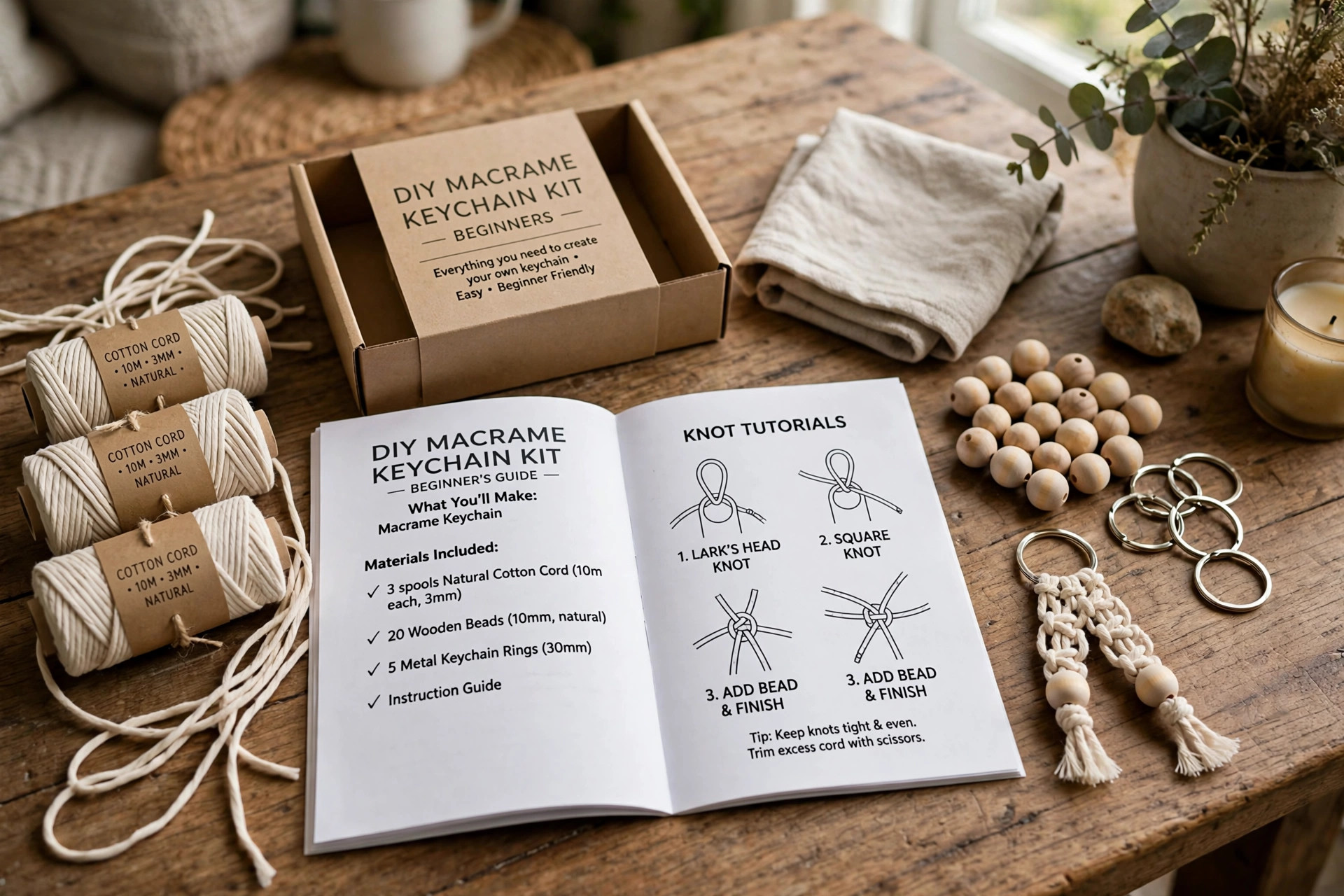

A diy macrame keychain kit for beginners gifts is a small box that holds everything a new crafter needs to make knotted cord keychains. It is one of the most popular craft gifts of recent years. The reason is simple. The kit does not ask much. It gives the maker cord, a ring, and a set of steps. In an hour or less, a beginner can hold a finished piece. That first small win makes the gift feel good to give and good to get.
Why It Matters
A handmade gift carries weight that a store gift cannot match. When someone opens a diy macrame keychain kit for beginners gifts, they see more than string and rings. They see an hour of quiet time. They see a new skill forming under their hands. They see a thing they made, with its small flaws and its charm.
Macrame is a forgiving craft. The knots are few. The tools are few. There is no machine to learn and no loud workshop. A keychain is the smallest project of all, so a beginner is not asked to spend a whole weekend on it. A kit built for beginners takes this idea one step further. It removes the guesswork. The cord is cut to the right length. The ring is the right size. The colors go together. The guide shows each knot in pictures.
These kits also make strong gifts for groups. Teachers give them at craft nights. Mothers give them to daughters. Friends give them at birthday parties. A diy macrame keychain kit for beginners gifts costs little, packs small, and suits almost any age above eight or nine. It is a gift that says: you can make something nice.
What to Look For in a Good Kit: Diy Macrame Keychain Kit for Beginners Gifts
Not all kits are equal. A poor kit leaves the beginner lost. A good kit leads them by the hand. Here is what to check before you buy.
The Guide
The printed guide is the heart of the kit. Look for one with large photos of each step, not small dark drawings. Each knot should be named. Lark’s head knot, square knot, and gathering knot are the three a beginner needs. A good guide shows them one at a time. Some kits add a code that opens a short video. That helps a great deal, since knots move in ways that paper cannot show.
The Cord
Cord is the main material. Most kits use cotton cord, either single-twist or braided. Cotton is soft on the hands and holds knots well. Check that the cord is at least three millimeters thick. Thinner cord is hard to hold and hard to see. The kit should cut the cord to length already, so the beginner does not need to measure. Extra cord is a plus. A beginner will cut wrong once or twice, and spare cord saves the project.
The Rings and Findings
The keychain ring should be strong and smooth. Cheap rings bend open and lose keys. Look for split rings of plated steel. Many kits add wooden beads or small tassel caps. These add beauty but also add steps. For a true beginner, one or two add-ons are enough.
The Tools
Most kits need no tool beyond the user’s hands. Some add a small comb or brush to fringe the cord ends. That is a nice touch. A kit that asks the buyer to own scissors, glue, or tape is not truly complete. Check the box list before you buy.
Types and Options
Kits come in a few common forms. Each suits a different gift giver.
Single-project kits. These hold enough cord and parts for one keychain. They cost the least and teach one pattern. They are the best choice when you give to many people at once, such as at a party or a classroom.
Multi-pattern kits. These hold more cord and rings, enough for three to five keychains. They teach two or three knot patterns. They cost a bit more. They suit a beginner who may love the craft and want to make gifts for others.
Deluxe kits. These add wooden beads, colored cord sets, tassel caps, a fringe comb, and a storage bag. They cost the most of the small kits. They make an impressive gift box. They still stay far below the price of a large craft machine.
Themed kits. Some kits tie the keychain to a season or theme: fall colors, ocean blues, holiday red and green. These make thoughtful birthday or holiday gifts.
When you shop for related beginner craft ideas, compare what is inside the box, not just the picture on the front. Two kits can look the same outside and differ a great deal inside.
Cost and Price
A diy macrame keychain kit for beginners gifts is an affordable present. Prices in the United States tend to run as follows.
– Single-project kits: three to eight dollars. These are often sold in packs, which brings the per-kit cost down. – Multi-pattern kits: eight to fifteen dollars. They hold more cord and teach more knots. – Deluxe kits: fifteen to twenty-five dollars. They add beads, tools, and storage.
You can find these kits at large craft stores such as Michaels and Joann, where shelves hold whole rows of beginner craft boxes. Art supply shops like Blick carry higher-end cord and kit options for those who want better materials. Home centers such as Home Depot stock craft kits in their seasonal aisles. Online marketplaces like Amazon and Etsy offer hundreds of choices, including kits from small makers who design their own patterns.
Watch for hidden costs. A kit that needs the buyer to own fabric glue or sharp scissors is not a bad buy, but it is not a complete gift. If you give the kit to a child, consider adding a small pair of blunt craft scissors to the gift bag.
How a Beginner Makes the First Keychain
Knowing the steps helps you pick a good kit. Most guides follow this order.
First, the maker folds two or four cords over the key ring and ties a lark’s head knot. This hangs the cords from the ring. Second, they tie a row of square knots down the length of the cord. The square knot is the main knot of macrame. It is made of four cords: two that stay still in the middle and two that wrap around them. Third, they may add a bead or two on the middle cords. Fourth, they tie a gathering knot near the end to hold all cords tight. Fifth, they trim the ends and brush them out into a fringe.
The whole job takes thirty to sixty minutes. The first keychain may look uneven. The second looks better. By the third, the hands know the knots.
For someone who enjoys soft fiber crafts, quality yarn for small handmade toys can be a natural next step after macrame. The hand skills carry over.
Care and Upkeep
A finished macrame keychain is a working item. It hangs from a bag or a set of keys. It will see wear. Teach the receiver these care points.
Keep the keychain dry. Cotton cord soaks up water and holds it. A wet keychain can grow mildew if it stays damp in a bag. If it gets wet, hang it in open air until it dries fully.
Brush the fringe now and then. A small comb keeps the ends full and soft. Loose fibers are normal. Trim them with sharp scissors.
Check the ring. Split rings wear at the joint over time. If the ring starts to gape, replace it before keys slip off.
Store spare cord flat. If the kit came with extra cord, keep it in the box. It is the right color and thickness for repairs.
Cotton cord can be washed gently by hand with mild soap if it gets dirty. Press it in a towel and let it air dry. Do not put it in a dryer.
Safety
Macrame is a safe craft, but a few points matter, above all when the gift goes to a child.
Cutting tools are the main risk. The kit needs scissors to trim cord. For children under ten, an adult should do the cutting. Blunt craft scissors are a safer choice for young hands.
Small parts are the second risk. Beads and ring caps can come loose. They are a choking hazard for toddlers. Keep finished keychains and spare beads away from very small children.
Dust from cut cord can irritate the nose. Cut cord in a room with open air. Shake the finished piece outside before use.
Work light matters. Knots are small. A dim room leads to eye strain and mistakes. A bright desk lamp helps the beginner see each cord clearly.
Take breaks. Hands new to knotting can cramp. A short rest every twenty minutes keeps the work fun.
Guides from long-standing home and craft publishers such as The Spruce often add their own safety notes for knot crafts, which is worth a look if you plan to teach a group.
Where the Craft Can Go Next
A keychain kit is a door, not a room. Many beginners move on to larger macrame work: plant hangers, wall pieces, and bag straps. The same three knots serve in all of them. The kit teaches the base skill.
If the gift receiver takes to the craft, useful next gifts include a full spool of cotton cord, a set of wooden beads, and a macrame board or clip stand to hold work steady. Family Handyman and Bob Vila both publish beginner-friendly project guides that show how simple tools support larger craft work. This Old House covers workshop setup tips that help any home crafter keep a tidy corner.
For those who like fabric crafts more broadly, a good iron for quilting and sewing is a fine upgrade gift once the hobby grows.
Frequently Asked Questions
How long does a beginner need to finish one keychain?
Most beginners finish in thirty to sixty minutes. The first one takes longest because each knot must be learned. By the second or third keychain, the time drops to about twenty minutes.
What age is right for a macrame keychain kit?
Children around eight or nine can follow the knots with an adult nearby. Teens and adults pick it up faster. The main limits are small parts for young children and the need for scissors.
Does macrame need any special talent?
No. Macrame is a set of repeated motions. If a person can tie a shoe, they can learn the square knot. Patience matters more than talent.
Can left-handed people use these kits?
Yes. The knots work the same in either hand. Some left-handed makers mirror the pictures in the guide, which comes naturally after a few tries.
How do I stop the cord from fraying while I work?
Wrap a small piece of tape around each cord end before you start. This keeps the ends tight while you tie knots. Remove the tape before you fringe the ends.
Is cotton or synthetic cord better for a beginner?
Cotton is better for a first kit. It is soft, it grips itself so knots hold, and it fringes nicely. Synthetic cord is strong but slippery, which makes knots harder to learn.
A Final Word
A diy macrame keychain kit for beginners gifts is small in size and large in effect. It turns an ordinary afternoon into a first lesson in making. The receiver learns three knots, finishes a real object, and gains a small proof that their hands can build things. Few gifts at this price do so much. Pick a kit with a clear guide, good cord, and complete parts. Wrap it with a note that says the first one does not need to be perfect. Then step back and watch a new crafter begin.
References
Amazon. (n.d.). Online shopping. https://www.amazon.com Blick Art Materials. (n.d.). Art and craft supplies. https://www.dickblick.com Bob Vila. (n.d.). Home improvement advice. https://www.bobvila.com Etsy. (n.d.). Handmade and craft marketplace. https://www.etsy.com Family Handyman. (n.d.). DIY home repair and maintenance. https://www.familyhandyman.com JOANN. (n.d.). Fabric and craft supplies. https://www.joann.com Michaels. (n.d.). Arts and crafts supplies. https://www.michaels.com The Home Depot. (n.d.). Home improvement products. https://www.homedepot.com The Spruce. (n.d.). Home and garden advice. https://www.thespruce.com This Old House. (n.d.). Home renovation guidance. https://www.thisoldhouse.com
Was this guide helpful?

About Robert Taylor
The My Garden US editorial team writes practical, in-depth home and garden guides for American homeowners — tested advice, no fluff.
You May Also Like
Needle Felting Kit for Beginners: Animals DIY
July 12, 2026 0 views
Leather Crafting Tools Kit for Beginners USA
February 21, 2026 0 views
How to Choose a Paint Palette for Acrylics Mixing at Home
July 27, 2026 0 views