
Introduction
Many people who live in small apartments love their balconies and patios, and they want to use them in the cool months too. The top rated infrared outdoor heaters for small apartments make that possible, warming people and chairs directly instead of wasting heat on the open air.
Infrared heat works like sunlight. It warms what it touches. A table, a chair, and a person all feel the warmth at once. The heat arrives fast. Most units reach full warmth in under a minute. For a small balcony, that is enough. You step outside, switch the heater on, and sit down in comfort.
This guide explains how these heaters work, what to look for, what types exist, what they cost, and how to use them safely.
Why Infrared Heat Fits Small Apartment Spaces: Top Rated Infrared Outdoor Heaters for Small Apartments
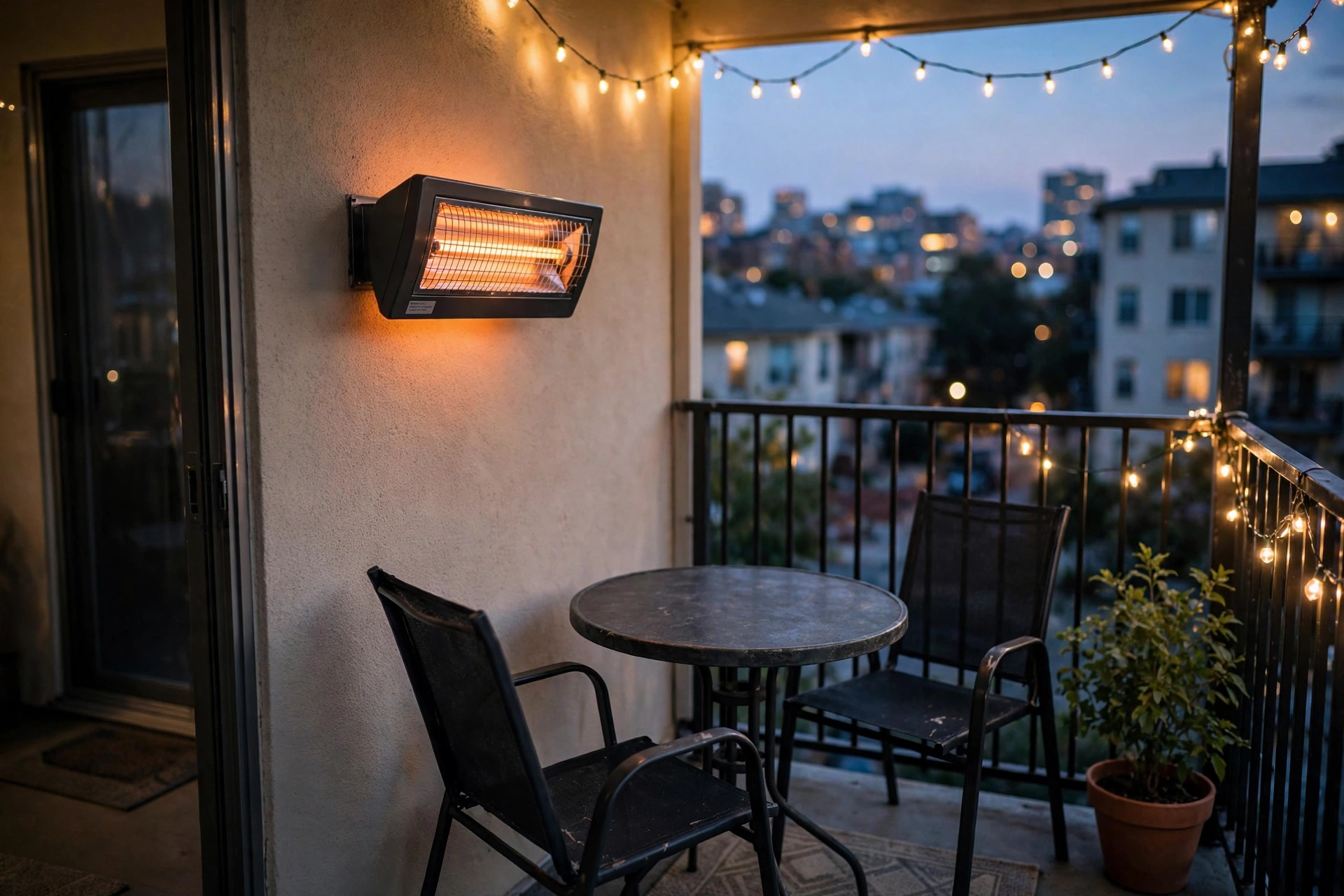
A small balcony has little room. A big gas patio heater would crowd it. Electric infrared heaters are slim. Many mount on a wall or hang from a ceiling. Some stand on a small pole. They take up almost no floor space. That matters when the patio is six feet wide.
Infrared heaters also run on a normal household outlet. Most use 1,500 watts. That is the same as a hair dryer. You do not need a gas line or a propane tank. You do not need a chimney. For a renter, this is a large benefit. The unit goes up with a few screws. It comes down just as fast at move-out time.
These heaters are quiet. They make no sound at all. There is no fan. There is no flame noise. The only sign of work is the warm glow. Neighbors will not hear it. In a close apartment building, quiet counts for much.
The heat is clean: no smoke, no smell, and no change to the air — kind to the person sitting under it and to the neighbors above.
Many shoppers start with an affordable infrared outdoor heaters buying guide before they buy. That is a wise move. Prices range wide. A little study saves regret.
How Infrared Heaters Work
An infrared heater turns electric power into radiant heat. A heating element gets hot. It gives off infrared waves. Those waves travel in straight lines. They warm solid objects, not the air. Skin feels the warmth right away.
This is different from a space heater with a fan. A fan heater warms the air. Outdoors, warm air floats away. Wind takes it in seconds. Infrared heat has no such problem. Wind can cool your skin, but the heater keeps sending waves. You stay warm even on a breezy night.
The element may be quartz or carbon. Quartz heats fast and burns bright. Carbon gives a softer glow. Both work well on a small balcony.
Directional Heat
Infrared heat moves in one direction, warming what is in front of it and nothing behind it. So point the heater at the chairs, not at the railing. A well-aimed heater covers a small balcony with ease.
Some units let you change the angle. A tilt bracket helps. You can aim the heat down at a small table. You can aim it across at two chairs. Adjustable aim is a feature worth having.
What to Look For When You Buy
Start with the size of your space. Measure the balcony. A 40-square-foot balcony needs far less heat than a 120-square-foot patio. Most 1,500-watt units cover 50 to 100 square feet. Check the maker claims, then take off a third for safety. Makers often test in still, warm rooms. Real balconies have wind.
Power and Heat Settings
Look for more than one heat setting so you can match the weather: low on mild nights, high on cold ones. Variable heat also saves power, and guides from The Spruce call adjustable controls a mark of a well-made unit.
Weather Rating
The heater will sit outside, so look for an IP rating on the box. IP55 or IP65 is common for outdoor models, and the higher number means stronger protection. Never buy an indoor-only heater for the balcony, whatever the price.
Mounting Style
Three mounting styles serve small apartments well. Wall-mounted units save all floor space. They bolt to the wall with a bracket. Hanging units drop from a ceiling or an overhead beam. They suit covered balconies. Freestanding units stand on a pole or a tripod. They need a small patch of floor. Pick the style that fits your balcony shape.
Cord Length
Check the cord length before you buy: the heater must reach an outlet without a stretched cord, and extension cords add risk outdoors. Measure from the outlet to the mounting point, add a foot of slack, and budget for an electrician if no outlet is near.
Safety Features
Good heaters carry tip-over protection and overheat shutoff. A tip-over switch cuts power if the unit falls. Overheat shutoff stops the heater if it gets too hot inside. These features are standard on top rated models. Do not buy a heater that lacks them. Reviews on Consumer Reports often stress safety features as a first thing to check.
Types and Options for Small Spaces
Wall-Mounted Electric Infrared Heaters
These are the most common choice for apartments. A slim bar or panel bolts to the wall. It aims out over the seating area. It uses no floor space at all. Most run at 1,500 watts. They suit balconies with a solid wall. If your balcony wall is glass or thin, mounting may be hard. Check with the building manager first.
Hanging Infrared Heaters
These hang from chains or rods. They work under a covered balcony or a pergola roof. The heat falls straight down onto the chairs. This style feels natural. The heater is out of the way. It is also out of reach of children. Many models in this style are made by stove and hearth makers like Napoleon.
Freestanding Tower Heaters
A tower heater stands on the floor. It takes the space of a small plant pot. It is easy to move. You can shift it as the evening goes. The base must be heavy and wide. A light base can tip in wind. For renters, this style needs no screws and no holes. That keeps the security deposit safe.
Tabletop Infrared Heaters
These small units sit on a table and warm one or two people. They are the cheapest and the weakest option, suited to a tiny balcony with a bistro set.
Propane Versus Electric
Some outdoor heaters burn propane. Propane units give more raw heat. They also give more trouble in an apartment. Most apartment leases ban open flames on balconies. Many cities ban propane tanks on balconies too. An electric infrared heater avoids all of this. It is the safer pick for apartment life. Fire safety rules from the EPA remind owners that fuel-burning heaters need clear venting and care.
Shoppers who like a live flame sometimes look at wood burning fire pits reviews and buying guide pages. A fire pit can be lovely at a house. It is rarely allowed on an apartment balcony. Check the lease and the local fire code before you dream.
Cost and Price
Price tells much of the story. Here is what to expect in plain numbers.
Tabletop units cost 40 to 80 dollars. They are simple. They warm a small area. They last a few seasons.
Freestanding tower units cost 100 to 250 dollars. The price rises with build quality and safety features. A heavy base and a weatherproof shell cost more. They are worth it.
Wall-mounted and hanging units cost 120 to 400 dollars. Brand name units sit at the high end. Carbon fiber elements cost more than quartz. Longer warranties cost more too. Most apartment buyers spend 150 to 250 dollars and get a fine unit.
Running cost matters too. A 1,500-watt heater draws 1.5 kilowatt-hours per hour, so one hour costs about 23 cents where power costs 15 cents per unit. An evening of three hours costs about 70 cents, and lower settings cut that in half. Compare prices at Home Depot and Lowe’s for current models.
What the Top Rated Models Share
The best-rated units share a few traits. They carry a clear weather rating. They offer at least two heat levels. They include tip-over and overheat protection. They come with a mounting bracket in the box. They back the heater with a two-year or three-year warranty. If a unit has all five, it is likely a sound buy.
Care and Upkeep
Infrared heaters ask for little care. That is part of their charm. A few habits keep them working for years.
Wipe the reflector and the element cover once a month during use. Dust cuts the heat output. Use a soft cloth. Let the unit cool fully before you touch it. Never spray water into the housing.
Check the cord each season for cracks, fraying, or loose plugs. A damaged cord is a fire risk — replace it rather than taping it and carrying on.
Tighten the mounting screws once a year, since wind can loosen bolts over time. A quick check each spring takes two minutes.
Store portable units indoors for winter if you can. A garage shelf or a closet works. This doubles the life of the paint and the seals. Wall-mounted units can stay up. Wipe them down and cover them if the maker sells a cover. The home repair guides at This Old House often give the same plain advice for all outdoor electric gear.
Safety for Apartment Dwellers
Heat and small spaces demand care. Follow these rules every time.
Keep the heater at least three feet from anything that can burn — curtains, cushions, plants, paper — and read the manual for the exact clearance your model needs.
Never leave the heater on when you go inside. Turn it off when the evening ends. Many models have a timer. Use it. A timer is cheap insurance against forgetfulness.
Keep children and pets away from the hot surface. The housing gets very hot. A guard screen helps but does not make it safe to touch. Teach the rule once: hot means do not touch.
Never use an indoor-only heater outside. The box must say outdoor rated, or the rain and the wiring will not mix well.
Plug the heater straight into the wall, never through a thin extension cord, and do not share the outlet with another big device. If the outlet feels hot, stop and call an electrician — the checklists at Family Handyman give the same warning for all high-wattage gear.
Check your lease. Many leases ban heaters on balconies. Some allow electric but not gas. Some allow both with written permission. A quick email to the manager beats a fine or a fight later. Renters in humid regions may also want to read the best outdoor fire pits for humid climates guide, since damp air changes what works well outdoors.
People who heat with wood or gas indoors sometimes research Heatilator fireplaces and similar built-in units. Those belong to the building, not the renter. An apartment dweller should stick to portable electric heat.
FAQ
How fast does an infrared heater warm a balcony?
Very fast. Most units reach full heat in under a minute, and you feel warmth on your skin within seconds.
Can I use an infrared heater on a covered balcony?
Yes, if the unit is rated for it and clearances are met. Keep the stated distance from the ceiling. Never mount a heater where the manual forbids it. When in doubt, pick a freestanding model placed well away from the roof.
Will it raise my power bill much?
A little. At full power, a 1,500-watt unit costs about 20 to 25 cents an hour in most areas. Three hours an evening, four evenings a week, adds about 10 to 12 dollars a month. Lower settings cut this nearly in half.
Are infrared heaters safe around kids?
They are safer than open flames but still hot. The surface can burn skin. Keep children at arm’s length. Use the tip-over shutoff models. Never let a child operate the heater alone.
Can wind make an infrared heater useless?
Wind cools your skin, but the heat waves still reach you. You will feel less warm in strong wind. Aim the heater close to the seating area, and add a wind screen if you can.
Do I need a special outlet?
No. A standard grounded outdoor outlet works. The outlet should be weatherproof with a cover. If your balcony outlet is old or loose, have it checked. A heater is a steady, heavy load.
A Short Final Word
The top rated infrared outdoor heaters for small apartments earn their praise. They warm fast. They use little space. They run quiet. They cost pennies an hour. For a renter with a small balcony, they are one of the simplest comforts money can buy.
Buy a weather-rated unit, mount it with care, keep it clear of soft things, and turn it off when you go in. Do these small things and it will serve you for many cool evenings. Seasonal tips from Bob Vila can help you plan the rest of your small outdoor space.
References
Bob Vila. (n.d.). Home improvement advice. https://www.bobvila.com Consumer Reports. (n.d.). Product reviews and ratings. https://www.consumerreports.org Family Handyman. (n.d.). DIY home repair and maintenance. https://www.familyhandyman.com Heatilator. (n.d.). Fireplaces and fireplace products. https://www.heatilator.com Lowe’s. (n.d.). Home improvement products. https://www.lowes.com Napoleon. (n.d.). Fireplaces, grills, and heating products. https://www.napoleon.com The Home Depot. (n.d.). Home improvement products. https://www.homedepot.com The Spruce. (n.d.). Home and garden advice. https://www.thespruce.com This Old House. (n.d.). Home renovation guidance. https://www.thisoldhouse.com U.S. Environmental Protection Agency. (n.d.). Protecting human health and the environment. https://www.epa.gov
Was this guide helpful?

About James Carter
The My Garden US editorial team writes practical, in-depth home and garden guides for American homeowners — tested advice, no fluff.
You May Also Like
The Best Electric Patio Heaters Buying Guide
September 11, 2026 0 views
Where to Buy Freestanding Electric Stoves in Colorado
October 3, 2026 0 views
Top Rated Fireplace Safety Gates for Florida Homes
September 12, 2026 0 views