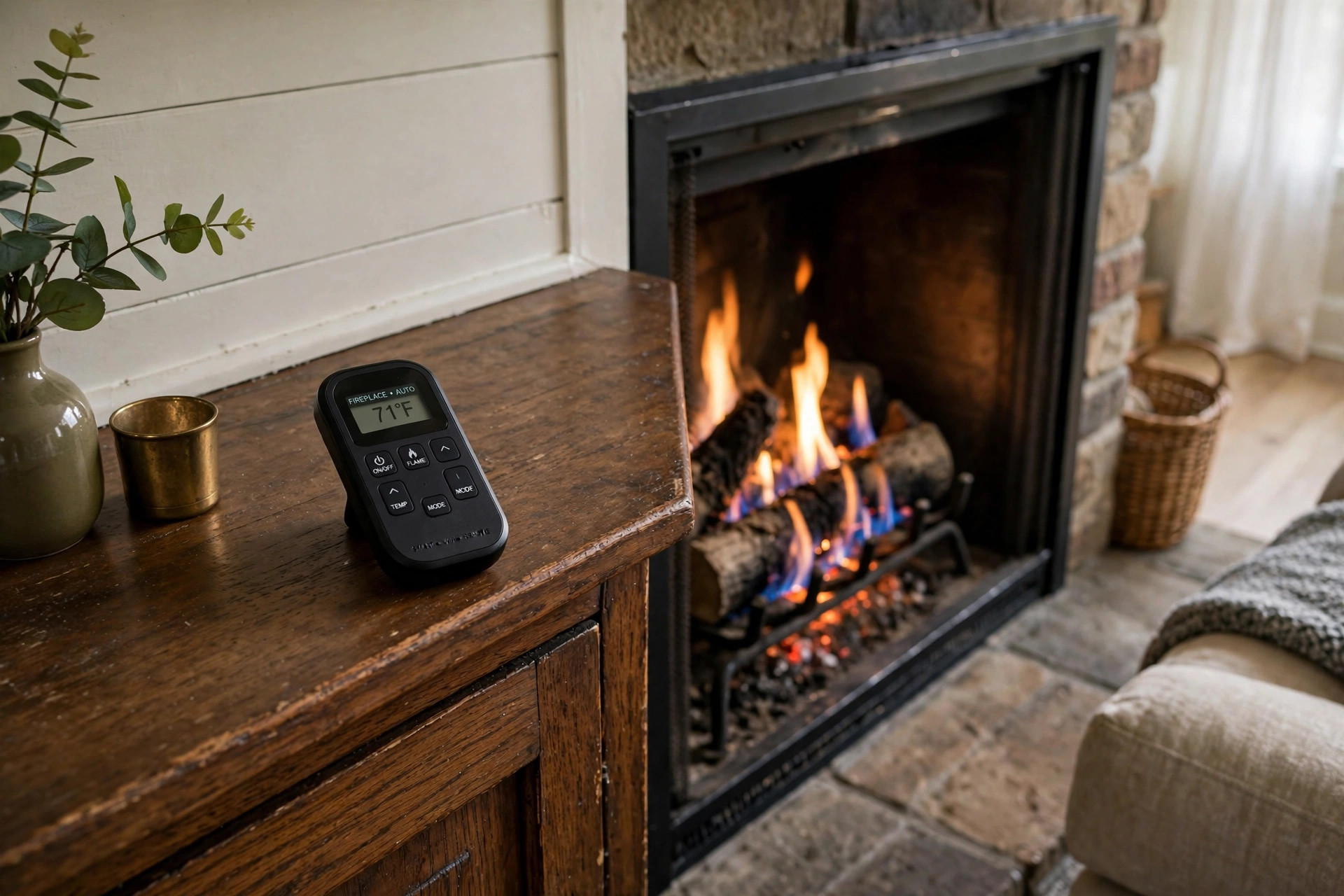

Shoppers who type smart fireplace remote controls for sale into a search box often want one simple thing: to turn their fireplace on and off without leaving the couch. The good news is that most modern remotes deliver that and more. The caution is that not every remote fits every fireplace. A remote that works with one gas valve may do nothing at all with another. A few minutes of reading before you buy will help you pick a model that works the first time and keeps your home safe.
Why a Remote Matters
A fireplace remote is more than a convenience item. It gives you steady control over heat and flame height from across the room. Many models also include a thermostat mode, which turns the burner off when the room reaches your set point and back on when the room cools. That small feature can cut wasted gas over a long heating season.
For older adults and people with limited movement, a remote means they never have to kneel by the hearth to work a valve or a wall switch. For parents, models with a child lock mean the fire cannot be started by a curious button press. In short, a good remote adds comfort, saves fuel, and lowers risk.
A thermostat remote can also smooth out hot and cold swings. Without one, a gas fireplace often runs at one fixed flame height, and the room slowly grows too warm. With a thermostat model, the fire eases back once the room is warm enough. That gentler cycle feels more comfortable and uses less gas across a season. Over a few winters, the savings can cover the cost of the remote itself.
How to Choose the Right Remote: Smart Fireplace Remote Controls for Sale
Universal Kits vs Brand-Specific Kits
Many stores sell universal remote kits that claim to fit most millivolt gas fireplaces. These work well when the valve is a common type, and they cost less than brand-name kits. Brand-specific kits, on the other hand, are made for one maker’s valves and often add features like fan control or accent light dimming. If your fireplace has a fan or lights built in, the brand kit may be the better buy. If it is a plain burner with no extras, a universal kit is often all you need.
Match the Remote to Your Fireplace
This is the step most buyers skip, and it causes most returns. Before you buy, find out what kind of fireplace you own. Gas fireplaces use different valve systems, and remotes are built for specific ones. Millivolt systems, electronic ignition systems, and older standing-pilot systems each need different receiver hardware.
Check your owner’s manual or the label inside the lower access panel of the fireplace. Look for the brand and model of the gas valve. Many remote makers publish a compatibility list on their site. If your valve is not listed, call the maker before you order. Retailers such as Home Depot’s fireplace section and Lowe’s also carry the main brands, and their listings often note which systems a remote supports.
Signal Type and Range
Most fireplace remotes use radio signals rather than the infrared light used by television remotes. Radio signals pass through cabinet doors and do not need a clear line of sight. That matters because the receiver box usually sits behind the lower louver or inside the access panel.
Check the stated range. Thirty to fifty feet is common and is enough for most living rooms. If your home is large or the fireplace sits in a basement family room, look for a longer range model. Note that walls, metal cabinets, and nearby electronics can shorten real-world range.
Thermostat and Timer Features
A simple on and off remote is fine for many homes. But a thermostat model gives you real temperature control. You set the target, and the remote tells the receiver to open or close the gas valve as needed. Timers are another useful option. They shut the fire off after a set number of hours, which is handy at bedtime. If you are comparing models, weigh whether the extra cost of these features matches how you actually use your fireplace.
Power Source
The handheld part almost always runs on small batteries. The receiver inside the fireplace usually runs on batteries too, which matters during a power outage. Some receivers accept a wall adapter as an option. Battery receivers are simpler to install, but you must remember to change batteries at the start of each heating season. A dead receiver battery is the most common cause of a remote that suddenly stops working.
Types of Remotes on the Market
Basic On and Off Remotes
These are the simplest units. One button starts the flame, another ends it. Some add a flame height button. Prices are modest, and setup is usually a ten-minute job. They suit homeowners who want basic comfort without extra electronics.
Thermostat Remotes
These add a small temperature sensor to the handheld unit. Set your target, and the fireplace holds the room near it. This type suits homes that use the fireplace as a regular heat source rather than a weekend treat. If you are also shopping for smart thermostat controlled gas fireplaces, a thermostat remote is often built into the unit already.
Smart Home Bridge Systems
The newest option connects the fireplace receiver to your home network through a small bridge module. Once linked, you can control the fire from a phone app or a voice assistant. Some bridges also send alerts if the fireplace runs longer than a set time. Setup takes more care, and you should check that the bridge works with your phone and voice platform before you buy. Guides at This Old House and Family Handyman explain the wiring basics in plain terms.
Cost and Price
Prices for smart fireplace remote controls for sale span a wide range. A basic on and off remote often costs between forty and eighty dollars. A thermostat model usually runs between eighty and one hundred fifty dollars. A smart home bridge system can run from one hundred twenty to two hundred fifty dollars, plus the cost of the bridge module if it is sold apart.
Professional installation adds to the bill. If a gas line must be moved or a new valve fitted, a licensed technician may charge one hundred to three hundred dollars for the visit. For simple receiver swaps on a millivolt system, many confident homeowners do the work themselves in under half an hour. If you are unsure about gas fittings, pay for a professional. The cost is small next to the risk of a gas leak.
When you shop, compare the full kit, not just the handheld. A low price may mean the receiver box is sold separately. Also check battery type and how many spares come in the box.
Care and Upkeep
A fireplace remote needs little care, but a few habits keep it reliable. Change the batteries in both the handheld and the receiver at the start of each fall. Wipe dust from the receiver box so the contacts stay clean. Keep the handheld in a fixed spot, such as a drawer near the fireplace, so it is not lost or sat on.
Test the child lock if your model has one. Press the lock button and confirm that the flame controls do not respond. Once a year, have the fireplace itself serviced by a technician. A clean burner and a clear vent keep the whole system working the way the EPA recommends for home heating equipment.
If the remote stops working, change the batteries first. Then check that the receiver switch is in the remote position rather than on or off. Makers such as Napoleon and Heatilator publish simple troubleshooting steps for their own systems, and most problems turn out to be a battery or a switch position.
Safety
Gas fireplaces are safe when they are used as directed, but a remote adds a layer you must respect. The Consumer Product Safety Commission warns that any gas appliance deserves care. Never leave the house or go to sleep with the fire running unless the timer is set. Keep furniture, rugs, and drapes at least three feet from the glass front.
Make sure a working carbon monoxide detector sits near the fireplace and that you test it each month. If you smell gas, do not touch the remote or any switch. Leave the house and call your gas company from outside.
Child safety deserves special care. A remote with a lockout feature is a strong help, but it is not a substitute for a physical barrier. Many families pair a remote with top rated childproof fireplace screens and keep the hearth area gated. Teaching older children that the remote is not a toy matters as much as any device.
Frequently Asked Questions
Will a remote work with my existing gas fireplace?
In most cases, yes, as long as you match the remote to your valve system. Millivolt systems accept the widest range of aftermarket remotes. Electronic ignition systems often need a brand-specific kit. Read your valve label, then check the remote’s compatibility list before you order.
Can I install it myself?
Many millivolt receiver kits are made for homeowner installation. The job usually means setting the receiver in the access panel, plugging in two wires, and pairing the handheld. If your system needs valve work or new gas connections, hire a licensed technician. The Department of Energy offers heating safety guidance that is worth a read before you start.
Does a smart remote use Wi-Fi?
The handheld remote itself usually uses a radio signal. Only bridge systems use Wi-Fi, and then it is the bridge module that joins your network, not the fireplace directly. If your internet goes down, the handheld still works on its radio signal.
Why does my remote work only sometimes?
The usual causes are weak batteries, a receiver switch left in the wrong position, or metal objects blocking the signal. Move the receiver antenna clear of metal panels if you can. Change both sets of batteries at the same time. If the trouble persists, check the maker’s troubleshooting page. Sites such as The Spruce also carry clear fix-it guides for common fireplace remote faults.
Should I remove the batteries in summer?
Yes, this is a sound habit. Remove the batteries from the handheld and the receiver when the heating season ends. This stops slow leakage that can corrode the contacts. Store the handheld in a dry drawer, and put fresh batteries in both units when cold weather returns.
Do smart fireplace remotes work during a power outage?
Battery-run handheld remotes keep working during an outage, since their radio signal needs no house power. Receivers that run on batteries also keep working, so the fire can still be lit and shut off. Only systems that rely on a wall plug or a Wi-Fi bridge lose their smart features when the power fails. That is another reason to change receiver batteries each fall, before storm season begins.
A Short Final Word
A smart fireplace remote is a small purchase that pays off every cold evening. Match the remote to your valve system, pick the features you will truly use, and follow basic gas safety. For homes that want a full upgrade rather than an add-on, luxury smart electric fireplaces with free shipping offer another path to push-button warmth. Take your time, read the label, and enjoy the fire.
References
Family Handyman. (n.d.). DIY home repair and maintenance. https://www.familyhandyman.com Heatilator. (n.d.). Fireplaces and fireplace products. https://www.heatilator.com Lowe’s. (n.d.). Home improvement products. https://www.lowes.com Napoleon. (n.d.). Fireplaces, grills, and heating products. https://www.napoleon.com The Home Depot. (n.d.). Home improvement products. https://www.homedepot.com The Spruce. (n.d.). Home and garden advice. https://www.thespruce.com This Old House. (n.d.). Home renovation guidance. https://www.thisoldhouse.com U.S. Consumer Product Safety Commission. (n.d.). Product safety information. https://www.cpsc.gov U.S. Department of Energy. (n.d.). Energy efficiency and renewable energy. https://www.energy.gov U.S. Environmental Protection Agency. (n.d.). Protecting human health and the environment. https://www.epa.gov
Was this guide helpful?

About Emily Rodriguez
The My Garden US editorial team writes practical, in-depth home and garden guides for American homeowners — tested advice, no fluff.
You May Also Like
Best Propane Fire Pits Buying Guide for American Homes
March 1, 2026 0 views
Top Rated Fireplace Hearth Rugs for Midwest Homes: A Buyer’s Guide
April 2, 2026 0 views
Ventless Vented Gas Log Sets with Free Shipping: A Complete Buyer’s Guide
May 8, 2026 0 views