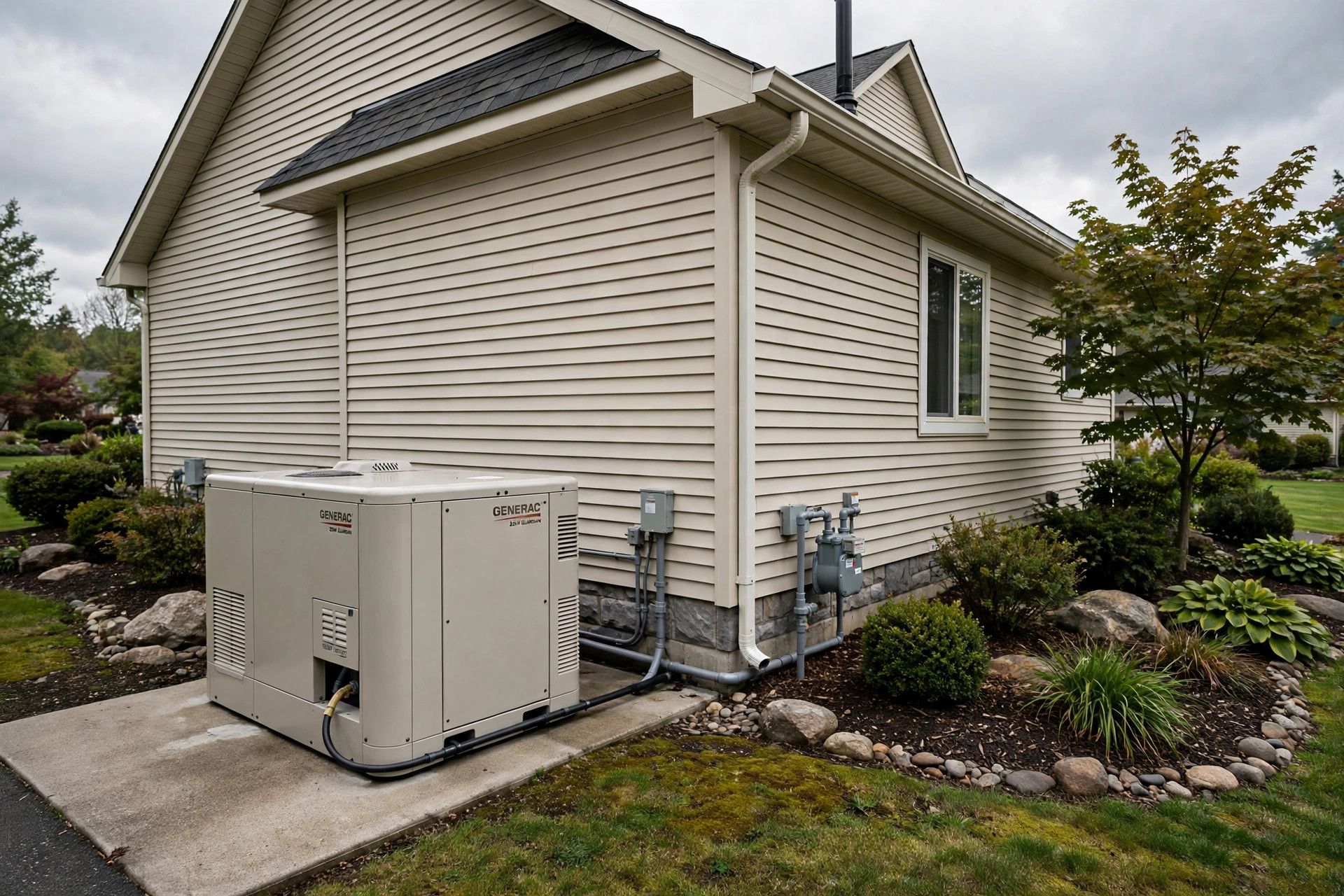

When the power fails, most homes go dark within a second. Food in the freezer warms up. The well pump stops. Phones slowly die. The whole house generator cost installed 2026 USA homeowners must weigh is the price of skipping all that trouble. A standby generator sits outside your home on a pad or a level base. When utility power drops, it starts on its own. Within half a minute, your lights, heat, and cooling come back. This guide lays out what you pay, why the price moves, and how to keep the machine ready.
Why Backup Power Matters
Storms knock out power for days. Heat waves push grids past their limits. Ice storms snap poles by the thousand. Each year, millions of American homes lose power. A few hours is an annoyance. Two days is a real problem.
A whole house unit protects what matters. Your furnace runs in winter. Your air conditioner runs in summer. The sump pump keeps the basement dry. Medical devices keep working. For families with small children, elderly parents, or home medical gear, this is more than comfort. It is safety.
Many owners also think of home security. A dark house with a dead alarm system is easy prey. A generator keeps the cameras, locks, and lights alive. You may want to read our piece on whether do security cameras lower insurance policies, since backup power and insurance often go hand in hand. Whole home backup also guards the smart devices people rely on, from smart outdoor lighting timers to package lock boxes for the porch. All of it needs power to do its job.
What to Look For When You Choose: Whole House Generator Cost Installed 2026 Usa
Size is the first thing to get right. Generators are rated in kilowatts, or kW. A small home with gas heat may manage on 10 kW. A large home with electric heat, a well pump, and central air may need 22 to 24 kW. Get the size wrong and you pay twice: too small and the unit cannot carry the load; too large and you burn extra fuel for years.
An electrician or a dealer does a load calculation. They list every major circuit. They add the starting watts, because motors like air conditioners draw a surge when they kick on. This step is worth the fee. It is the difference between a system that works on a bad night and one that trips off when you need it most.
Fuel type comes next. Most standby units run on natural gas or liquid propane. Natural gas hooks to your home gas line, so you never refill a tank. Propane needs a tank on your property, but it suits rural homes past the gas lines. A few models run on diesel, though those are rare in homes. The U.S. Department of Energy offers plain guidance on home energy choices that can help you think through fuel tradeoffs.
The transfer switch is the brain of the system. It watches utility power. When power fails, it starts the generator and shifts the load to it. When power returns, it shifts back and shuts the generator down. Automatic switches cost more than manual ones, but they work when no one is home. That is the whole point of backup power.
Noise matters too. Air-cooled units hum at about the level of a lawn mower. They sit a set distance from the house per code. Liquid-cooled units run quieter but cost more. If neighbors are close, check your town rules on noise and setbacks before you buy.
Types and Options on the Market
Standby generators fall into three rough groups.
Air-cooled units cover 7 to 24 kW. They cool with fans, like a car engine with extra help. Most homes choose this group. They cost less up front and fit on a small concrete pad. Leading makers in this space include Generac and Kohler, whose homepages list current models and dealer contacts.
Liquid-cooled units start around 25 kW and climb past 100. They use a radiator like a truck. They run longer under heavy load and last more years. They suit large estates and small businesses. The price jumps hard at this tier.
Portable generators are a different animal. They cost far less, but they do not start on their own and cannot power a whole house through the panel without a proper manual transfer setup. They also raise serious safety issues with carbon monoxide. The Www.cpsc.gov tracks injuries from portable units each year and urges strict care with placement and fueling.
You will also see whole-house battery backups sold as an option. They are silent and clean, but they store only a few hours of whole-home energy. For multi-day outages, a fuel-fed generator remains the workhorse.
Cost and Price: What You Pay in 2026
Here is the honest answer to the big question. The whole house generator cost installed 2026 USA buyers face usually lands between 7,000 and 15,000 dollars for an air-cooled unit, fully installed. Smaller systems in easy installs can dip near 6,000. Large liquid-cooled systems can pass 20,000 once all the work is done.
The unit itself is the biggest slice. A 14 kW air-cooled standby unit often sells for 3,500 to 5,500 dollars. A 22 to 24 kW unit runs 5,000 to 7,500 dollars. Brands, warranties, and dealer stock move these numbers.
Installation labor adds 2,000 to 5,000 dollars in most cases. This covers the electrician, the gas plumber, the pad or foundation, and the transfer switch. The switch alone costs 500 to 1,500 dollars. If your panel is full, you may need a panel upgrade. If the gas line is far from the pad, trenching adds cost. Permits run 100 to 500 dollars depending on the town.
Site work can surprise people. A new propane tank costs 1,000 to 3,000 dollars installed. A long trench for gas or electric lines adds hundreds more. Some homes need tree work or grading before the pad goes in. Get these items in the quote, not after.
Maintenance contracts run 300 to 600 dollars a year. Most owners buy one. It covers the yearly oil and filter change, the battery check, and the exercise test that runs the unit for a few minutes each week. Fuel adds up too. Natural gas costs less per hour than propane. A 22 kW unit at full load can burn through several gallons of propane per hour, so a long outage is not cheap to ride out.
Reviews and price tracking help you sanity-check quotes. Www.consumerreports.org, Www.cnet.com, and Www.pcmag.com all publish generator ratings and buying advice. Retailers such as The Home Depot list unit prices that make a fair dealer quote easier to judge.
One more cost note: some dealers offer financing. Rates and terms vary. Read the fine print before you sign. A generator is a long-lived machine, but interest adds real money over five or ten years.
Care and Upkeep
A generator is only useful if it starts. Most units run a weekly self-test. Make sure yours is set and that it actually runs. Listen for odd sounds. Check the control panel for warning codes.
Oil changes come once a year or every 100 to 200 hours of run time. Filters, spark plugs, and air cleaners follow the manual schedule. The battery is the weak point. It lasts two to four years. A dead battery on a storm night means a silent generator. Many owners keep a battery tender or swap on schedule.
After a real outage, check the fuel supply and the oil level. Log the run hours. If the unit ran for days, move the service visit up. Keep the area around the unit clear. Leaves, snow, and mulch can block air flow. Keep at least a few feet of space on all sides.
Keep a simple service log. Note the date, hours, and work done at each visit. This record helps you track the warranty and proves care if you ever sell the home. Many buyers see a maintained generator as a plus, much like a new roof or a serviced furnace.
Watch your smart home gear through all this. Devices from the https://store.google.com, Www.ring.com, Www.simplisafe.com, and ADT ride through outages on the generator, but only if the circuits that feed them are on the backed-up panel. Ask your installer which circuits are covered. Tech coverage of backup gear at Www.theverge.com can give you ideas for what to protect.
Safety Rules That Cannot Be Skipped
Whole house generators are safe when installed right. The rules are simple and firm.
Only a licensed electrician should wire the transfer switch. Never backfeed power through a wall outlet with a homemade cord. That trick kills line workers and can burn your house down.
Place the unit per code. Manufacturers and towns set clear distances from windows, doors, and vents. Exhaust must blow away from the house. Carbon monoxide is odorless and it kills. Keep detectors with fresh batteries on every floor.
Fuel work needs a pro. Gas lines leak if fitted wrong. Propane tanks need proper setbacks from the home and from ignition sources. Do not store spare fuel near the unit.
Finally, teach your household the basics. Everyone should know where the main shutoff is and how the weekly test sounds. A generator that surprises people is a generator no one trusts.
Frequently Asked Questions
How much does a whole house generator cost installed in 2026? Most air-cooled installs land between 7,000 and 15,000 dollars. That covers the unit, transfer switch, labor, permits, and basic site work. Larger or harder jobs cost more.
How long does installation take? The physical install takes one to three days. Permits and inspections add one to four weeks. Order your unit early in storm season, since dealer schedules fill up.
How long can it run? On natural gas, as long as the gas flows. On propane, it depends on tank size. A 500-gallon tank can feed a mid-size unit for a week or more at part load. Track your fuel during long outages.
Does it power the entire house? A right-sized unit with a whole-home transfer switch powers everything up to its rated load. Smart load shedding can drop heavy circuits like pool heaters first, so the rest stays on.
Will it raise my home insurance? Some insurers give credits for standby generators because they cut claims from frozen pipes and food loss. Ask your agent before you buy. You may also want to read about whether security cameras can lower insurance costs, since insurers reward several kinds of protection.
How loud is it? Air-cooled units measure roughly 60 to 70 decibels at a standard distance. That is like normal talk up to a vacuum cleaner. Check local noise rules if neighbors are near.
A Final Word
The whole house generator cost installed 2026 USA families pay is real money. But so is a flooded basement, a dead furnace in January, or a week of spoiled food and hotel bills. Size the unit with a pro, get three written quotes, and keep up the yearly service. Then when the lights go out on your street, yours stay on.
References
CNET. (n.d.). Technology news and reviews. https://www.cnet.com Consumer Reports. (n.d.). Product reviews and ratings. https://www.consumerreports.org Generac. (n.d.). Home standby generators. https://www.generac.com Google Store. (n.d.). Smart home devices. https://store.google.com Kohler. (n.d.). Bathroom and kitchen fixtures. https://www.kohler.com PCMag. (n.d.). Technology product reviews. https://www.pcmag.com Ring. (n.d.). Smart home security devices. https://www.ring.com SimpliSafe. (n.d.). Home security systems. https://www.simplisafe.com The Home Depot. (n.d.). Home improvement products. https://www.homedepot.com U.S. Consumer Product Safety Commission. (n.d.). Product safety information. https://www.cpsc.gov U.S. Department of Energy. (n.d.). Energy efficiency and renewable energy. https://www.energy.gov Www. (n.d.). Home and garden information. https://www
Was this guide helpful?

About Sarah Mitchell
The My Garden US editorial team writes practical, in-depth home and garden guides for American homeowners — tested advice, no fluff.
You May Also Like

Best Door Reinforcement Kit Reviews USA: What Makes a Door Strong
March 22, 2026 0 views
Smart Curtain Rod Reviews for Sliding Doors: A Practical Buying Guide
August 29, 2026 0 views
Best Outdoor Smart Plug Reviews 2026 USA: What to Buy
August 15, 2026 0 views