
A front porch should glow when the sun goes down. A dark driveway can feel unwelcome. A dark yard can draw the wrong kind of attention. This is why so many readers search for smart outdoor lighting timer reviews usa. A good timer takes over the chore of switching lights on and off. It keeps the porch lit at dusk. It keeps the garden lit through the night. It saves power when the house sleeps.
Smart timers have moved past the old dial that turned with a pin. The new models connect to the home network. They follow sunrise and sunset times for your street. They answer to a phone app. Some answer to a voice command. Many work with motion sensors. They give the homeowner fine control without a trip to the outlet in the cold.
This guide gathers what buyers in the United States should know. It explains how these timers work. It lists the main types on the market. It covers price, care, and safety. It also answers the questions readers ask most often.
Why a Smart Outdoor Lighting Timer Matters
Light is a quiet form of protection. Police departments in many towns say a lit doorway makes a thief think twice. A path light that burns all night can keep steps visible. A timer makes this steady light automatic. The owner sets it once. The timer does the rest.
Smart timers beat simple mechanical timers in three ways. First, they track the real sunset. Days grow short in winter. Days grow long in summer. A fixed 6 p.m. setting turns lights on too late in December. A smart timer shifts with the season. Second, they handle outages better. Many keep the schedule in memory. The lights return to plan when power returns. Third, they offer remote control. A homeowner on a trip can check the app. He can see if the porch light is on. He can turn it on from another state.
Energy savings matter too. Outdoor lights waste power when they burn past dawn. A smart timer can cut them at sunrise. It can dim them late at night. Over a year, the savings add up. The U.S. Department of Energy notes that efficient lighting and controls trim household bills. Shoppers can compare timer features on Energy Star and on Consumer Reports before they spend.
Reviews from across the country show a clear trend. Homeowners want timers that set up in minutes. They want apps that do not freeze. They want hardware that survives rain, heat, and ice. The rest of this guide reviews what the market offers.
What to Look for When You Choose: Smart Outdoor Lighting Timer Reviews Usa
A smart timer has many features. Not all of them matter to every home. The points below help a buyer sort the useful from the extra.
Timer Modes
Check the modes before you buy. Most smart timers offer countdown, dusk to dawn, and custom schedules. Dusk to dawn uses your location. It finds the local sunset. It turns lights on at that minute. It turns them off at sunrise. Custom schedules let the owner pick hours. A good choice is a timer that mixes both. It can run dusk to dawn on weekdays and a shorter run on weekends.
Some timers add a random mode. It shifts on and off times by a few minutes each night. This makes an empty house look lived in. It is a small trick. It can help when the family travels.
Power and Load Rating
Read the load rating on the box. Outdoor lighting timers are built for certain wattage. A timer rated for 1,800 watts handles most porch and garden setups. Low voltage landscape lights draw far less. String lights and holiday displays draw more. Add up the watts of every light on the circuit. Keep the total under the rating. Overload can burn out the timer. It can also trip the breaker.
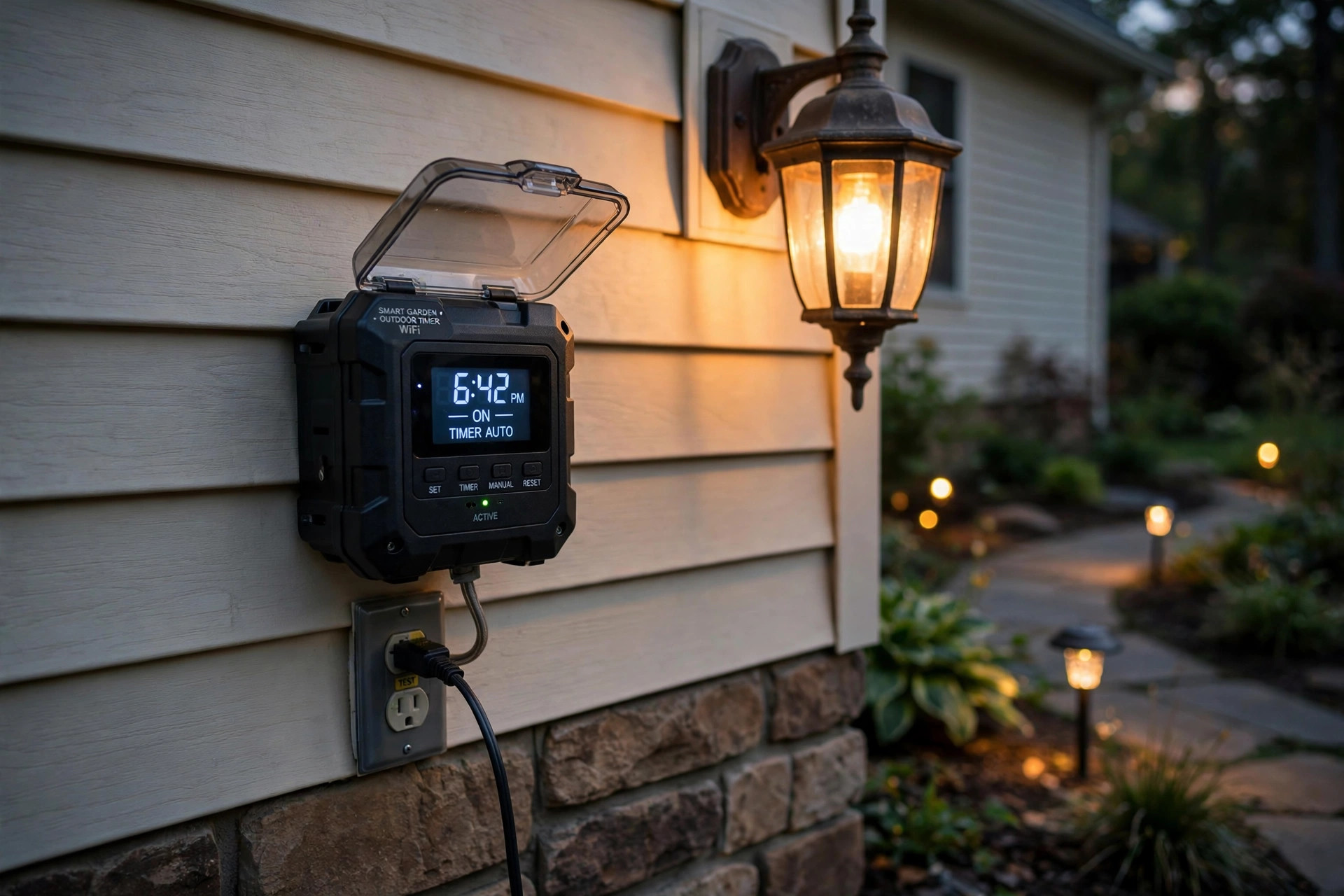
Check indoor versus outdoor rating. A timer meant for a bedroom will not survive rain. Look for a weatherproof case. Look for a grounded plug. Check reviews of outdoor gear on CNET to see how models hold up in real storms.
App and Voice Control
Most smart timers pair with a phone app. The app sets schedules. It shows power use. It sends alerts if a light fails. Test the app before you trust it. Read recent app store reviews. An app that crashes in winter cold is a poor tool.
Voice control is a bonus. Many timers work with the voice assistants in American homes. A command can switch the patio lights on. Check compatibility on the box. Details on voice assistants appear on the Google Store and in smart home roundups on The Verge.
Connectivity
Smart timers connect by Wi-Fi, Bluetooth, or a hub. Wi-Fi models work from anywhere. They need a strong signal at the outlet. Bluetooth models work close by. They are simple but short range. Hub models link many devices through one bridge. They suit big yards with many light zones. Pick the type that matches the size of the property.
Main Types of Smart Outdoor Lighting Timers
Shoppers will meet four main types in American stores. Each has strengths.
Plug-in smart timers. These plug into an outdoor outlet. The lights plug into the timer. They take minutes to set up. They suit porch lights, string lights, and holiday displays. They are the most reviewed type in the USA. They cost the least.
Hardwired smart switches. These replace a wall switch indoors. They control the porch or garage lights on that circuit. They need basic wiring skill. Some owners hire an electrician. They look clean. Nothing sits outside to tempt weather or theft.
Smart transformer timers. These serve low voltage landscape lights. They plug in or mount near the house. They feed a chain of path lights and spotlights. They often include zones. Each zone can run its own schedule. They suit planned garden designs.
Astronomic wall timers. These fit inside a wall box. They know the sunrise and sunset for your area. Many now add smart features. They bridge the old dial timer and the new app world.
For broader home protection, readers often pair timers with cameras. Our guide to /wireless-outdoor-security-camera-reviews-2026/ covers camera options that work well beside timed lighting. A lit yard plus a camera makes a strong pair.
Cost and Price in the USA
Prices vary by type and brand. The figures below reflect typical American retail in recent years.
Plug-in smart timers sell for about 15 to 40 dollars. Simple models sit at the low end. Models with energy tracking and dual outlets cost more. Hardwired smart switches sell for about 25 to 60 dollars. The switch costs that much. An electrician adds 75 to 150 dollars if the owner does not wire it himself. Smart transformer timers for landscape lights sell for about 60 to 200 dollars. Large multi zone units reach the top of that range. Astronomic wall timers sell for about 30 to 70 dollars.
Running costs are small. LED lights draw little power. A set of path lights may use less than 20 watts. A timer itself uses a trickle of power. The savings come from stopping waste. Lights that once burned past dawn now shut off on time.
Watch for sales. Big box stores cut prices in spring and before the holidays. Online shops run deals too. Comparison reviews on PCMag help buyers spot real value and avoid inflated list prices.
Care and Upkeep
A smart timer needs little care. A few habits keep it working for years.
Keep the case clean. Wipe dust and cobwebs from vents. Do not hose a timer with a strong spray. A damp cloth is enough. Check the outlet cover. A cracked cover lets rain in. Replace it before water reaches the timer.
Update the app and firmware. Makers fix bugs through updates. An old firmware can drop the schedule. Turn on auto updates when the app offers them.
Check the ground fault protection. Outdoor outlets should sit on a GFCI circuit. Test the GFCI button each season. It should trip and reset with a click. If it fails, call an electrician.
In cold states, bring plug-in timers indoors for deep winter if the manual says so. Most weatherproof models stay out all year. Still, a sheltered outlet lasts longer than an exposed one.
Safety
Outdoor electricity demands respect. Water and current do not mix. Follow these rules.
Buy timers listed by a national testing lab. Look for the UL or ETL mark on the box. The U.S. Consumer Product Safety Commission warns against unlisted electrical gear. Unlisted timers can overheat. They can fail in rain.
Never exceed the load rating. Never run a timer with a damaged cord. Keep connections off wet ground. Raise the timer or mount it on a wall. Use outdoor rated extension cords only.
Turn off the breaker before wiring a hardwired switch. Test the wires with a voltage tester. When in doubt, hire a licensed electrician. Readers who plan bigger electrical work may also read our piece on /smart-doorbell-installation-cost-near-me/ for typical trade costs near home.
Smart devices also raise privacy questions. A timer app may collect location and usage data. Read the privacy policy. Use a strong password. Turn on two step sign in. Our guide /smart-home-privacy-concerns-explained-usa-guide/ explains these steps in plain terms. Security firms such as SimpliSafe, ADT, and Ring publish similar advice for connected home gear.
Frequently Asked Questions
Do smart outdoor lighting timers work without Wi-Fi? Many do. Basic schedules run on the timer itself. Wi-Fi adds remote control and sunset tracking. If the network drops, most timers keep the last schedule. Bluetooth models never need Wi-Fi at all.
Can a smart timer control my existing porch light? Yes, in most cases. A plug-in timer works with any light that plugs in. A hardwired smart switch works with a light on a wall switch. Check the wattage first. LEDs, halogens, and incandescents all work within the rating.
Are smart outdoor timers hard to install? Plug-in models take minutes. Plug in the timer. Plug in the lights. Open the app. Follow the steps. Hardwired switches need the breaker off and basic wiring. Owners with no wiring skill should hire an electrician.
Will a smart timer raise my electric bill? It should lower it. Timers stop lights from burning all day. Dusk to dawn control trims hours in summer. LED lights add only pennies a day. The timer pays for itself in saved power.
Can I use one timer for holiday lights and year round lights? Yes. Many owners move a plug-in timer from holiday displays to patio string lights by season. Save one schedule for holidays. Save another for summer nights. Switch between them in the app.
What happens during a power outage? Most smart timers keep the schedule in memory. They resume when power returns. Some need the clock reset after a long outage. Models with battery backup keep time through short cuts. Check the manual for your model.
A Final Word
The best smart outdoor lighting timer is the one that fits the home. A small porch needs a simple plug-in timer. A big garden needs a zoned transformer. A renter needs a model that leaves no mark. Reviews across the USA point to the same lesson. Buy for your real setup. Do not buy for features you will never use.
Read the load rating. Check the weatherproof case. Test the app early. Keep the firmware fresh. Respect the wiring rules. Do these things and the lights will greet you every night, on time, without a thought.
References
ADT. (n.d.). Home security and automation. https://www.adt.com CNET. (n.d.). Technology news and reviews. https://www.cnet.com Consumer Reports. (n.d.). Product reviews and ratings. https://www.consumerreports.org ENERGY STAR. (n.d.). Energy efficient products. https://www.energystar.gov Google Store. (n.d.). Smart home devices. https://store.google.com PCMag. (n.d.). Technology product reviews. https://www.pcmag.com Ring. (n.d.). Smart home security devices. https://www.ring.com SimpliSafe. (n.d.). Home security systems. https://www.simplisafe.com The Verge. (n.d.). Technology news and reviews. https://www.theverge.com U.S. Consumer Product Safety Commission. (n.d.). Product safety information. https://www.cpsc.gov
Was this guide helpful?

About Sarah Mitchell
The My Garden US editorial team writes practical, in-depth home and garden guides for American homeowners — tested advice, no fluff.
You May Also Like

Best Mesh WiFi for Smart Home 2026 USA
July 24, 2026 0 views
Best Security Light with Camera 2026 USA: A Simple Buyer’s Guide
May 9, 2026 0 views
Schlage vs Kwikset Smart Lock Comparison USA: Which Front Door Lock Is Right for You
January 23, 2026 0 views