
When summer ends, many pool owners ask how to winterize above ground pool systems so their pool survives the cold. Winterizing is not hard work, but it does take care and order. Done right, it protects the liner, the pump, the filter, and the frame from ice damage. Done wrong, or skipped, it can cost hundreds of dollars in spring repairs. This guide walks through each step in plain terms, with simple tools and plain common sense.
Why Winterizing Matters
Water freezes in winter. Frozen water grows. It pushes against walls, cracks fittings, and tears liners. An above ground pool holds thousands of gallons of water, and that water will freeze solid in cold states. A pool left full and untreated turns into a sheet of green water by spring. A pool drained all the way down can collapse under wind and snow.
Proper winterizing sits between these two mistakes. You lower the water, not drain it. You add chemicals, not guess. You cover the pool, not leave it open. Pool care guides such as those on Swim University stress that the small effort of fall closing saves the large effort of spring opening.
What You Need Before You Start: How to Winterize Above Ground Pool
Gather your supplies a week before closing day. You will need:
– A winter pool cover sized for your pool – Cable and winch to hold the cover tight – Winterizing chemicals: shock, algaecide, and a floater or winter kit – Pool pillows or an air pillow – A skimmer cover plate or plug – A return fitting plug – Antifreeze made for pools – A leaf net if trees stand near your pool
Many pool supply stores, including Leslie’s Pool Supplies and Pool Warehouse, sell winter kits that bundle the chemicals in one box. A kit removes the guesswork for a first-time owner.
How to Winterize an Above Ground Pool Step by Step
Step 1: Clean the Pool Well
A dirty pool stays dirty all winter. Skim the surface. Brush the walls and floor. Vacuum the pool. Clean out the skimmer basket and the pump basket. Every leaf and bug left in the water becomes food for algae under the cover.
Step 2: Test and Balance the Water
Test the water with a test kit or strips. Aim for normal ranges: pH between 7.2 and 7.6, total alkalinity between 80 and 120, and chlorine between 1 and 3 parts per million. Balanced water protects the liner from stains over the winter. Home improvement stores like The Home Depot carry test kits in every price range.
Step 3: Shock and Add Algaecide
Add shock to the water in the evening. Run the pump for several hours after shocking so the chemical spreads through the whole pool. The next day, add winter algaecide. Some owners use a floating chlorinator with slow-dissolve tablets through the fall. A quality winter pool cover review can help you pair your chemicals with the right cover type.
Step 4: Lower the Water Level
Lower the water to a few inches below the skimmer. For most pools, that is four to six inches below the skimmer opening. Do not drain the pool fully. The remaining water holds the walls and liner in shape against wind. It also gives ice room to grow without pushing straight on the liner.
Step 5: Remove and Store the Equipment
Take off the pump, the filter, the hoses, the skimmer basket, and any ladders or steps. Drain every part fully. Water left inside a pump or filter housing will freeze and crack the housing. Store the equipment indoors if you can. A dry garage or shed is fine. If your pool uses a pool heater, drain it too and follow the maker’s winter steps.
Step 6: Plug the Openings
Put a plug or cover plate on the skimmer. Screw a plug into the return fitting inside the pool. Blow out the lines if your setup has plumbing under the pool, then pour pool antifreeze into the lines. Never use car antifreeze. Pool antifreeze is made to be safe around pool water.
Step 7: Place the Air Pillow
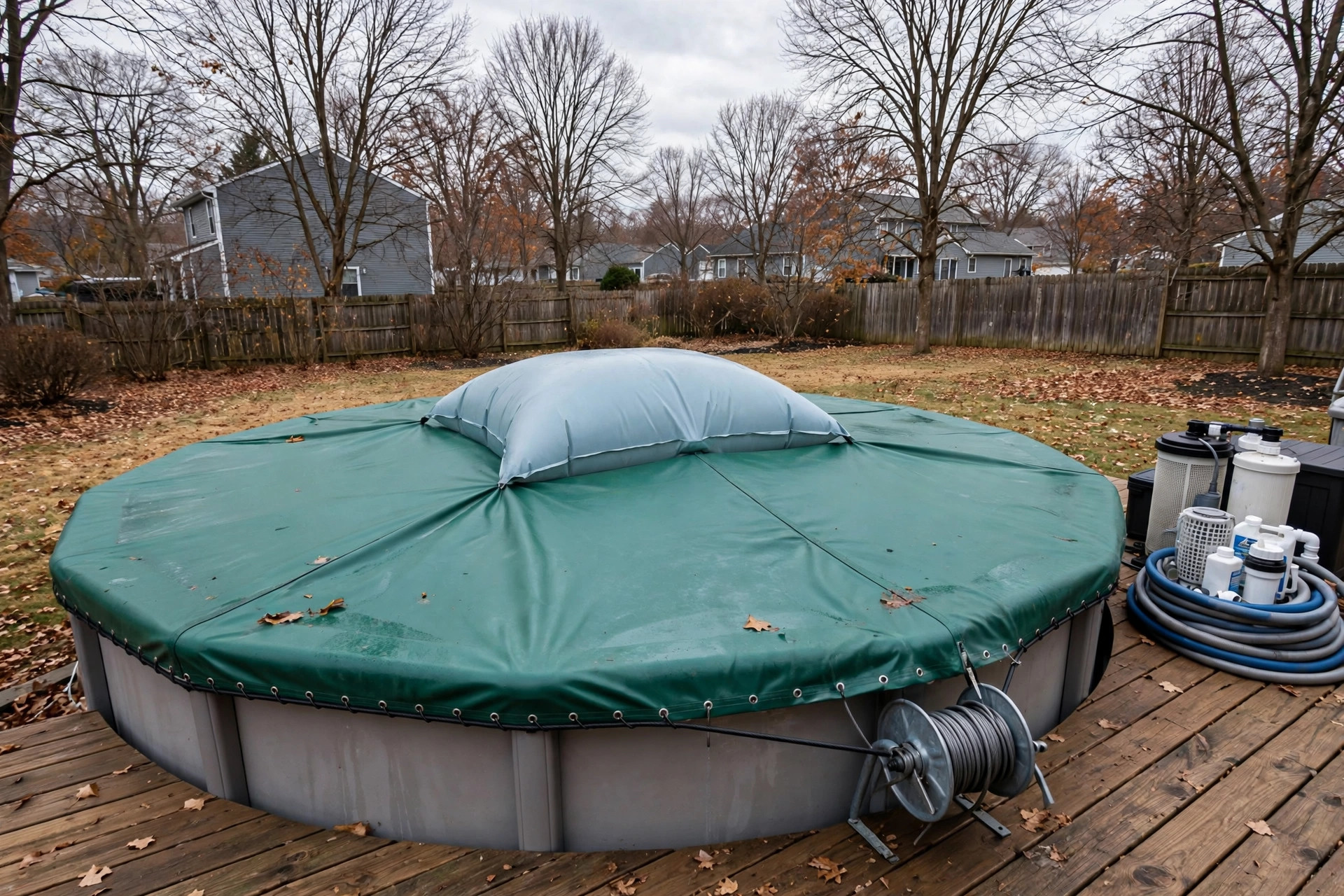
An air pillow floats in the center of the pool under the cover. It absorbs ice pressure as the water freezes. It also tents the cover so rain and snow melt drain off toward the edges instead of pooling in the middle. Blow up the pillow most of the way, tie it off, and set it in the center.
Step 8: Put On the Winter Cover
Spread the cover over the pool. Let it hang over the walls on all sides. Thread the cable through the cover loops and tighten it with the winch so the cover sits snug below the top rail. The cover should have a little slack across the water so it can rest on the surface without pulling tight.
Types of Winter Covers and Other Options
Not all covers do the same job. The main types are:
– Standard winter covers. Heavy plastic or woven sheets that block light and keep out debris. Most above ground owners use these. – Mesh safety covers. These let rain drain through while blocking leaves. They are lighter but do not keep out fine silt or sunlight as well. – Solid safety covers. Strong covers that support weight. They cost more and suit pools where safety rules demand them.
Read best pool cover reviews for winter before you buy, since size and strength matter more than brand. The U.S. Consumer Product Safety Commission publishes pool safety guidance on its site at cpsc.gov, worth a look if children or pets live near the pool.
Choosing Your Winterizing Supplies
The right supplies make winterizing easier and more effective. A few points help you buy well.
Cover Size and Shape
Measure your pool before you buy a cover. A winter cover should be a few feet wider than the pool in every direction so it hangs over the walls. A cover that is too small will not hold the cable. A cover that is too large will bunch up and catch wind. Round pools need round covers. Oval pools need oval covers. Check the maker’s sizing chart, not just the pool name.
Winter Chemical Kits
A basic winter kit holds shock, algaecide, and sometimes a stain guard. Buy a kit rated for your pool size in gallons. A kit meant for a small pool will not protect a large one. For pools over 15,000 gallons, use two kits or a kit plus extra algaecide. Sealed kits from known pool brands keep their strength for a season. Old chemicals from years past may be weak, so check dates on the boxes.
Plugs, Pillows, and Cable
Use plugs made for pool fittings. Hardware store plugs can work, but pool plugs fit better and last longer. Pick an air pillow sized for your pool: a four-foot pillow suits most round pools. The cable that holds the cover should be vinyl coated so it does not rust against the pool wall. A winch at the end of the cable makes tightening simple and even.
Cost of Winterizing an Above Ground Pool
Winterizing is cheap compared with repairs. A do-it-yourself closing costs about 50 to 150 dollars. A winter cover costs 40 to 120 dollars depending on pool size. Chemical kits run 25 to 60 dollars. Plugs, pillows, and a cable add another 20 to 40 dollars.
A hired pool company charges 150 to 350 dollars to close an above ground pool. The price rises with pool size and distance. Many owners pay for a professional closing the first year and do it themselves after that. A torn liner, by contrast, costs 200 to 800 dollars to replace, and a cracked filter can cost 300 dollars or more. Winterizing pays for itself many times over.
Care and Upkeep Through the Winter
Winterizing is not the end of the work. Check the pool a few times over the winter:
– Keep the cover clear. Brush off heavy leaves and pump off standing water after rain or snow melt. A cover weighed down with water can tear or sink. – Check the cable. Wind can loosen the cable. Tighten it again if the cover starts to slip. – Watch the water level. If the cover dips deep into the water, the pool may be losing water. Check for leaks once the pool opens in spring. – Do not break the ice. Never chop or smash ice in the pool. Sharp ice and tools can cut the liner. Let ice melt on its own.
In mild climates where freezes are rare, some owners run the pump during cold nights instead of closing. This is a different method, and it works only where the pool never sits frozen for days. Owners with spas may look at hot tub winter care from makers like Hot Spring or Bullfrog Spas for ideas on freeze protection, since the principle is the same: moving water resists freezing.
Safety While You Winterize
Pool chemicals are strong. Wear gloves and eye protection when you handle shock or algaecide. Add chemicals to water, never water to chemicals. Keep children and pets away from the work area. Store leftover chemicals in a cool, dry place far from the house heater.
Covers also need respect. A pool with a standard winter cover can look solid. It is not. A child or pet that walks onto a loose cover can sink. Keep the fence and gate locked through the off season, the same as in summer.
FAQ
When should I winterize my above ground pool?
Close the pool when daytime highs fall below 65 degrees on a regular basis. In most of the country, that means late September to late October. Do not close too early in warm weather. Heat plus low chemical levels grows algae fast under a cover.
Can I leave my above ground pool up all winter?
Yes, if you winterize it properly. Above ground pools are made to stay up year round. Take down only small soft-sided pools that the maker says to store. For standard steel-wall pools, keep the pool up, lower the water, cover it, and store the equipment inside.
Should I drain the pool completely?
No. Never drain an above ground pool fully for winter. The water holds the liner against the walls and gives the frame its shape. Without water, wind can twist the frame and a liner can shrink or tear. Lower the water below the skimmer and leave the rest.
What if I already closed the pool and forgot the algaecide?
Open the cover, add the algaecide, and close it again. One missed dose is easy to fix in the fall. By spring, a skipped algaecide can mean green water and a full cleanup job.
Is winterizing an inground pool the same?
The ideas are the same: clean, balance, lower water, protect lines, cover. The details differ because inground pools have tile, main drains, and plumbing runs that need blowing out. If you own both types, read a guide on how to winterize an inground pool properly for the differences.
How long does winterizing take?
Plan two to three hours for a first closing. Experienced owners finish in about an hour. The cleaning takes the most time. The chemical steps and cover take less.
A Short Final Word
Learning how to winterize above ground pool systems is one of the best habits a pool owner can build. It takes an afternoon each fall. It guards the liner, the pump, and the frame through months of cold. It turns spring opening from a repair job into a simple cleanup. Follow the steps in order, use the right chemicals, and keep the cover tight. Your pool will open in spring ready for another summer.
Related guides on this site include best above ground pool for families, how to open pool for summer season, and best pool pump for inground pools.
References
Best pool cover for winter reviews. (n.d.). Home and garden information. https://www.best-pool-cover-for-winter-reviews/ Bullfrog Spas. (n.d.). Hot tubs and spas. https://www.bullfrogspas.com Hot Spring Spas. (n.d.). Hot tubs and spas. https://www.hotspring.com How to winterize inground pool properly. (n.d.). Home and garden information. https://www.how-to-winterize-inground-pool-properly/ Leslie’s Pool Supplies. (n.d.). Pool supplies and equipment. https://www.lesliespool.com Pool heater for above ground pools. (n.d.). Home and garden information. https://www.pool-heater-for-above-ground-pools/ Pool Warehouse. (n.d.). Pool equipment and supplies. https://www.poolwarehouse.com Swim University. (n.d.). Pool and hot tub care guides. https://www.swimuniversity.com The Home Depot. (n.d.). Home improvement products. https://www.homedepot.com The Spruce. (n.d.). Home and garden advice. https://www.thespruce.com U.S. Consumer Product Safety Commission. (n.d.). Product safety information. https://www.cpsc.gov
Was this guide helpful?

About David Wilson
The My Garden US editorial team writes practical, in-depth home and garden guides for American homeowners — tested advice, no fluff.
You May Also Like
The Best Hot Tub for Muscle Recovery: A Plain Guide
June 3, 2026 0 views
Best Pool Vacuum for Sand Bottom: How to Choose the Right One
July 10, 2026 0 views
Pool Heater for Above Ground Pools: A Plain Guide to Warm Water All Season
June 30, 2026 0 views