---
Table of Contents
Table of Contents
Pool chemicals keep water clear and safe. In the jug, though, they are concentrated and reactive. Chlorine, shock, acid, and algaecide can start fires, release toxic gas, or burn skin when they are stored wrong. A shed is a fine place to keep them, and most pool owners do, but the shed has to be set up right. Here is how to store pool chemicals safely in a shed so nobody gets hurt and nothing goes wrong. This article explains how to store pool chemicals safely in a shed in simple terms.
Store Pool Chemicals Safely in a Shed: Why Storage Matters So Much
When it comes to store pool chemicals safely in a shed, getting the details right makes all the difference.
Many homeowners find that store pool chemicals safely in a shed is easier than they expected once they know the basics.
Pool chemicals look harmless on the shelf. They are not. Chlorine products are oxidizers, which means they feed fires and react violently with many common substances. Mixed with acid, chlorine releases toxic chlorine gas. Mixed with ammonia or nitrogen fertilizers, it can explode. Damp chlorine can heat up and ignite nearby combustibles.
These are not rare freak events. Thousands of Americans visit emergency rooms each year for pool chemical exposures, and a large share of those incidents happen at home (CDC, n.d.-b). Most are preventable. Proper storage is the simplest prevention there is.
A shed concentrates the risk because it is small, often hot, and usually shared with other stuff: gasoline, paint, fertilizer, tools. Setting the shed up with separation, ventilation, and locks turns it from a hazard into a safe storeroom.
Pick the Right Spot in the Shed
Many homeowners find that store pool chemicals safely in a shed is easier than they expected once they know the basics.
The key to store pool chemicals safely in a shed is choosing the right approach for your space and budget.
Not every corner of the shed works. Choose the storage spot with care.
Keep chemicals away from heat. Do not store them against the sunny wall of a metal shed, near a water heater, or beside any motor. The CDC advises storing pool chemicals below 95 degrees and out of direct sunlight, following the maker's guidance on humidity and heat (CDC, n.d.-a).
Keep them dry. Moisture degrades chlorine products and can trigger reactions. A shed with a leaky roof or a dirt floor that floods is a bad chemical storehouse. Fix leaks first. Store containers off the floor on shelves or pallets so a little water never reaches them.
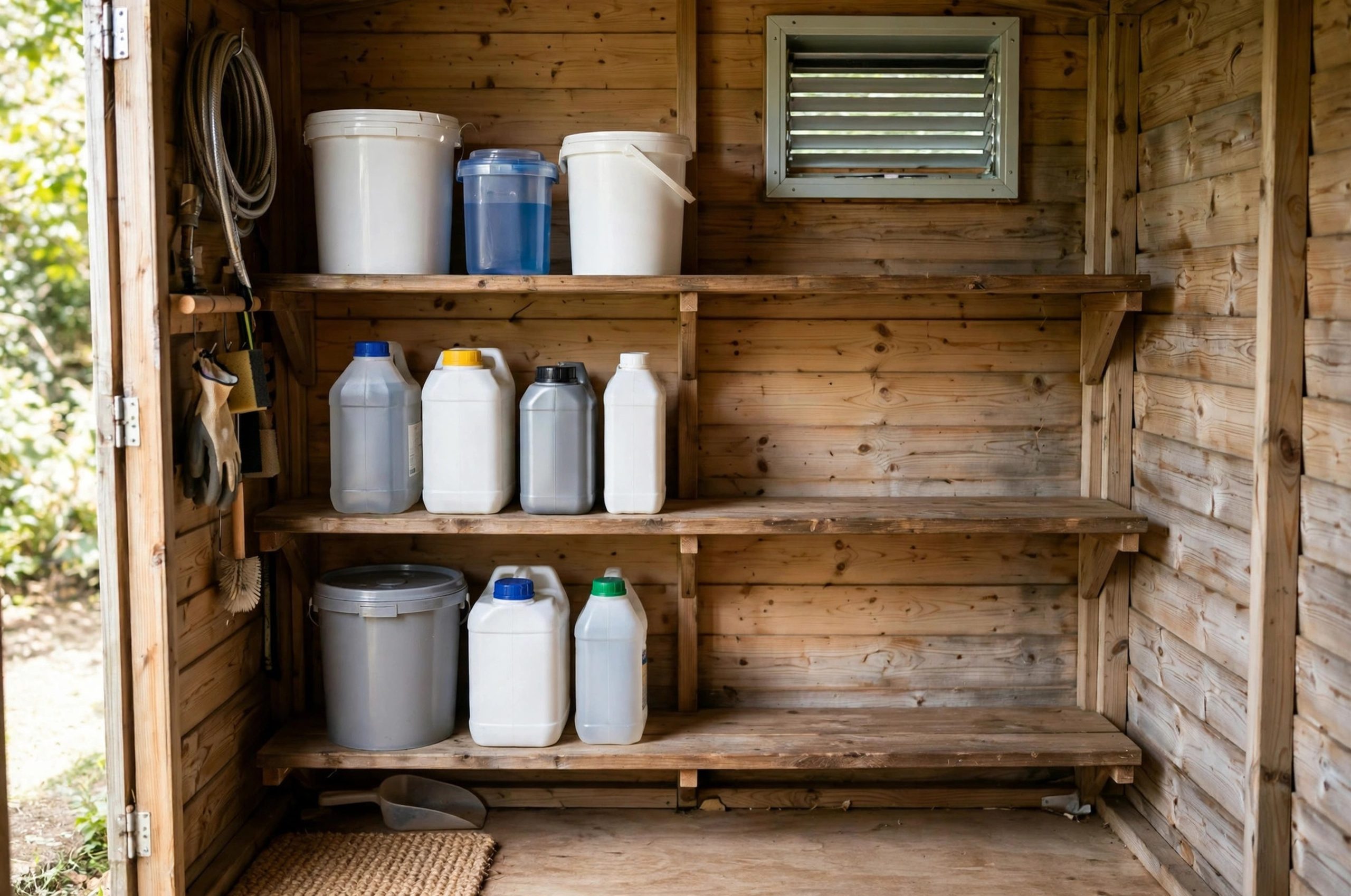
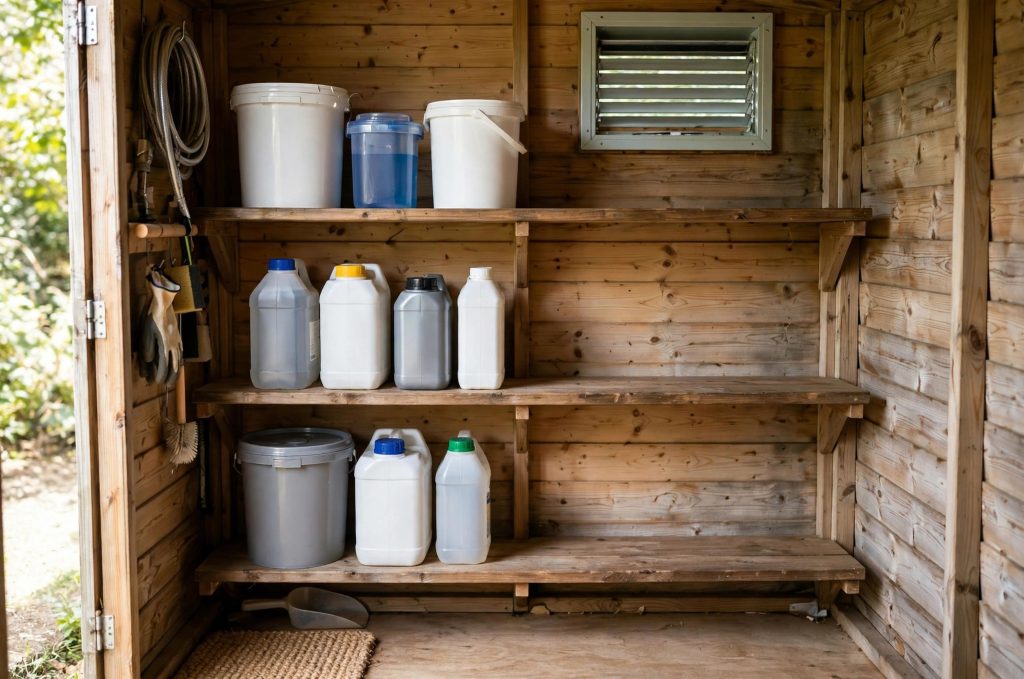
Keep them ventilated. Fumes build up in a sealed shed, especially in summer heat. Ventilation lets gases escape instead of concentrating. A shed with a vent, a louvered door, or a small exhaust fan works. Never store pool chemicals in an airtight box or a sealed cabinet without airflow (H2O Pool Supply, n.d.).
Keep them reachable but not in the way. You will handle these jugs often. Put them where you can lift them without climbing or stretching, but away from the main walkway where they could get knocked over.
Ventilate the Shed
The key to store pool chemicals safely in a shed is choosing the right approach for your space and budget.
With a little planning, store pool chemicals safely in a shed can fit even a busy schedule.
Ventilation deserves its own section because sheds are the worst offenders. A small wooden or metal shed in full sun turns into an oven. Heat speeds chemical breakdown and builds fumes.
Add vents low and high so air flows through. A screened vent near the floor and another near the roof peak creates natural draft. If the shed has no vents, install them. A simple louvered vent from the hardware store takes an hour to fit.
Some owners add a small solar or electric exhaust fan. It does not need to run all day. A fan on a thermostat that kicks on in heat keeps the shed from baking the chemicals.
Leave the shed door open while you work inside. Fresh air protects you while you measure and pour. Never mix or measure chemicals in a closed shed (Fire and Rescue NSW, n.d.).
Separate Chemicals from Each Other
With a little planning, store pool chemicals safely in a shed can fit even a busy schedule.
Before you start, it helps to understand how store pool chemicals safely in a shed works in real homes.
This is the rule that prevents the worst accidents. Store each chemical in its own spot, apart from the others.
Chlorine and acid must never sit side by side. If both leak or spill, the mix makes toxic gas. Keep oxidizers (chlorine, shock, bromine) on one shelf and acids (muriatic acid, pH reducer) on another, with space between them. Store liquids below solids, never above. A leaking jug of acid dripping onto chlorine powder is exactly the disaster you are preventing (Transport Canada, n.d.).
Keep pool chemicals away from everything else in the shed too. Gasoline, paint, solvents, pesticides, and fertilizer all react badly with pool chemicals. Give pool chemicals their own dedicated shelf or cabinet, clearly marked, with nothing else on it. The fire services checklist is blunt: store pool chemicals away from hydrocarbons like petrol, kerosene, and oil (Fire and Rescue NSW, n.d.).
Use separate measuring cups for each chemical, and never return spilled material to the jug. One contaminated scoop can ruin a whole container or start a reaction inside it (Crystal Pools, n.d.).
Lock It Against Kids and Pets
Before you start, it helps to understand how store pool chemicals safely in a shed works in real homes.
A good plan for store pool chemicals safely in a shed saves time, money, and frustration.
Children are curious and fast. Pool chemicals burn skin, blind eyes, and poison if swallowed. The shed must be locked.
Put a real lock on the shed door, not just a latch. Inside, store chemicals in a locking cabinet if kids can reach the shed at all. Keep containers in their original packaging with labels intact, and never move chemicals into food or drink containers. A child who finds granules in a soda bottle will not know the danger (CDC, n.d.-a).
Store chemicals up high enough that small children cannot reach them even if the shed is open for a moment. Tell older kids the shed chemicals are off limits and why. Pets count too. Dogs chew jugs, and cats knock things off shelves.
Handle Spills and Emergencies
A good plan for store pool chemicals safely in a shed saves time, money, and frustration.
For most people, store pool chemicals safely in a shed comes down to a few smart choices.
Even careful owners spill. Know the drill before it happens.
For a dry spill, sweep it up with a dedicated broom and dustpan. Do not use the shop vacuum. Do not wash it back into the jug. Dispose of the swept material per the label or local hazardous waste rules. For a liquid spill, contain it with absorbent material, ventilate the area, and clean up wearing gloves and eye protection (Transport Canada, n.d.).
If chemicals mix and start smoking or fuming, get out. Do not try to be a hero. Call emergency services from fresh air. Fires involving pool chemicals need water only, never a dry chemical extinguisher on some products, so let the fire crew handle it (ANSES, n.d.).
Post the poison control number inside the shed door. In the United States, that is 1-800-222-1222. For skin or eye contact, flush with water for at least 15 minutes and get medical help. If someone swallows pool chemicals, do not induce vomiting. Call poison control at once (Transport Canada, n.d.).
The Shed Setup Checklist
For most people, store pool chemicals safely in a shed comes down to a few smart choices.
Walk through this list once a season.
The shed has vents or airflow and does not bake in the sun. The roof does not leak. Chemicals sit on shelves or pallets off the floor. Each chemical has its own spot, with chlorine products separated from acids. Liquids sit below solids. No gasoline, paint, fertilizer, or solvents share the chemical shelf. Containers are original, labeled, upright, and tightly closed. The shed door locks. Poison control number is posted. A broom, dustpan, gloves, and goggles live in the shed for spill duty. Old or swollen containers are gone, disposed of properly.
Old chemicals deserve a note. Chlorine loses strength over time, especially in heat. Swollen jugs, clumped powder, or containers that hiss when opened are warning signs. Do not use them. Contact your local hazardous waste program for disposal. Never pour old chemicals down the drain or in the trash (CDC, n.d.-a).
Storing Through the Off Season
If you are new to store pool chemicals safely in a shed, start with the simplest option and build from there.
When swim season ends, the shed still needs attention. Cold does not make chemicals safe to ignore. Freeze-thaw cycles can crack containers. Check them before winter and again in spring.
Do a full inventory at closing time. Toss anything degraded. Tighten every cap. Make sure the shed stays ventilated even when you are not visiting it weekly. A shed sealed up tight all winter builds fumes and moisture. For seasonal pool routines, see the pool closing checklist.
In spring, inspect before you buy more. You may already have what you need, and buying fresh stock of degraded chemicals wastes money.
Common Shed Mistakes
When it comes to store pool chemicals safely in a shed, getting the details right makes all the difference.
Storing chlorine next to muriatic acid on the same shelf. Keeping the gas can beside the shock. Leaving jugs on the dirt floor. Letting the shed hit extreme heat with no vents. Moving chemicals into unmarked containers. Letting kids grab the shed key. Mixing old and new product in one jug. Every one of these has caused real incidents. Every one is easy to avoid.
Set the shed up once, check it twice a season, and the chemicals stay safe, strong, and ready. For more on keeping the whole pool area safe, browse the guides on winter pool covers and salt water pool troubleshooting. That is all it takes to store pool chemicals safely in a shed with confidence.
References
ANSES. (n.d.). Disinfectants for swimming pools and spas: Follow the instructions for use. https://www.anses.fr/en/content/disinfectants-swimming-pools-and-spas-be-sure-follow-instructions-use
CDC. (n.d.-a). Pool chemical safety. https://CdC.gOV/healthy-swimming/toolkit/pool-chemical-safety.html
CDC. (n.d.-b). Pool chemical-associated health events in public and residential settings. https://www.cdc.gov/mmwr/preview/mmwrhtml/mm6319a3.htm
Crystal Pools. (n.d.). Safety checklist: 10 tips for handling and storing pool chemicals. https://www.crystalpoolsinc.com/safety-checklist-9-tips-for-handling-storing-pool-chemicals/
Fire and Rescue NSW. (n.d.). Pool chemical safety. https://www.fire.nsw.gov.au/fire-safety/home-fire-safety/topics/pool-chemical-safety
H2O Pool Supply. (n.d.). Storage tips: How to safely store pool chemicals. https://h2opoolsupply.ca/storage-tips-how-to-safely-store-pool-chemicals/
Robert Allen Pools and Spas. (n.d.). Safety and maintenance tips for indoor pools. https://robertallenpoolsandspas.com/safety-maintenance-tips-indoor-pools/
Transport Canada. (n.d.). How to handle chlorine incidents at swimming pools. https://tc.canada.ca/en/dangerous-goods/canutec/articles/how-handle-chlorine-incidents-swimming-pools
Was this guide helpful?

About My Garden US
The My Garden US editorial team writes practical, in-depth home and garden guides for American homeowners — tested advice, no fluff.
You May Also Like
Best Hot Tub for Backyard Parties: How to Choose the Right One
May 15, 2026 17 views
How to Choose the Best Pool Vacuum for Vinyl Liner Pools
May 2, 2026 16 views
How to Install Pool Fence Yourself: A Step-by-Step Guide
March 3, 2026 18 views