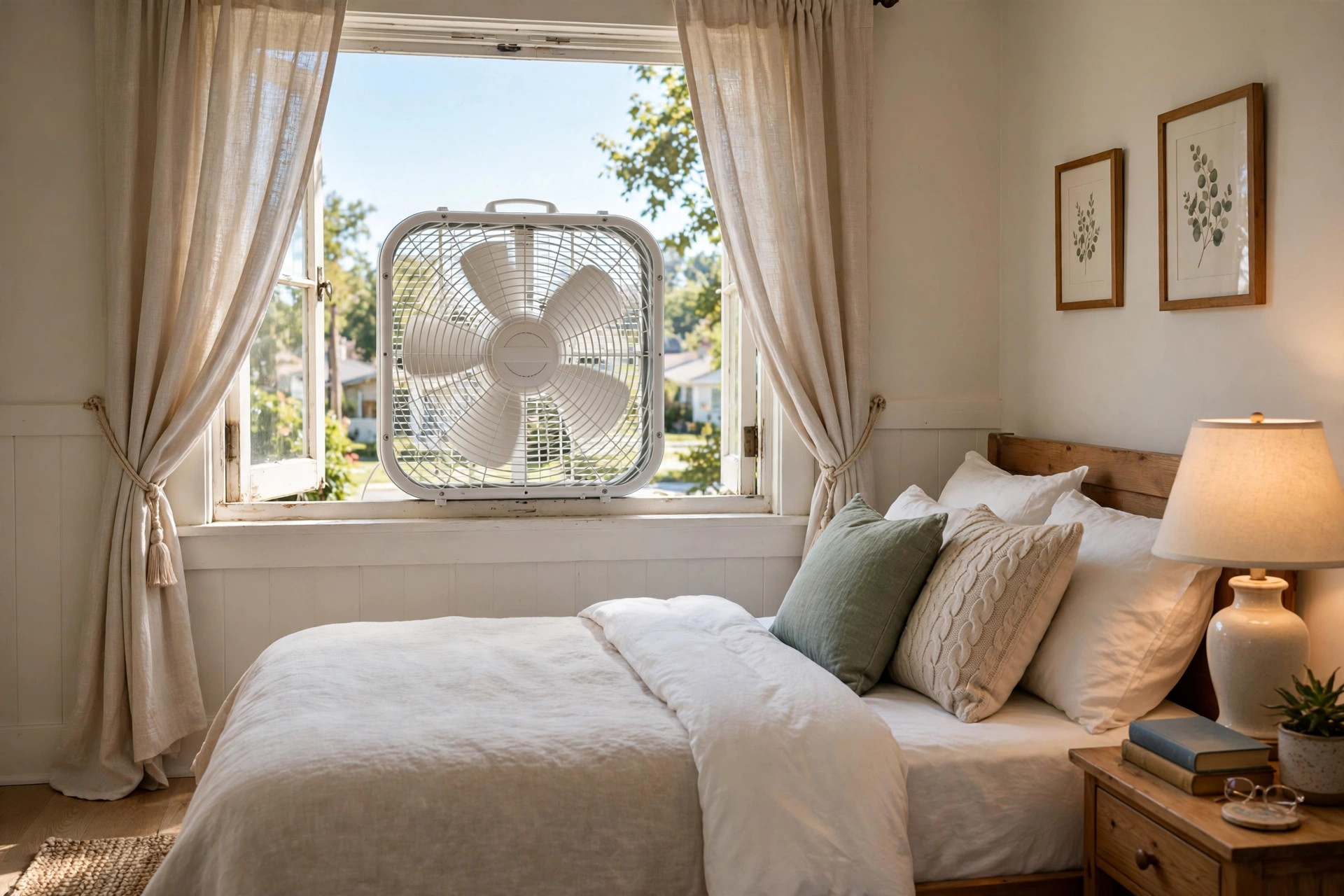

This guide to the best box fan for window reviews 2026 usa looks at what matters when you buy one of these simple machines. A box fan is a square fan, usually about twenty inches on each side. It fits in most home windows. It can pull cool air in from outside. It can push hot air out of a room. It costs far less than air conditioning. It also uses far less power. Many homes in the United States still keep one in a bedroom window through the warm months.
Why a Box Fan in the Window Matters
Summer heat can make a home feel close and heavy. Air conditioning cools the air, but it costs money to run. A window fan works with the air that is already there. At night, the air outside is often cooler than the air inside. A fan in the window moves that cooler air through the room. The breeze also helps sweat dry on the skin. This makes the body feel cooler even when the temperature stays the same.
A fan does not lower the temperature on a thermometer. It makes the room feel cooler to the person in it. This is called the wind chill effect. A steady breeze of even a few miles per hour can make a room feel four or five degrees cooler. That small change is often enough to sleep well on a warm night. Lennox notes that moving air helps a room feel cooler without extra cooling power.
Window placement is the key to the whole idea. A fan on a table stirs the same stale air. A fan in the window trades old air for new air. It brings in fresh air from the garden or the street. It sends out the warm air that collects near the ceiling. The U.S. Department of Energy lists window ventilation as one of the lowest cost cooling steps a home owner can take.
What to Look for When You Buy One: Best Box Fan for Window Reviews 2026 Usa
Not all box fans are the same. The cheap models work, but the better ones move more air and last longer. These are the points that matter most in reviews.
Size and Fit
Most box fans measure about twenty inches square and four or five inches deep. This size fits the lower half of a normal double hung window. Measure the window opening before you buy. The fan should sit firm in the frame without large gaps. A fan that is too small will let warm air leak in around it. A fan that is too large will not fit at all. Some fans come with foam strips to close small gaps. Keep these strips. They make a plain fan work much better.
Airflow and Power
Airflow is measured in cubic feet per minute, or CFM. A normal box fan moves about 1,500 to 2,500 CFM on its high setting. Higher numbers mean more air moved. For a bedroom, 1,500 CFM is often enough. For a living room, look for 2,000 CFM or more. Power use is measured in watts. A box fan uses about 60 to 100 watts on high. That is less than one tenth of a small window air conditioner. Running a fan all night costs only a few cents.
Noise Level
A fan makes noise. The blades cut the air. The motor hums. Some people like the steady hum. It covers other sounds and helps them sleep. Others find it too loud. Reviews often list noise in decibels. A quiet fan runs near 50 decibels on low. A loud one can pass 65 decibels on high. That is close to the sound of normal talk. If you plan to sleep with the fan on, try to find one with a quiet low setting. A fan with a sleep mode or a timer can help here.
Speed Settings and Controls
Three speed settings are standard. Low, medium, and high. Some fans add a fourth or fifth speed. More speeds give finer control. A thermostat control is a useful extra. It turns the fan off when the room reaches a set temperature. A timer is also useful. It turns the fan off after one or two hours so you do not wake up cold. Remote controls are rare on box fans, but some models include them. They let you change the speed from bed.
Types of Window Fans You Can Buy
The word box fan covers several designs. Each one has its own strengths. Reviews in 2026 group them into three main types.
Standard Box Fans
The standard box fan is the square metal or plastic box most people know. It blows air in one direction only. You turn it around to change the direction. It is cheap, simple, and strong. Prices start near twenty five dollars. It has no thermostat and no timer. It is the best choice when you want simple airflow at the lowest price. Many homes use two of them, one in each end of the house, to build a cross breeze.
Reversible Window Fans
A reversible fan can blow air in or out with the flip of a switch. You do not need to lift and turn the whole unit. This is useful at night. You can pull cool air in until midnight, then push warm air out near dawn. Reversible fans often fit the window frame like a small shutter. Some have two or three small blades instead of one large blade. They cost more than standard box fans. They are quieter than box fans in many cases.
Twin Window Fans
A twin window fan has two small fans side by side in one frame. Each fan can be set to blow in or out on its own. This gives more control. You can bring air in on one side and push air out on the other. The frame fits most vertical sliding windows. It will not fit in a wide casement window. Twin fans are light and easy to carry. Prices run from forty to ninety dollars. The smaller blades move less air than a large box fan, but two of them together can cool a small bedroom well.
Cost and Price in 2026
Box fans are among the cheapest cooling tools a home can buy. A basic box fan costs twenty five to forty dollars in most American stores. A mid range model with more speeds and a sturdier frame costs forty to sixty dollars. A reversible or twin window fan costs fifty to ninety dollars. The most costly models, with thermostats and timers, can pass one hundred dollars.
The real savings come from running costs. A box fan uses about 75 watts on high. At a power price of sixteen cents per kilowatt hour, eight hours of use costs about ten cents. A small window air conditioner uses about 900 watts. The same eight hours cost about one dollar and fifteen cents. Over one summer, a fan can save a family more than one hundred dollars on the power bill. Energy Star points out that fans let you set the thermostat a few degrees higher and still feel cool.
How to Set Up and Use a Box Fan in a Window
Good placement matters as much as the fan itself. A few simple steps turn a plain fan into a strong cooling tool.
Pull Air In or Push Air Out
A window fan works best when it pushes hot air out of the room. Hot air collects near the ceiling and in closed rooms. Point the fan outward in the warmest room of the house. This throws the hot air outside. The room will pull replacement air from other parts of the house. Open a window in a cooler room on the shady side of the house. Cool air will flow in there and move toward the fan. This one simple rule fixes most poor results.
Seal the Open Space Around the Fan
Air follows the easy path. If gaps remain around the fan, air will slip through them instead of passing through the blades. This wastes power. Close the gaps with foam strips, a cut piece of cardboard, or a towel. Some fans include foam panels for this job. A tight seal can double the useful airflow of the same fan.
Build a Cross Breeze
One fan cools one room. Two fans cool a whole floor. Put one fan in a window on the windward side of the house, blowing inward. Put a second fan in a window on the far side, blowing outward. Air will move through the rooms between them. This is called cross ventilation. This Old House shows how this pattern moves hot air out of a house fast in the evening. Keep interior doors open so the air has a clear path.
Care and Upkeep
A box fan needs little care, but a little care goes far. Dust collects on the blades. Dust makes the fan noisy and weak. Turn the fan off and unplug it. Wipe the front and back grills with a damp cloth. Use a soft brush to reach between the grill bars. Do this once a month during the warm season.
Check the cord for wear. A cracked cord can be a fire risk. Replace the fan if the cord is damaged. Oil is not needed on most modern fans. The motors are sealed. If the fan starts to wobble or buzz, the blades may be bent. A bent blade can be straightened with care, but a bad wobble means it is time for a new fan. Store the fan in a dry place over winter. Cover it with a bag to keep dust out. Family Handyman has simple guides for cleaning and storing fans between seasons.
Safety Notes
Fans are simple machines, but they still need care. Never put fingers or sticks through the grill while the fan runs. Keep the fan away from water. Do not run a fan in a window during rain. Water and power do not mix. Make sure the fan sits firm in the window so it cannot fall out. A falling fan can hurt someone below or break on the ground.
Do not run the cord under a rug or through a doorway where it can wear. Plug the fan straight into a wall outlet when you can. If you must use an extension cord, use a short one rated for the load. Keep small children and pets clear of the fan while it runs. Carrier reminds home owners that fans are helpers, not replacements for full cooling systems in extreme heat. On very hot days, when the air outside is hotter than the air inside, turn the fan off and keep windows closed until the evening cools.
Frequently Asked Questions
Does a box fan in the window really cool a room? It cools the people in the room, not the air on the thermometer. The moving air helps sweat dry and makes the body feel cooler. At night, it can also pull in cooler outside air and push out the hot air of the day.
Is it better to blow air in or out? Blowing hot air out usually works best. It throws the warm air of the room outside. Fresh air then flows in through other open windows. Try both directions in your own room. The outward setting wins in most homes.
Can a box fan replace air conditioning? In mild heat, yes. In severe heat, no. When the air outside is above about ninety five degrees, a fan only moves hot air. At that point you need real cooling. Many homes use a fan with the air conditioner. The fan spreads the cool air, so the thermostat can be set a few degrees higher. This cuts the power bill. A window air conditioner for large rooms can pair well with a fan for this job.
How much power does a box fan use? About 60 to 100 watts on high. That is less than a normal light bulb in some homes. Running one all night costs only a few cents. This low cost is one reason fans stay popular even as air conditioning spreads.
Are box fans safe to run all night? Yes, for most people. Choose a fan with a firm base and a clean cord. Keep it away from curtains and bedding so air can flow free. A timer that turns the fan off after a few hours adds peace of mind. People with breathing problems may want to keep the window partly closed on dusty nights.
What is the difference between a box fan and a whole house fan? A box fan sits in one window and cools one or two rooms. A whole house fan is fixed in the attic or ceiling and pulls air through the entire house. The whole house fan moves far more air but costs much more to install. A box fan is the simple first step.
A Short Final Word
A box fan is not new technology. It is an old idea that still works. It costs little to buy and almost nothing to run. Set in a window, it trades stale air for fresh air all night long. For mild summer nights, it is all many homes need. For hot nights, it still helps the air conditioner work less. Read the reviews, measure your window, and pick a fan with the airflow and noise level that suits your room. For related cooling options, you can also look at an evaporative cooler for the garage, Trane and Rheem for full home cooling systems, and Goodman Manufacturing for basic ventilation choices.
References
Carrier. (n.d.). Heating and cooling systems. https://www.carrier.com ENERGY STAR. (n.d.). Energy efficient products. https://www.energystar.gov Family Handyman. (n.d.). DIY home repair and maintenance. https://www.familyhandyman.com Goodman. (n.d.). Heating and cooling equipment. https://www.goodmanmfg.com Lennox. (n.d.). Heating and cooling systems. https://www.lennox.com Rheem. (n.d.). Heating, cooling, and water heating. https://www.rheem.com This Old House. (n.d.). Home renovation guidance. https://www.thisoldhouse.com Trane. (n.d.). Heating and air conditioning. https://www.trane.com U.S. Department of Energy. (n.d.). Energy efficiency and renewable energy. https://www.energy.gov
Was this guide helpful?

About Lisa Anderson
The My Garden US editorial team writes practical, in-depth home and garden guides for American homeowners — tested advice, no fluff.
You May Also Like
Best HVAC Companies Near Me Reviews 2026
May 6, 2026 0 views
Heat Pump Tax Credit 2026 Requirements USA: What Every Homeowner Must Know
September 28, 2026 0 views
Duct Sealing Cost With Aeroseal Near Me: A Plain Guide for Homeowners
September 27, 2026 0 views