
Why Indoor Humidity Matters
A cool mist vs warm mist humidifier comparison must begin with a plain fact. Dry air hurts comfort and health. In winter, heated homes often drop to 20 or 25 percent relative humidity. That dry air dries skin, cracks lips, and makes noses bleed. It also lets static electricity build up, so every doorknob gives a small shock. Wood floors shrink and crack. Paintings and wood furniture can warp. In summer, dry air is less common, but air conditioning can still pull moisture from the air and leave a home feeling dry.
Health experts agree that most homes feel best at 30 to 50 percent relative humidity. A humidifier adds water vapor to the air and lifts the level into that range. This simple act can ease a cough at night, calm dry eyes, and help people sleep better. It can also lower heating bills a little, because moist air feels warmer than dry air at the same temperature.
The two main kinds of room humidifiers are cool mist and warm mist. Both raise humidity, but they do the job in different ways. Each has real strengths and real drawbacks. This cool mist vs warm mist humidifier comparison walks through the facts, section by section, so you can pick the right one for your home and your family.
How to Choose Between Cool Mist and Warm Mist: Cool Mist vs Warm Mist Humidifier Comparison
Before you compare models, answer three questions. First, who will use the humidifier? A child or a pet in the home changes the safety picture. Second, what room will it serve? A small bedroom needs a small tank. A large living room needs a large tank or a whole house unit. Third, how much care do you want to do? Both types need regular cleaning, but warm mist units need it more.
Your budget also matters. Cool mist models usually cost less to buy, but they can cost more to run in some cases. Warm mist models usually cost less to run per hour of use in some homes, but they use more electricity to heat water. The sections below lay out each point so the choice becomes clear.
What Size Room Do You Need to Cover
Manufacturers rate humidifiers by the size of room they can serve. A small unit covers up to 300 square feet. A medium unit covers 300 to 600 square feet. A large unit covers 600 square feet or more. Measure your room and buy a unit rated for it. A small unit in a large room will run all day and never catch up.
Check the Water Tank Size
Tank size sets how often you refill. A one gallon tank may run 8 to 12 hours on low. A two gallon tank may run a full day. Larger tanks mean fewer trips to the sink. They also make the unit heavier to carry when full.
Types of Humidifiers
Cool Mist Humidifiers
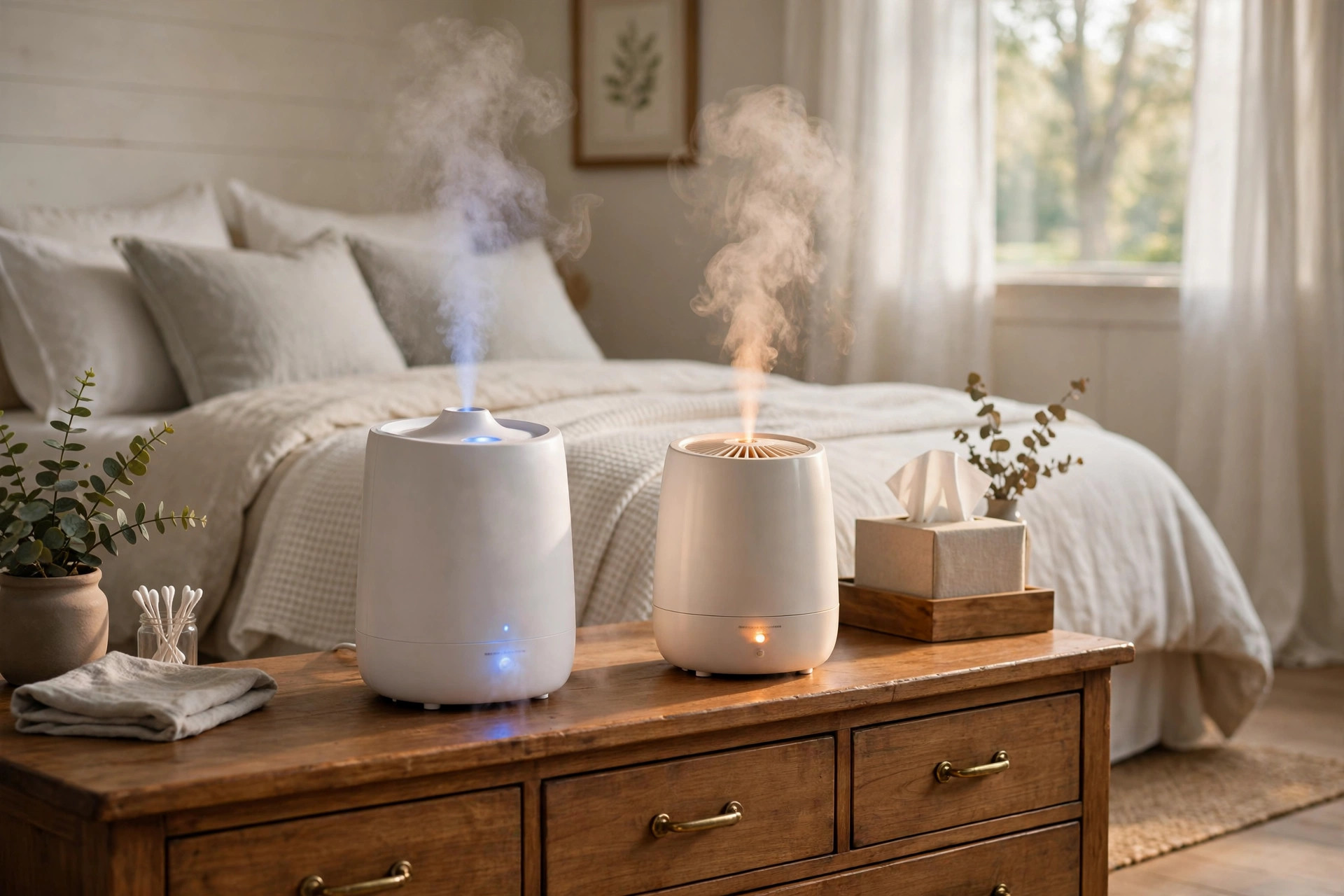
Cool mist humidifiers release room temperature mist into the air. They come in two main styles. Evaporative models blow air through a wet wick or filter, and the water turns to vapor as the air passes through. Ultrasonic models use a tiny vibrating plate to break water into very fine droplets, and a fan blows the droplets into the room.
Evaporative models have one nice trait. They cannot add too much moisture to the air. The wick only gives off as much vapor as the air can hold. Ultrasonic models have no such limit. They keep adding mist until the room is damp. That is why a humidistat or an automatic shut off is useful with ultrasonic units.
Cool mist models are safe around children and pets because the mist is not hot. They also cost less to run than warm mist models in most cases, since they do not heat water. The main drawback is maintenance. The wick or filter must be replaced on schedule, and the tank must be cleaned often to stop mold and bacteria.
Warm Mist Humidifiers
Warm mist humidifiers, also called steam vaporizers, heat water until it boils. The steam cools a little as it leaves the unit, but it is still warm. The warm mist feels good in a cold room, and many people like the gentle hum of the heater.
Warm mist units kill most germs and mold in the water because boiling sterilizes it. That is their strongest point. They do not need a wick or filter, so there are no filter costs. The main drawbacks are energy use and safety. The heating element uses more power than a fan. The hot steam can burn a child or a pet that gets too close.
How the Two Types Differ at a Glance
In this cool mist vs warm mist humidifier comparison, the key facts line up as follows. Cool mist units cost less to run, are safe around children, and need filter changes. Warm mist units kill germs with heat, feel warm in cold rooms, use more electricity, and pose a burn risk. Neither type is right for every home. The right pick depends on your family, your rooms, and your habits.
Cost and Price
Room humidifiers come at a wide range of prices. Small cool mist units for a bedroom often sell for 25 to 60 dollars. Larger cool mist units with more features sell for 60 to 150 dollars. Warm mist units fall in a similar range, often 30 to 80 dollars for a small bedroom model. Prices vary by brand, tank size, and features like a built in humidistat.
Running costs differ. A cool mist evaporative model may use 15 to 40 watts of power, which is about the same as a small fan. A warm mist model may use 200 to 400 watts, which is much more. Over a full heating season, the warm mist unit can add a clear amount to the electric bill.
Filter costs add up for evaporative cool mist models. Wick filters cost 5 to 15 dollars each and last one to three months with daily use. Ultrasonic cool mist models need no wick, but they work best with distilled water in hard water areas. Distilled water costs about one dollar per gallon at the store. Tap water is fine in many homes, but hard water leaves white mineral dust on furniture near ultrasonic models.
A whole house humidifier tied to the furnace is a bigger buy. It often costs 200 to 600 dollars for the unit, plus installation. For a full look at larger units, see our guide to the best whole house humidifier reviews 2026 usa. Installation adds more, but the unit covers the entire home with one tank.
Care and Upkeep
Cleaning matters more than any feature. A dirty humidifier can spread mold and bacteria into the air. Both types need a cleaning routine, and warm mist types need extra care because heat and standing water breed germs fast.
Follow these steps for safe care:
1. Empty the tank every day. Never let water sit overnight. 2. Rinse the tank with clean water before each refill. 3. Wipe the base and the mist outlet with a soft cloth. 4. Clean with vinegar once a week. Soak the tank in a mix of one part white vinegar and four parts water for 30 minutes, then rinse well. 5. Replace wick filters on schedule for evaporative models. 6. Use distilled water if your tap water is hard. It cuts mineral dust and scale. 7. Dry the unit fully before long term storage.
For warm mist units, descale the heating element with vinegar each week. Mineral scale makes the heater work harder and shortens its life. For evaporative units, throw away a wick that smells musty or looks stained. A fresh wick costs little and keeps the air clean.
Placement matters too. Set the unit on a flat, water safe surface at least two feet from walls and furniture. Keep it out of reach of small children. Do not aim the mist at wood furniture, electronics, or curtains. Aim for the center of the room.
Safety
Safety is one of the biggest points in this cool mist vs warm mist humidifier comparison. Cool mist units are the safer choice around children and pets. The mist is room temperature. There is no hot surface to touch and no boiling water to spill.
Warm mist units need care. The steam can burn skin on contact. The base and the heating element stay hot during use. Keep warm mist units well out of reach of children and pets. Never place one where a child could pull it off a table. Unplug it before moving it, and let it cool before cleaning.
Both types carry a mold risk if neglected. Mold can grow in a tank that sits with old water. People with allergies or asthma should be extra careful with cleaning. Mold spores in the air can trigger attacks. The energy.gov site and the energystar.gov site both stress that proper upkeep is part of safe operation for any heating or air treatment device in the home.
A humidistat helps with safety and comfort. It reads the humidity level and shuts the unit off when the target is reached. This stops over humidifying, which can feed mold in walls and carpets. Aim to keep indoor humidity between 30 and 50 percent. A cheap hygrometer from a hardware store can check the level in any room.
Parents of babies should note one more point. Pediatricians often suggest cool mist for a nursery. A hot steam unit in a nursery is a burn risk for a crawling child. For help picking a bedroom unit, read our roundup of the best portable humidifier for bedroom usa.
When a Whole House Unit Makes Sense
A room humidifier suits one or two rooms. If the whole house feels dry, a whole house humidifier tied to the furnace or ductwork is the neater answer. It adds moisture to all rooms at once. It has no tank to refill. It uses the home’s water line instead.
Whole house units come in bypass, fan powered, and steam styles. A bypass unit uses the furnace fan to move air through a wet pad. A fan powered unit has its own fan. A steam unit boils water and pushes steam into the ducts. Each has pros and cons for cost, care, and energy use.
If dry winter air is your main problem, read our guide on the ideal indoor humidity in winter usa guide to learn the best target levels for each room. The guide explains why 30 to 40 percent is the sweet spot for most winter homes.
Frequently Asked Questions
Is cool mist or warm mist better for a cold or the flu?
Both can help ease a stuffy nose and a dry cough. Warm mist feels soothing in a cold room. Cool mist is safer and easier to keep running all night. Most doctors suggest either one, as long as you clean it well. The moist air itself is what helps, not the temperature of the mist.
Which type is quieter at night?
Ultrasonic cool mist models are the quietest. They make almost no sound. Evaporative cool mist models make a low fan hum. Warm mist models make a soft bubbling sound as the water heats. Light sleepers often prefer ultrasonic cool mist units for the bedroom.
Can I use tap water in a humidifier?
Yes, tap water works in most humidifiers. Hard tap water leaves white mineral dust around ultrasonic models and scale in warm mist heaters. If your water is hard, distilled water cuts both problems. Empty the tank daily either way.
How often should I clean my humidifier?
Rinse and refill the tank every day. Do a vinegar soak once a week. Replace wick filters every one to three months. A clean unit runs better and keeps the air safe. This schedule holds for both cool mist and warm mist models.
Do humidifiers raise the electric bill a lot?
Cool mist models use very little power, about like a small fan. Warm mist models use much more because they heat water. Over a long heating season, a warm mist unit can add a noticeable amount to the bill. If energy cost is a worry, a cool mist unit is the cheaper pick. You can check energy use tips at carrier.com, trane.com, lennox.com, and goodmanmfg.com, which all publish guides on home heating costs.
Can a humidifier make mold worse?
Yes, if it is misused. Too much moisture feeds mold in walls, carpets, and window sills. Keep indoor humidity at 30 to 50 percent. Use a humidistat or a hygrometer to check. Clean the tank often. Guides at thisoldhouse.com and familyhandyman.com explain how to spot and stop moisture problems in the home.
The Final Word
This cool mist vs warm mist humidifier comparison comes down to one choice. Pick cool mist if you want low energy use, safe operation around children and pets, and quiet nights. Pick warm mist if you want germ killing heat, no filter costs, and warm mist that feels good in a cold room. Either way, buy the right size for the room, clean it on schedule, and keep humidity between 30 and 50 percent. Do that, and your home will feel better all winter long.
References
Carrier. (n.d.). Heating and cooling systems. https://www.carrier.com ENERGY STAR. (n.d.). Energy efficient products. https://www.energystar.gov Family Handyman. (n.d.). DIY home repair and maintenance. https://www.familyhandyman.com Goodman. (n.d.). Heating and cooling equipment. https://www.goodmanmfg.com Lennox. (n.d.). Heating and cooling systems. https://www.lennox.com This Old House. (n.d.). Home renovation guidance. https://www.thisoldhouse.com Trane. (n.d.). Heating and air conditioning. https://www.trane.com U.S. Department of Energy. (n.d.). Energy efficiency and renewable energy. https://www.energy.gov
Was this guide helpful?

About Lisa Anderson
The My Garden US editorial team writes practical, in-depth home and garden guides for American homeowners — tested advice, no fluff.
You May Also Like

Electric Fireplace Insert Reviews 2026 USA: A Plain Buyer’s Guide
January 24, 2026 0 views
The Best Wood Stove for 2000 Sq Ft: Reviews and a Buyer’s Guide
February 21, 2026 0 views
Garage Insulation Kit for Metal Doors USA: A Plain Guide for Homeowners
January 3, 2026 0 views