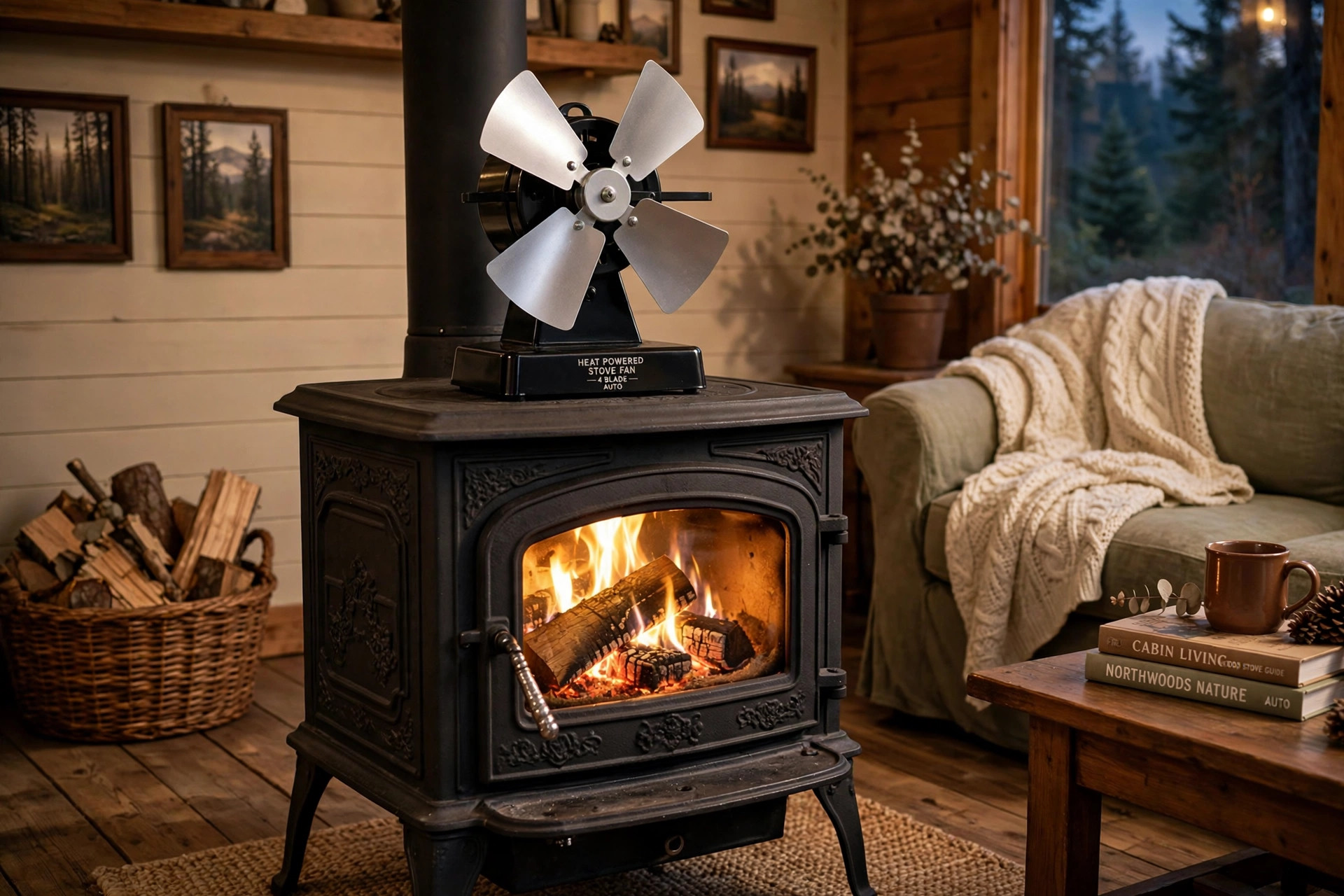

When winter comes, a wood stove can heat one corner of a room very well and leave the rest of the room cold. A heat powered stove fan solves this problem in a simple way. It sits on top of the stove. It uses the heat of the stove to run. It blows warm air out into the room. There is no cord. There is no plug. There is no battery to change. This heat powered stove fans reviews and buying guide will help you understand how these fans work, which types are worth the money, and how to choose the right one for your stove.
Why a Heat Powered Stove Fan Matters
A wood stove makes most of its heat at the top of the stove body. That heat rises straight up to the ceiling. The ceiling does not need heat. The chairs, the couch, and the people in the room need it. Without help, the hot air stays in one place. A stove fan moves that air. It takes the hot air from the top of the stove and pushes it out across the room.
The gain is not small. Many stove owners report that the far side of the room feels warmer after they put a fan on the stove. The stove itself does not have to work harder. The fan does not use fuel. It only moves heat that is already there. For a pellet stove or a wood stove, this means better use of every log or bag of pellets you burn.
How a Heat Powered Stove Fan Works: Heat Powered Stove Fans Reviews and Buying Guide
A heat powered stove fan uses a thermoelectric module. This is a small device inside the base of the fan. When one side of the module is hot and the other side is cool, it makes a small electric current. This is called the Seebeck effect. The current drives a small motor. The motor turns the fan blades.
Here is the process, step by step. You place the fan on the flat top of the stove. The base of the fan picks up heat from the stove top. The bottom of the thermoelectric module gets hot. The top of the module stays cooler, because air flows around it. The difference in heat makes power. The fan turns.
No wire is needed. No battery is needed. The fan is quiet, because the motor is small and there is no gearbox. Most fans make a soft hum that most people do not notice. They are made to run for years. The thermoelectric module has no moving parts to wear out.
How Much Heat Is Needed
The fan will not start on a cold stove. It needs a hot surface. Most fans start to turn when the stove top reaches about 150 to 200 degrees Fahrenheit. They reach full speed near 500 to 600 degrees Fahrenheit. If the stove is too cool, the blades will not move. This is normal. It is not a sign that the fan is broken.
Do not let the stove top get too hot either. Most makers warn that the fan should not sit on a surface above about 660 degrees Fahrenheit. Extreme heat can damage the motor and the module. Many fans have a small built in guard that lifts the blades when it gets too hot.
Types of Heat Powered Stove Fans
Single Blade Fans
Most stove fans use one blade. This blade is usually made of aluminum. It has three or four vanes. The blade turns slowly and pushes a steady stream of warm air forward. Single blade fans are the most common type. They are also the least costly.
Twin Blade Fans
Some fans have two blades. They move more air than a single blade fan. They are good for larger rooms. They cost more. In a small cabin, a twin blade fan may be more than you need.
Tall and Short Models
Fans come in different heights. A tall fan lifts the air stream higher and can reach over furniture. A short fan fits under a low shelf or a stove pipe that runs close to the wall. Measure the space above your stove before you buy. Leave a few inches of clear space around the fan.
Fans With Thermometers
A few models include a small strip thermometer on the base. The strip shows the stove top heat in bands. This helps you place the fan in the right spot. The thermometer is a nice extra, but it is not required.
What to Look for When You Buy
Blade Count and Air Flow
Air flow is measured in cubic feet per minute, or CFM. Most single blade fans move about 100 to 180 CFM. Twin blade models can move 200 to 350 CFM. For a room up to about 400 square feet, a single blade fan is usually enough. For an open plan of 600 square feet or more, look at a twin blade model.
Base Size and Stability
The base of the fan must sit flat on the stove top. A wider base is more stable. A narrow base can tip if the stove top is small. Check the size of your stove top before you order. The base should fit with space around it. It should not hang over the edge.
Blade Material
Most blades are made of anodized aluminum. This is light and it holds up to heat. Do not buy a fan with plastic blades. Plastic will melt or warp near a hot stove. Aluminum blades can bend if the fan falls, so keep the fan where it will not be knocked off the stove.
Start Heat and Top Heat
Look for the starting heat and the top safe heat in the spec list. The starting heat tells you when the fan will begin to turn. The top safe heat tells you when to worry. A fan that starts at 150 degrees and stays safe to 650 degrees is a good all round choice.
Noise
Stove fans are quiet, but they are not silent. Most make less noise than a whisper. If noise matters to you, look for a model with a good motor and sealed bearings.
Reviews of Popular Models
Four blade single motor fans are the workhorses. They cost little. They move enough air for one room. Most owners give them high marks for value. They are the best pick for a first stove fan.
Twin blade fans earn praise from owners of big rooms and open plans. They push more air and the difference can be felt at the far wall. The trade is cost and size.
Premium fans from well known stove brands get good marks for build and life span. They often start at lower heat than cheap models. They cost two to three times the price of a basic fan. If you burn wood every day all winter, the extra cost can be worth it.
Cheap no name fans are mixed. The weak point is usually the motor or the blade balance. If you buy a cheap fan, test it for the full first winter before you depend on it. Independent test groups such as Consumer Reports also publish buyer advice for home heating products that is worth a look before you spend.
Cost and Price
A basic heat powered stove fan costs about 20 to 40 dollars. Mid range models with better motors and larger blades cost about 40 to 80 dollars. Premium fans from stove makers can cost 80 to 150 dollars. Twin blade models sit at the top of each price band.
The fan pays for itself if it lets you burn less wood. Better air flow means the room reaches a good heat faster. Many owners find they can close the stove damper a little and still feel warm. Over one winter, this can save a real amount of wood or pellets.
Care and Upkeep
A stove fan needs little care. Dust the blades now and then with a soft cloth. Dust on the blades makes the fan less efficient and can cause a small wobble. Let the stove cool fully before you clean the fan.
Keep the fan in a safe spot when it is not on the stove. The blades bend easily. A bent blade makes the fan vibrate and makes noise.
Store the fan in its box in the warm months if you do not use it. Keep it dry. There is no battery to remove, so there is nothing else to do for the summer.
Safety
A stove fan is safe when it is used right, but it sits on a very hot stove. Place the fan toward the back of the stove top, not at the front edge. It should be far from the path where you open the stove door. Do not let the blades strike the stove pipe or the wall.
Keep children and pets away from the fan. The blades are not sharp, but the stove top is very hot. A child who reaches for the fan can get burned on the stove.
Do not touch the fan while the stove is hot. Use the cool top handle if the fan has one, and only when the fan has cooled down.
Check the fan each winter before you start burning. Look for bent blades, a loose base, and a motor that hums but does not turn. A fan that will not turn on a hot stove may have a dead module. Replace it rather than trying to fix the inside parts.
The Consumer Product Safety Commission offers general safety guidance for home heating products, and the EPA publishes clean burning tips for wood stoves that pair well with good heat flow in the home.
Placement Tips for Best Results
Where you put the fan matters as much as which fan you buy. Place it on the flat rear part of the stove top. Aim the blades toward the room, not toward a wall. If the fan sits too close to a wall, the air hits the wall and loses speed.
Leave the stove pipe area clear. Put the fan to one side of the pipe. Make sure the blades cannot touch the pipe as they spin.
In a two room layout, aim the fan toward the door or opening that joins the rooms. The warm air will flow through the opening.
Stove Fan or Electric Fan
A stove fan needs no power. This is a big plus during a power cut. Many wood stove owners burn wood because they want heat when the power is out. A stove fan keeps working in that case. An electric fan stops.
An electric fan moves more air. But it uses power, it makes more noise, and it needs a cord near a hot stove.
Most wood stove owners are happy with a stove fan. It is simple, safe, and it works with no extra effort. If you heat with a freestanding electric stove or you want the look of a stove without wood, an electric room fan may fit better. For a true wood burner, the stove fan is the natural match. If you are still choosing your stove, read our best wood burning stoves buying guide before you decide.
Frequently Asked Questions
How long does a heat powered stove fan last?
Most last five to ten years with normal use. The thermoelectric module has no moving parts. The motor is the part that wears. A well made motor with sealed bearings lasts the longest. Cheap motors may fail in two or three years.
Can the fan sit on any stove?
It can sit on most flat top wood stoves, pellet stoves, and coal stoves. It will not work well on a stove with a curved or ribbed top, because the base cannot pick up heat evenly. It also needs a stove that gets the top hot enough. Check the start heat of the fan against how hot your stove runs.
Does the fan use any fuel or power?
No. The fan gets all its power from the heat of the stove. There is no cord, no battery, and no fuel. This is why it works during power cuts.
Will the fan melt if the stove gets too hot?
Most fans are safe to about 650 degrees Fahrenheit on the stove top. Above that, the motor and the module can be damaged. Many fans have a guard that lifts the blades when the base gets too hot. Do not run the stove over hot for long with the fan on it.
Is a twin blade fan worth the extra cost?
For a large room or an open plan, yes. A twin blade fan moves much more air. For a small cabin, a single blade fan is enough.
Can I use a stove fan on a gas stove?
No. A stove fan is made for solid fuel stoves like wood and pellet stoves. A gas kitchen stove does not have a flat top that holds steady high heat in the right way, and the fan base will not pick up heat evenly. Stove makers design these fans for wood and pellet heat.
Where to Learn More Before You Buy
The guides below helped shape this article. They are free and worth a read before you shop.
– Napoleon — wood heat buying tips. – Heatilator — fireplace and heating guides. – Lowe’s — stove accessory buying guides. – The Home Depot — stove fan product guides. – This Old House — home repair advice. – Family Handyman — DIY project guides. – The Spruce — home and garden how to guides.
A Final Word
A heat powered stove fan is one of the best small buys for a wood stove owner. It costs little. It uses no power. It makes the room warmer with the same amount of wood. Choose a fan with a low start heat, a stable base, and honest air flow numbers. Place it well, keep it clean, and it will serve you for many winters.
References
Consumer Reports. (n.d.). Product reviews and ratings. https://www.consumerreports.org Family Handyman. (n.d.). DIY home repair and maintenance. https://www.familyhandyman.com Heatilator. (n.d.). Fireplaces and fireplace products. https://www.heatilator.com Lowe’s. (n.d.). Home improvement products. https://www.lowes.com Napoleon. (n.d.). Fireplaces, grills, and heating products. https://www.napoleon.com The Home Depot. (n.d.). Home improvement products. https://www.homedepot.com The Spruce. (n.d.). Home and garden advice. https://www.thespruce.com This Old House. (n.d.). Home renovation guidance. https://www.thisoldhouse.com U.S. Consumer Product Safety Commission. (n.d.). Product safety information. https://www.cpsc.gov U.S. Environmental Protection Agency. (n.d.). Protecting human health and the environment. https://www.epa.gov
Was this guide helpful?

About Michael Thompson
The My Garden US editorial team writes practical, in-depth home and garden guides for American homeowners — tested advice, no fluff.
You May Also Like
Ventless Fireplace Remote Controls for Sale: A Complete Buying Guide
February 26, 2026 0 views
Best Electric Fireplace Mantels for Humid Climates: A Buyer Guide
August 13, 2026 0 views
Affordable Floating Fireplace Mantels for USA Homes Guide
March 20, 2026 0 views