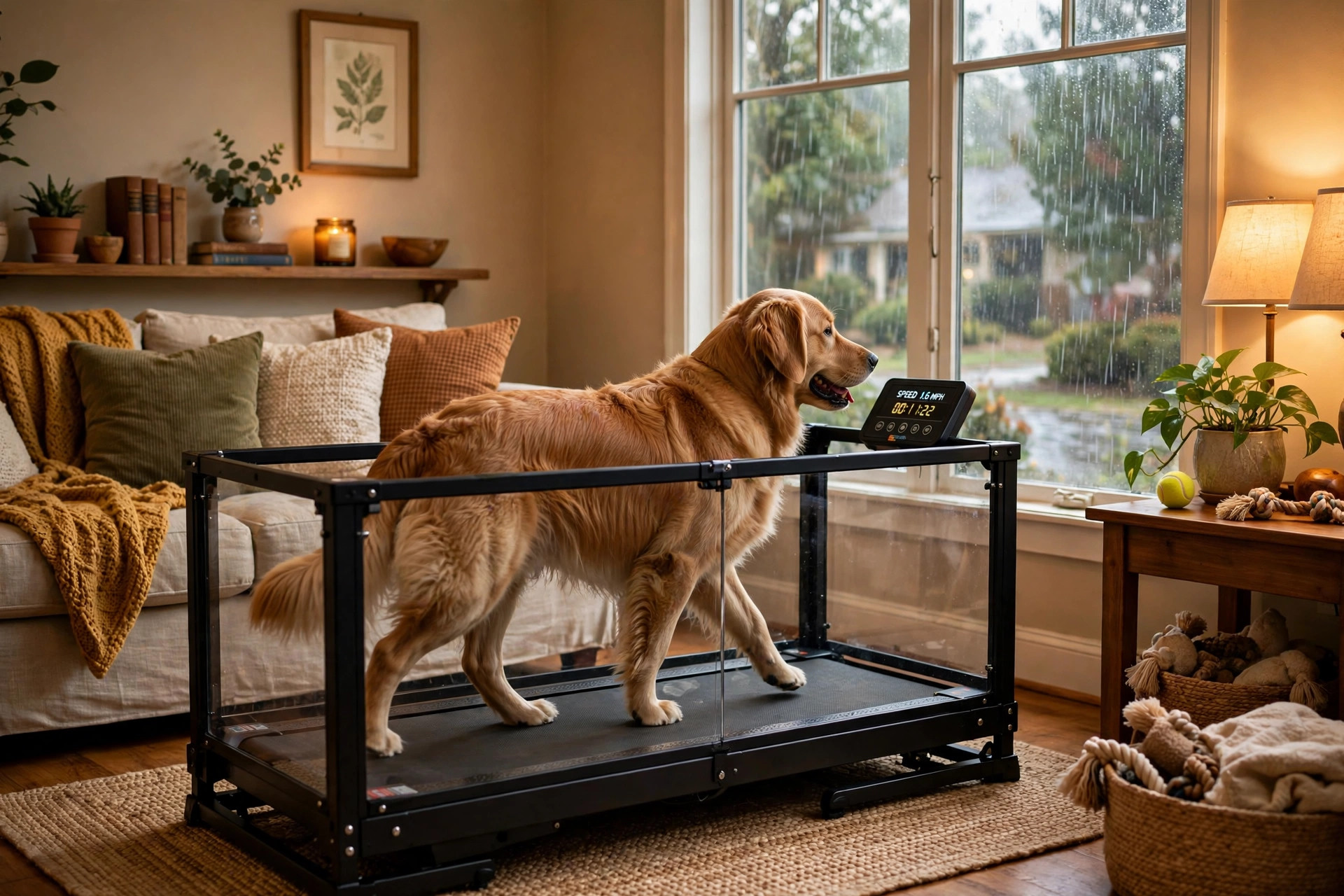

Rain falls hard against the window. The street outside is dark and wet. Your dog stands by the door, tail wagging, ready for a walk that cannot happen. This is a common scene in many American homes. A dog treadmill for indoor exercise on rainy days solves this problem. It gives your dog the walk he needs without going out into the storm. The machine is simple: a belt moves under your dog’s feet while he walks at a steady pace, dry and safe. Many owners now keep one in the garage or living room for wet days, cold snaps, and times when work keeps them late. This guide explains what a dog treadmill is, how to choose one, what it costs, and how to use it well.
Why Indoor Exercise Matters on Rainy Days
Dogs need daily movement. A dog that misses exercise for two or three rainy days in a row often shows it. He may chew furniture, bark at nothing, or pace the house at night. Vets have long said that steady exercise keeps a dog’s weight in check and his mind calm. Walking is the most basic form of that exercise. When rain makes the road unsafe, a treadmill takes the place of the walk.
Rain brings more trouble than wet fur. Slick roads can injure paws, cold rain can chill a small dog, and thunder can frighten even a brave one. A dog treadmill for indoor exercise on rainy days removes these risks. Your dog walks in a warm, dry room while the storm passes outside. The American Kennel Club and other dog groups remind owners that exercise should fit the dog’s age and health, and indoor walking is a fine choice when the weather turns bad.
Indoor exercise also helps owners. A person who works long hours may not want to walk in the rain at night. A senior owner may fear slipping on wet steps. A treadmill lets the dog work out at home while the owner watches from a chair. It does not replace love or play, but on rainy days it keeps the routine alive.
What to Look for in a Dog Treadmill: Dog Treadmill for Indoor Exercise Rainy Days
Not every treadmill fits every dog. Size is the first thing to check. Measure your dog from nose to the base of his tail. Add twelve inches. That is the shortest belt length that will do. A small dog can use a short belt. A large breed needs a long one, or he will have to shorten his step. Width matters too. The belt should be wide enough for your dog to stand with comfort on each side.
Speed range is the next point. A good dog treadmill runs from a slow walk to a light trot. Most dogs never need a fast run. Slow speeds let you start a shy dog gently. A steady mid speed gives a strong dog a real workout. Look for small speed steps. Big jumps in speed can startle a dog.
Noise is a third point. Dogs hear better than we do. A loud motor can scare a nervous dog. Quiet motors cost more, but they make training easier. If you can, read reviews from other dog owners before you buy. Many pet supply reviews note how loud each model runs in a real home.
The frame should be strong. A cheap frame may shake when a heavy dog trots. Check the weight limit on the box. Pick a limit well above your dog’s weight. Side rails help a new dog stay straight, and a safety clip that stops the belt if the dog stumbles is a wise feature. Some models have a small screen that shows time and speed. That is useful but not required.
Types of Dog Treadmills
Dog treadmills come in three main types. Each suits a different home and budget.
Motorized Treadmills
These are the most common. A motor drives the belt. You set the speed with buttons or a remote. They give the most even workout. A motorized model works for nearly any dog, from a puppy to a strong adult. They need a power outlet. They are also the heaviest type, so plan where it will sit before it arrives.
Self-Powered Treadmills
These have no motor. The dog’s own steps move the belt. They are quiet and use no power. Many are built from wood or metal with a curved track. They suit bold, active dogs that like to set their own pace. A shy dog may refuse to push the belt at first. Training takes longer with this type, but some owners prefer it because the dog controls the effort.
Underwater and Therapy Treadmills
These are found at vet clinics and rehab centers, not in homes. The belt runs under water to ease pressure on joints. They help dogs that are healing from surgery or coping with arthritis. A home owner rarely buys one. But if your vet suggests hydrotherapy, ask where the nearest clinic is. The PetMD health library explains how vets use controlled exercise to help dogs recover from injury.
How to Train Your Dog to Use It
Training is slow work. Do not rush it. Let the dog sniff the machine while it is off. Place treats on the belt. Let him step on and off as he pleases. Praise every small step.
Next, run the belt at its slowest speed while the dog stands beside it. When he seems calm, guide him onto the belt. Hold the leash loosely. Never tie the leash to the machine. Keep the first sessions to two or three minutes. End with praise and a treat.
Add one or two minutes each day. Most dogs walk for fifteen to twenty minutes within two weeks. Watch his body. If he pants hard or lags behind, stop. If he looks relaxed, you can keep going a bit longer. Always stand near the machine. A dog should never use a treadmill alone. Guidance from groups like the ASPCA on safe exercise stresses that owners should stay present and watch for signs of fatigue.
Some dogs never take to the belt. That is fine. Not every dog likes machines. If your dog stays fearful after two weeks of gentle work, stop and try other indoor games instead. A treadmill is a tool, not a test.
Cost and Price Range
Dog treadmills cost from about one hundred fifty dollars to over one thousand dollars. Small motorized models for toy breeds sit at the low end. Large models for big breeds cost the most. Self-powered wood models often fall in the middle.
Extra features raise the price. A quiet motor, a long belt, a strong frame, and a display screen all add cost. Think about what you need. A calm ten-pound dog does not need the strongest machine. A seventy-pound dog that trots hard needs a solid build. Buying the right size once is cheaper than buying twice.
A motorized treadmill uses about as much power as a light bulb while it runs. There is no fuel or upkeep cost beyond cleaning. Some owners compare pet products online to find sales. Prices often drop in the fall, when makers clear stock before the new year.
Do not forget the floor. A treadmill works best on a flat, hard floor. If you use it on carpet, place a mat under it. The mat keeps the machine steady and catches loose fur. A good home supply mat from a hardware store will do the job.
Care and Upkeep
A dog treadmill needs little care. Wipe the belt after each use with a dry cloth. Dog fur and dirt build up fast. Once a week, check under the belt for trapped fur. Once a month, look at the belt for wear. A belt that frays at the edge should be replaced before it tears.
Keep the machine dry. Store it away from windows where rain can blow in. If it folds, fold it after use so it does not block the room. Check the power cord for chew marks. Dogs love to chew cords. Run the cord behind the machine or cover it with a cord guard.
Once a year, tighten the bolts. A shaking frame wears out faster than a firm one. If the belt slips to one side, most models have a small screw at the back to center it. Your manual will show how. The Whole Dog Journal has long advised owners to keep exercise gear in good shape, since worn gear can injure a dog.
Safety Rules for Rainy-Day Workouts
Safety comes first. Follow these rules every time.
First, never leave a dog alone on a running treadmill. Stay in the room. Watch his breathing and his step. Second, never tie the leash to the machine. If the dog stumbles, a tied leash can choke him. Hold it or let it drag loose under your watch. Third, start slow. A cold dog should warm up at a walk before any trot. Fourth, give water. Place a bowl near the machine and offer a drink after each session. Fifth, check paws. Wet weather softens paw pads, and a long session can rub them raw. Check his feet when you finish.
Older dogs need extra care. A pet ramp for a couch helps a senior dog reach his rest spot after a workout, and short sessions suit him better than long ones. Puppies also need short sessions. A young dog’s bones are still growing. Ask your vet how long your puppy should walk. Dogs with heart trouble, breathing trouble, or recent surgery should not use a treadmill unless the vet says yes. When in doubt, call your vet first.
Keep the room cool. A dog works up heat fast. Open a window or run a fan. If your dog pants with his tongue out wide and will not settle, stop the session. The Spruce Pets exercise guides note that overwork can harm a dog as much as no work at all.
Other Indoor Options for Wet Days
A treadmill is one tool among many. On a rainy day you can also play indoor fetch down a long hall, hide treats around the house for him to find, or teach a new trick. Ten minutes of training tires a dog’s mind.
Rest matters too. After a workout, give your dog a calm place to sleep. An indestructible dog bed for chewers suits a strong dog that ruins soft beds. A tired dog with a good bed sleeps well through a stormy night. For homes with cats, a cat enclosure for a balcony is a different kind of indoor pet project, but the same rule holds: give each animal a safe, calm space of its own.
Mix indoor games with the treadmill. A dog that does the same thing every day gets bored. Change the speed, change the time, or end the session with a game. Keep it fresh and your dog will look forward to rainy days instead of dreading them.
Frequently Asked Questions
How long should a dog walk on a treadmill?
Start with two to three minutes. Build up to fifteen or twenty minutes for most adult dogs. Very active breeds may go thirty minutes. Watch your dog, not the clock. If he slows down or pants hard, stop. Young, old, or sick dogs need shorter sessions. Ask your vet for a number that fits your dog.
Can a puppy use a dog treadmill?
Yes, with care. Keep sessions very short, under five minutes. Use the slowest speed. A puppy’s joints are still forming, so never push him to trot. Stop the moment he looks tired. Keep sessions under five minutes and use the slowest speed.
Is a human treadmill safe for dogs?
A human treadmill can work in a pinch, but it is not ideal. The belt is often too short for a dog’s stride. The motor may be loud. The side rails are made for human hands, not dog safety. A dog treadmill has a longer belt, quieter motor, and better rails. If you use a human treadmill, stay close, use the slowest speed, and keep sessions short.
Do dogs really like treadmills?
Many do, once trained. Dogs like routine. A dog that learns the treadmill means a walk will often step on it on his own. Some dogs never like it. They may fear the sound or the moving belt. Do not force a fearful dog. Try indoor games instead. A happy dog is the goal, not a trained one.
How much room does a dog treadmill need?
Plan for the machine’s length plus three feet of clear space behind it and two feet on each side. Most fold for storage. Measure your room before you order. A garage, a spare room, or a wide hallway all work. Keep it away from stairs and sharp furniture edges.
Can a treadmill replace outdoor walks?
No. A treadmill replaces the exercise part of a walk, not the whole walk. Outdoor walks give a dog fresh smells, sights, and meetings with other dogs. Use the treadmill on rainy days and bad-weather days. Walk outside when the sky clears. Both have a place in a good routine.
A Final Word
Rain will come. Storms will pass. Your dog will still need his walk. A dog treadmill for indoor exercise on rainy days keeps that promise when the sky says no. Pick the right size. Train with patience. Keep sessions short and safe. Wipe the belt, check the paws, and give your dog water and rest. Do these simple things and even the wettest month will pass without a restless dog. When the sun returns, head outside together. The treadmill will wait for the next storm.
References
American Kennel Club. (n.d.). Dog care and training resources. https://www.akc.org ASPCA. (n.d.). Pet care and animal welfare resources. https://www.aspca.org Chewy. (n.d.). Pet supplies. https://www.chewy.com PetMD. (n.d.). Pet health information. https://www.petmd.com PetSmart. (n.d.). Pet supplies and services. https://www.petsmart.com The Home Depot. (n.d.). Home improvement products. https://www.homedepot.com The Spruce Pets. (n.d.). Pet care guides and product reviews. https://www.thesprucepets.com Whole Dog Journal. (n.d.). Dog training and care magazine. https://www.whole-dog-journal.com
Was this guide helpful?

About Michael Thompson
The My Garden US editorial team writes practical, in-depth home and garden guides for American homeowners — tested advice, no fluff.
You May Also Like
Cat Carrier With Wheels for Travel Ease: A Complete Buyer Guide
February 11, 2026 0 views
Indoor Rabbit Cage Large for House Bunnies: A Complete Guide
June 12, 2026 0 views
Dog Raincoat for Large Breeds: A Waterproof USA Buying Guide
June 10, 2026 0 views