---
Table of Contents
Table of Contents
- Dog Agility Course at Home: Why Build a Backyard Agility Course
- Planning Your Course: Space and Safety
- Materials You Will Need
- Obstacle 1: The Bar Jump
- Obstacle 2: Weave Poles
- Obstacle 3: The Tunnel
- Obstacle 4: The Pause Table
- Obstacle 5: The Teeter-Totter
- Teaching the Course: Training Basics
- Arranging Your First Course
- Safety Rules for Backyard Agility
- When to Take It Further
- References
Agility looks like a sport for professionals. Fast dogs, perfect handlers, expensive equipment. But at its heart, agility is just a dog running, jumping, and weaving through obstacles while having the time of its life. You can build a dog agility course at home for the cost of a few PVC pipes and a free afternoon. Here is what to know about dog agility course at home before you start.
This guide walks you through the classic obstacles, the materials you need, and how to teach your dog each piece safely. No experience needed. If you can cut pipe and hold a treat, you can do this.
Dog Agility Course at Home: Why Build a Backyard Agility Course
When it comes to dog agility course at home, getting the details right makes all the difference.
Many homeowners find that dog agility course at home is easier than they expected once they know the basics.
Agility gives your dog something most pets never get: a job. Dogs were bred to work. When they have no work, they invent their own, and their inventions usually involve your couch, your garden, or your trash can.
A home course burns energy fast. Fifteen minutes of agility tires a dog out more than an hour of walking, because it works the brain and the body at the same time. The dog has to think, listen, and move with precision. That mental work is what produces the deep, satisfied nap afterward.
It also builds your bond. Agility is a team sport. Your dog learns to read your body language. You learn to read your dog. Shy dogs gain confidence. Rowdy dogs learn focus. The AKC notes that communication and confidence matter as much as obstacle skills, and that foundation work with positive methods is the right place to start (AKC agility training tips).
And it is simply fun. Watching your dog figure out a tunnel for the first time is pure joy.
Planning Your Course: Space and Safety
Many homeowners find that dog agility course at home is easier than they expected once they know the basics.
The key to dog agility course at home is choosing the right approach for your space and budget.
Before you buy anything, look at your yard. You need a flat area with good footing. Grass is ideal. Avoid concrete, gravel, and slick decking, which are hard on joints and paws.
A beginner course fits in a space about the size of a two-car garage, roughly 20 by 30 feet. You do not need a full competition ring. Start with three or four obstacles and add more as your dog learns.
Check the ground for holes, sharp rocks, and sprinkler heads. Move anything the dog could crash into. Give each obstacle a few feet of clear run-up and landing room on both sides.
Think about your dog too. Puppies with open growth plates should not jump at full height. Heavy or older dogs do better with low jumps and gentle obstacles. If your dog has joint issues, ask your vet before starting. Agility should never hurt.
One more rule: start low and go slow. Every obstacle begins at its easiest setting. Confidence first, speed later.
Materials You Will Need
The key to dog agility course at home is choosing the right approach for your space and budget.
With a little planning, dog agility course at home can fit even a busy schedule.
Most backyard obstacles are built from PVC pipe and household items. Here is a basic shopping list:
- Ten to twelve 10-foot lengths of 1-inch PVC pipe
- A bag of PVC elbows and T-connectors
- PVC cutter or hacksaw
- Measuring tape and marker
- Two buckets or large planters (for jump uprights)
- Sand or gravel to weight the buckets
- Six to twelve garden stakes or 3-foot PVC sections (weave poles)
- A children's play tunnel or a large tarp with hula hoops
- A sturdy low plank or board (pause table or dog walk)
- Duct tape and zip ties
This Old House publishes a full cut list for a PVC agility jump, weave poles, and a teeter-totter, with step-by-step assembly photos (This Old House DIY agility course). You do not need to build everything at once. Start with jumps and weave poles, the two cheapest and most useful pieces.
Obstacle 1: The Bar Jump
With a little planning, dog agility course at home can fit even a busy schedule.
Before you start, it helps to understand how dog agility course at home works in real homes.
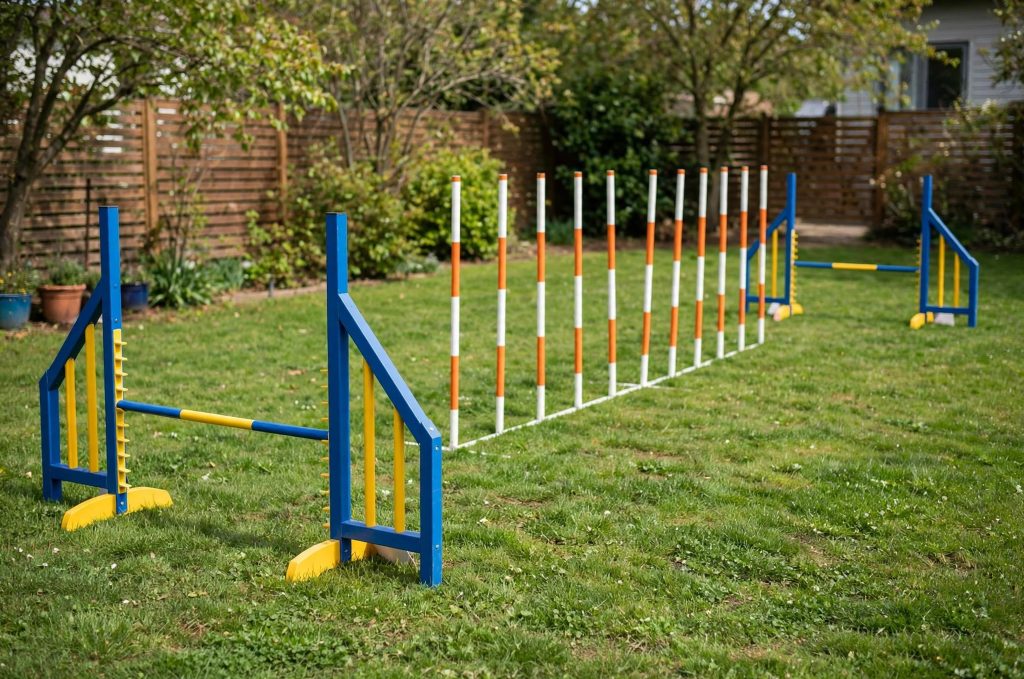
The bar jump is the classic agility obstacle and the easiest to build. You need two uprights and one crossbar.
The simplest version: set a broomstick across two buckets, two chairs, or two stacks of bricks. For a sturdier build, make PVC uprights set in sand-weighted buckets, with the crossbar resting loosely on top.
The crossbar must never be fixed in place. It has to fall away if the dog hits it. A dog that crashes into a solid bar can get hurt and will lose confidence fast. Binder clips, loose cups, or simple notches all work as bar rests that release on impact.
Start with the bar on the ground. Let your dog walk over it for treats. Raise it a few inches at a time over several sessions. A good rule of thumb is to keep jumps low, around ankle height, until your dog is confident and grown. For training walks between sessions, a no-pull harness gives you better control while your dog is still learning focus.
Obstacle 2: Weave Poles
Before you start, it helps to understand how dog agility course at home works in real homes.
A good plan for dog agility course at home saves time, money, and frustration.
Weave poles are the zigzag line of upright poles the dog threads through. They look hard, but dogs learn them fast with the right method.
For a home set, push six to twelve garden stakes or 3-foot PVC pipes into soft ground in a straight line. Standard spacing is about 24 inches apart, but start wider, around 30 inches, while your dog learns the pattern. Make sure the tops are blunt. Cap PVC with rounded fittings, and never drive stakes so deep that they become rigid and dangerous if the dog bumps them.
To teach the weave, lure your dog through with a treat in your hand, guiding the zigzag path step by step. Reward every correct pass. Keep sessions to five minutes. Most dogs get the idea within a week of short daily sessions.
One detailed DIY guide suggests starting with poles spaced wide and narrowing them as the dog gains skill, and stresses that pole tops must never be sharp (DIY agility build guide).
Obstacle 3: The Tunnel
A good plan for dog agility course at home saves time, money, and frustration.
For most people, dog agility course at home comes down to a few smart choices.
Dogs either love tunnels or fear them. There is no middle ground. The good news is that fear turns to love quickly with patient training.
The cheapest tunnel is a children's play tunnel from a toy store. Anchor it to the ground with tent stakes so it cannot roll while the dog is inside. A homemade version uses hula hoops lined up in a row with a tarp draped over and taped into a tube.
Start with the tunnel short and straight, so the dog can see daylight through the other end. Toss treats through. Let the dog walk through on leash. Never push or pull a scared dog into a tunnel. When the short straight tunnel is easy, make it longer, then add a gentle curve.
Some trainers crawl through first to show the dog it is safe. It looks silly. It works.
Obstacle 4: The Pause Table
For most people, dog agility course at home comes down to a few smart choices.
If you are new to dog agility course at home, start with the simplest option and build from there.
The pause table teaches the dog to run to a raised platform, stop, and wait. It is a great impulse-control exercise.
Build it from a sturdy low table, a plywood square on short legs, or even a large flat-topped storage bin. Keep it low, about a foot off the ground for beginners. The surface must be non-slip. A rubber mat or outdoor carpet glued on top works well.
Teach it by luring the dog onto the table, asking for a sit or down, counting to five, and releasing with a treat. Gradually extend the wait. This obstacle doubles as a general training tool. A dog that can hold a stay on a table in the yard can hold a stay anywhere.
Obstacle 5: The Teeter-Totter
If you are new to dog agility course at home, start with the simplest option and build from there.
When it comes to dog agility course at home, getting the details right makes all the difference.
The teeter is the trickiest home build and the scariest obstacle for many dogs. Build it only when the easier obstacles are solid.
A simple teeter is a long plank, about 8 to 12 feet, balanced on a low fulcrum like a short section of large pipe or a small sawhorse. The board must tip slowly and quietly. A board that slams down will terrify most dogs.
Introduce it with the board flat on the ground. Walk the dog across for treats. Then raise one end a few inches. Then the other. Only when the dog walks the full board happily do you let it tip, and you control the tip with your hand at first so it moves slowly.
Many backyard courses skip the teeter entirely, and that is fine. Jumps, weaves, tunnels, and a pause table give you a complete fun course without it.
Teaching the Course: Training Basics
When it comes to dog agility course at home, getting the details right makes all the difference.
Many homeowners find that dog agility course at home is easier than they expected once they know the basics.
Equipment is only half the project. The other half is teaching your dog to use it. A few principles make everything easier.
One obstacle at a time. Do not string obstacles together until your dog knows each one alone. Rushing creates confusion and kills enthusiasm.
Short sessions. Five to ten minutes, once or twice a day. End while your dog still wants more. A tired or bored dog learns nothing.
Treats and praise. Reward every try, not just perfect runs. In the beginning, effort is what you are building. A good treat pouch keeps rewards handy and your hands free.
Let the dog set the pace. If your dog is worried about an obstacle, go back a step. Confidence grows in small wins. Forcing a scared dog destroys trust that takes weeks to rebuild.
Learn the handling basics. Your body position tells the dog where to go next. Facing an obstacle sends the dog toward it. Turning your shoulders turns the dog. You do not need fancy moves for backyard fun, but knowing that your feet steer the dog will save you a lot of frustration.
A beginner-friendly training guide covers foundation skills like focus and body awareness before equipment, which is exactly the right order (beginner agility training at home).
Arranging Your First Course
Many homeowners find that dog agility course at home is easier than they expected once they know the basics.
Once your dog knows three or four obstacles, link them into a simple sequence. A good starter layout:
1. Bar jump 2. Straight tunnel 3. Weave poles (six poles, wide spacing) 4. Pause table
Walk the sequence yourself first, planning your path. Then run it with your dog on leash, luring as needed. When that flows, try it off leash in a fenced area. Add obstacles or rearrange the order as skills grow.
Change the layout every week or two. Dogs memorize patterns fast, and part of agility's brain workout is reading new sequences. Moving two obstacles creates a whole new course.
Safety Rules for Backyard Agility
The key to dog agility course at home is choosing the right approach for your space and budget.
Fun comes first, but safety keeps it fun. Follow these rules every session:
- Warm up with a short walk before running obstacles.
- Keep jumps low for puppies, seniors, and heavy breeds.
- Check every obstacle before each session. Tighten, re-stake, and replace worn parts.
- Train on grass or other forgiving surfaces, never concrete.
- Stop if your dog is panting hard, limping, or losing interest.
- Keep fresh water nearby.
- Never train in extreme heat. Early morning or evening is best in summer.
The AKC's getting-started page recommends beginning with tunnels and weave poles at home, practicing daily in short sessions, and considering a beginner class at a local club to learn safe handling (AKC agility getting started). A class is a great next step once your dog loves the backyard course.
When to Take It Further
With a little planning, dog agility course at home can fit even a busy schedule.
Some dogs catch the agility bug hard. If yours begs to run the course every day and learns new obstacles in a single session, look into local agility clubs. Most offer beginner classes that welcome total newcomers, and many let you rent ring time to practice.
Competition is optional. Plenty of dogs run backyard courses their whole lives and never see a trial. The point was never the ribbons. The point was a tired, happy dog and an owner who learned to speak fluent dog.
For recall work between agility sessions, a dog whistle can sharpen your dog's response to cues at a distance, which pays off on course. Once you try it, dog agility course at home gets easier each time.
References
Canine Care Central. (n.d.). DIY dog agility course: Easy home projects, training benefits, and backyard fun guide. https://caninecarecentral.com/dog-care/diy-dog-agility-course-easy-home-projects-training-benefits-and-backyard-fun-guide/
Carlson Agility. (n.d.). Dog agility and the American Kennel Club. https://carlson-agility.com/dog-agility-the-american-kennel-club/
Comfort Home Pet Services. (n.d.). At home agility fun. http://comforthomepetservices.precisepetcare.com/blog/377/at-home-agility-fun
Course FAQ. (n.d.). How to make a dog agility course out of PVC. https://course-faq.com/how-to-make-a-dog-agility-course-out-of-pvc
Eco-Savvy. (n.d.). DIY dog agility: Build a course in one day. http://eco-savvy.blog/diy-dog-agility-build-course-one-day
Hepper. (n.d.). 8 DIY dog agility course equipment plans. https://articles.hepper.com/diy-agility-course-equipment-plans/
K9 Magazine. (n.d.). Beginning your dog's agility training at home. https://www.k9magazine.com/beginning-your-dogs-agility-training-at-home/
National Animal Health Foundation. (n.d.). Easy DIY dog agility course: Building a fun backyard course. https://www.nahf.org/article/diy-dog-agility-course
American Kennel Club. (n.d.). Agility: Get started. https://www.akc.org/sports/agility/getting-started/
American Kennel Club. (n.d.). Dog agility training: Skills, obstacles, and benefits. https://www.akc.org/expert-advice/training/agility-training-tips-competition/
This Old House. (n.d.). How to build a DIY dog agility course. https://www.thisoldhouse.com/pets/how-to-build-a-dog-agility-course
Was this guide helpful?

About My Garden US
The My Garden US editorial team writes practical, in-depth home and garden guides for American homeowners — tested advice, no fluff.
You May Also Like
Dog Cooling Vest for Summer Walks Heat: Keep Your Dog Safe on Hot Days
May 5, 2026 16 views
Best Dog Bed for Chewers: Indestructible USA Options That Last
April 12, 2026 20 views
Best Pet Odor Eliminator for Yard and Grass: A Practical Guide
September 1, 2026 15 views