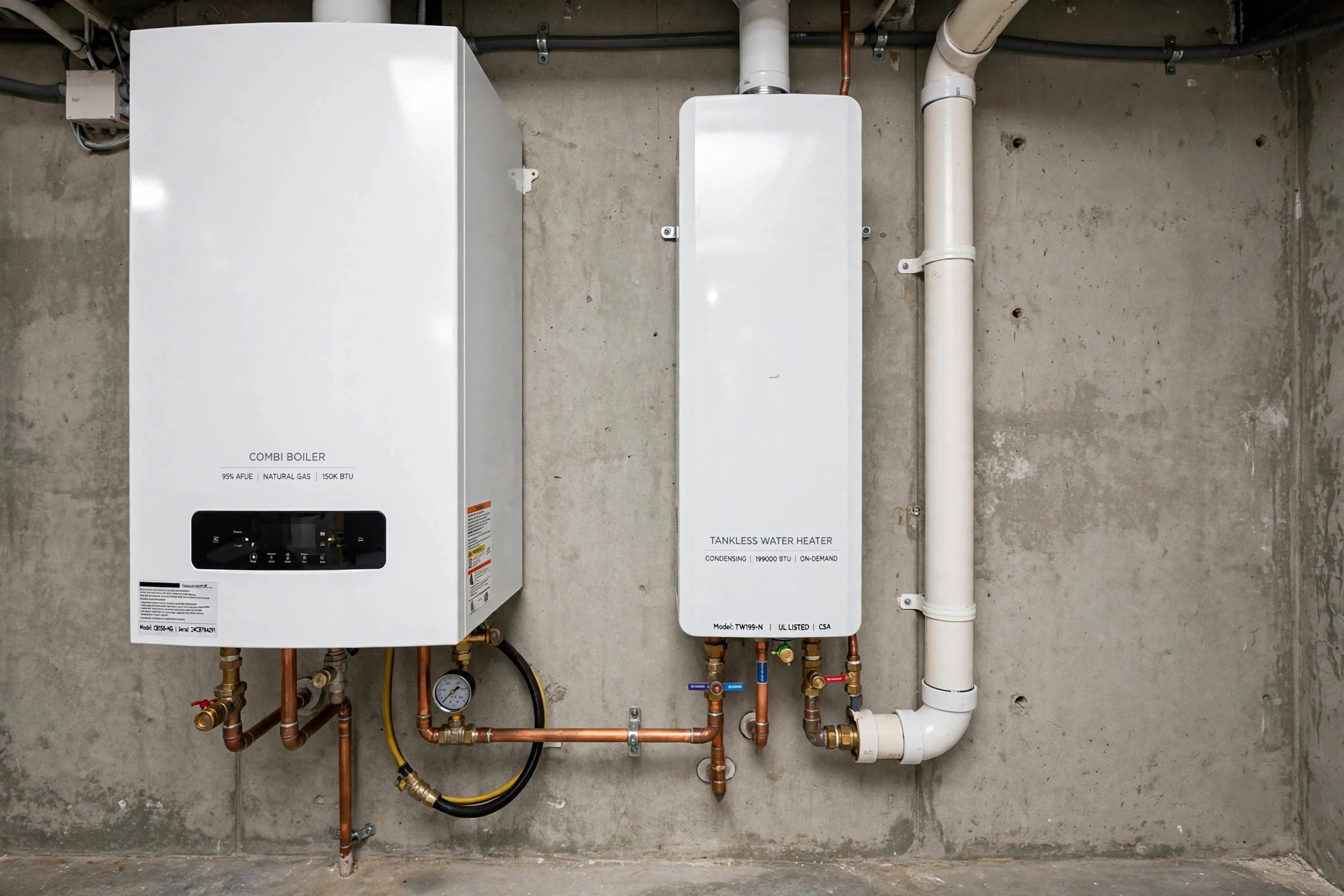

Many homeowners who need a new heating system run into the same hard choice. Should they buy a combination boiler, or should they buy a tankless water heater? A combi boiler vs tankless comparison usa shoppers often search for gives mixed answers. The two machines look alike on the wall, but they do different work. One unit heats your home and your hot water at the same time. The other makes hot water only. This guide walks through both options in plain terms, so you can choose with care and spend your money well.
Why This Choice Matters
Heat and hot water are the two largest energy costs in most American homes. A wrong pick can raise your gas bill for twenty years. A right pick can cut it. Both a combi boiler and a tankless water heater are modern, wall-hung machines that make hot water on demand. Neither needs a big storage tank in the corner of the basement. That shared trait is why buyers confuse them. But the difference in how they work decides which one belongs in your house.
A combi boiler is short for combination boiler. It is one unit that runs two jobs. It heats water for your radiators or radiant floors, and it also heats your tap water. A tankless water heater, often called an on-demand water heater, does one job only. It heats tap water when you turn on the faucet. It does nothing for your space heat. If your house uses a furnace or a heat pump for warm air, the tankless unit may be enough. If your house uses hot water or steam for heat, the combi boiler may be the better fit. Most combi boiler pros and cons lists start from this simple fact, and the rest of this article builds on it.
How Each Unit Works: Combi Boiler vs Tankless Comparison Usa
The Combi Boiler
A combi boiler burns natural gas or propane in a sealed chamber. A heat exchanger warms the water that moves through your heating pipes. When you open a hot tap, a diverter valve shifts the machine to domestic hot water first. Your radiators pause while you shower, then resume when the tap closes. Efficiency ratings often run 92 to 96 percent AFUE, which means almost all the fuel turns into useful heat.
The Tankless Water Heater
A tankless water heater also heats water only when you call for it. Cold water enters the unit, passes over a gas burner or electric coils, and leaves hot in seconds. Gas models reach 80 to 96 percent efficiency, while electric models are near 100 percent at the point of use. When no tap is open, the unit sits idle and burns nothing. That is the main selling point. You never pay to keep fifty gallons of water hot all day. The trade-off is flow rate. A tankless unit can only heat a fixed number of gallons per minute, and cold incoming water in winter states lowers that number.
How to Choose for Your Home
Start with your heating system. Walk to your basement and look. Do you see radiators, baseboard heaters, or in-floor radiant loops? Then you have a hydronic heating system, and a combi boiler can replace your old boiler in one step. Do you see warm air ducts and a furnace? Then your heat already has a source, and a tankless water heater may handle your hot water needs alone.
Next, count your simultaneous hot water uses. A combi boiler vs tankless comparison always comes back to flow rate. A family of five with two bathrooms running at once needs a strong unit. Gas tankless units range from 150,000 to 200,000 BTU and deliver about 5 to 10 gallons per minute, depending on the climate. In warm states like Florida or Texas, incoming water is milder, so tankless output climbs. In cold states like Minnesota or Maine, winter well water can enter at 40 degrees, and output drops hard.
Fuel type comes third. Combi boilers burn gas or propane in the American market. Tankless units come in gas and electric versions. Electric tankless models are cheaper to buy, but they draw heavy power, sometimes three 40-amp circuits or more. Many older homes need an electrical panel upgrade to run one. Check your panel before you fall in love with an electric model.
Finally, think about space and venting. Both units hang on a wall and need venting to the outside. High-efficiency gas models use plastic PVC or polypropylene vent pipe, which costs less to install than metal chimney liners. Electric tankless models need no vent at all. If your basement is cramped, both free the floor space that a tank boiler once took.
Types and Options on the Market
Combi Boiler Types
Non-condensing combi boilers are the older design. They are cheaper to buy but waste more heat up the flue, with efficiency around 80 to 84 percent. Condensing combi boilers capture heat from exhaust gas and reach the mid 90s in efficiency. In the United States, condensing models are now the common choice for new installs.
Tankless Water Heater Types
Gas tankless units divide into condensing and non-condensing models, just like boilers. Condensing tankless units cost more up front but use less gas over their life. Whole-house electric tankless units heat all your tap water but need strong electrical service. Point-of-use electric models are small boxes that serve one sink or shower, best used as helpers rather than the main water heater for a whole house.
Cost and Price in the USA
Price is where many buyers start their combi boiler vs tankless comparison, and the numbers below reflect typical 2026 installed costs across the United States. Local labor and gas line work move these figures up or down.
A condensing combi boiler usually costs between 4,500 and 8,500 dollars installed. The unit itself runs 2,500 to 5,000 dollars, and labor, venting, and pipe work make up the rest. Homes that already have a boiler with gas piping in place sit at the low end. If you are comparing outdoor wood boiler cost installed usa as an alternative, expect wood units to run higher, since they need outdoor placement and underground piping.
A gas tankless water heater usually costs between 2,500 and 5,500 dollars installed. The unit itself runs 1,000 to 2,500 dollars. Electric tankless units cost 500 to 1,500 dollars for the unit, plus 1,000 to 3,000 dollars for installation, more if the electrical panel needs an upgrade. A tankless install can grow expensive when the gas line must be upsized, because a 199,000 BTU unit drinks more gas than an old tank heater did.
Running costs tell the rest of the story. Both types use less fuel than old tank heaters. A condensing combi boiler can cut heating bills by 15 to 30 percent compared with an old 80 percent boiler. A tankless water heater can cut water heating bills by 25 to 35 percent compared with an old tank. Actual savings depend on gas prices in your state, which vary widely. Federal tax credits for high-efficiency equipment change from year to year, so check current rules at energy.gov before you buy.
Care and Upkeep
Both machines need yearly care, and both last longer with it. A combi boiler needs an annual service visit. The technician checks the burner, cleans the heat exchanger, tests the condensate trap, and confirms safe venting. Cost runs 150 to 300 dollars a year. Hard water leaves mineral scale inside the hot water side of the unit, so homes with hard water should add a water softener or a scale filter.
A tankless water heater needs a yearly flush with vinegar or a descaling solution to remove mineral buildup. A plumber charges 100 to 200 dollars for this, or a handy homeowner can do it with a small pump kit. Skip the flush in hard water areas and the unit loses flow and efficiency. Guides at familyhandyman.com show the flush steps in plain detail for do-it-yourself owners.
Expected life is strong for both. A well-kept combi boiler lasts 15 to 25 years. A well-kept tankless water heater lasts 15 to 20 years, often twice the life of a tank heater. Keep your service records, because makers ask for them when you file a warranty claim.
Safety
Gas units of both kinds must be installed by a licensed professional. Combustion makes carbon monoxide, a gas you cannot see or smell. Proper venting, a carbon monoxide detector on each floor, and yearly service keep the risk low. Never block the vent pipe or the air intake. In winter, check that snow and ice have not buried the outdoor vent terminal. The Consumer Product Safety Commission’s partner resources at cpsc-adjacent guidance from This Old House cover venting safety basics for homeowners.
Hot water temperature matters too. Both units can be set above 140 degrees, which scalds skin in seconds. Set the domestic hot water to 120 degrees, which the Department of Energy recommends as a safe and efficient setting. If you need hotter water for a dishwasher without a booster heater, talk to your installer about safe mixing valve options rather than raising the whole system temperature.
Electric tankless units carry their own risk. They pull very high amperage. An undersized wire or breaker can overheat. Only a licensed electrician should size and wire the circuits. Never guess at breaker sizes from internet forums.
Which One Wins for Common USA Homes
For a small to mid-size home in the Northeast or Midwest with radiators or baseboards, the combi boiler usually wins. It replaces the aging boiler and the water heater in one box, saves floor space, and runs at high efficiency. A boiler replacement cost near me 2026 search shows that a straight boiler swap costs nearly as much as a combi, so the added hot water function comes at little extra.
For a home with a furnace or heat pump and warm-air ducts, the tankless water heater usually wins. The heating side is already solved, so paying for a combi boiler would buy function you do not need. A gas tankless unit gives endless hot water at a lower installed price.
For homes with best boiler for radiant floor heat usa needs, meaning in-floor radiant loops, the combi boiler is the natural match. Radiant floors run on low water temperatures, which is exactly where condensing combi boilers reach their peak efficiency. Pairing a tankless unit with radiant heat requires extra controls and is rarely worth the trouble.
For large homes with three or more bathrooms, neither single unit may be enough on its own. Two tankless units in parallel, or a combi boiler plus a storage tank, may be needed. Have a professional run a heat loss and hot water load calculation before you buy. Makers like Rheem, Carrier, Trane, Lennox, and Goodman publish sizing guides that installers use every day.
FAQ
Can a combi boiler heat my whole house and my shower water at the same time? It handles both, but it gives hot water first. When you open a tap, the heating side pauses for the length of the shower. In a well-insulated home, the radiators cool only slightly, and most owners never notice.
Is a tankless water heater cheaper to run than a combi boiler? Not always. A tankless unit only makes hot water, so you cannot compare the two on gas bills alone unless you add the cost of running your furnace or heat pump. Compare the full heating plus hot water cost of your home, not just one box against the other.
Do I need a bigger gas line for a tankless unit? Often, yes. A gas tankless heater can draw 150,000 to 199,000 BTU at full fire, more than the tank heater it replaces. The installer must check the gas meter and the pipe size. Upsizing the gas line adds 500 to 1,500 dollars to the job in many cases.
Can I install either unit myself? No. Gas piping, venting, and combustion setup need a licensed professional in every state. Mistakes can leak gas or carbon monoxide. Electric tankless units also need a licensed electrician. Do-it-yourself work on either unit voids the warranty and may break local code.
Which one is better for hard water areas? Both suffer from scale, but the tankless unit is more sensitive because its narrow passages clog faster. A water softener or scale filter is close to required for tankless units in hard water regions. Combi boilers face the same need on their hot water side. Budget 500 to 2,000 dollars for treatment equipment if your water is hard.
How long until the investment pays back? Compared with keeping an old inefficient system, payback often lands between 5 and 10 years through lower fuel bills. Compared with buying a basic new tank heater instead, the payback is longer. Buy the efficient option for comfort and long-term savings, not for a quick payoff.
A Short Final Word
A combi boiler vs tankless comparison usa buyers can trust comes down to one question. Does your house heat with hot water or with warm air? Hot water heat points to the combi boiler. Warm air heat points to the tankless water heater. Get quotes from two or three licensed installers, ask each to show the math on fuel savings, and check current efficiency listings at energystar.gov before you sign. Either choice, installed well and serviced yearly, will serve your home for decades.
References
Carrier. (n.d.). Heating and cooling systems. https://www.carrier.com ENERGY STAR. (n.d.). Energy efficient products. https://www.energystar.gov Family Handyman. (n.d.). DIY home repair and maintenance. https://www.familyhandyman.com Goodman. (n.d.). Heating and cooling equipment. https://www.goodmanmfg.com Lennox. (n.d.). Heating and cooling systems. https://www.lennox.com Rheem. (n.d.). Heating, cooling, and water heating. https://www.rheem.com This Old House. (n.d.). Home renovation guidance. https://www.thisoldhouse.com Trane. (n.d.). Heating and air conditioning. https://www.trane.com U.S. Department of Energy. (n.d.). Energy efficiency and renewable energy. https://www.energy.gov
Was this guide helpful?

About Lisa Anderson
The My Garden US editorial team writes practical, in-depth home and garden guides for American homeowners — tested advice, no fluff.
You May Also Like
Best Oil Furnace Reviews for Northeast USA: What to Know Before You Buy
January 18, 2026 0 views
Best Ductless Range Hood Reviews 2026 USA: What to Buy and Why
January 10, 2026 0 views
Best Whole House Humidifier Reviews 2026 USA: A Practical Guide for Dry Homes
April 11, 2026 0 views