
Every home in America has a small piece of equipment that works harder than most people know. It sits inside the heating and cooling system, and it catches the dust, pet hair, and pollen that would otherwise blow through every room. It is the air filter. The question homeowners ask more than any other about it is simple: how often to change hvac filter schedules really call for? This guide gives the answer in plain terms, with real schedules for real homes.
Most American families run their heating or cooling for about half the year, and many run it all year. Over that time, a dirty filter forces the system to work harder, raises the power bill, and leaves the air less clean. A fresh filter costs a few dollars and takes five minutes to change. Yet surveys of homeowners keep finding the same thing: the filter is the part people forget most. The sections below explain why it matters, how often to change it, what kind to buy, and how to do the job safely.
Why Changing the Filter Matters
The filter has two jobs. The first is to protect the equipment. Dust that builds up on the blower fan and the indoor coil cuts air flow and makes the motor strain. The second job is to protect the air you breathe. A clogged filter cannot trap new particles, so dust keeps moving through the ducts and out of the vents.
When air flow drops, the system runs longer to reach the same temperature. That extra run time shows up on the electric bill. The U.S. Department of Energy has long noted that a dirty filter is a common cause of wasted energy in home heating and cooling. In bad cases, restricted air flow can freeze the indoor coil in summer or overheat the furnace in winter. Both repairs cost far more than a year of filters.
There is also comfort to think of. Rooms far from the system may stay warm or cold when the filter is clogged, because less air reaches them. People with allergies often notice the difference first. A fresh filter is not a cure for allergies, but it keeps the air steadier from week to week.
How Often to Change an HVAC Filter: How Often to Change Hvac Filter Usa Guide
There is no single answer, but there are clear rules of thumb that fit most American homes.
Thin 1-inch fiberglass filters: change every 30 days. These are the cheapest filters, the flat kind sold in packs. They clog fast. If your system uses one, mark the calendar for once a month.
1-inch pleated filters: change every 60 to 90 days. The folds give the filter more surface area, so it lasts longer. Most homes with a standard filter slot use this type. Three months is the common advice, and it fits most families without pets.
2-inch pleated filters: change every 4 to 6 months. The extra depth holds more dust.
4-inch or 5-inch media filters: change every 6 to 12 months. These sit in a special cabinet near the furnace or air handler. They hold a great deal of dust and last the longest.
These are starting points. The next section explains when to change more often.
What Changes the Schedule
The filter makers give a schedule for an average home. Your home may not be average.
Pets. One dog or cat can cut the filter’s life nearly in half. Two or more pets, or a dog that sheds heavily, may mean a monthly change even with a pleated filter. Pet hair mats against the filter and blocks air fast. If you keep the best air filter for allergies reviews usa buyers praise, you will still need to change it sooner with pets in the house.
Allergies and asthma. If someone in the home has allergies, a cleaner filter changed more often helps. Many families with allergy sufferers change a pleated filter every 45 to 60 days.
Home size and occupancy. A small apartment with one person keeps a filter clean longer than a large house with five people and a busy front door. More foot traffic means more dust.
Smoking or wood heat. Cigarette smoke and wood stoves load the filter with fine particles. Change monthly in these homes.
New construction or remodeling. Dust from construction work is thick and fine. Check the filter every two weeks during the work, and change it as needed.
Location. Homes near busy roads, farms, or in dry dusty regions collect dirt faster. Coastal homes with salt air may see faster buildup too. When in doubt, pull the filter and look at it. If you cannot see light through it, it is time.
Types of HVAC Filters
It helps to know what you are buying. Filters come in a few basic types.
Fiberglass flat filters are the cheapest, often two or three dollars. They catch large dust but little else. They protect the equipment at a basic level. They must be changed monthly.
Pleated filters use folded synthetic or cotton-blended material. They cost five to fifteen dollars and catch far more. They are the best choice for most homes. Look at the MERV rating on the package. MERV stands for minimum efficiency reporting value, and it runs from 1 to 16 for home filters. Most homes do well with MERV 8 to 11. The best merv 13 filter for hvac reviews usa shoppers compare are popular with allergy families, since MERV 13 catches smaller particles, but not every system can handle the extra resistance, so check your system’s manual first.
Washable filters are made to be rinsed and reused. They cost twenty to fifty dollars. They save money over years, but they must dry fully before going back in, and they do not catch as much as a good pleated filter.
Electronic air cleaners and media cabinets are built into some systems. An electronic air cleaner vs media filter usa comparison shows both options last longer than throwaway filters, but they cost more up front and need their own care schedule.
Buy the right size. The size is printed on the side of your old filter, such as 16x25x1. Measure if the print is gone. A filter that does not fit lets air pass around it, which defeats the purpose.
Cost and Price
Filters are one of the cheapest parts of home upkeep. A pack of pleated 1-inch filters at a home store runs about fifteen to thirty dollars. That works out to roughly five to ten dollars per change. Over a year, most families spend between twenty and sixty dollars on filters.
Compare that to the cost of not changing them. A service call for a frozen coil or a failed blower motor can run several hundred dollars. Higher power bills from a strained system add up quietly month after month. The filter is cheap insurance.
Big box stores, hardware stores, and online sellers all carry standard sizes. Buying a year’s worth at once often cuts the price per filter. Write the date on the filter frame with a marker when you put it in. That way you always know how old it is.
How to Change the Filter
Changing a filter is a job most homeowners can do themselves. It takes five minutes.
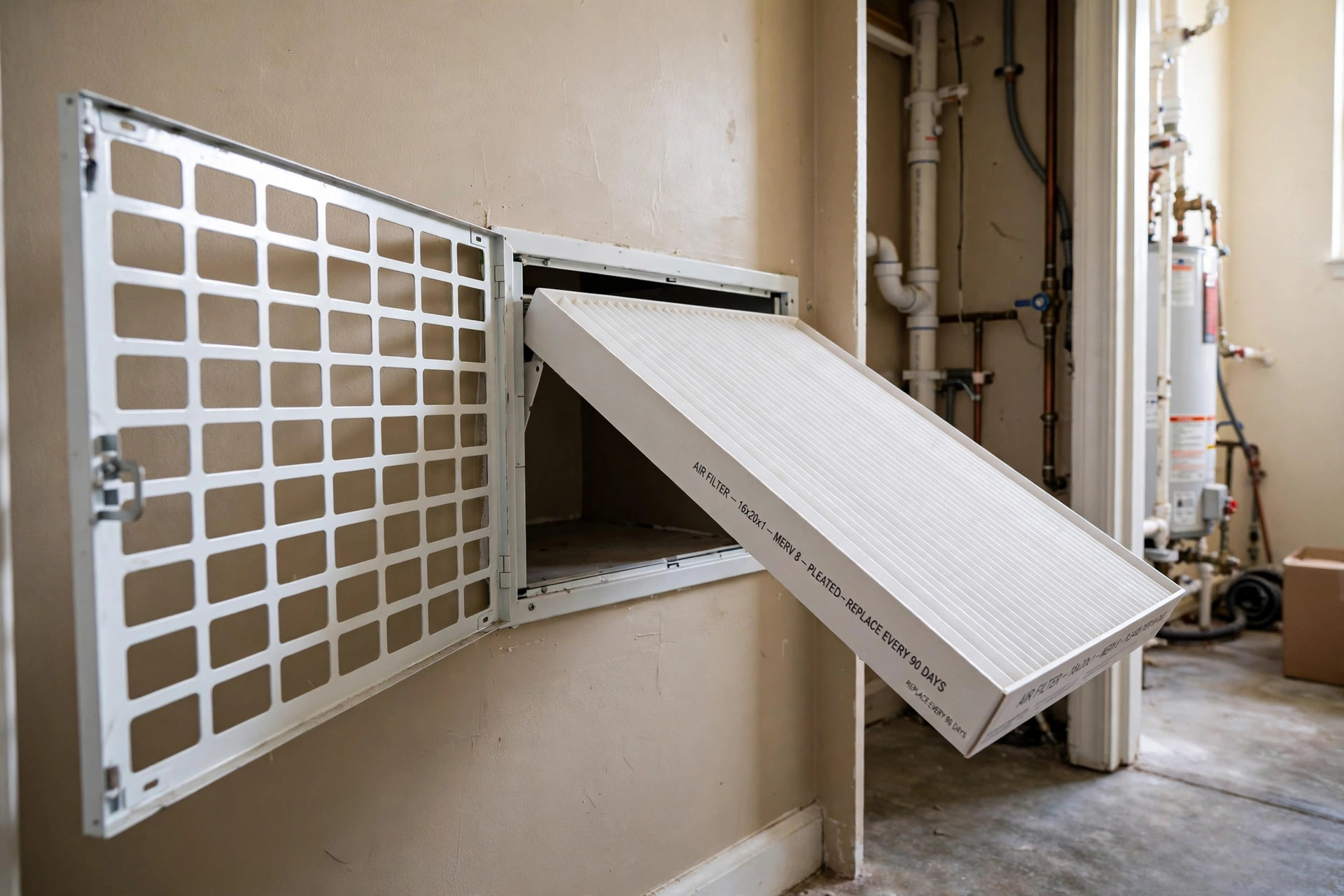
1. Turn the system off. Switch the thermostat to off, or turn off the power switch near the furnace. This keeps dust from being pulled in while the filter is out. 2. Find the filter. It is usually in the return-air grille in a wall or ceiling, or in a slot at the furnace or air handler itself. Look for a removable cover or a slot marked on the duct. 3. Note the direction. The old filter has arrows printed on its frame showing air flow direction. The arrows should point toward the furnace or air handler, away from the return duct. 4. Pull the old filter out. Slide it out gently. If it is a grille-mounted filter, open the grille and lift it out. 5. Check the size and condition. Read the size on the frame. Look at how dirty it is; this tells you whether your schedule is right. 6. Slide the new filter in. Match the size and point the arrows the right way. Close the cover or grille. 7. Turn the system back on. Set the thermostat as it was.
If the filter is inside a furnace cabinet that requires tools or panel removal, take a photo of the setup first so you can put everything back. If you are unsure, ask a technician to show you during the next service visit.
Care and Upkeep
Beyond the filter itself, a few habits keep the system breathing easy.
Keep the area around the furnace and the return grille clear. Boxes, clothes, and furniture piled against the return grille block air just like a dirty filter does. Vacuum the return grille cover now and then so dust does not cake on it.
Have the system serviced once a year. A technician will check the coil, the blower, and the refrigerant or gas parts, and will tell you if your filter choice suits the system. The advice on sites like This Old House and Family Handyman agrees with what most pros say: the annual checkup and the regular filter change are the two highest-value maintenance steps a homeowner can do.
Watch the calendar. Many people tie the filter change to another monthly task, such as paying a bill or changing a smoke detector battery check. A phone reminder works too. The ENERGY STAR program also reminds homeowners that regular filter changes are part of keeping a system efficient.
If your filter gets dirty far faster than the schedule suggests, look for causes: gaps around the filter that let air bypass it, a return duct pulling air from a dusty attic, or a system running the fan all the time. A technician can help track these down.
Safety
Filter changes are safe, but a few points matter.
Always turn the system off first. A running blower can pull a loose filter out of shape and can draw a cloud of dust into the ducts.
Do not run the system with no filter in place, even for a short time. Dust will coat the coil and blower, and that buildup is hard to clean.
If you have a gas furnace, do not disturb gas lines or panels you do not understand. The filter slot is outside the sealed combustion area on most models, but if anything looks wrong, stop and call a professional. Guidance from Carrier and Trane both stress leaving internal furnace parts to trained technicians.
People with strong dust allergies may wear a simple dust mask when handling a dirty filter. Bag the old filter before carrying it through the house so trapped dust does not shake loose. Wash your hands after.
Frequently Asked Questions
Does a more expensive filter last longer? Not always. Price and life are related to thickness and material, not just brand. A 4-inch media filter lasts many months, while a cheap 1-inch pleated filter lasts three. Read the maker’s guidance on the package, and check the filter by eye. Reviews at Consumer Reports can help compare real performance.
Can I vacuum a disposable filter and reuse it? It is not a good idea. Vacuuming removes surface dust but pushes fine dirt deeper into the media, and the filter never works as well again. Pleated filters are made to be thrown away. If you want a reusable option, buy a washable filter made for the purpose, from a maker like Lennox or Rheem.
Will a high-MERV filter hurt my system? It can, if the system was not built for it. A MERV 13 filter resists air flow more than a MERV 8. Older or smaller systems may strain. Check the owner’s manual or ask a technician before stepping up. Makers such as Goodman publish guidance on filter ratings for their equipment.
What if my filter is dirty after only two weeks? Something is adding extra dust. Check for construction work, a pet sleeping near the return, or a filter slot that does not seal well. If nothing explains it, have the ducts checked. The U.S. Department of Energy notes that leaky ducts can pull dust from attics and crawl spaces.
Should I change the filter before summer and winter? Yes, that is a fine habit. Cooling season and heating season are when the system works hardest. A fresh filter at the start of each season is money well spent.
Do I need to change the filter if I barely run the system? If the system has not run for months, the filter has not collected much. But check it anyway before the season starts. Humidity and time can wear the media, and a quick look costs nothing.
A Final Word
The air filter is small, cheap, and easy to forget. It is also one of the few parts of a home you can care for yourself with no special skill. Pick a filter that fits your system, write the date on it, and set a reminder. Most homes do well changing a standard pleated filter every three months, monthly with pets or allergies, and once a year for the thick media type. Five minutes, a few dollars, cleaner air, and a system that lasts longer. That is a fair trade.
References
Carrier. (n.d.). Heating and cooling systems. https://www.carrier.com Consumer Reports. (n.d.). Product reviews and ratings. https://www.consumerreports.org ENERGY STAR. (n.d.). Energy efficient products. https://www.energystar.gov Family Handyman. (n.d.). DIY home repair and maintenance. https://www.familyhandyman.com Goodman. (n.d.). Heating and cooling equipment. https://www.goodmanmfg.com Lennox. (n.d.). Heating and cooling systems. https://www.lennox.com Rheem. (n.d.). Heating, cooling, and water heating. https://www.rheem.com This Old House. (n.d.). Home renovation guidance. https://www.thisoldhouse.com Trane. (n.d.). Heating and air conditioning. https://www.trane.com U.S. Department of Energy. (n.d.). Energy efficiency and renewable energy. https://www.energy.gov
Was this guide helpful?

About Lisa Anderson
The My Garden US editorial team writes practical, in-depth home and garden guides for American homeowners — tested advice, no fluff.
You May Also Like

Ductless Mini Split Installation Cost Per Zone
March 29, 2026 0 views
Linear Electric Fireplace Reviews for Living Room: What Buyers Should Know
March 2, 2026 0 views
MrCool vs Pioneer Mini Split Comparison: An Honest Guide for American Homeowners
February 28, 2026 0 views