
Most homes in the United States have at least one ceiling fan. Many owners never change its setting. They leave the fan as it was on the day it was installed. This is a mistake. A fan that spins the wrong way can make a hot room feel warmer. This ceiling fan direction for summer usa guide will show you which way your fan should turn in warm weather. It will also show you how to check the setting and how to change it.
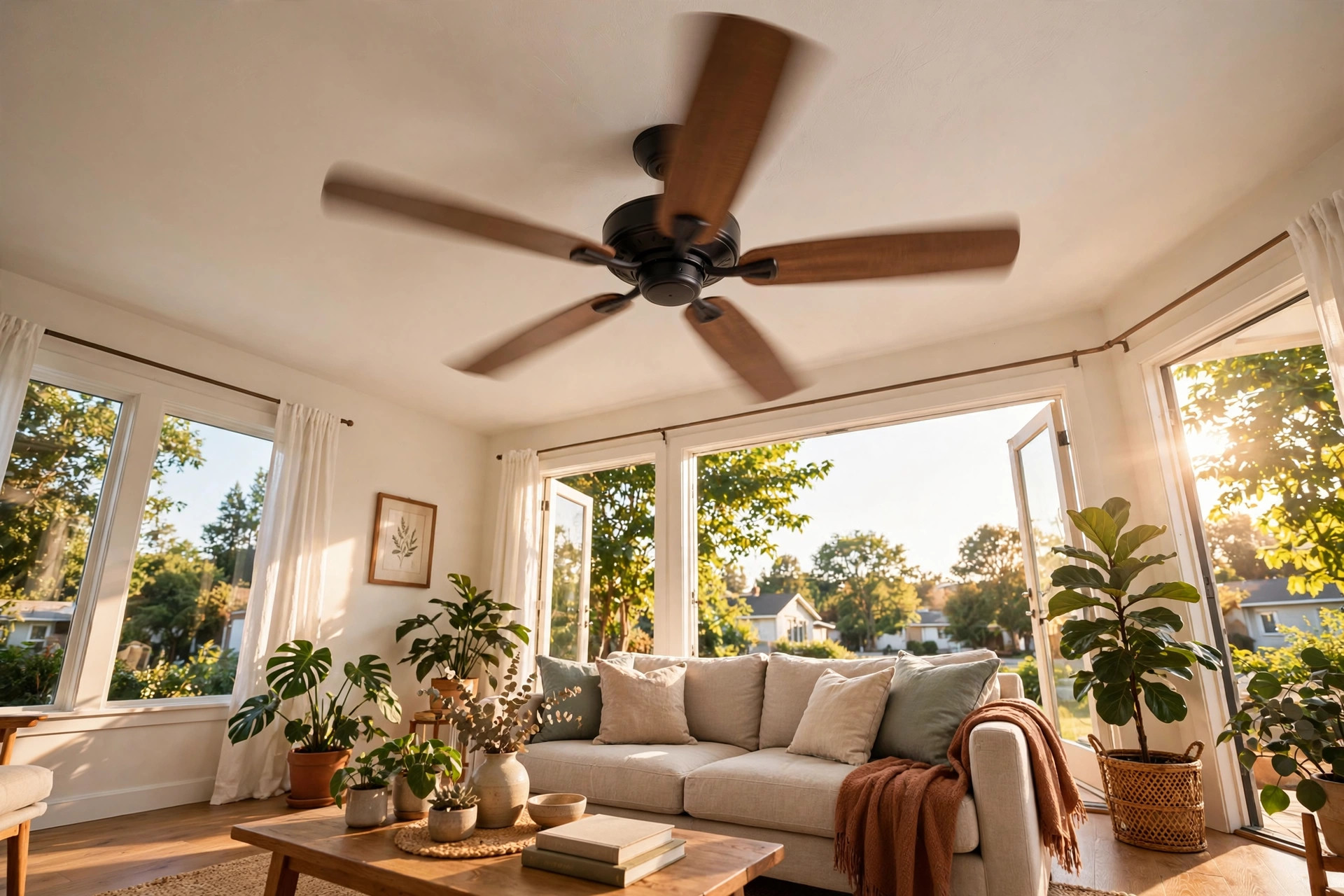
The basic rule is easy to remember. In summer, a ceiling fan should spin counterclockwise when viewed from below. This motion pushes air down toward the floor. The moving air touches your skin. It helps sweat dry. That process makes you feel cooler, even when the room temperature stays the same. A ceiling fan does not cool a room. It cools the people in the room. That difference matters.
When the fan spins clockwise, it pulls air up. That is the winter setting. It can make summer heat feel worse. Many people run their fans the wrong way all season and never know why the room feels warm. A quick check and fix take only minutes. This guide walks you through each step.
Why Fan Direction Matters in Summer
Air movement is the whole job of a ceiling fan. In summer, the goal is a breeze that moves across your skin. When the blades spin counterclockwise, the front edge of each blade tilts down. Air is forced toward the floor. You feel a steady downdraft. This is called the wind chill effect. Moving air carries heat away from your skin. It also speeds up the drying of sweat. Your body cools itself by sweating. When sweat dries faster, you feel cooler. The thermometer on the wall does not move. Your comfort does. That is why fan direction matters so much.
The wrong direction gives you the opposite result. When blades spin clockwise, the tilt of the blades pulls air up toward the ceiling. No breeze reaches you at floor level. In winter, that pattern is useful. Warm air rises to the ceiling. The fan pushes it back down along the walls. In summer, the pattern fights your comfort. You get no cooling breeze. The motor still uses power. You pay for electricity and gain nothing. Setting the direction right is the simplest free improvement you can make to a hot room.
Which Way Your Fan Should Spin in Summer: Ceiling Fan Direction for Summer Usa Guide
Stand under the fan and look up. In summer, the blades should move counterclockwise. That means they travel from right to left as they pass in front of you. Another way to picture it: on a clock face, the blades move from twelve to nine to six. This is the opposite of how clock hands move. Counterclockwise is the cooling mode on almost every ceiling fan sold in the United States. Some fans have a summer and winter label on the switch. Summer always means counterclockwise.
The rule holds for fans of every size, from small bedroom fans to outdoor patio fans. If your fan has a remote control, the summer setting may be marked with a snowflake icon or the word summer. Check the manual if the marks are not clear.
One common point of confusion is speed. Speed does not change the direction rule. A fan on low speed still cools you in counterclockwise mode. A fan on high speed still cools you. Use the speed that feels right. Lower speeds save energy. Higher speeds move more air. The direction stays counterclockwise in both cases.
How to Tell Which Way Your Fan Is Turning
The fastest test takes five seconds. Stand under the fan and look up. Watch the blades. If they move from right to left across the front, they are turning counterclockwise. That is the summer setting. You can also feel the air. Place your hand a few feet below the fan. If you feel a clear breeze on your palm, the fan is pushing air down. That means counterclockwise. If you feel almost no air movement, the fan may be pulling air up. That is the winter setting.
Some people find it hard to judge blade motion. Motion blur makes the blades look like a disc. In that case, turn the fan off. Let the blades stop. Then turn it on at the lowest speed. Slow blades are easier to track. These simple tests beat guessing.
How to Change the Direction of Your Fan
Most ceiling fans have a small direction switch on the motor housing. Turn the fan off first. Let the blades stop moving. The switch is usually on the side of the motor, near the bottom. Flip it to the other side. Then turn the fan back on. That is the whole job.
Some newer fans hide the switch inside the light kit or behind a cover. Check the manual that came with the fan. It shows the exact location. Fans with a remote control are even easier. Many remotes have a reverse button. Press it and the fan changes direction. Wall controls may also have a reverse setting. If your control has no reverse option, look for the switch on the motor. There is one on almost every fan.
Do not try to change direction while the blades are spinning. A moving blade can hurt your fingers. Always stop the fan first. If you cannot reach the switch, use a steady step stool. Never stand on a chair with wheels. Safety comes first, even for a small job.
Common Types of Ceiling Fans
Ceiling fans come in many styles. The type you own does not change the summer rule. Counterclockwise is still correct. But knowing your type helps with care and parts. Standard fans hang from a downrod. This is the most common type in American homes. The downrod sets the fan at the right height. Hugger fans sit close to the ceiling. They suit rooms with low ceilings, under eight feet. Dual motor fans have two sets of blades on one unit. They move a lot of air. They are popular in large rooms. Outdoor fans are built for damp or wet locations. They have sealed motors and weather safe blades. You can use them on porches and patios. Energy rated fans are worth a look when you shop.
Some fans carry an energy rating. Fans rated by ENERGY STAR meet strict rules for power use. They move more air per watt of electricity. That rating is worth a look when you shop for a new fan. No matter the type, check the direction each spring.
What to Look for When Choosing a Ceiling Fan
Size comes first. A fan that is too small will not move enough air. A fan that is too big looks wrong and can feel drafty. Match fan size to room size: 29 to 36 inches for rooms up to 75 square feet, 36 to 44 inches for rooms up to 144 square feet, and 50 to 54 inches for rooms up to 225 square feet. Measure your room before you shop.
Blade pitch matters too. Pitch is the angle of the blades. A pitch of 12 to 15 degrees moves air well. Flat blades look modern but move little air. Motor quality matters for noise. A quiet motor makes a fan you can sleep under. Guides from This Old House suggest listening to a fan run before you buy, when that is possible.
Light kits add function. Many fans include a light or accept a kit. Check that the light uses standard bulbs. Controls matter for daily use. A pull chain is simple and cheap. A remote adds comfort. A wall control looks clean. Smart controls add voice and app control. Make sure the model you buy has an easy direction switch. You will change direction twice a year. An easy switch saves trouble. Also check the warranty. A good fan carries a warranty of ten years or more on the motor.
Cost and Price
A ceiling fan is one of the cheapest ways to fight summer heat. A basic fan costs 50 to 150 dollars. Mid range fans cost 150 to 300 dollars. High end and smart fans cost 300 to 600 dollars or more. Installation adds cost if you hire an electrician. A simple swap where a fixture already exists runs 75 to 150 dollars. A new install with new wiring can run 200 to 400 dollars or more.
Running a fan is cheap. A typical fan uses 15 to 75 watts. That is far less than an air conditioner, which may use 2000 watts or more. Running a fan for eight hours a day can cost just a few dollars a month. The real savings come from the thermostat. A fan lets you set your air conditioner four degrees higher with the same comfort. The U.S. Department of Energy notes this trick in its cooling guides. Four degrees can cut cooling bills by a large share.
Compared with a full cooling system, a fan is a bargain. A dual fuel heat pump system costs thousands of dollars to install. A ceiling fan costs a small fraction of that. Equipment makers such as Carrier, Trane, Lennox, Rheem, and Goodman all point out that fans cut the load on cooling equipment.
Care and Upkeep
Dust is the enemy of a ceiling fan. Blades collect dust fast. Dusty blades move less air and can throw dust into the room. Clean the blades once a month in summer. Use a damp cloth or a pillowcase. A pillowcase traps dust inside as you slide it along each blade.
Check the screws twice a year. Vibration can loosen the screws that hold the blades. Tighten any loose screws with a screwdriver. A wobbly fan is often a fan with loose parts. If the fan still wobbles, use a balancing kit. The kit comes with small weights. Many fans include a kit in the box. Step by step guides from Family Handyman walk through the fix.
Oil is rarely needed on modern fans. Most motors are sealed. Do not add oil unless the manual says to. Check the light bulbs when you clean. Replace dead bulbs with the right type. Some fans take special bulbs. Each spring, check the direction before the first hot week. Each fall, switch to clockwise for winter. Two minutes of care keeps the fan quiet and strong for years.
Safety Tips
Turn off power before you touch a fan for repair. Use the wall switch and the breaker. A spinning blade can cut skin. Never change the direction switch while blades move. Keep the fan at the right height. Blades should be at least seven feet above the floor.
Keep the fan away from bunk beds and loft beds. A person sitting up in bed should not reach the blades. Make sure the fan is rated for its location. Indoor fans do not belong on a wet porch. Damp rated fans suit covered porches. Wet rated fans suit open areas.
Do not hang a fan from a standard light box unless the box is rated for fans. Fan boxes are stronger. If you are not sure, hire an electrician. Check that the fan is listed by a safety lab. Look for a UL or ETL mark on the box. This mark means the fan passed safety tests. Never let children swing from a fan or throw things at it. A fan is a machine, not a toy.
Frequently Asked Questions
Which way should my ceiling fan spin in summer?
Counterclockwise when viewed from below. This pushes air down and creates a cooling breeze. This is the core rule of any ceiling fan direction for summer usa guide.
Does a ceiling fan actually cool a room?
No. A fan cools people, not rooms. The moving air helps sweat dry. Your skin feels cooler. The air temperature stays the same. Turn the fan off when you leave the room. An empty room gains nothing from a running fan.
Should I change the fan direction in winter?
Yes. In winter, set the fan to clockwise at low speed. This pulls cool air up and pushes warm air near the ceiling back down along the walls. Before you plan bigger winter work, such as a wood stove installation, set the fan to winter mode and feel how much warmer the room gets.
Why does my fan wobble?
Loose screws are the most common cause. Tighten all blade screws. If it still wobbles, use a balancing kit. A bent blade can also cause wobble. Replace a bent blade rather than trying to bend it back.
Can a ceiling fan replace my air conditioner?
Not in very hot weather. A fan moves air. It does not remove heat or moisture. In heavy heat, use the fan with the air conditioner. The fan lets you raise the thermostat and still feel cool.
How high should I set the thermostat when using a fan?
Many guides suggest four degrees higher than normal. If you usually set 72, try 76 with the fan on.
A Final Word
Ceiling fan direction is a small detail with a big payoff. Counterclockwise in summer gives you a cooling breeze. Clockwise in winter pushes warm air down. Check the setting each spring. Clean the blades. Tighten the screws. Keep this ceiling fan direction for summer usa guide in mind when the first hot week arrives. Your rooms will feel cooler, your air conditioner will work less, and your bills will stay lower. If your home uses electric baseboard heat, a line voltage thermostat can help manage winter costs the same way a fan helps in summer. Small steps, taken on time, make a home comfortable all year.
References
Carrier. (n.d.). Heating and cooling systems. https://www.carrier.com ENERGY STAR. (n.d.). Energy efficient products. https://www.energystar.gov Family Handyman. (n.d.). DIY home repair and maintenance. https://www.familyhandyman.com Goodman. (n.d.). Heating and cooling equipment. https://www.goodmanmfg.com Lennox. (n.d.). Heating and cooling systems. https://www.lennox.com Rheem. (n.d.). Heating, cooling, and water heating. https://www.rheem.com This Old House. (n.d.). Home renovation guidance. https://www.thisoldhouse.com Trane. (n.d.). Heating and air conditioning. https://www.trane.com U.S. Department of Energy. (n.d.). Energy efficiency and renewable energy. https://www.energy.gov
Was this guide helpful?

About Lisa Anderson
The My Garden US editorial team writes practical, in-depth home and garden guides for American homeowners — tested advice, no fluff.
You May Also Like

Garage Insulation Kit for Metal Doors USA: A Plain Guide for Homeowners
January 3, 2026 0 views
Window Fan for Whole House Cooling Reviews
June 24, 2026 0 views
Whole House Dehumidifier Installation Cost USA: A Full Guide
September 26, 2026 0 views