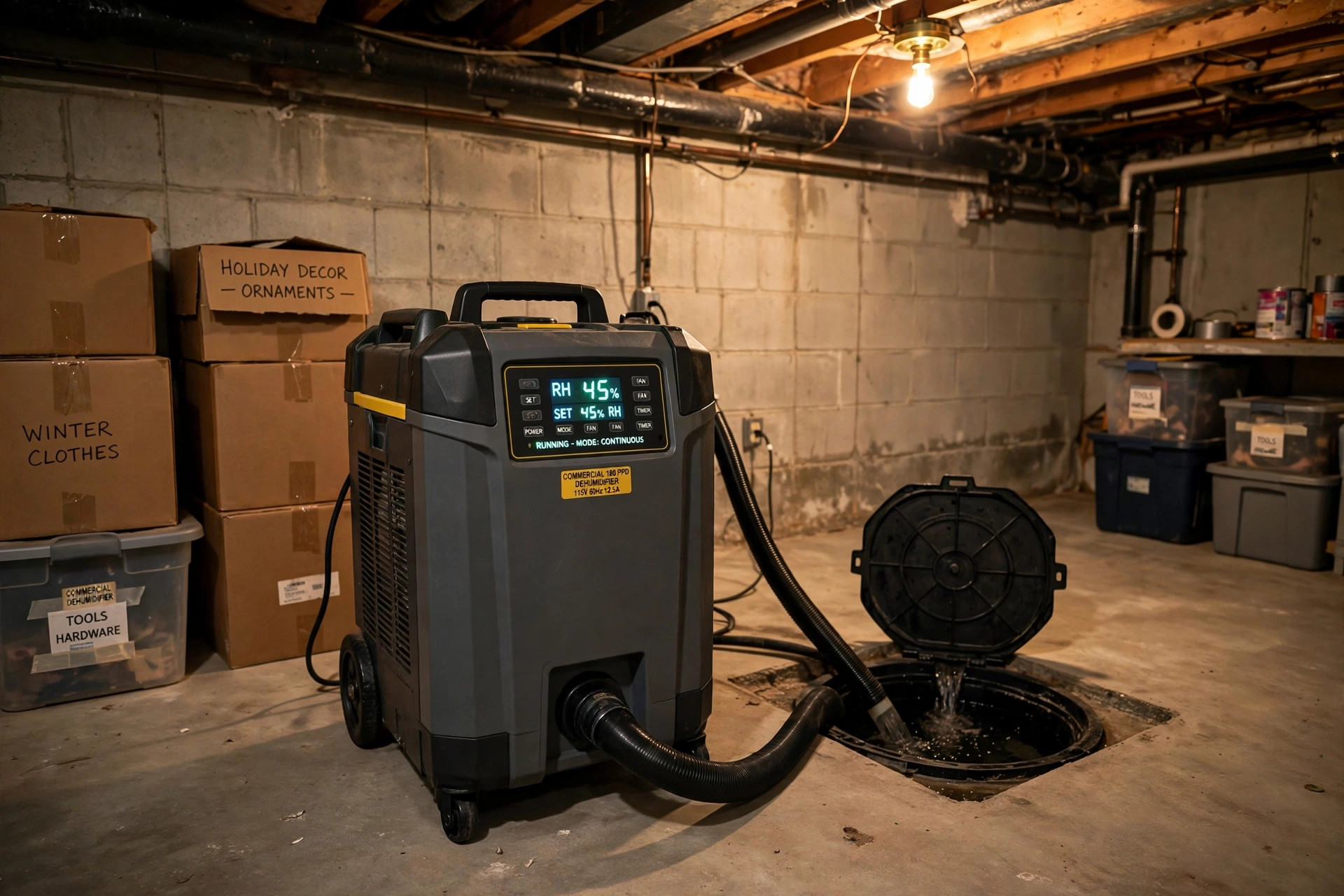

A damp basement can ruin stored goods, damage wood framing, and invite mold. If you have tried a small home unit and found that it never keeps up, it may be time to look at commercial grade dehumidifiers for basements with free shipping. These are heavier machines, built for large damp spaces, and many sellers now ship them to your door at no extra charge. This guide explains what makes them different, how to choose the right size, what they cost, and how to keep one running for years.
Why a Basement Needs a Strong Dehumidifier
Basements sit below ground level. Soil holds water, and water vapor passes through concrete walls and floors even when you cannot see any leak. In summer, warm humid air enters through doors, windows, and vents and cools against the cold walls, which leaves moisture on the surface. This is why so many basements smell musty.
High humidity causes real harm. Cardboard boxes soften and fall apart. Tools rust. Wood joists and beams can develop rot over time. Paint peels. And when damp air lingers, mold and mildew grow on walls, stored fabric, and furniture. Health agencies have long warned that indoor moisture feeds mold growth and that controlling moisture is the first step in fighting it. The Environmental Protection Agency explains that keeping indoor humidity between 30 and 50 percent is one of the best ways to limit mold problems in the home.
A commercial grade dehumidifier is built for this kind of job. Where a small home unit may pull 30 pints of water from the air per day, a commercial unit can pull 90, 120, or even more. It is meant to run for long hours, often in cool damp air, without stopping to rest. For a large basement, a damp crawl space, or a home that has had water problems, that extra strength makes the difference between a dry room and a room that always feels damp.
What to Look For When You Choose One: Commercial Grade Dehumidifiers for Basements with Free Shipping
Not every large dehumidifier is worth the price. Here are the points that matter most.
Pint Capacity
Capacity is measured in pints of water removed per day. For a very damp basement over 2,000 square feet, look for at least 90 to 120 pints per day. For a smaller basement with moderate dampness, 70 pints may be enough. A unit that is too small will run all day and still leave the air damp. A unit that is too large is not a real problem, but it costs more to buy.
Low Temperature Operation
Basements are cool. A cheap dehumidifier may frost over when the room drops below 60 degrees. Look for a unit with auto defrost, which melts ice off the coils so the machine keeps working in cold air. This matters a great deal in northern states, where basement walls stay cold well into spring.
Drainage Options
Emptying a bucket by hand gets old fast. A commercial grade dehumidifier should have a hose outlet so water can drain into a floor drain, a sump pit, or a sink. Many large models also have a built-in pump that can push water up and out, even through a basement window. If your basement has no floor drain, a pump model is worth the extra money.
Energy Use
Large machines use real power. Look for models that carry the Energy Star label, which marks appliances that meet federal tests for efficient use of power. The Energy Star program gives simple guidance on what the label means and how much a rated dehumidifier can save over time. A unit that draws less power will cost you less each month, and on a machine that runs day and night, the savings add up.
Noise Level
Basements are often under bedrooms. Check the decibel rating before you buy. Commercial units are louder than small home units, but the better ones are built to run quiet enough that you will not hear them through the floor.
Durability and Warranty
A commercial grade machine should have metal housing or heavy plastic, copper coils, and a warranty of at least three years. Homeowner guides at Family Handyman often point out that a longer warranty is a good sign that the maker stands behind the machine.
Types and Options
Commercial grade dehumidifiers for basements come in a few main types.
Portable floor units. These sit on the basement floor and plug into a standard outlet. They are the most common choice. Some have wheels and handles so you can move them from room to room.
Units with built-in pumps. These cost more but drain themselves. The pump sends water through a thin hose to a sink or out a window. For finished basements where you never want to think about drainage, a pump model is the best fit.
Whole-house and ductable units. These tie into the home’s ductwork and dry the whole house from one spot. They cost far more and usually need a professional to install. They are best for very large homes or homes with chronic dampness in every room.
Low grain refrigerant units. These are the heavy-duty machines used by restoration companies after floods. They pull moisture from very dry air and cost a great deal. Most homeowners do not need one, but if your basement has had standing water, they are worth knowing about.
When you shop, you will also see the phrase “large basement dehumidifier with pump” in many listings. That simply describes a high-capacity portable unit with a built-in drain pump, and it is the type most homeowners end up buying. Another common phrase is “commercial dehumidifier for damp basement,” which is used for units made to run in the cool, wet air found below ground level.
Cost and Price
A commercial grade dehumidifier for a basement usually costs between $400 and $1,200. The price depends on capacity, pump features, brand, and build quality. Basic 70-pint units sit at the low end. Units that pull 120 pints or more, or that include a pump, sit at the high end.
Running cost matters too. A 120-pint unit may draw 700 watts or more. If it runs eight hours a day, it can add $15 to $40 to your monthly electric bill, depending on local rates. Energy guides at the U.S. Department of Energy explain how to estimate the running cost of any appliance so you can plan ahead.
Free shipping changes the math. These machines weigh 50 to 80 pounds, so freight charges can add $60 to $100 to the price. When a seller offers commercial grade dehumidifiers for basements with free shipping, that can be as good as a 10 percent discount. Check the fine print, though. Some sellers count free shipping only for the standard ground service and charge extra for rural delivery or for a lift-gate drop at your door.
Watch for sales in spring and early summer, when stores stock up for the damp season. Buying guides at Consumer Reports note that testing results and seasonal price drops often line up, so a little patience can pay off.
How to Buy Smart Online
Buying a heavy machine online is safe if you take a few simple steps.
First, read the product specs for capacity, coverage area, drain options, and warranty. Do not trust the marketing headline alone. Home advice writers at Bob Vila remind readers to check the fine print on coverage claims, since makers often test in ideal conditions.
Second, read customer reviews for patterns. One bad review means little. Twenty reviews that mention the same broken pump or short life mean a great deal. Review summaries at The Spruce often collect the most common praise and complaints in one place.
Third, confirm the return policy. A dehumidifier that arrives damaged or that does not fit your space should be easy to send back. Some sellers charge restocking fees on heavy items, so know the terms before you order.
Fourth, check what “free shipping” really covers. Ask whether it includes tracking, insurance, and delivery to your door. Large home retailers such as Lowe’s publish their shipping terms in plain language, which gives you a baseline to compare against smaller sellers.
Care and Upkeep
A commercial grade dehumidifier will run for years if you care for it. Most care takes only a few minutes each month.
Clean or replace the air filter. Dust and lint clog the filter and force the machine to work harder. Most units have a washable filter. Rinse it every two to four weeks and let it dry before you put it back.
Check the drain hose. Algae and grime can clog a drain hose, which causes water to back up. Flush the hose with a mild bleach solution once or twice a year. If your unit has a pump, run clean water through it now and then to keep it clear.
Wipe the coils. Dust on the cooling coils cuts efficiency. Unplug the unit, remove the cover if the manual allows, and wipe the coils with a soft cloth. Never bend the coil fins.
Watch the humidity setting. Set the target humidity to 45 percent for a basement. Setting it much lower makes the machine run longer without much gain. A simple wall-mounted humidity gauge, called a hygrometer, lets you check that the unit is doing its job.
Give it air. Leave at least six inches of space around the unit so air can flow in and out. Do not push it against a wall or pile boxes around it.
Seasonal guides at This Old House often list dehumidifier care as part of spring home prep, which is a good reminder to service the machine before the damp season starts.
Safety
Dehumidifiers are safe when used with care, but a few rules apply.
– Plug the unit directly into a wall outlet. Do not use an extension cord, since a heavy machine can overheat a light-duty cord. – Keep water away from the power cord and the outlet. If the drain hose runs near electrical gear, reroute it. – Clean the unit as the manual says. A dusty machine runs hot. – If you smell burning or hear grinding, unplug the machine at once and call the maker. – In a basement that has had flooding, have an electrician check the outlets before you run any large appliance.
Cleaning guides at Good Housekeeping stress the same basic rule that applies to all heavy appliances: keep them clean, dry, and plugged in directly.
Where Dehumidifiers Fit in Home Care
A dehumidifier is one tool in a larger plan to keep a home dry and clean. It works best alongside other steps: fixing gutter and drainage problems outside, sealing cracks in the foundation, and keeping the basement aired out when the weather allows.
If you already fight mold, a dehumidifier pairs well with other steps. Some homeowners read mold removal sprays reviews and buying guide to find products for spots the dehumidifier cannot prevent. Others look into quiet mold remediation services near me when the problem is too large to handle alone, or compare companies through top rated mold remediation services reviews.
Frequently Asked Questions
How long should a commercial grade basement dehumidifier run each day? In a damp basement, expect it to run six to twelve hours a day at first. Once the room reaches the target humidity, the unit will cycle on and off by itself. In summer it will run more. In winter, if the basement stays dry, it may barely run at all.
What humidity level should I set for a basement? Aim for 45 percent relative humidity. That is dry enough to stop mold and musty smells but not so dry that the machine runs all the time. Most experts say to keep indoor humidity between 30 and 50 percent.
Can I leave it running while I am away? Yes, if it drains through a hose or pump to a safe outlet. A unit that relies on a bucket will fill up and shut off, which defeats the purpose. Make sure the drain path is clear and leads somewhere water can go without harm.
Do I still need one if my basement never floods? Flooding is not the only source of dampness. Vapor passes through concrete all the time, and humid summer air condenses on cool basement walls. Many dry-looking basements still hold humidity above 60 percent. A hygrometer will tell you the truth.
How much will it add to my electric bill? A large unit drawing 700 watts and running eight hours a day uses about 170 kilowatt-hours per month. At typical rates that is roughly $20 to $35 a month. An Energy Star rated unit will use less.
Is a pump model worth the extra cost? If your basement has no floor drain and you do not want to empty a bucket every day, yes. The pump lets the unit run without any daily care, which is the whole point of a commercial grade machine.
A Short Final Word
Commercial grade dehumidifiers for basements with free shipping are a sound buy for any homeowner fighting damp air below ground level. They cost more than small home units, but they move far more water, run in cooler air, and last longer. Choose the right size, confirm the drain plan, and read the shipping terms before you order. With a little care, the machine will keep your basement dry for many years, and the musty smell will become a memory.
References
Bob Vila. (n.d.). Home improvement advice. https://www.bobvila.com Consumer Reports. (n.d.). Product reviews and ratings. https://www.consumerreports.org ENERGY STAR. (n.d.). Energy efficient products. https://www.energystar.gov Family Handyman. (n.d.). DIY home repair and maintenance. https://www.familyhandyman.com Good Housekeeping. (n.d.). Product reviews and home advice. https://www.goodhousekeeping.com Lowe’s. (n.d.). Home improvement products. https://www.lowes.com The Spruce. (n.d.). Home and garden advice. https://www.thespruce.com This Old House. (n.d.). Home renovation guidance. https://www.thisoldhouse.com U.S. Department of Energy. (n.d.). Energy efficiency and renewable energy. https://www.energy.gov U.S. Environmental Protection Agency. (n.d.). Protecting human health and the environment. https://www.epa.gov
Was this guide helpful?

About Robert Taylor
The My Garden US editorial team writes practical, in-depth home and garden guides for American homeowners — tested advice, no fluff.
You May Also Like

Top Rated Robot Vacuum Cleaners for Southern States
April 22, 2026 0 views
Budget Friendly Pet Odor Eliminator Sprays for Sale: A Simple Guide for Pet Owners
February 18, 2026 0 views
Reliable Ceiling Fan Dusters Buying Guide
March 6, 2026 0 views