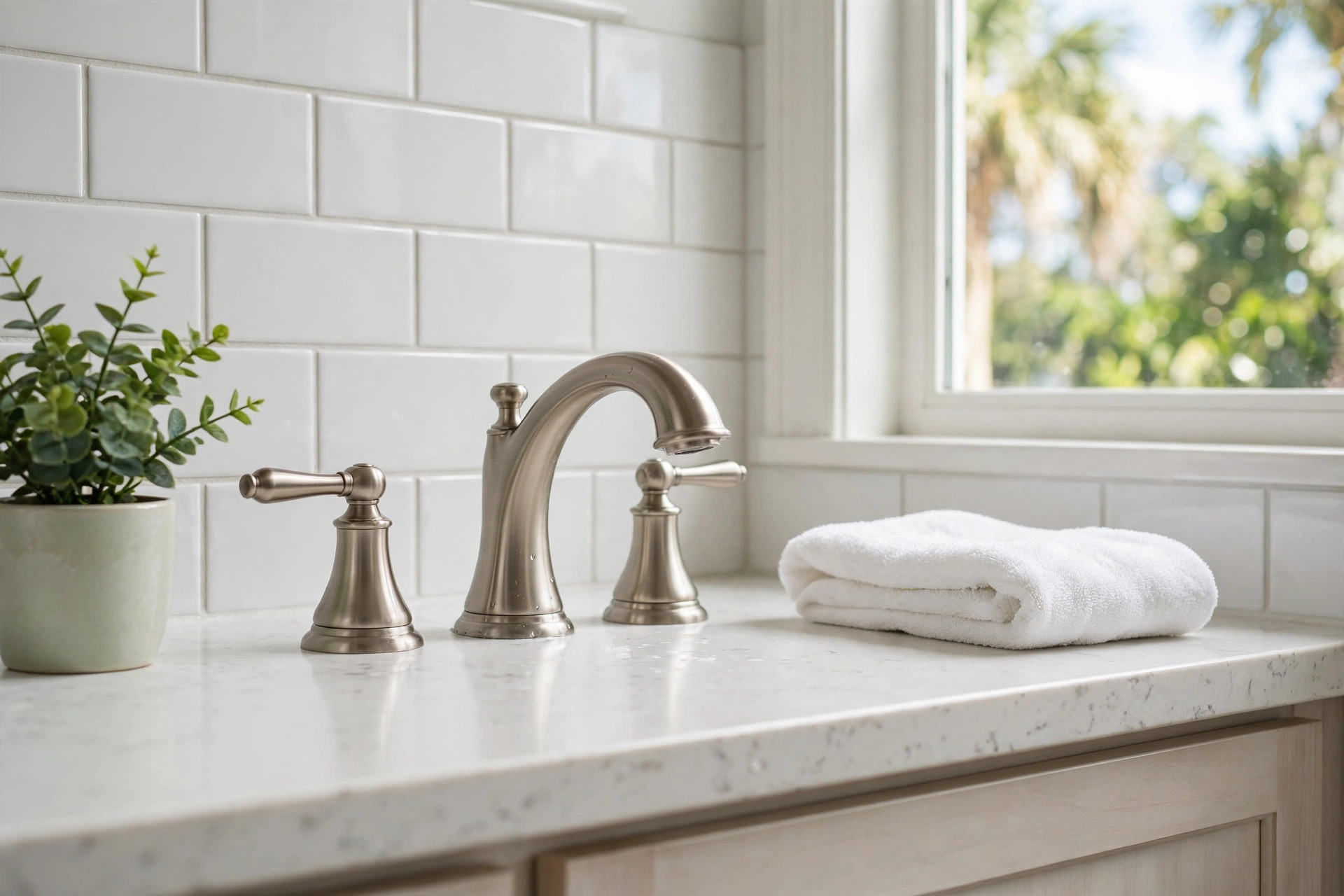

When you shop for brushed nickel faucets Florida homes USA buyers trust, you are really shopping for two things at once. You want a faucet that looks right in your bath or kitchen. And you want one that stands up to Florida’s damp air, salt breeze, and hard water. Many owners in the Sunshine State learn the hard way that a cheap faucet can spot, pit, or corrode in a year or two near the coast. A good brushed nickel faucet, made well and cared for simply, can look fine for a decade or more. This guide explains the finish, the parts that matter, the prices you will see, and how to keep it bright in a Florida home.
Why the Finish Matters in Florida
The word “finish” means the outer skin of the faucet. On a brushed nickel faucet, that skin has a soft, satin glow. It is not mirror shiny like polished chrome. It is not dark like oil-rubbed bronze. Fine lines in the metal give it a brushed look, which is why it hides water spots and fingerprints better than chrome.
Florida adds three problems that other states have less. First, humidity. Bathrooms in Miami, Tampa, or Orlando stay damp for hours after a shower. Moist air speeds up corrosion on cheap metal. Second, salt. Homes near the Gulf or the Atlantic get salt in the air. Salt eats into thin plating. Third, hard water. Many parts of Florida pull water from limestone wells. The water leaves white mineral crust on faucets. A strong finish resists all three. A thin one does not.
Brushed nickel suits Florida homes for another reason. It matches the light, coastal style many Florida bathrooms use: white tile, pale grout, sea-glass colors, light wood. It also matches most cabinet hardware, from shower grab bars to towel hooks. That makes it easy to build a whole bath in one finish without hunting for rare parts.
How to Choose the Right Faucet: Brushed Nickel Faucets Florida Homes Usa
Look Past the Shine
A faucet is not solid nickel. Most faucets are brass or zinc under the skin. Brass bodies last longer than zinc bodies. Zinc is cheaper and can crack under stress. When you read the box, look for “solid brass construction.” It is the single best sign of a faucet built to last. The brushed nickel layer is then bonded or plated over the brass.
Ask how the finish is made. Good makers bond the finish with a process called PVD, short for physical vapor deposition. In plain words, the metal is coated in a vacuum so the layer is thick and even. PVD finishes resist scratches, salt, and mineral stains far better than simple electroplating. You will find good guidance on faucet construction and finish quality at Moen, one of the large fixture makers.
Valves Decide How Long It Lasts
The valve is the part inside that starts and stops the water. Ceramic disc valves are the modern standard. Two hard ceramic discs slide over each other to open and close the flow. They seal well and can run for hundreds of thousands of turns without dripping. Avoid old-style rubber washers. They wear out, they drip, and in Florida’s hard water they crust over fast. A faucet with ceramic discs costs more up front and far less in plumber visits.
Fit the Holes in Your Sink
Before you buy, count the holes in your sink or vanity top. A centerset faucet fits a 4-inch spread of three holes. A widespread faucet uses separate handles and a spout, usually on 8-inch spreads. A single-hole faucet fits one hole and often has a small plate to cover extra holes. Measure first. If you pair a new faucet with new bathroom sink vanities, confirm the hole pattern of the top before you order either one.
Check Water Pressure and Flow
Florida homes on wells or older city lines can have low pressure. Look at the flow rate on the box, marked in gallons per minute, or GPM. Bathroom faucets in the United States are limited to 1.2 GPM. That is enough for a sink if the faucet is built well. Kitchen faucets allow up to 1.8 GPM. If your pressure is weak, choose a faucet known for strong flow rather than a very low-flow model. The U.S. Environmental Protection Agency water pages explain how flow rates tie to water use and savings.
Types and Options for Florida Baths and Kitchens
Bathroom Sink Faucets
These are the most common buy. A centerset brushed nickel faucet suits a small powder room. A widespread set suits a master bath with room to spare. Our brushed nickel faucets buying guide covers finish grades in more detail. Wall-mounted faucets are a newer look. They free up counter space, but they need pipes in the wall, so they fit best in a full remodel. For a complete brushed nickel faucet overview, Delta Faucet shows how finishes pair across a bath.
Shower and Tub Faucets
A shower valve set in brushed nickel should match your sink faucet. Buy the valve and the trim from the same maker and the same finish family. “Brushed nickel” can differ slightly from one brand to another. Mixing brands can leave you with a shower handle that looks a shade darker than the sink faucet. In Florida rentals and beach condos, owners often pick one brand for the whole unit so future repairs are simple.
Kitchen Faucets
Kitchen faucets work harder than bath faucets. They pull down, they swivel, they face grease and food acids. In a Florida kitchen, pick a model with a high arc so you can fill tall pots, a pull-down sprayer with a braided hose, and a spot-resistant finish. Brushed nickel hides the daily fingerprints that chrome shows. If you cook often, a touchless model keeps raw-chicken hands off the handle. You can compare kitchen and bath fixture lines at Kohler to see how finishes run across a whole house.
Laundry and Outdoor Sinks
Garages and lanais in Florida often have a utility sink. A simple brushed nickel or chrome utility faucet resists the damp garage air better than painted steel. Match the hose thread to your washing machine hookup. These faucets cost little and save the kitchen sink from muddy beach gear.
Cost and Price in the USA
Prices run wide. A basic brushed nickel bathroom faucet from a store brand can cost 40 to 80 dollars. It will have a zinc body, simple plating, and rubber parts. It may look fine for a year or two in a dry inland bath. Near the coast, it often spots and pits early.
The middle range, 90 to 200 dollars, is where most Florida owners should shop. You get a brass body, ceramic disc valves, and a bonded finish. Big-box stores carry these from the main brands. Both Home Depot and Lowe’s stock wide ranges you can see in person, which helps because photos hide finish differences.
High-end models run 220 to 500 dollars or more. You pay for heavier brass, finer finish work, designer shapes, and longer warranties. For a forever home on the water, the extra cost can pay off. For a rental unit, the middle range is usually the smart buy.
A plumber in Florida often charges 150 to 300 dollars to install a bathroom faucet, more if old valves must be replaced. Many owners do it themselves with basic tools. Turn off the water first, keep a bucket under the trap, and follow the maker’s sheet. If the shutoff valves under the sink are old and stuck, call a plumber rather than forcing them.
Care and Upkeep in a Humid Climate
Brushed nickel is easy to keep if you follow a few plain rules. Wipe the faucet dry after heavy use, or at least once a day. Standing water leaves mineral spots, and Florida water is rich in minerals. Use a soft cloth with mild dish soap and warm water. Rinse and dry. That is all most days need.
Never use harsh cleaners. Bleach, ammonia, and abrasive powders can strip the finish. Avoid scrub pads. For hard-water crust, lay a cloth soaked in white vinegar on the spot for ten minutes, then rinse well and dry. Do not leave vinegar sitting for hours. It is a mild acid and can dull the finish if overused.
In coastal homes, wipe faucets a bit more often. Salt film builds up slowly and you may not see it until the finish looks dull. A quick wipe with a damp cloth once or twice a week keeps it off. Run the bathroom fan during and after showers. Lower humidity helps the finish and fights mold at the same time. You will find practical bathroom care guides at The Spruce and step-by-step fixture upkeep at This Old House.
Re-caulk around the faucet base when the old caulk cracks. Water that seeps under the base rots the counter and corrodes the faucet from below. A five-dollar tube of silicone caulk and ten minutes of work prevent a much bigger repair.
Safety Notes
Hot water burns fast. Set your water heater to 120 degrees Fahrenheit. At higher settings, a child or older adult can scald in seconds under a strong faucet. Many new faucets have anti-scald stops in the shower valve. Make sure yours is set right after install.
Heavy widespread faucets can strain a thin vanity top. If the top flexes, add support brackets under it. When you drill new holes in stone or quartz, wear eye protection and go slow. Stone dust is hard on lungs.
If your home was built before 1986, old pipes may contain lead solder. New faucets sold in the United States must meet low-lead rules, but the old pipes stay. If you worry about lead, run the tap for 30 seconds before drinking, and use cold water for cooking. The U.S. Consumer Product Safety Commission posts recalls and safety notices for plumbing products worth checking before you buy.
Frequently Asked Questions
Is brushed nickel the same as stainless steel?
No. Brushed nickel is a nickel finish over brass or zinc. Stainless steel faucets are made of steel through and through. They look alike at a glance, but stainless resists corrosion a bit better and costs more. Both hide spots well. Read brand specs side by side, for example at HGTV’s home guides, before you decide.
Will brushed nickel rust in a Florida beach house?
A well-made brushed nickel faucet will not rust like iron, but a cheap one can pit and stain in salt air. The risk is in the thin plating, not the color. Buy a brass-body faucet with a bonded PVD finish and keep it wiped down. Homes right on the beach should rinse fixtures with fresh water now and then, the same way you rinse outdoor gear.
Can I mix brushed nickel with chrome in one bathroom?
You can, but it looks better to match. Chrome is bright and cool; brushed nickel is soft and warm. If you must mix, keep each finish in its own zone, for instance chrome on the shower and nickel on the sink. Design guides at Bob Vila show how mixed metals can work when done on purpose.
How long should a good faucet last?
A brass faucet with ceramic disc valves often lasts 15 to 20 years in normal use. In Florida, salt air and hard water can shorten that if the finish is thin or care is poor. The valve usually outlives the finish. When the finish fails but the valve is fine, some owners replace only the trim if the maker still sells it.
Do I need a plumber to install a bathroom faucet?
Many owners do it themselves. The job needs an adjustable wrench, plumber’s putty or silicone, and patience. Turn off the water at the wall valves first. If the valves are frozen or the old faucet is corroded in place, call a plumber. A forced fitting can crack the sink.
Why does my new faucet have low flow?
First check the aerator, the small screen at the spout tip. Florida sediment clogs aerators fast. Unscrew it, rinse it, and screw it back. If flow is still weak, the supply valves may be half closed or the lines may hold debris from the install. Flush the lines with the faucet removed, then reinstall.
A Short Final Word
Brushed nickel faucets suit Florida homes because they look calm, hide spots, and pair with coastal style. The finish name alone does not promise quality. Look under the skin for brass, ceramic disc valves, and a bonded finish. Pay the middle price, not the lowest. Wipe the faucet down, skip harsh cleaners, and re-caulk when needed. Do that, and your faucet will stay bright through many humid summers.
References
Bob Vila. (n.d.). Home improvement advice. https://www.bobvila.com Delta Faucet. (n.d.). Kitchen and bathroom faucets. https://www.deltafaucet.com HGTV. (n.d.). Home and garden ideas. https://www.hgtv.com Kohler. (n.d.). Bathroom and kitchen fixtures. https://www.kohler.com Lowe’s. (n.d.). Home improvement products. https://www.lowes.com Moen. (n.d.). Faucets and plumbing fixtures. https://www.moen.com The Home Depot. (n.d.). Home improvement products. https://www.homedepot.com The Spruce. (n.d.). Home and garden advice. https://www.thespruce.com This Old House. (n.d.). Home renovation guidance. https://www.thisoldhouse.com U.S. Consumer Product Safety Commission. (n.d.). Product safety information. https://www.cpsc.gov U.S. Environmental Protection Agency. (n.d.). Protecting human health and the environment. https://www.epa.gov
Was this guide helpful?

About David Wilson
The My Garden US editorial team writes practical, in-depth home and garden guides for American homeowners — tested advice, no fluff.
You May Also Like

Double Sink Vanities for Sale USA: A Plain Guide for Homeowners
July 23, 2026 0 views
Heated Floor Kits American Homes Guide
May 25, 2026 0 views
Quiet Exhaust Fans for Sale USA: A Plain Guide
March 15, 2026 0 views